

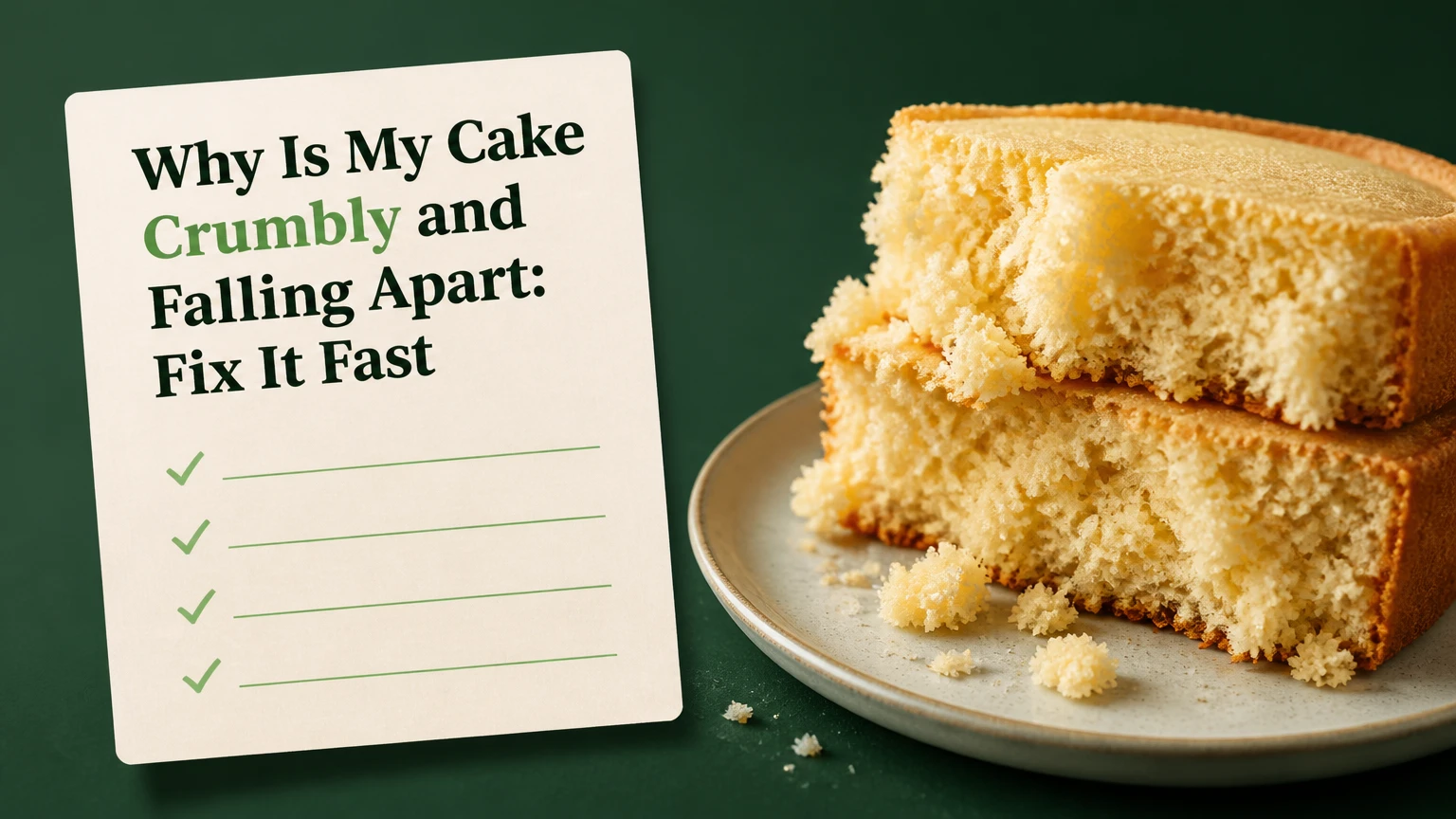
A cake becomes crumbly and falls apart when its baked structure cannot hold moisture and pressure, usually because the formula contains too much flour, too little liquid or fat, or the cake was overbaked. Overmixing, excess leavener, excess sugar, cutting while warm, and inaccurate measuring can also create a weak crumb.
Key Facts at a Glance
- Scooping flour directly from a container can add approximately 20-30% more flour than a recipe intended.
- A cake that crumbles into dry pieces usually lost too much moisture or received too much flour.
- A cake that is moist but collapses often has excess sugar, fat, liquid, or leavener relative to its structure.
- Cake layers are more fragile while warm; cool them completely before trimming, filling, or slicing.
- A digital scale gives more reliable flour measurements than cups, especially for layer cakes.
- Simple syrup can improve dryness, but it cannot rebuild a cake whose protein and starch structure never set.
Why Is My Cake Crumbly and Falling Apart?
A crumbly cake usually has either a dry crumb or a weak crumb. A dry crumb snaps into small pieces because the flour absorbed more liquid than the recipe allowed, while a weak crumb may feel moist yet break because eggs, starch, gluten, or baking structure did not set in the correct proportion.
Cake structure forms during mixing and baking. Flour starch absorbs water and gelatinizes in the oven, egg proteins coagulate, and, in wheat cakes, hydrated flour proteins form some gluten. Butter, oil, and sugar soften that network, which is desirable until tenderizing ingredients overwhelm the structural ingredients.
The most common practical cause is measurement error. King Arthur Baking recommends weighing flour because volume measurements vary substantially with packing, and a heavily packed cup can shift a recipe from tender to dry. The second frequent cause is overbaking, particularly when an oven runs hotter than its dial indicates.
What does a normal cake crumb need?
A normal cake crumb needs enough flour and egg to form connected cell walls, enough liquid to hydrate starch and proteins, and enough fat and sugar to soften the result without preventing the structure from setting. Baking powder or baking soda must create gas at a rate the batter can retain.
Cake type changes the balance. A chiffon cake relies heavily on whipped egg foam, a butter cake uses creamed fat and sugar, and a pound cake depends on a relatively dense egg, flour, fat, and sugar framework. The same mistake does not produce the same texture in every formula.
Which Symptom Matches Your Cake?
The quickest diagnosis comes from texture, timing, and appearance together. A cake that is dry throughout points toward flour or heat, while a moist cake that breaks into large chunks points toward insufficient setting or too much tenderizing ingredient.
| Symptom | Most likely cause | Check next | Corrective action |
|---|---|---|---|
| Dry, sandy crumbs | Excess flour or overbaking | Weigh flour; test oven at 350°F | Reduce flour error; remove cake earlier |
| Moist pieces collapse | Excess liquid, sugar, fat, or leavener | Compare ingredient weights | Use tested formula; avoid random additions |
| Large tunnels and fragile walls | Overmixed batter or excess leavener | Inspect crumb near holes | Mix only until combined; level leavener |
| Edge dry, center crumbly | High oven temperature or thin pan | Test oven and pan color | Lower heat 10-15°F; check earlier |
| Crumbles only when sliced | Warm cake or dull knife | Compare cooled and warm slices | Cool fully; use a serrated knife |
| Crumbly gluten-free cake | Missing binder or poor flour blend | Review starch and binder | Use a tested blend with binder |
A crumbly cake is not always a dry cake. If the pieces feel damp, greasy, or sticky, adding more liquid will usually make the failure worse. That texture suggests a structural imbalance rather than simple dehydration.
Why is my cake crumbly but not dry?
A moist but crumbly cake usually contains too much tenderizing material relative to its structural ingredients, or it was removed before the center fully set. High sugar, excess oil, extra fruit, too much leavener, or an underbaked center can leave the cake soft but unable to support slicing.
Look for a shiny or gummy center, a sunken middle, large holes, or layers that compress under light pressure. Those signs differ from overbaking, which produces a uniformly dry crumb and often dark, rigid edges.
Did Too Much Flour Cause the Problem?
Too much flour is the leading measurement-related cause of a dry, disconnected cake crumb. Flour absorbs water, so even a modest excess can leave starch particles insufficiently hydrated and create a cake that breaks instead of flexing.
A cup of all-purpose flour can weigh roughly 120-130 grams depending on the measurement method, while many recipes assume approximately 120 grams. The recipe’s intended weight matters more than a universal cup conversion. Spoon flour into a dry measuring cup and level it, or weigh it in grams.
| Measuring method | Typical flour in one cup | Likely result | Best use |
|---|---|---|---|
| Digital scale | 120-130 g | Most repeatable crumb | Layer cakes and testing |
| Spoon and level | 120-130 g | Reliable home method | Recipes written by volume |
| Fluff, scoop, and level | 130-145 g | Drier, heavier cake | Avoid for precision |
| Packed scoop | 145-165 g | Very dry, crumbly cake | Never use intentionally |
Do not automatically replace all-purpose flour with cake flour as a repair. Cake flour contains less protein and can produce a softer crumb, but it also offers less structural strength. A formula written for all-purpose flour may need adjustment if the substitution is substantial.
How do ingredient ratios affect cake strength?
Ingredient ratios determine whether the crumb is flexible, firm, gummy, or fragile. A useful starting check for a conventional butter cake is to compare ingredient weights rather than cups: sugar often approximates flour, eggs commonly sit near the fat weight, and eggs plus other liquid must adequately hydrate the dry ingredients.
These are diagnostic ranges, not universal rules. A high-ratio cake, sponge, oil cake, and pound cake use different formulas, so changing ingredients based on a generic ratio can create a second failure.
| Ingredient imbalance | Crumb effect | Typical visible clue | Safer correction |
|---|---|---|---|
| Flour +10% or more | Dry and brittle | Fine loose crumbs | Reweigh flour |
| Liquid -10% or more | Tight and dry | Pale, firm interior | Restore recipe liquid |
| Fat -10% or more | Less tender, dry mouthfeel | Harsh crumb edges | Follow tested formula |
| Sugar +10% or more | Weak and sticky | Collapse or wet center | Reduce only to formula level |
| Leavener +25% or more | Oversized cells | Tunnels and sinking | Measure level teaspoons |
Sugar does more than sweeten cake. Sugar binds water and delays protein coagulation, which improves tenderness but can weaken the crumb when the quantity is excessive. Fat coats flour proteins and limits gluten development, yet too much fat can prevent a stable network from forming.
Could Mixing Have Made the Cake Fall Apart?
Mixing can cause crumbly cake in two opposite ways. Overmixing after flour is added develops a tighter gluten network and can produce a tough cake that fractures, while undermixing can leave uneven fat, flour, or leavener distribution and create weak zones.
Cream butter and sugar until the mixture is visibly lighter and aerated, often 3-5 minutes with a stand mixer at medium speed. Add eggs gradually so the emulsion remains smooth. Once flour enters, mix only until no dry streaks remain, then stop.
What is the correct mixing checkpoint?
The correct checkpoint is a uniform batter with no dry flour pockets, no unmixed butter lumps, and no long period of mixing after the final flour addition. A few small bubbles are normal; a batter that has become elastic or glossy from prolonged mixing has likely received too much mechanical development.
For a creamed butter cake, room-temperature butter should indent when pressed but remain solid. Melted butter changes the aeration process, and cold butter can leave dense fragments that bake unevenly.
Expert rule: scrape the bowl once or twice, but do not compensate for poor scraping by running the mixer for another two minutes. Scraping fixes distribution; prolonged mixing changes structure.
Is Your Cake Overbaked or Baked Too Hot?
Overbaking removes water from the starch and protein network until the cell walls become rigid and fracture under a knife. An oven that runs 15-25°F hotter than its setting can overbake the edges before the recipe’s stated time has elapsed.
Use an independent oven thermometer on the center rack. Begin checking five minutes before the recipe’s minimum time, then test the center with a toothpick or skewer.
| Baking observation | Likely interpretation | Next test | Adjustment |
|---|---|---|---|
| Dry crumbs on skewer | Cake may be overbaked | Press center lightly | Remove sooner |
| Wet batter on skewer | Center is underbaked | Test again in 5 minutes | Continue baking |
| Few moist crumbs | Usually ready | Check spring-back | Remove and cool |
| Deep crack with dry edges | Heat too high | Oven thermometer | Lower temperature 10-15°F |
| Pale, fragile center | Underbaking or low heat | Check internal set | Extend baking gradually |
A fully baked butter cake usually springs back lightly in the center and begins pulling slightly from the pan edge. For many cakes, an internal temperature around 200-210°F indicates a set crumb, although formula, pan depth, and moisture content alter the exact endpoint.
Do not rely on a toothpick alone for very moist cakes. A clean skewer can appear before the center has developed enough strength, especially when the cake contains fruit, puree, or a high proportion of sugar.
Why Does Cutting Make the Crumbling Worse?
Cutting a warm cake often makes an acceptable crumb look broken. Starch has not fully set, fat remains soft, and steam is still moving through the interior, so pressure from a knife can compress and tear the cells.
Cool a standard layer cake in its pan for 10-15 minutes, turn it onto a rack, and wait until fully cool before splitting or frosting. Dense cakes may benefit from 30-60 minutes of cooling, while chilling a wrapped layer for 30 minutes can make trimming cleaner.
Use a sharp serrated knife and a gentle sawing motion. A smooth, dull knife presses downward and pushes crumbs away from the cut line.
How long should cake cool before slicing?
Most cakes should cool at least 30-60 minutes before slicing, and layered cakes should be completely cool before filling. A warm cake can crumble even when the recipe and baking time were correct, so cooling is a handling requirement rather than an optional finishing step.
The exception is a cake intentionally served warm, such as a spoon dessert. Such cakes are not expected to produce clean slices.
How Can You Rescue a Cake That Already Fell Apart?
A baked cake can be improved, but the best rescue depends on whether the crumb is dry, structurally weak, or underbaked. Syrup helps dry cake, frosting binds loose pieces, and layered desserts make crumbling irrelevant; none of these methods safely repairs raw batter or a wet, unset center.
| Cake condition | Best rescue | Typical time | Main limitation |
|---|---|---|---|
| Dry but fully baked | Sugar syrup, 2-4 tbsp per layer | 10 minutes | Cannot restore lost shape |
| Broken layers | Frosting between pieces | 15-25 minutes | Requires chilling for stability |
| Many loose crumbs | Cake balls with frosting | 30-45 minutes | Texture becomes denser |
| Crumbly cubes | Cream and custard layers | 15-20 minutes | Needs immediate refrigeration |
| Wet center | Return to oven if safe | 10-20 minutes | May remain gummy |
| Burned edges and dry middle | Trim and layer | 20-30 minutes | Burnt flavor remains |
Can simple syrup save dry cake?
Simple syrup can soften a dry cake by adding moisture to the crumb, but it cannot reconstruct broken cell walls. Brush a fully cooled layer lightly with equal parts sugar and water syrup, beginning with 1-2 tablespoons per 8-inch layer, then wait 10 minutes before adding more.
Too much syrup produces a wet, sliding layer. Use a pastry brush or spray bottle for even coverage rather than pouring syrup into one area.
If the cake is already structurally weak, assemble it in a loaf pan or dessert dish instead of stacking tall layers. Chilling for 30-60 minutes firms the fat-based filling and reduces breakage.
When should you make cake pops or a layered dessert?
Make cake pops when the cake has many loose crumbs but no burnt or stale flavor. Mix frosting into the crumbs one tablespoon at a time until the mixture holds a ball, then chill before coating.
Choose a layered dessert when the cake remains flavorful but cannot be sliced. Cake cubes absorb cream, custard, or fruit juices and can become a deliberate soft texture. Refrigerate assembled desserts and serve them within one to two days for the best crumb.
How Do Cake Types Change the Diagnosis?
Cake type changes the structural failure point. Butter cakes most often suffer from flour, creaming, or overbaking errors; sponge cakes depend on egg foam; pound cakes need adequate emulsification; and gluten-free cakes need a binder or a carefully designed flour blend.
| Cake type | Main structure | Common crumbly failure | Best prevention |
|---|---|---|---|
| Butter cake | Flour, eggs, creamed fat | Excess flour or overbaking | Weigh flour; cream properly |
| Oil cake | Eggs, flour, starch, oil | Excess liquid or weak set | Follow formula; bake fully |
| Sponge cake | Whipped eggs and flour | Deflated foam | Fold gently; avoid underbaking |
| Pound cake | Eggs, flour, fat, sugar | Poor emulsion or dry bake | Add eggs gradually |
| Gluten-free cake | Starch, eggs, binder | No cohesion after cooling | Use tested blend and binder |
Oil-based cakes often stay softer at room temperature because oil remains liquid, but oil does not automatically provide strength. A poorly balanced oil cake can be greasy, sink, or crumble when lifted.
Gluten-free cake needs special attention because wheat gluten is absent. Xanthan gum, psyllium, eggs, starch gelatinization, and proper cooling can supply cohesion, but quantities vary by flour blend. Use the blend manufacturer’s guidance rather than adding a fixed amount blindly.
Is cake flour better for preventing crumbs?
Cake flour can reduce toughness because its lower protein content forms less gluten, but it is not a universal cure for crumbling. Cake flour works best in recipes developed for it; replacing all-purpose flour without adjusting liquid or leavener can make a delicate cake too weak.
For a wheat cake that is dry and crumbly, correcting flour quantity and baking time usually matters more than changing flour type.
What Should You Change on the Next Bake?
Change one variable at a time so the next cake reveals the actual cause. The most reliable sequence is to weigh the flour, verify the oven, follow the original ingredient quantities, and stop baking when the center is set rather than when the edges look very dark.
Use this controlled troubleshooting protocol:
- Record the formula. Write the flour, sugar, fat, egg, liquid, and leavener weights.
- Weigh the flour. Use the recipe’s stated gram weight, or spoon and level if no weight is provided.
- Check the oven. Place an oven thermometer beside the cake pan and compare the actual temperature.
- Standardize the pan. Use the stated diameter and material; dark metal pans brown and heat edges faster.
- Mix to checkpoints. Cream fat and sugar fully, then stop mixing shortly after flour disappears.
- Check early. Test the center five minutes before the minimum baking time.
- Cool completely. Wrap the cooled cake before storing or assembling.
- Change one factor. Do not reduce flour, add liquid, lower heat, and change flour type simultaneously.
Typical correction: if a cake is dry, uniformly crumbly, and had packed flour, first correct the flour measurement and remove it from the oven earlier. If the cake is moist, sunken, and fragile, inspect leavener, sugar, liquid, and center doneness before adding moisture.
An honest limitation matters here: no troubleshooting table can replace the original recipe. A cake formula with a missing egg, incorrectly copied liquid quantity, or altered pan size may fail even when technique is sound.
Frequently Asked Questions
Can I add more liquid to cake batter next time?
Add liquid only when the recipe or a tested reformulation calls for it. Extra liquid can dilute egg and flour structure, lengthen baking, and create a wet center. If the previous cake was dry because flour was packed, correct the flour measurement first rather than adding water or milk by guesswork.
Why does boxed cake mix fall apart?
Boxed cake mix usually falls apart because the mix received too much flour-like dry material, too little liquid or egg, excessive baking time, or an incorrect pan size. Follow the package quantities exactly, weigh added ingredients when possible, and cool the cake before removing it from the pan.
Can I freeze a crumbly cake?
Freezing can make a fragile cake easier to handle, but it cannot repair a dry structure. Wrap the fully cooled cake tightly, freeze it for 30-60 minutes before trimming, and thaw it while wrapped to limit condensation on the surface.
Why is the outside firm while the inside crumbles?
A firm outside with a crumbly interior usually indicates excessive oven heat, a dark pan, or a pan placed too close to a heating element. The exterior sets quickly while the center loses moisture or remains structurally weak. Verify oven temperature and use a lighter pan if the recipe permits.
Should I refrigerate cake before cutting it?
Refrigerating cake for 30-60 minutes can make layers easier to trim and stack because the fat-based crumb firms. Refrigeration does not replace full baking or cooling, and an underbaked center remains gummy after chilling.
What is the fastest way to stop a cake from falling apart?
The fastest solution for a baked cake is to chill it, apply a thin layer of frosting as a crumb coat, and assemble it without aggressive trimming. For a dry cake, add syrup sparingly first. For a wet center, rebake only if the cake has been handled safely and the center is still clearly underbaked.
The Bottom Line
Why is my cake crumbly and falling apart? The most likely explanation is a dry or weak crumb caused by excess flour, inadequate moisture or fat, overbaking, incorrect leavening, or mixing and handling errors. Weigh the flour, verify the oven, stop baking when the center is set, and cool the cake completely before cutting. For an already baked cake, use light syrup for dryness, frosting for broken pieces, or layered dessert assembly when clean slices are no longer realistic.
