

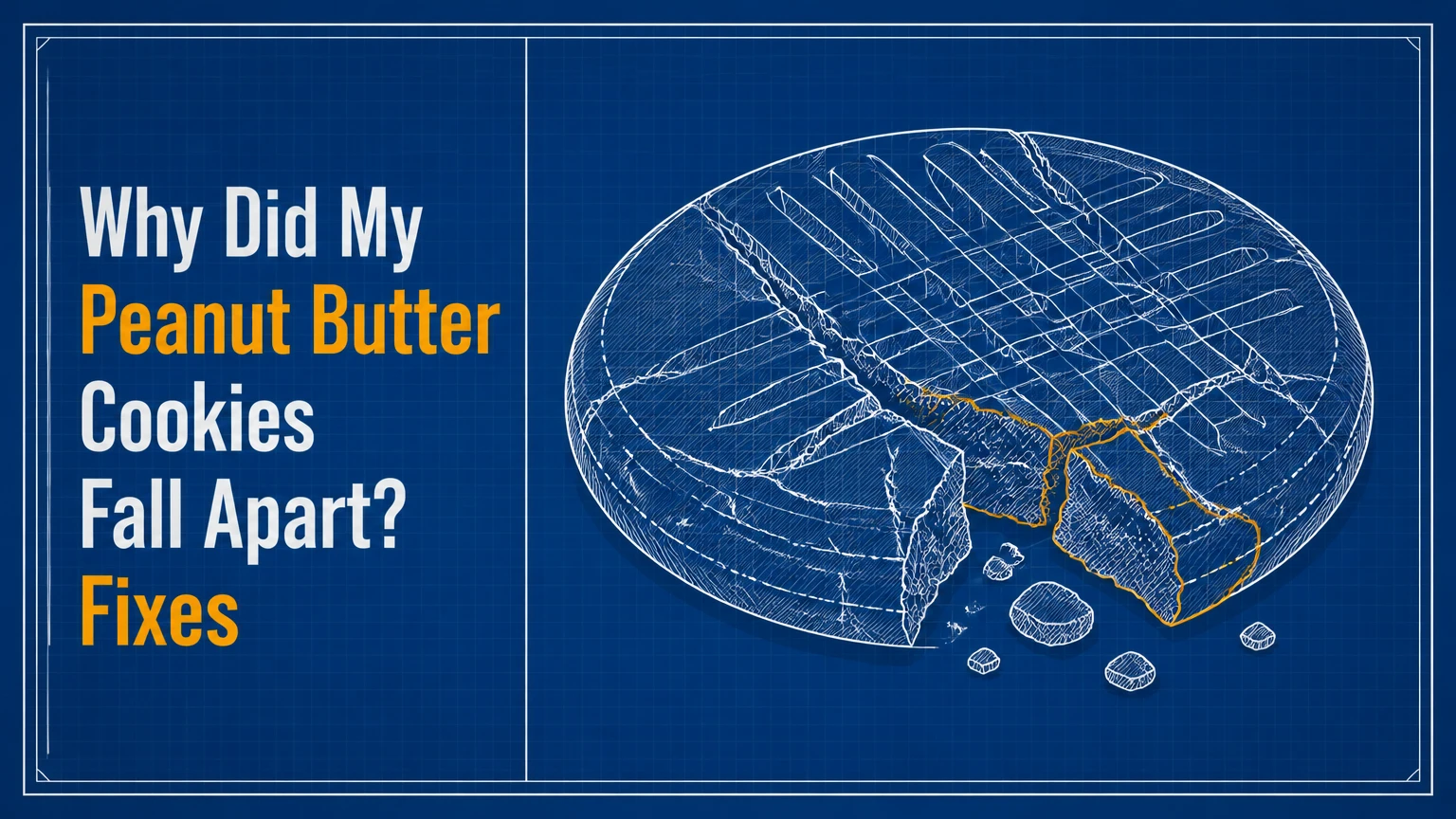
Peanut butter cookies usually fall apart because the dough has too little effective binder for its fat and sugar, the flour was mismeasured, the peanut butter was unusually oily, or the cookies were moved before cooling. Overbaking removes the moisture that binds flour, egg, and sugar, while an incompatible flourless or eggless formula can crumble even when baked correctly.
Key Facts at a Glance
- Peanut butter cookies need a workable balance of fat, moisture, flour, egg protein, and sugar.
- Natural peanut butter can produce fragile cookies when its separated oil is not thoroughly reincorporated.
- Scooping flour directly from the bag can add roughly 10-30% more flour than a weighed recipe requires.
- Cookies continue setting on the hot baking sheet for 5-10 minutes after removal from the oven.
- A flourless peanut butter cookie needs a different structural formula from a traditional flour-based cookie.
- Chilled dough reduces spreading, but chilling cannot repair a recipe with insufficient binder.
Why Did My Peanut Butter Cookies Fall Apart?
Peanut butter cookies fall apart when their structural network cannot support the cookie after fat melts and moisture evaporates. In a flour-based recipe, flour starch, limited gluten, egg proteins, and partially dissolved sugar create the main framework; peanut butter adds fat and dry peanut particles that weaken that framework when the formula contains too little moisture or flour.
The failure often begins before baking. Fat coats some flour particles, sugar competes for available water, and peanut solids interrupt a continuous dough matrix. During baking, butter or peanut oil melts before flour and egg proteins fully set, so a high-fat dough spreads or loses cohesion.
Cookie structure does not depend on gluten alone. Most peanut butter cookies intentionally develop less gluten than bread because excessive gluten produces toughness. The useful structure comes from several smaller systems working together: hydrated flour, gelatinized starch, coagulated egg proteins, dissolved sugar, and solidified fats.
A practical diagnosis starts with timing. Cookies that crumble while being lifted are usually under-set, overbaked, too dry, or structurally weak. Cookies that hold together warm but shatter after cooling usually lost too much moisture or contain a fat-to-binder imbalance.
How Does Peanut Butter Change Cookie Structure?
Peanut butter changes cookie structure by adding concentrated fat, protein, fiber, and finely ground peanut solids without behaving exactly like butter or flour. Commercial creamy peanut butter is emulsified and relatively consistent, while natural peanut butter can contribute a variable amount of free oil from one jar or batch to another.
Fat weakens and tenderizes the matrix
Peanut oil coats flour particles and limits water contact with flour proteins. That effect shortens gluten development, which helps create a tender cookie, but too much free oil leaves fewer connected particles to form a stable crumb.
Butter also contributes fat, yet butter contains approximately 15-18% water, while peanut butter is mostly fat and solids. Replacing butter with peanut butter therefore changes both the fat level and the available moisture. A one-for-one substitution can make dough dense, dry, or fragile depending on the original formula.
Sugar changes both tenderness and cohesion
Sugar attracts water, delays protein setting, and dissolves during baking. Granulated sugar can recrystallize as cookies cool, while brown sugar retains more moisture because of its molasses content. A cookie with a high proportion of white sugar may become crisp and brittle; a cookie with more brown sugar usually stays softer but may spread if the dough is too warm.
Flour and egg create the load-bearing framework
Flour provides starch and proteins. Egg contributes water and proteins that coagulate during heating. Neither ingredient has a universal required quantity because cookie formulas vary by peanut butter concentration, fat type, sugar type, scoop size, and desired texture.
The often-repeated idea that cookies reach one universal setting temperature is too simple. Egg proteins set across a range of temperatures, starch absorbs water as heat rises, and the center can remain soft while the edges have already firmed. Residual heat on the pan completes part of that process.
Which Ingredient Usually Caused the Crumbling?
The ingredient most often responsible is excess flour or insufficient moisture, but oily peanut butter, reduced egg, sugar substitutions, and unplanned ingredient swaps can produce the same symptom. The fastest way to identify the cause is to compare the failed batch with the recipe’s intended ingredient weights and the cookie’s appearance.
| Ingredient or process | Typical failure | What the cookies look like | First correction |
|---|---|---|---|
| Flour | 10-30% excess by volume | Pale, sandy, thick, cracked | Weigh flour or use 120-130 g per cup, depending on flour |
| Natural peanut butter | 1-2 tablespoons excess free oil | Greasy dough, fragile edges, irregular spread | Stir completely, then test one cookie |
| Egg | 15-50 g less liquid and protein | Dry centers, poor cohesion, little spread | Restore the specified large egg or liquid binder |
| Sugar | 10-25% reduction | Dry, dull, less spread, crumbly edges | Follow the recipe’s sugar weight |
| Butter substitution | Moisture and fat changed | Dense, oily, or brittle texture | Use the stated fat or recalculate the formula |
| Baking time | 2-5 minutes too long | Dark edges, dry centers, hard snap | Remove when centers remain soft |
| Cooling | Moved under 5 minutes | Broken bottoms, bent cookies | Leave on the tray 5-10 minutes |
How much flour is too much?
An extra 15-30 grams of flour can noticeably dry a small batch containing 1-2 cups of flour. The exact threshold depends on the amount of peanut butter and egg, but a packed measuring cup can add far more flour than a recipe developer intended.
Most US all-purpose flour weighs approximately 120-130 grams per level cup when spooned and leveled. A scale is more reliable because “one cup flour” can weigh different amounts depending on the flour, measuring method, and recipe convention.
Do not automatically add flour to oily dough. If the dough is greasy but not dry, extra flour may restore shape. If the dough is already stiff and sandy, more flour will make the baked cookies worse.
Is Natural Peanut Butter the Reason?
Natural peanut butter is a likely cause when the jar contains a visible oil layer, the oil was not fully mixed in, or the recipe was designed for a stabilized commercial spread. Natural and conventional peanut butter are not interchangeable by texture alone because their emulsifiers, sugar, salt, and oil distribution differ.
| Peanut butter type | Typical composition or behavior | Dough effect | Best use |
|---|---|---|---|
| Commercial creamy | Stabilized oil, peanut solids, often sugar and salt | Predictable viscosity and spread | Standard flour-based recipes |
| Commercial crunchy | Stabilized spread plus peanut pieces | More solids and less continuous matrix | Recipes allowing 10-20 g extra moisture |
| Natural stirred | Peanuts, oil, salt, variable separation | Variable free oil and stiffness | Recipes written for natural peanut butter |
| Natural no-stir | Stabilized or processed oil system | More consistent than stirred varieties | Substitution when texture matches |
| Powdered peanut butter | Defatted peanut solids, often 40-60% fewer calories by weight | Less fat, more absorbency | Add-in or partial flour replacement |
The common fix of adding 1-2 teaspoons of flour can help a slightly oily dough, but it is not universal. Add flour in 5-gram increments, bake one test cookie, and inspect the result. Excess oil can also indicate that the peanut butter was measured before the separated oil was reincorporated.
Natural peanut butter is not inherently unsuitable. It is simply less forgiving. Stir the entire jar until no oil remains at the surface, measure by weight, and avoid using a recipe whose liquid and flour balance already sits near the edge of dryness.
Did Flour Measurement or Mixing Create the Problem?
Flour measurement can create crumbly peanut butter cookies before the oven is turned on, while inadequate mixing can leave dry flour pockets that never hydrate. Both problems produce a dough that appears cohesive in the bowl but breaks apart after baking.
Weigh the dry ingredients
Use a kitchen scale whenever possible. If a recipe gives volume only, spoon flour into a dry measuring cup and level the top with a straight edge instead of dipping the cup into the flour container.
| Measurement method | Typical flour in one US cup | Likely batch effect |
|---|---|---|
| Spoon and level | 120-130 g | Closest to most tested recipes |
| Light scoop | 130-140 g | Slightly drier cookie |
| Direct scoop from bag | 145-165 g | Often dry and crumbly |
| Heavily packed cup | 170 g or more | High risk of sandy dough |
Mix until no dry pockets remain
Creaming butter and sugar incorporates air, but creaming cannot compensate for missing liquid. After flour enters the bowl, mix only until the dry streaks disappear, then scrape the bottom and sides once.
Under-mixing leaves unhydrated flour clusters. Over-mixing is less likely to cause crumbling in a peanut butter cookie than excess flour, but it can produce a dense cookie by distributing flour unevenly and reducing the intended tenderness.
A useful practitioner checkpoint is the squeeze test. Press a tablespoon of dough in your palm. The dough should compact into a ball without feeling wet or leaving loose flour. If it fractures into separate crumbs, correct the dough before baking.
Did You Overbake the Cookies?
Overbaking is one of the most common reasons peanut butter cookies become fragile after cooling. Every extra minute in a 350°F oven removes water from the edges and center, and the cookies can seem acceptably soft while hot before becoming brittle at room temperature.
Remove peanut butter cookies when the edges are lightly colored and the centers look soft, slightly puffy, or underdone. The hot tray continues transferring heat after removal, so waiting for the center to appear firm in the oven usually produces a dry final texture.
| Visual sign at removal | Likely final texture | Recommended response |
|---|---|---|
| Pale edge, wet shiny center | Soft and possibly under-set | Add 1 minute next batch |
| Light golden edge, soft matte center | Tender and cohesive | Preferred stopping point |
| Medium brown edge, firm center | Crisp and dry | Reduce time by 2-3 minutes |
| Dark edge, cracked dry center | Brittle and overbaked | Reduce time and check oven temperature |
| Bottom dark before top colors | Excessive pan heat | Use a lighter pan or parchment |
Oven temperature matters because a dark metal sheet absorbs heat more aggressively than a pale aluminum sheet. An inexpensive oven thermometer can reveal a 25-50°F temperature error that changes a 10-minute cookie into an overbaked one.
Did You Move Them Before They Set?
Moving hot peanut butter cookies immediately after baking can make intact cookies fall apart. The interior is still soft, the fats remain liquid, and dissolved sugar has not yet cooled into a stable structure.
Keep the cookies on the baking sheet for 5-10 minutes, then transfer them with a thin spatula to a rack. Do not slide them directly from parchment onto a rack while they are hot because the flexible parchment can bend the cookies.
| Cooling stage | Time | What happens | Correct handling |
|---|---|---|---|
| Oven to tray | 0-2 minutes | Fat remains liquid | Leave cookies untouched |
| Initial tray set | 5 minutes | Edges firm and bottoms stabilize | Test one with a spatula |
| Standard tray cooling | 8-10 minutes | Crumb gains strength | Transfer carefully |
| Rack cooling | 20-40 minutes | Fat and sugar finish setting | Store only after fully cool |
| Storage | After 40 minutes | Texture equilibrates | Use an airtight container |
A cookie that breaks only when lifted during the first two minutes may not have an ingredient problem. A cookie that breaks after ten minutes on the tray needs a formula or baking correction.
How Do Cookie Styles Change the Diagnosis?
Flour-based, flourless, vegan, and low-carbohydrate peanut butter cookies use different structural systems, so the same symptom has different causes. A flourless cookie cannot be repaired by adding more gluten because its intended structure comes mainly from egg protein, sugar, and peanut solids.
| Cookie style | Main binder | Common fragile-cookie cause | Reliable adjustment |
|---|---|---|---|
| Flour-based | Flour starch, egg, sugar | Excess flour or overbaking | Weigh flour and shorten bake |
| Three-ingredient flourless | Egg, sugar, peanut solids | Oily spread or dry egg protein | Stir peanut butter and remove earlier |
| Vegan | Starch, flax, aquafaba, or replacer | Weak hydration or poor gel | Use the specified binder and rest dough |
| Keto or almond flour | Nut solids, egg, gums, sweetener | Low moisture or brittle sweetener | Add binder, compress dough, test sweetener |
| Whole-grain | Bran, starch, egg, sugar | Bran absorbs available water | Rest 20-30 minutes before baking |
| Filled or thumbprint | Base dough plus filling | Thin walls or excess filling | Use smaller wells and chill shaped dough |
Why do three-ingredient cookies crumble?
Three-ingredient peanut butter cookies usually crumble because they were overbaked, made with unusually oily peanut butter, or shaped too large for the recipe’s binder level. A typical formula uses about 1 cup peanut butter, 1 cup sugar, and 1 large egg, but brand differences make that ratio a starting point rather than a guarantee.
Flourless cookies have no starch network from wheat flour. Their egg proteins set as water leaves the dough, and their sugar helps create a cohesive baked mass. Removing the egg, reducing the sugar, or substituting a low-moisture sweetener changes the structure substantially.
Why do vegan peanut butter cookies fall apart?
Vegan peanut butter cookies fall apart when the egg substitute does not provide enough water, gel strength, or particle binding. Ground flaxseed, chia, commercial egg replacer, aquafaba, and starch slurry are not structurally identical, so a recipe must be written around the chosen substitute.
A flax egg typically needs about 1 tablespoon ground flaxseed mixed with 2.5-3 tablespoons water, followed by 5-10 minutes of hydration. That mixture adds gel, but it does not reproduce egg white elasticity or egg yolk emulsification exactly.
Why do almond-flour cookies crumble?
Almond flour cookies crumble because almond flour contains no gluten and absorbs water differently from wheat flour. Erythritol can also produce a drier, more crystalline texture than sucrose, while allulose generally retains a softer texture but can brown quickly.
Compress almond-flour dough firmly into portions, chill it for 20-30 minutes, and use the binder specified by the recipe. Xanthan gum may help some formulas at approximately 0.25 teaspoon per small batch, but excess gum creates a gummy rather than cohesive cookie.
Can You Rescue Peanut Butter Cookie Dough?
Unbaked dough can often be rescued, but baked cookies cannot be made structurally identical after excessive moisture has been removed. The correct adjustment depends on whether the dough is dry, greasy, loose, or simply too warm.
| Dough symptom before baking | Likely cause | Rescue quantity | Test |
|---|---|---|---|
| Cracks when squeezed | Too much flour or low moisture | 1 teaspoon milk, 5 g at a time | Dough forms a smooth ball |
| Greasy and loose | Free peanut oil or warm fat | 5-10 g flour or 1-2 g cornstarch | Test cookie holds its mound |
| Dry sandy crumbs | Packed flour or reduced egg | 1 tablespoon beaten egg, 5 g at a time | Dough binds without becoming wet |
| Soft but cohesive | Warm butter or peanut butter | Chill 30-60 minutes | Portion keeps defined edges |
| Spreads during test bake | High fat or warm pan | Chill, then add 5 g flour if needed | Edge sets before center thins |
Bake one test cookie after every adjustment. A full-batch correction can turn a fragile cookie into a tough one if the original problem was oven temperature rather than dough composition.
For already baked cookies, let them cool completely before judging. If they are merely delicate, store them in an airtight container and use a spatula. If they are dry crumbs, repurpose them as an ice cream topping, cheesecake crust component, or layered dessert base instead of trying to rehydrate them.
What Is the Most Reliable Fix for the Next Batch?
The most reliable prevention method combines weighed ingredients, the correct peanut butter type, a single test cookie, and complete tray cooling. A 350°F oven, 30-minute chill, 9-12 minute bake, and 5-10 minute tray rest are useful starting points for many recipes, not mandatory values for every formula.
Step 1: Match the peanut butter to the recipe
Use stabilized commercial peanut butter when the recipe does not specify a type. If using natural peanut butter, fully mix the jar, weigh the required amount, and bake a test portion before changing the flour.
Step 2: Weigh flour and sugar
Record flour and sugar in grams. Avoid volume substitutions when the recipe uses weight because a difference of 20-40 grams can change the dough from flexible to crumbly.
Step 3: Check dough cohesion
Squeeze a portion of dough. A cohesive dough should hold a compact ball without visible dry pockets, although it may still feel slightly soft.
Step 4: Chill when the dough is loose
Chill portioned or unportioned dough for 30-60 minutes if the fat is soft or the cookies spread during testing. Chilling controls spread; it does not replace a missing egg or correct excessive flour.
Step 5: Bake a test cookie
Bake one cookie at the recipe temperature. Use a smaller test portion if the full cookies are large, because a 30-gram scoop and a 60-gram scoop do not finish at the same time.
Step 6: Cool before transferring
Leave the test cookie on the tray for 5-10 minutes. Transfer it only after the edge supports the spatula and the base no longer bends sharply.
Which Fix Matches Each Failure Pattern?
The right fix depends on when the cookie failed and whether the dough was dry, oily, spread thin, or intact until handling. Changing several ingredients at once hides the cause and makes the next batch harder to diagnose.
| Failure pattern | Most likely cause | Adjustment for next batch | What not to change first |
|---|---|---|---|
| Crumbles hot on tray | Weak binder or excess flour | Check egg and flour weights | Do not add more leavener |
| Holds hot, breaks cold | Overbaking or low moisture | Reduce bake by 1-3 minutes | Do not automatically add egg |
| Greasy and fragile | Natural peanut butter oil | Re-emulsify and test | Do not add a full cup of flour |
| Spreads thin then cracks | Warm dough or excess fat | Chill 30-60 minutes | Do not increase temperature sharply |
| Thick, dry, sandy | Packed flour | Reduce flour to recipe weight | Do not bake longer |
| Breaks only on rack transfer | Early handling | Rest 5-10 minutes on tray | Do not alter the formula |
| One side breaks | Uneven mixing or pan hot spot | Scrape bowl and rotate pan once | Do not overmix for several minutes |
| Edges burn, center crumbles | Dark pan or hot oven | Use pale pan and thermometer | Do not simply reduce sugar |
What Are the Main Edge Cases?
Altitude, pan color, scoop size, substitutions, and storage can make a correct recipe appear faulty. These factors alter heat transfer, evaporation, spread, or final moisture without changing the written ingredient list.
At high altitude, lower air pressure can increase spreading and evaporation. A practical test is to reduce oven temperature by 10-15°F or shorten baking slightly, then adjust only one variable. Local altitude recipes are more reliable than applying a universal correction.
Large cookies need longer for the center to set, but longer baking also dries the edges. Use smaller portions, lower the bake time, or shape the dough flatter if the recipe was written for 25-gram cookies and your portions weigh 50 grams.
Parchment reduces sticking and moderates direct pan heat. A greased dark sheet can brown the bottoms rapidly, causing the cookie to crack when lifted even when the top looks pale.
Storage affects perceived texture. Leave cookies uncovered while they are hot so steam does not make the surface greasy, then seal them after they cool. A slice of bread can soften some cookies in a container, but it cannot rebuild a cookie that was structurally underbound.
How Much Time and Money Does a Correction Take?
A typical corrected batch takes 10 minutes to mix, 30-60 minutes to chill when needed, 9-12 minutes to bake, and 30-40 minutes to cool fully. Ingredient cost is commonly about $3-$7 for a batch, excluding equipment and specialty substitutes.
| Correction scenario | Extra time | Typical added cost | Best intervention |
|---|---|---|---|
| Reweigh existing ingredients | 5 minutes | $0 | Use a kitchen scale |
| Chill loose dough | 30-60 minutes | $0 | Refrigerate before portioning |
| Replace natural peanut butter | 5 minutes | $3-$6 | Use a stabilized 16-ounce jar |
| Add a test cookie | 10-12 minutes | Under $0.25 | Bake one portion first |
| Replace egg substitute | 10 minutes | $1-$4 | Use a tested commercial replacer |
| Repurpose baked crumbs | 15 minutes | $0-$2 | Make a crust or topping |
These figures are typical household ranges, not fixed prices. Brand, region, package size, and dietary ingredients create the largest cost differences.
What Should You Remember About This Failure?
Why did my peanut butter cookies fall apart? In most batches, the answer is excess flour, insufficient moisture, oily peanut butter, overbaking, or premature handling, with the exact cause identified by when the cookie loses its shape.
Start with the least disruptive checks: weigh the flour, confirm the egg amount, inspect the peanut butter, and compare the actual bake time with the recipe. Bake one test cookie, cool it for 5-10 minutes, and change only one variable. That method produces a more reliable correction than adding flour or liquid by guesswork.
Peanut butter cookies do not require one universal flour-to-fat ratio. They require a coherent formula in which moisture, starch, protein, sugar, and fat can set together. The same method prevents most cases of why did my peanut butter cookies fall apart.
Frequently Asked Questions
Can I add flour to peanut butter cookie dough that is already crumbly?
Yes, but flour is usually the wrong first addition when the dough is crumbly. Add 1 teaspoon of milk or 5 grams of beaten egg, mix, and test the dough by squeezing it. Add flour only when the dough is greasy and cannot hold a mound, using 5-gram increments.
Should peanut butter cookie dough always be chilled?
No. Chilling is useful when the dough is soft, the kitchen is warm, or the cookies spread during a test bake. A firm dough with balanced ingredients may bake successfully without chilling, while chilling cannot correct excess flour, missing egg, or an oily peanut butter formula.
Why did my peanut butter cookies crack but not completely crumble?
Cracks are often normal in peanut butter cookies because the surface dries and expands unevenly as the cookie spreads. Deep cracks combined with a sandy texture indicate excess flour or overbaking; shallow cracks with a cohesive center usually indicate normal surface expansion.
Can I use crunchy peanut butter instead of creamy?
Usually, but crunchy peanut butter adds peanut pieces that interrupt the dough’s continuous structure. Use the same weight rather than the same volume, avoid adding extra flour automatically, and bake a test cookie. Very coarse pieces can make thin or small cookies more fragile.
How can I make peanut butter cookies softer after they cool?
Reduce baking time by 1-3 minutes, use some brown sugar when the recipe permits, and store fully cooled cookies in an airtight container. Do not add extra liquid without recalculating the dough because excess moisture can cause spreading, greasy bottoms, or under-set centers.
Are crumbly peanut butter cookies safe to eat?
Crumbly cookies are generally safe if the dough reached a suitable baking temperature and the ingredients were fresh. Texture does not determine food safety. Avoid tasting raw dough containing untreated flour or raw egg, and discard cookies with rancid peanut butter odors, mold, or unusual spoilage.
