

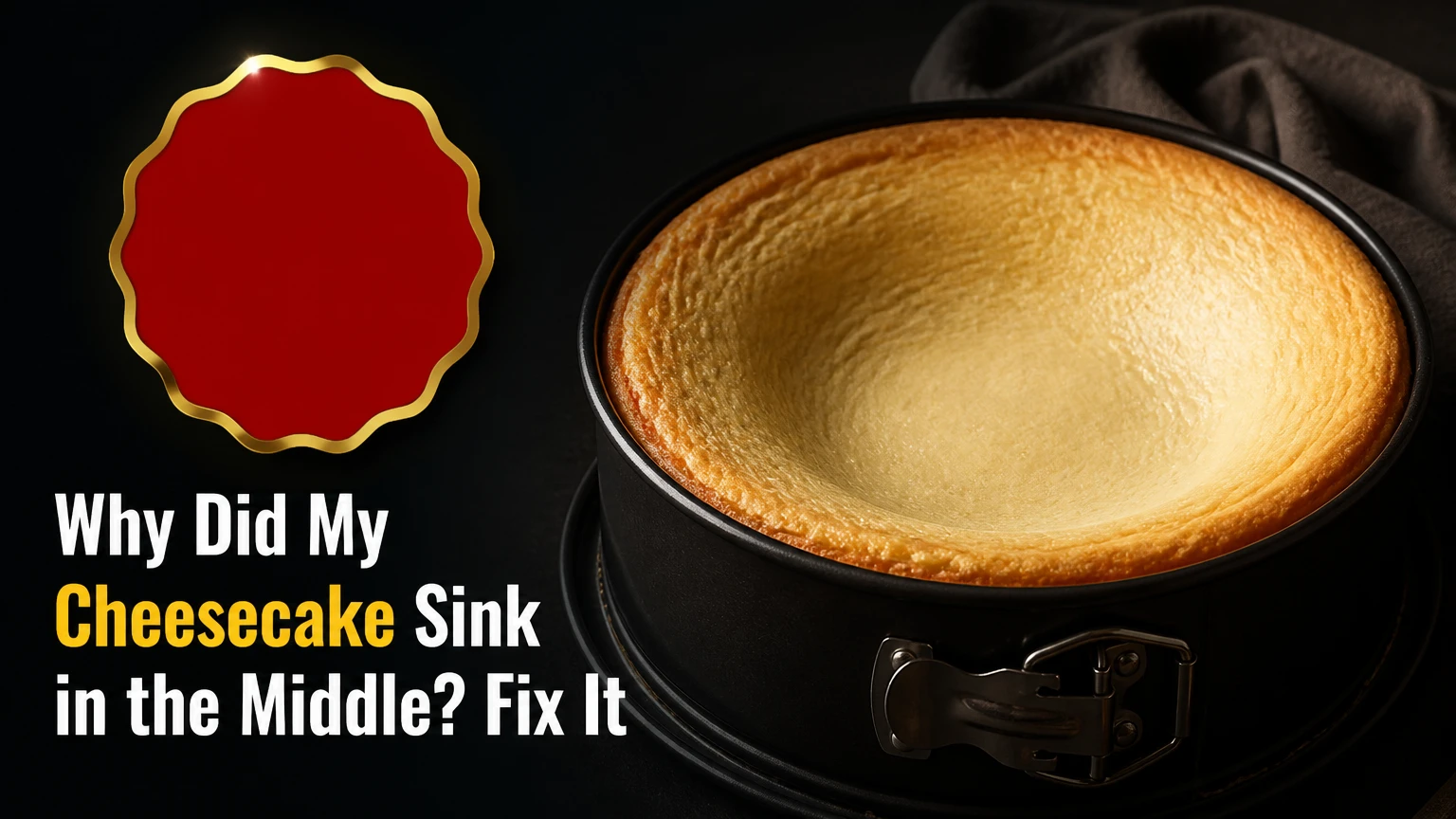
A cheesecake sinks in the middle when its center rises with expanding air or steam but has not formed a strong enough egg-protein structure to support itself during cooling. The most common causes are overmixing, excessive oven heat, underbaking, rapid cooling, and edges stuck to the pan. A shallow dip can be normal; a deep, wet crater signals a structural or doneness problem.
Key Facts at a Glance
- A baked cheesecake is a custard, so eggs provide most of its internal structure rather than gluten.
- A cheesecake center that jiggles slightly is usually finished; a liquid-looking center is underbaked.
- Overmixed batter contains more air, which creates greater expansion and more post-bake contraction.
- High heat can set and inflate the edges while leaving the center too soft to support its weight.
- A springform edge should be loosened after baking so cooling shrinkage does not pull the center downward.
- A sunken cheesecake is usually safe if the center reached a safe cooking temperature and the filling contains no raw, spoiled ingredients.
Why Does the Center Collapse After Baking?
The center of a baked cheesecake collapses because the custard loses volume faster than its protein network can support it. Cream cheese, sugar, eggs, and dairy form a dense emulsion; heat expands air and water vapor, while egg proteins gradually coagulate around the liquid and fat.
A cheesecake therefore behaves differently from a flour cake. Flour cakes rely on starch gelatinization and a gluten or egg network, whereas cheesecake depends primarily on egg coagulation, dairy solids, and gradual moisture loss. The finished structure remains delicate even when the outside appears firm.
The collapse usually begins during cooling. Air bubbles contract, steam condenses into water, and the filling shrinks. If the center is still weak, the top falls into a valley. A small, even depression of 3-6 millimeters is common in rich cheesecake, especially when the recipe contains sour cream or a large amount of liquid.
What does a normal cheesecake dip look like?
A normal cheesecake dip is shallow, centered, and firm enough to slice after chilling. The surface may settle slightly below the rim, but it should not look wet, wrinkled, or collapsed beneath a rigid ring of overbaked filling.
A deep crater usually points to one of four mechanisms:
- The batter contained too much air.
- The outer ring set before the center.
- The center did not coagulate sufficiently.
- The pan edge prevented natural shrinkage.
| Surface appearance after cooling | Most likely cause | Texture check | Best response |
|---|---|---|---|
| Shallow, even dip of 3-6 mm | Normal custard settling | Firm after 6-12 hours | Serve as usual |
| Deep valley with wet center | Underbaking or excess liquid | Sloshes when moved | Chill, then assess safety and texture |
| High rim with sharp crater | Excessive heat | Firm edges, loose center | Lower heat and extend gentle baking |
| Wrinkles and broad collapse | Rapid cooling or over-aeration | Dense lower layer | Mix slowly and cool gradually |
| One-sided depression | Uneven oven heat or tilted rack | Uneven firmness | Level the rack and verify oven temperature |
Why Did My Cheesecake Sink in the Middle?
Your cheesecake most likely sank because the center was under-set, the batter contained excess air, or the cheesecake cooled too abruptly. High heat often combines both problems: the perimeter becomes firm and puffy while the middle remains soft, then the center contracts and falls as the hot cheesecake cools.
Did mixing cause the crater?
Overmixing can cause a cheesecake crater by incorporating air, particularly after the eggs enter the bowl. A stand mixer fitted with a whisk introduces more air than a paddle, and high-speed mixing creates bubbles that expand in the oven before collapsing during cooling.
Cold cream cheese contributes indirectly. Lumps encourage longer mixing, and longer mixing increases aeration. Bring cream cheese, eggs, and sour cream to approximately 20-22°C before mixing, then use low speed and stop when the batter is smooth.
A practical rule is to mix the cream cheese and sugar until smooth, add dairy, and incorporate eggs one at a time at the lowest speed. Scrape the bowl manually rather than continuing to run the mixer for several minutes after the batter already looks uniform.
Did the oven temperature cause sinking?
An oven set above about 160°C or 325°F can make cheesecake sink by setting the edges too rapidly. The outer batter puffs and coagulates first, while the thick center receives heat more slowly and remains structurally weak.
Oven dials can be inaccurate by 10-25°C, especially during long bakes. An inexpensive oven thermometer placed near the cheesecake reveals whether a displayed 150°C is actually 165°C. Convection settings also increase heat transfer, so a recipe written for conventional heat may require a reduction of approximately 15°C or 25°F.
High temperature is not universally wrong. Basque cheesecake intentionally uses intense heat, often around 220-250°C or 425-480°F, to produce a dark top and soft center. That style is expected to sink and should not be judged by New York cheesecake standards.
| Cheesecake style | Typical oven temperature | Typical bake time | Expected center |
|---|---|---|---|
| New York style, water bath | 145-160°C, 290-320°F | 60-100 minutes | Slightly wobbly, not liquid |
| Classic sour cream cheesecake | 150-165°C, 300-325°F | 55-90 minutes | Soft jiggle across 5-8 cm |
| Mini cheesecakes | 160-175°C, 320-350°F | 18-30 minutes | Center trembles briefly |
| Basque cheesecake | 220-250°C, 425-480°F | 35-55 minutes | Very soft center, intentional settling |
| No-bake cheesecake | 0°C oven temperature | 4-12 hours chilling | Set by gelatin, chocolate, or refrigeration |
Can Cooling Make Cheesecake Sink?
Rapid cooling can deepen a cheesecake’s central depression because hot air contracts, steam condenses, and the custard shrinks before its proteins finish stabilizing. A cheesecake removed immediately from a hot oven and placed near a cold window or refrigerator faces a sharper temperature change.
For a tall baked cheesecake, turn off the oven when the perimeter is set and the center still moves as one soft mass. Leave the cheesecake inside for 45-60 minutes with the door open 5-10 centimeters. Move it to the counter until barely warm, then refrigerate it for at least 6 hours.
Gradual cooling cannot repair a center that is genuinely raw. It only reduces thermal shock after the cheesecake has received enough heat. Cooling is therefore a secondary control, not a substitute for correct baking.
Why did the middle sink after refrigeration?
Refrigeration can reveal a problem that began in the oven. The center may look level while warm because steam supports it temporarily, then fall as the steam condenses and the filling becomes cold and dense.
Do not cover a hot cheesecake tightly. Condensation dripping onto the surface can create wet patches, while trapped heat slows the cooling of the center. Cool the cheesecake uncovered until room temperature, then cover it and refrigerate.
| Cooling stage | Typical duration | Correct condition | Common error |
|---|---|---|---|
| Residual oven cooling | 45-60 minutes | Door cracked 5-10 cm | Removing immediately |
| Counter cooling | 60-120 minutes | Pan feels barely warm | Covering while hot |
| Refrigerator setting | 6-12 hours | Center slices cleanly | Cutting after 1-2 hours |
| Freezer firming for service | 30-60 minutes | Cold, not frozen solid | Freezing before full chilling |
When Is Cheesecake Fully Baked?
A cheesecake is fully baked when the outer 5-8 centimeters are visibly set and the center has a controlled wobble rather than a liquid wave. The internal temperature is typically about 65-72°C or 149-162°F, depending on the recipe and desired texture.
A probe thermometer provides useful confirmation, but temperature is not the only test. Insert the probe into the center without touching the metal pan, because the pan can produce a falsely high reading. A center that ripples like liquid batter needs more baking.
The knife test is unreliable because it creates a crack and can make a properly creamy cheesecake appear wet. Instead, gently shake the pan. The edges should remain almost still, while the central area should tremble as a single unit.
Expert pastry instructor Shirley Corriher describes the desired movement as a “uniform jiggle,” a useful distinction from batter that visibly sloshes. The phrase matters because a custard can look soft while still being structurally ready.
| Doneness signal | Finished cheesecake | Underbaked cheesecake |
|---|---|---|
| Edge movement | Nearly stationary | Moves with the center |
| Center movement | Single soft wobble | Liquid wave or slosh |
| Surface | Matte or lightly glossy | Wet and shiny |
| Probe temperature | 65-72°C, 149-162°F | Often below 65°C, 149°F |
| Chilled texture | Clean, creamy slice | Wet, loose, or paste-like center |
Is a Water Bath Necessary?
A water bath is not mandatory, but it is the most forgiving method for a tall, dense cheesecake because water limits the pan’s surrounding temperature to roughly the boiling point and slows moisture loss. A steam pan below the cheesecake offers some buffering but does not provide the same even heat.
Direct bain-marie baking requires a leak-resistant springform setup. Wrap the outside with two or three overlapping layers of wide foil, or place the springform pan inside a larger oven-safe cake pan before adding hot water. Fill the roasting pan with boiling water to about halfway up the cheesecake pan.
Water can leak through foil seams and ruin a crumb crust. A water bath also adds handling risk when moving a heavy roasting pan. The method is less useful for shallow cheesecakes, mini cheesecakes, and intentionally dark Basque cheesecake.
| Baking method | Heat environment | Leak risk | Best use |
|---|---|---|---|
| Direct water bath | 100°C, 212°F water buffer | Moderate | 5-8 cm tall classic cheesecake |
| Water pan on lower rack | Humid oven, indirect buffer | None | Home ovens and beginners |
| No water bath, low heat | Dry heat at 145-160°C | None | Short or rustic cheesecakes |
| Insulated cake pan | Reduced edge heating | Low | Springform pans with weak seals |
| High-heat bake | 220-250°C, 425-480°F | None | Basque style with intentional collapse |
Which Baking Method Fits Your Cheesecake?
Choose a direct water bath for a tall, pale, smooth New York cheesecake; choose a lower-rack water pan when leak prevention matters more than maximum thermal control. A no-bath, low-temperature bake works for a shallow or rustic cheesecake, while Basque cheesecake requires a separate high-heat method.
The method should match the recipe’s design. Using water-bath advice for a Basque cheesecake can prevent its characteristic browned surface, while using a dry high-heat oven for a tall cream-cheese custard increases edge overbaking.
Which method is best for a leak-prone springform pan?
A lower-rack water pan is the safest alternative for a springform pan that leaks. Place a wide metal pan containing 1-2 liters of boiling water on the rack below the cheesecake, leaving space for air circulation.
This arrangement raises oven humidity and moderates drying, but it does not equalize heat as effectively as surrounding the pan with water. Reduce the cosmetic expectation slightly. The top may brown more, and the perimeter may set sooner.
Should you grease the cheesecake pan sides?
Greasing the sides lightly helps release the cheesecake, but it does not replace loosening the edge after baking. A thick layer of butter can make the crust greasy and may encourage the filling to slide against the pan wall.
Run a thin offset spatula or knife around the edge after approximately 10 minutes of cooling, when the filling has begun to contract but is not fully cold. Keep the blade against the pan, not the cheesecake, to avoid cutting the filling.
Why Did the Middle Sink While the Edges Stayed High?
The middle sinks while the edges stay high when the perimeter receives more heat than the thick center. The edges then coagulate, dry, and sometimes puff before the center has developed enough strength, creating a raised ring around a collapsing interior.
Pan size changes this balance. A cheesecake baked in a 9-inch pan is usually shallower than the same batter in an 8-inch pan, so the center sets sooner. Do not transfer the same bake time between pans without recalculating depth.
A dark metal pan absorbs heat faster than a light aluminum pan. Glass also changes heat transfer and may require a lower temperature with a longer bake. Rack position matters because the top and bottom heating elements can produce different edge temperatures.
| Variable | More aggressive condition | Likely result | Adjustment |
|---|---|---|---|
| Pan diameter | 8 inches with full batter | Deep center, longer bake | Add 10-20 minutes |
| Pan diameter | 9 inches with same batter | Shallower filling | Start checking 10 minutes earlier |
| Pan material | Dark metal | Faster edge heating | Reduce heat 5-10°C |
| Oven setting | Convection at 160°C | Stronger airflow and heat | Use 145-150°C |
| Rack position | Directly above bottom element | Dark crust, firm lower edge | Move to center rack |
Do Recipe Ingredients Change the Risk?
Recipe ingredients change sinking risk because water, fat, sugar, eggs, and stabilizers alter the custard’s coagulation range. Extra sour cream, yogurt, citrus juice, or fruit puree adds water, while additional sugar delays egg-protein setting and can leave the center softer.
Cream cheese brands also vary in moisture. Tub-style spreadable cream cheese usually contains more water and stabilizers than full-fat block cream cheese, so it can produce a looser filling. Use block cream cheese unless the recipe specifically names a spreadable product.
Eggs provide structure, but adding extra eggs does not automatically prevent sinking. Too many eggs can create a rubbery texture and increase puffing. Cornstarch or flour can improve stability in some recipes, although those ingredients change the intended creamy texture.
| Ingredient change | Structural effect | Surface clue | Practical correction |
|---|---|---|---|
| Tub cream cheese | Higher moisture, weaker set | Loose center after chilling | Use full-fat block cream cheese |
| Extra sour cream | More water, softer custard | Broad central dip | Reduce added liquid or extend bake |
| Extra sugar | Delayed coagulation | Pale, soft center | Follow tested recipe ratios |
| Fruit puree | Added water and acidity | Wet pockets or streaks | Drain puree or use a stabilizer |
| Cornstarch | Firmer, less fragile set | Cleaner slices | Add only when recipe specifies it |
What Is the Most Reliable Prevention Process?
The most reliable prevention process uses room-temperature ingredients, low-speed mixing, a verified oven temperature, gentle heat, a measured doneness test, and gradual cooling. The complete schedule usually takes 90 minutes of baking and cooling followed by 6-12 hours of refrigeration.
- Prepare the ingredients. Bring block cream cheese, eggs, and sour cream to 20-22°C for about 60-120 minutes. Weigh ingredients when possible, because excess dairy or sugar changes the set.
- Build a smooth base. Mix cream cheese and sugar on low speed until no lumps remain. Scrape the bowl once or twice instead of increasing mixer speed.
- Add eggs carefully. Add one egg at a time and mix only until each yolk disappears. Stop immediately after the batter becomes uniform.
- Remove large bubbles. Pour the batter into the crust, then tap the pan gently 3-5 times on a folded towel. Pop visible bubbles with a toothpick.
- Set up gentle heat. Use a water bath or place 1-2 liters of boiling water on the rack below. Verify the oven with an independent thermometer.
- Bake until the center moves correctly. Use 145-160°C, or 290-320°F, for a classic cheesecake. Stop when the perimeter is set and the center makes one soft wobble.
- Cool gradually. Turn off the oven, crack the door 5-10 centimeters, and leave the cheesecake inside for 45-60 minutes.
- Release and chill. Loosen the edge after about 10 minutes, cool completely on the counter, then refrigerate uncovered or loosely covered for 6-12 hours.
You will know the process worked when the cheesecake has a level or gently rounded surface, a firm perimeter, and a center that slices cleanly without wet paste. The most common mistake is extending high-temperature baking to eliminate all movement, which produces dry edges while the center still cools unevenly.
What if the cheesecake has already sunk?
A sunken cheesecake cannot be restored to its original height after the custard structure collapses. The cheesecake can still be served if the center is fully cooked, and a chilled crater can hold fruit, a thin sour-cream layer, chocolate topping, or whipped cream.
Do not bake a completely chilled cheesecake again merely to raise the top. Reheating often creates curdled dairy, a dry perimeter, and additional cracking. If the center is genuinely liquid, return the cheesecake to a low oven before chilling, but accept that the texture may become uneven.
Use the crater as a serving feature rather than cutting away a large amount of filling. A thin topping preserves the cheesecake’s balance better than several centimeters of sweet filling.
Is a Sunken Cheesecake Safe?
A sunken cheesecake is safe to eat when the custard is fully cooked, has been chilled promptly, and has not remained at room temperature for more than 2 hours. A deep depression alone is not a food-safety indicator, because some cheesecakes intentionally settle.
Discard cheesecake with a raw liquid center that contains egg, especially if it has been held warm for an extended period. The USDA recommends refrigerating perishable foods within 2 hours, or within 1 hour when ambient temperatures exceed 32°C or 90°F.
A cheesecake that is firm but visually sunken is a quality problem. A cheesecake that is liquid, warm for several hours, sour-smelling, or contaminated requires a safety decision rather than a cosmetic repair.
How Do Special Cheesecakes Behave?
Basque, no-bake, mini, and soufflé-style cheesecakes have different structural expectations, so a central dip is not equally diagnostic across styles. Basque cheesecake is intentionally baked hot and often sinks, while no-bake cheesecake sets through refrigeration rather than egg coagulation.
Sour cream-topped cheesecakes may develop a second soft layer that looks like a collapse even when the main filling is stable. Fruit-swirl cheesecakes can also appear sunken where puree adds moisture.
| Cheesecake type | Main setting mechanism | Normal appearance | Main sinking warning |
|---|---|---|---|
| Basque | Egg proteins and high-heat browning | Dark, irregular, sunken center | Liquid center after full chilling |
| New York style | Eggs, cream cheese, slow baking | Dense, pale, slight dip | Deep crater and wet paste |
| No-bake | Gelatin, chocolate, or cold setting | Firm after 4-12 hours | Loose filling after overnight chilling |
| Mini cheesecake | Short bake and rapid heat transfer | Small center wobble | Hollow or rubbery filling |
| Soufflé cheesecake | Egg foam and starch | Delicate rise and settling | Severe shrinkage and wet base |
What Mistakes Cause Sinking Even When the Recipe Is Correct?
A correct recipe can still sink when measurement, equipment, or handling changes the heat and moisture balance. The most frequent hidden variables are pan substitution, convection heat, oversized eggs, leaking water baths, and opening the oven repeatedly.
The five most useful diagnostic clues
- Sharp raised edges: suspect excessive heat or an undersized pan.
- Wet central paste: suspect underbaking, excess liquid, or an inaccurate oven.
- Many pinholes: suspect overmixing and trapped air.
- Crack around the perimeter: suspect overbaking, rapid cooling, or a stuck edge.
- Even shallow settling: suspect normal contraction rather than failure.
Practitioner rules that prevent repeat failures
- Measure the batter depth before baking. A filling deeper than about 5 centimeters needs more time at lower heat.
- Treat the oven setting as an estimate until an oven thermometer confirms it.
- Never use the mixer to “finish” a batter that is already smooth.
- Loosen the edge early enough to permit shrinkage, but do not unmold a warm cheesecake.
- Judge doneness by movement and temperature together, not by a perfectly motionless surface.
Can You Prevent Sinking Without a Water Bath?
You can prevent severe sinking without a water bath by baking a shallower cheesecake at 145-160°C, using a lower-rack pan of boiling water, and cooling the finished cheesecake gradually. This approach reduces the risk of water leakage but provides less protection against dry edges and uneven oven heat.
A no-bath method is a reasonable choice for a 9-inch cheesecake with moderate filling depth, a reliable oven, and a topping that hides minor surface changes. It is a poor choice for a very tall 8-inch cheesecake when a flawless, pale top is the priority.
The water-pan alternative is easier to handle, but its humidity does not directly surround the cheesecake pan. Expect the outer 2-3 centimeters to set somewhat faster than they would in a submerged bath.
Frequently Asked Questions
Can I eat cheesecake that sank but still jiggles?
A slight jiggle is acceptable when the cheesecake moves as one set mass and reaches approximately 65-72°C in the center. A liquid wave, sloshing movement, or wet paste after chilling indicates underbaking rather than normal creaminess. Chill the cheesecake fully before judging its final texture.
Why did my cheesecake crack and sink?
A crack and sinking usually result from overbaking, rapid cooling, or a filling that stuck to the pan wall. As the cheesecake contracts, the fixed edge pulls against the shrinking center. Lower the heat, cool the cheesecake gradually, and loosen the perimeter after about 10 minutes.
Should I put a sunken cheesecake back in the oven?
Put a sunken cheesecake back in the oven only when the center is still visibly liquid and the cheesecake has not been chilled. Bake it at approximately 150°C or 300°F until the perimeter sets and the center moves as one mass. Reheating a cold cheesecake usually damages texture.
Why did my no-bake cheesecake sink overnight?
A no-bake cheesecake sinks overnight when its setting agent is insufficient for the liquid and fat content, the filling was not chilled long enough, or warm ingredients melted gelatin or chocolate. Refrigerate for 6-12 hours, then review the recipe’s gelatin, chocolate, or whipped-cream proportions.
Does opening the oven make cheesecake sink?
Opening the oven repeatedly can lower the temperature and extend the time required for the center to set, especially during the first half of baking. One brief check near the expected finish is usually harmless. Avoid frequent door opening and never slam the oven door.
How long should cheesecake rest before slicing?
A baked cheesecake should rest in the refrigerator for at least 6 hours, with 8-12 hours producing cleaner slices for a tall cake. Cooling on the counter first prevents excess condensation and thermal shock. Slice with a warm, dry knife and clean the blade between cuts.
The Bottom Line
Why did my cheesecake sink in the middle? The usual answer is a weak center that expanded during baking and contracted during cooling, often because of excess air, high heat, underbaking, or a stuck edge. Use room-temperature ingredients, low-speed mixing, a verified 145-160°C oven, a controlled jiggle test, and gradual cooling. A shallow dip is normal; a deep, wet crater requires a doneness and food-safety check.
