

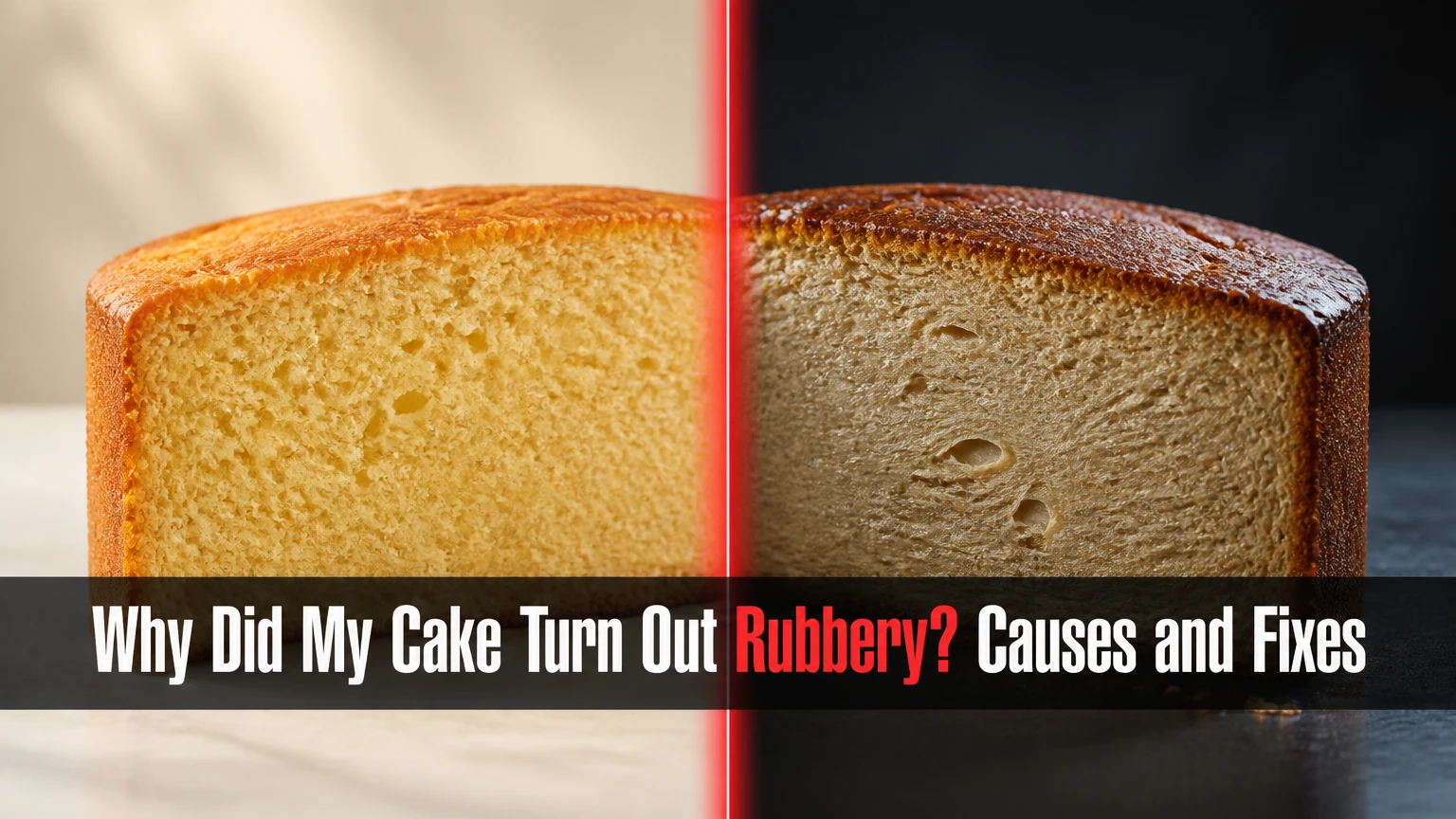
A cake turns rubbery when its crumb becomes too elastic, dense, or chewy because gluten developed excessively, egg proteins tightened, starch remained gummy, or the cake lost the moisture needed for a tender structure. The most common trigger is overmixing after flour is added, but incorrect flour, excess egg, underbaking, and oven temperature can produce similar results.
Key Facts at a Glance
- Overmixing develops gluten, especially in batters made with all-purpose or bread flour.
- A rubbery, dry cake usually indicates overbaking or excessive oven heat.
- A rubbery, wet bottom usually indicates underbaking, excess liquid, poor aeration, or a pan that is too small.
- Cake flour usually contains about 7-9% protein, while bread flour commonly contains about 12-14%.
- Resting overmixed batter for 15-20 minutes may relax gluten slightly, but it cannot reverse a severe mixing error.
- A finished rubbery cake cannot regain its original crumb, although syrup, cream, custard, or crumbling can improve how it eats.
Why Did My Cake Turn Out Rubbery?
A rubbery cake has a structural problem, not one single cause. Flour proteins can form an elastic gluten network, egg proteins can contract into a firm gel, and starch can create a gummy matrix when the batter has excess moisture or insufficient heat. These mechanisms may occur together, so the crumb pattern matters more than one isolated clue.
Tender cake depends on balance. Flour and eggs provide structure, sugar and fat limit toughness, leavening creates expansion, and water allows starch to swell. When structure-building forces overpower tenderizing forces, the baked crumb feels springy rather than soft.
What does a rubbery cake feel like?
A rubbery cake feels elastic under pressure, resists a fork, and may compress without breaking into fine crumbs. A cake that is merely dense can still be moist and tender, while a rubbery cake stretches, squeaks slightly when cut, or rebounds after being pressed.
Texture can also vary within one cake. The center may be gummy from underbaking, the edges may be dry from excessive heat, and the upper crumb may be firm because the batter rose poorly.
How Does Cake Batter Become Elastic?
Cake batter becomes elastic when water, flour proteins, mechanical mixing, and heat create a stronger network than the recipe requires. Glutenin contributes stretch, gliadin contributes extensibility, and mixing brings those proteins into contact with water so the network can develop.
Cake does not need zero gluten. It needs limited gluten because the batter must hold expanding gas without becoming breadlike. Fat, sugar, eggs, and low-protein flour reduce the risk by interrupting protein contact or building structure through other mechanisms.
A practical rule from pastry work is to stop mixing as soon as the flour disappears. A fixed limit such as 60 seconds is not universal because a whisk, stand mixer, hand mixer, and folding motion develop gluten at different rates. Visual stopping cues are more reliable than a stopwatch.
Why does overmixing make cake rubbery?
Overmixing makes cake rubbery because repeated agitation aligns and strengthens hydrated flour proteins. The resulting gluten network holds the crumb together too tightly, producing chewiness and resistance instead of a short, tender bite.
The risk rises after liquid contacts flour. Mixing a creamed butter mixture before flour is added does not create the same gluten risk because the flour has not yet hydrated. Once flour and liquid combine, every additional rotation increases mechanical development.
| Mixing situation | Typical action | Rubberiness risk | Correct stopping cue |
|---|---|---|---|
| Creaming butter and sugar | 3-5 minutes at medium speed | Low for gluten | Butter is pale and aerated |
| Adding eggs to creamed butter | 30-60 seconds per addition | Low to moderate | Mixture is emulsified |
| Adding flour with a stand mixer | 15-30 seconds on low | Moderate | No dry flour remains |
| Folding flour by hand | 8-15 folds | Low to moderate | Batter looks streak-free |
| Mixing muffin-style batter | 10-20 strokes | Moderate | A few small lumps remain |
| Using bread flour | Same time as recipe | High | Avoid unless recipe specifies it |
Did the Flour Cause the Rubbery Texture?
Flour can cause rubbery cake when its protein content is too high, too much flour is added, or the selected flour does not match the recipe. Scooping flour directly from a container can compact the ingredient and add substantially more flour than intended, which creates a dry, tight crumb.
Cake flour is usually the safest choice for a tender layer cake because its lower protein content limits gluten formation. All-purpose flour can work well, but it leaves less tolerance for excessive mixing. Bread flour is designed for chewy structure and is a poor substitute in most cakes.
| Flour type | Typical protein | Best cake use | Rubberiness concern |
|---|---|---|---|
| Cake flour | 7-9% | Sponge, layer, chiffon cake | Fragile crumb with heavy fillings |
| Pastry flour | 8-10% | Tart-style and tender cakes | Less widely available |
| All-purpose flour | 10-12% | Everyday butter cakes | Toughens when overmixed |
| Bread flour | 12-14% | Yeasted or intentionally chewy bakes | Excessive elasticity in standard cake |
Weigh flour when possible. A typical cup of all-purpose flour may weigh about 120-130 grams when spooned and leveled, but the correct value depends on the brand and recipe. Use the recipe’s stated gram weight when one is provided rather than replacing it with a generic cup conversion.
Can all-purpose flour replace cake flour?
All-purpose flour can replace cake flour, but the cake may have a slightly firmer crumb. A common kitchen substitution is to remove 2 tablespoons from each cup of all-purpose flour and replace that amount with cornstarch, then sift the mixture thoroughly.
The substitution is not chemically identical to commercial cake flour. It changes the starch-to-protein balance and can work in many layer cakes, but it may perform differently in recipes that depend on a precise flour weight or high-volume foam.
Did Too Many Eggs Make the Cake Rubbery?
Too many eggs can make a cake rubbery because egg proteins set into a firm network during baking. Egg whites contain more water and protein than yolks, so adding extra whites often produces a springy, spongelike crumb, while extra yolk generally adds richness and tenderness.
Egg size matters when a recipe specifies a particular standard. A large egg without its shell weighs about 50 grams, with roughly 30 grams of white and 18-20 grams of yolk. A medium egg contributes less total liquid and protein, so careless substitutions can change the batter ratio.
| Egg size | Approximate weight without shell | Approximate liquid contribution | Common recipe effect |
|---|---|---|---|
| Small | 38-43 g | 35-40 g | Less moisture and structure |
| Medium | 44-49 g | 41-46 g | Moderate structure |
| Large | 50-56 g | 47-53 g | Standard US recipe reference |
| Extra-large | 57-64 g | 54-61 g | More liquid and protein |
Eggs also become rubbery when overbaked. Heat causes egg proteins to unfold, bond, and contract; excessive contraction squeezes water from the crumb. The result can resemble an overcooked egg dish, especially in custard-like cakes, flourless cakes, and recipes with several whites.
Was the Oven Too Hot or the Cake Overbaked?
An oven that runs 15-25°F hotter than its setting can over-set the outside of a cake and tighten egg proteins before the interior finishes expanding. Overbaking produces a dry, firm, rubbery crumb, while underbaking produces a wet, gummy, and sometimes rubbery center.
An oven thermometer is more dependable than the dial. Place it near the center of the oven, preheat for at least 20 minutes, and compare the reading with the recipe temperature. Check again after the heating element cycles because some ovens fluctuate substantially.
| Symptom | Likely heat problem | Supporting clue | Next adjustment |
|---|---|---|---|
| Dry and rubbery throughout | Overbaking or high temperature | Dark edges and hard crust | Reduce time by 5-10 minutes |
| Wet rubbery center | Underbaking or low temperature | Skewer shows thick batter | Continue baking in 5-minute intervals |
| Firm top, raw middle | Excessive top heat | Surface sets early | Lower temperature by 15-25°F |
| Dense bottom layer | Weak heat or poor aeration | Bottom remains shiny | Verify pan position and leavening |
| Uneven crumb | Hot spots or crowded oven | One side rises more | Rotate only after structure sets |
Pan material changes baking behavior. Dark metal absorbs more radiant heat than light aluminum, glass often requires a modest temperature reduction, and silicone insulates the batter so the center may need longer to set. Follow the recipe’s pan guidance before changing temperature.
How do you test cake doneness accurately?
Test cake doneness when the center has risen and the surface springs back lightly. A toothpick should emerge with a few moist crumbs, not wet batter; an instant-read thermometer typically reads about 200-210°F for many butter cakes, although formula and pan depth alter the ideal endpoint.
The thermometer method is especially useful for dense chocolate, banana, yogurt, and fruit cakes, where a toothpick can pass through a moist pocket and give a misleading result. Insert the probe into the center without touching the pan.
Why Is the Bottom of the Cake Rubbery?
A rubbery bottom usually results from underbaking, excess liquid, poor leavening, a pan that is too small, or batter separation. The bottom receives less direct heat than the sides and may remain gelatinized when the top appears finished.
Cold ingredients can also destabilize a butter-based emulsion. If cold eggs or milk cause the fat mixture to curdle, the batter may distribute water and fat unevenly. The cake can then contain dense, wet pockets even when the overall baking time is correct.
| Bottom-layer appearance | Most likely cause | Confirmation | Prevention |
|---|---|---|---|
| Shiny, wet, and compact | Underbaking | Batter clings to skewer | Bake until center reaches endpoint |
| Dark and firm | Pan too low or oven too hot | Hard lower crust | Use middle rack and lighter pan |
| Greasy and dense | Broken emulsion | Curdled batter before baking | Use ingredients near 68-72°F |
| Pale and gummy | Weak leavening | Little rise throughout | Check freshness and measurement |
| Fruit-heavy and wet | Excess fruit moisture | Moisture around fruit pieces | Drain or reduce added liquid |
Do not confuse a moist bottom with a syrup-soaked cake. Some formulas intentionally contain a wet layer, especially cakes with fruit, custard, or a poured topping. The intended recipe structure determines whether that texture is a failure.
Can You Fix Rubbery Cake Batter Before Baking?
You can reduce the damage from mildly overmixed batter, but no rescue technique fully restores tender structure. Let the batter rest for 10-15 minutes, preheat the oven completely, and bake immediately afterward; resting may relax some gluten, while additional mixing will make the problem worse.
If the batter is severely elastic, thick, or visibly overworked, avoid adding extra flour, liquid, or leavening. Those additions change the formula unpredictably. Bake a small test portion if enough batter remains, then adjust the remaining batter only when the test reveals a clear issue such as underbaking.
Batter rescue protocol
- Stop mixing immediately.
- Scrape the bowl without stirring repeatedly.
- Rest the batter for 10-15 minutes at room temperature.
- Prepare the correct pan and verify the oven temperature.
- Bake in the center of the oven.
- Check the center with a skewer or thermometer.
- Cool according to the recipe before judging texture.
A batter containing raw eggs should not sit unrefrigerated for extended periods. The short rest above is a texture experiment, not a food-storage method.
How Can You Diagnose the Exact Cause?
Diagnose rubbery cake by combining crumb texture, moisture distribution, rise, crust color, and the mixing method. A single symptom such as density does not distinguish between excess flour, failed leavening, underbaking, and overmixing.
| Finished-cake pattern | Most probable cause | Less likely cause | Best confirmation |
|---|---|---|---|
| Rubbery and dense everywhere | Overmixing or excess flour | Weak leavener | Review flour weight and mixing |
| Rubbery but moist | Excess egg white or underbaking | High-protein flour | Check center temperature |
| Rubbery and dry | Overbaking or hot oven | Too little fat | Inspect crust and thermometer |
| Gummy bottom only | Underbaking or separation | Pan too small | Examine batter and pan depth |
| Tough edges, soft center | High heat or dark pan | Uneven rack position | Compare edge color |
| Chewy after chilling | High sugar or syrup | Overmixing | Warm a slice and reassess |
Recipe type changes the diagnosis. A chiffon cake naturally has a resilient foam crumb, a flourless cake may be dense and elastic from egg coagulation, and a butter cake should usually break into shorter, finer crumbs.
Which Cake Methods Reduce Rubberiness?
Oil-based, reverse-creamed, and low-protein-flour methods generally provide more protection against rubberiness than a conventional high-mix butter method. The best choice depends on whether the priority is tenderness, aeration, stacking strength, or a light foam structure.
| Method | Fat interaction | Mixing tolerance | Typical crumb | Limitation |
|---|---|---|---|---|
| Conventional creaming | Butter aerates sugar | Moderate | Light and fine | Can toughen after flour addition |
| Reverse creaming | Fat coats flour first | High | Even and velvety | Less dramatic rise |
| Oil-based mixing | Liquid oil limits protein bonding | High | Moist and soft | Less buttery flavor |
| Foam method | Whipped eggs provide lift | Low to moderate | Light and springy | Deflates with rough folding |
Reverse creaming is useful because flour is coated with fat before most liquid enters. That reduces direct hydration of flour proteins, although the method does not make gluten chemically impossible and cannot compensate for an incorrect ingredient ratio.
A practical expert rule is to choose the method that matches the cake’s job. Use reverse creaming for level layer cakes, oil-based formulas for moist everyday cakes, and conventional creaming when buttery flavor and aeration matter more than maximum mixing tolerance.
How Do You Prevent a Rubber-Textured Cake?
Prevent rubbery cake by controlling flour weight, flour protein, mixing, egg size, oven temperature, pan depth, and bake endpoint. These variables interact, so changing only one may not solve a problem caused by several small deviations.
Prevention checklist
- Weigh flour in grams with a digital scale.
- Use the flour named in the recipe.
- Bring eggs, milk, and butter near 68-72°F unless the recipe specifies otherwise.
- Mix flour on low speed only until incorporated.
- Fold the last dry streaks by hand.
- Use an oven thermometer rather than trusting the dial.
- Fill the pan about one-half to two-thirds full.
- Avoid opening the oven during the first two-thirds of baking.
- Test the center, not only the edge.
- Cool the cake on a rack so trapped steam does not condense underneath.
Ingredient substitutions deserve special caution. Replacing milk with yogurt, adding extra fruit, using liquid sweeteners, or swapping egg sizes changes water, protein, acidity, or sugar concentration. Record substitutions so the resulting texture can be explained rather than guessed.
What equipment helps most?
A digital scale and oven thermometer provide the highest practical value. Typical retail prices are $10-25 for a scale and $6-15 for an oven thermometer, while a probe thermometer commonly costs $15-35.
| Tool | Typical price | Useful specification | Problem it detects |
|---|---|---|---|
| Digital scale | $10-25 | 1 g resolution | Excess flour |
| Oven thermometer | $6-15 | Reading to 5°F | Incorrect oven heat |
| Instant-read probe | $15-35 | Reading to 1°F | Underbaked center |
| Lightweight aluminum pan | $12-30 | 2-inch depth | Uneven heat absorption |
| Fine sieve | $8-20 | 1-2 mm mesh | Flour and leavener distribution |
The tools do not replace technique. A scale cannot correct overmixing, and an oven thermometer cannot correct a pan filled far above its intended capacity.
Can You Save a Finished Rubbery Cake?
You cannot reverse the baked gluten, egg, and starch structure, but you can make a rubbery cake more pleasant by adding moisture, fat, and contrast. Salvage works best when the cake is dense yet fully cooked; raw, spoiled, or strongly burnt cake should not be served.
For syrup-soaking, combine equal parts water and sugar by weight, heat until dissolved, cool the syrup, and brush about 1-2 tablespoons over each cake layer. Apply gradually because excess syrup can create a wet, pasty crumb rather than a soft one.
| Salvage method | Quantity for an 8-inch cake | Resting time | Best result |
|---|---|---|---|
| Simple syrup | 2-4 tablespoons | 30 minutes | Dry, firm cake |
| Custard trifle | 2 cups custard | 1-4 hours chilled | Dense cake with wet crumb |
| Whipped cream layers | 2 cups cream | 1-2 hours chilled | Elastic cake with contrast |
| Cake pops | 2 cups crumbs plus 1/2 cup frosting | 20 minutes | Cake that holds shape |
| Toasted cubes | 3 cups cake cubes | 10 minutes | Firm cake used as a topping |
Cut away hard edges, cube the remaining cake, and layer it with fruit, custard, or whipped cream for a trifle. Crumbling the cake with enough frosting to bind it creates cake pops, where the original dense structure becomes useful rather than distracting.
Do not use syrup to hide a raw center. Return underbaked cake to the oven when possible, covering the top loosely if it is already dark, and continue until the center is set.
What Changes for Boxed, Gluten-Free, and Specialty Cakes?
Boxed cake can become rubbery when the mix is overmixed, too much liquid or egg is added, the pan is too small, or the cake is underbaked. Gluten-free cake can feel gummy because starches and hydrocolloids retain water differently from wheat flour, so the cake may require a longer cooling period before its crumb stabilizes.
| Cake type | Common rubbery trigger | Better diagnostic | Useful correction |
|---|---|---|---|
| Boxed yellow cake | Excess mixing or added egg | Compare package liquid volume | Mix only until smooth |
| Gluten-free cake | Excess water or gum | Cool fully before cutting | Weigh blend and rest batter |
| Chiffon cake | Overbaked foam or poor folding | Check egg foam volume | Fold gently and avoid dryness |
| Pound cake | Excess flour or overbaking | Weigh flour and test center | Use moderate heat |
| Fruit cake | Wet fruit pockets | Inspect fruit distribution | Drain fruit and extend baking |
Gluten-free formulas often need binders such as xanthan gum or psyllium, but adding more binder without a tested formula can create a gummy, elastic result. Use a blend designed for cake rather than replacing wheat flour gram for gram with one isolated starch.
Altitude also changes the result. At higher elevations, lower air pressure can make cakes rise rapidly and collapse, while water evaporates sooner. A high-altitude recipe may require reduced leavening, slightly more liquid, or a higher baking temperature, but exact changes depend on elevation and formula.
Frequently Asked Questions
Can a rubbery cake be caused by too much baking powder?
Too much baking powder can make a cake rise quickly and collapse, leaving a dense or gummy crumb, although it does not usually create the same elastic texture as overmixed gluten. Excess leavener can also leave a bitter or soapy taste. Measure level teaspoons and replace old leavener when its activity declines.
Why is my cake rubbery after refrigeration?
Refrigeration can make butter and other fats firm, which makes cake feel harder and chewier without changing its original structure. Wrap the cake well, bring slices to room temperature for 20-40 minutes, and reassess the crumb. If the cake remains elastic when warm, overmixing or overbaking is more likely.
Does sugar make cake rubbery?
Excess sugar can make cake gummy because sugar attracts water and delays starch setting. Too little sugar can also produce a dry, firm crumb because sugar normally tenderizes by competing for water. Follow the formula closely, especially when replacing granulated sugar with honey, syrup, or another liquid sweetener.
Should cake batter rest before baking?
Cake batter should usually be baked soon after mixing because leavening begins reacting and aeration can decline. A brief 10-15 minute rest may relax mildly overdeveloped gluten, but resting cannot repair severe overmixing, restore lost air, or correct excess flour.
Why did my cake turn out rubbery only in the middle?
Rubberiness limited to the middle usually indicates underbaking, a pan that is too small or deep, excess liquid, or a collapsed center. Confirm the center temperature, compare the pan dimensions with the recipe, and continue baking until the middle springs back and contains no wet batter.
The Bottom Line
Why did my cake turn out rubbery? The leading explanation is excessive structure from overmixing, high-protein flour, tight egg proteins, or ungelatinized starch in an underbaked center. Identify whether the cake is rubbery throughout, dry, or wet at the bottom, then correct the matching variable rather than changing the whole recipe. Weigh flour, mix briefly after flour enters, verify oven heat, and judge doneness at the center.
