

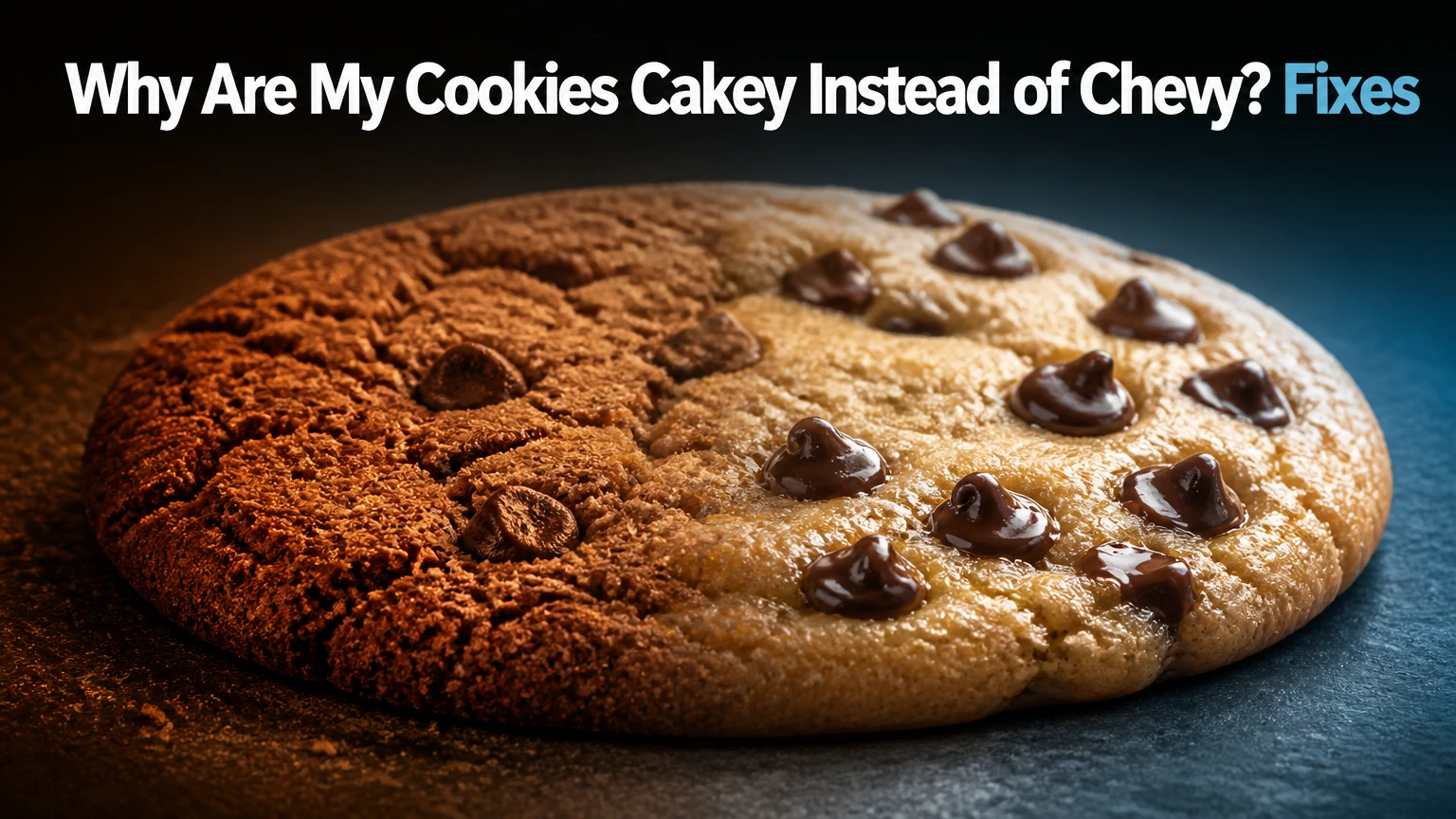
Cookies become cakey instead of chewy when the dough contains too much flour or water, traps excessive air or steam, or sets before it can spread. The most common causes are packed flour, over-creamed butter, extra egg white, too much baking powder, and under-spreading from cold dough. Correct the dominant cause rather than changing every ingredient at once.
Key Facts at a Glance
- Cakey cookies have a thicker, more aerated crumb; chewy cookies have a denser, flexible interior.
- A packed cup of flour can add roughly 20-30% more flour than a properly measured cup.
- Creamed butter introduces air, while melted butter usually produces a denser cookie with greater spread.
- Baking powder tends to increase lift, but baking soda only promotes spread when the formula contains enough acid.
- One large egg contributes about 50 grams without its shell, including approximately 30 grams of water-rich white.
- A cookie removed when the center still looks slightly soft usually finishes setting during cooling.
Why Are My Cookies Cakey Instead of Chewy?
Cakey cookies result from a dough structure that rises and sets before enough fat liquefies and the cookie spreads. Excess flour absorbs available moisture, egg proteins reinforce the interior, and baking powder or creamed butter adds gas. The result is a thick cookie with a soft, bread-like crumb instead of a dense, bendable center.
A chewy cookie needs a different balance. Its dough must contain enough moisture for a flexible interior, enough fat and sugar to limit rigid structure, and enough heat for the edges to set while the middle remains soft. Chewiness does not come from one ingredient alone.
The three most useful diagnostic clues are shape, crumb, and flavor. A domed cookie with a fine, tender crumb usually points toward excess aeration or leavening. A thick, dry cookie with a floury taste points toward excess flour. A pale, soft cookie that spreads very little may have a cold dough, a cool oven, or insufficient fat.
What Happens Inside the Oven?
Heat melts butter, dissolves sugars, expands trapped air, and turns water into steam. Gluten proteins and egg proteins then set around that expanding gas. If the dough has too much flour, too much leavener, or too much mechanically introduced air, the structure holds a dome rather than flowing outward.
Cookie dough does not need to avoid all structure. Without structure, it becomes greasy or flat. The goal is controlled structure: enough flour and protein to hold the cookie together, but not enough to create a cake-like crumb.
Which Ingredients Create a Cakey Texture?
The ingredients most likely to create cakiness are excess flour, extra egg white, baking powder, and butter that has been heavily creamed with sugar. The same ingredients can be useful in the right formula, so the quantity and method matter more than the ingredient name.
| Ingredient or method | Typical cakey effect | Chewier direction | Important limitation |
|---|---|---|---|
| Flour | 130-160 g per packed cup can make dough dense and thick | 120-130 g per level, spooned cup | Recipe flour targets vary by cookie type |
| Whole egg | About 50 g per large egg adds water and protein | Replace 1 whole egg with 1 yolk for a richer dough | Removing all whites can make cookies greasy |
| Baking powder | 1-2 teaspoons per 120-150 g flour can add lift | Reduce only if the recipe is already domed | Soda needs acid to react effectively |
| Softened butter | 18-25°C butter can trap air during creaming | Melted butter at about 35-45°C reduces aeration | Hot butter can melt sugar and cause greasy spread |
| White sugar | Encourages crisp edges and faster moisture loss | Pair with brown sugar for a softer center | Too much brown sugar can make cookies wet |
| Cake flour | Lower protein and fine particles produce tenderness | All-purpose flour often gives more structure and chew | Bread flour can become tough if overmixed |
Was Too Much Flour Added?
Too much flour is the leading cause when cookies are cakey, thick, pale, and dry rather than merely soft. Scooping flour directly from a bag compresses it, and a packed cup can weigh around 150 grams, while many recipes assume approximately 120-130 grams per cup.
A digital scale provides the most repeatable result. If volume is unavoidable, stir the flour, spoon it into the measuring cup, and level it with a straight edge. Do not tap the cup on the counter.
For a recipe containing 240 grams of flour, a practical test is to reduce the next batch by 15-20 grams, not by an arbitrary two tablespoons per cup. Large reductions can create greasy cookies that collapse after cooling.
How Does Butter Change Cookie Texture?
Butter affects spread through temperature, water content, and air incorporation. Softened butter creamed with sugar creates small air cells that expand in the oven, while melted butter contributes little trapped air and lets the dough spread more readily.
Melted butter does not automatically produce a chewy cookie. The dough also needs a suitable flour-to-fat ratio, enough sugar, and controlled baking. Browned butter introduces a second variable because evaporation removes water. A recipe designed for ordinary butter may become too dry if browned butter replaces it without adding back roughly 1-2 teaspoons of water per 115 grams of butter.
Do Eggs Make Cookies Cakey?
Egg whites make cookies more cakey when their water and protein exceed the formula’s needs. Egg yolks add fat and emulsifiers, which generally produce a richer, denser texture. Replacing one whole egg with one yolk can reduce cakiness, but it also reduces hydration and binding.
Egg size matters. A United States large egg weighs about 50 grams out of the shell, but recipes that use two or three eggs can accumulate meaningful variation. Weigh beaten egg when precision matters, especially after changing butter or flour.
Cakey Versus Chewy: Which Formula Fits Your Goal?
Chewy cookies generally use moderate flour, substantial brown sugar, limited aeration, and a baking time that leaves the center slightly soft. Cakey cookies use more structural ingredients, more lift, or a mixing method that incorporates air.
| Texture target | Fat method | Sugar balance | Egg approach | Typical leavener profile |
|---|---|---|---|---|
| Cakey | Creamed butter, 18-21°C | 60-100% white sugar | Whole eggs or added whites | Baking powder, often 1-2 tsp |
| Chewy | Melted or briefly mixed butter | 50-75% brown sugar | Whole egg plus optional yolk | Small soda amount, acid-dependent |
| Crisp | Creamed or low-moisture butter | High white sugar | Limited egg | Low moisture, longer bake |
| Gooey | Melted butter | High brown sugar | Yolk-rich formula | Minimal leavener |
| Thick and soft | Cool butter or chilled dough | Brown sugar dominant | Whole egg | Moderate leavener, short bake |
Bread flour deserves careful treatment. Its higher protein can increase chew in some formulas, but it can also make a cookie firm or bready when the dough is mixed aggressively. All-purpose flour is usually the safer starting point for a chewy chocolate chip cookie; use bread flour only when the recipe has enough fat and moisture to support it.
Baking soda is not a universal replacement for baking powder. Baking powder contains an acid and a base, so it can create carbon dioxide without relying on acidic ingredients in the dough. Baking soda requires an acid such as brown sugar’s acidic components, molasses, yogurt, natural cocoa, or another specified ingredient. Removing baking powder without balancing acidity can produce flat, dense, or alkaline-tasting cookies.
How Can You Diagnose the Exact Cause?
The cookie’s appearance after cooling gives better evidence than the raw dough alone. Compare one cookie from the center of the tray with one from the edge, because pan position can reveal uneven oven heat or excessive spreading.
| Finished-cookie symptom | Most likely cause | Confirmation test | Next-batch correction |
|---|---|---|---|
| Tall dome, fine crumb, pale center | Excess leavener or creamed air | Cut one open and inspect small air cells | Reduce baking powder by 25-50% |
| Thick, dry, floury interior | Excess flour | Weigh flour and compare with recipe grams | Remove 15-20 g from a 240 g flour batch |
| Dense but greasy cookie | Too little flour or excessive melted butter | Dough looks shiny and pools on pan | Add 10-15 g flour to the next test |
| Soft center with cakey outer ring | Overbaking or high oven heat | Edges are brown before center sets | Reduce bake by 1-2 minutes |
| Little spread, domed top | Dough too cold or pan too cold | First cookie remains nearly spherical | Rest dough 10 minutes before baking |
| Puffy cookie that collapses | Excess steam or leavener | Cookie sinks during cooling | Reduce liquid or leavener modestly |
Did You Over-Cream the Butter?
Over-creaming is likely when the dough becomes visibly pale and fluffy, especially after several minutes with a stand mixer. For many drop cookies, mixing butter and sugar for 1-2 minutes is enough; whipping until mousse-like can create a high volume of air that expands into a cake-like texture.
The correction is mechanical rather than chemical. Mix softened butter and sugar until smooth and integrated, then add the egg only until no liquid streaks remain. After flour enters the bowl, stop when the last dry patches disappear.
Did You Chill the Dough Too Long?
Chilling can increase thickness because cold fat delays spreading. A 2-24 hour rest also hydrates flour and improves flavor, but a very cold dough placed directly into the oven may set around a dome before it spreads adequately.
For a recipe that already produces cakey cookies, test two dough temperatures. Bake one portion after 10-15 minutes at room temperature and another after 2 hours in the refrigerator. If the warmer portion spreads and the chilled portion stays domed, reduce chilling time instead of adding more leavener or changing flour.
How Do You Fix the Next Batch?
Fix the next batch with a controlled, one-variable test. Weigh the flour, use the intended egg size, reduce excess aeration, and bake two cookies before committing the entire tray.
Step 1: Weigh the Flour
Measure flour by grams, using the recipe’s stated weight. If no weight exists, use 120-130 grams per level cup as a practical starting range for all-purpose flour, then compare the dough consistency with the recipe’s visual description.
Success checkpoint: The dough should hold a scoop shape but remain soft enough to flatten slightly.
Common mistake: Removing a large amount of flour before checking whether the original cup was packed.
Step 2: Control the Butter
Use melted butter cooled to approximately 35-40°C, or use softened butter and mix briefly. Whisk melted butter with sugar by hand until combined, but do not beat the mixture to a pale foam.
Success checkpoint: The mixture looks glossy or smooth, not whipped and voluminous.
Common mistake: Adding hot butter, which can dissolve sugar unevenly and melt chocolate or create oily dough.
Step 3: Rebalance Eggs and Sugar
For a richer, less cakey result, replace one whole egg with one yolk in a recipe that uses multiple eggs. Use brown sugar for part of the sweetener, but do not replace all white sugar automatically because white sugar contributes spread and crisp edges.
Success checkpoint: The dough has a cohesive, pliable texture without liquid pooling.
Common mistake: Adding extra yolks without reducing another liquid or structural ingredient.
Step 4: Review Leavening
Compare the recipe’s baking powder and baking soda with its acidic ingredients. Reduce baking powder by 25-50% only when the cookies are visibly puffed and the formula has more lift than the desired texture requires.
Success checkpoint: The first test cookie rises modestly, spreads, and retains a slightly rounded center.
Common mistake: Substituting soda at one-quarter the powder amount without checking acid balance.
Step 5: Bake a Test Cookie
Bake one cookie at 165-175°C, or 325-350°F, on a fully cooled, light-colored baking sheet. Start checking 1-2 minutes before the original recipe’s minimum time, because oven temperature and dough size change the result.
Success checkpoint: The edges look set and lightly colored while the center remains soft and slightly underdone.
Common mistake: Waiting for the middle to look fully baked in the oven, which usually creates a firm or cakey cookie after carryover cooking.
What Baking Controls Preserve Chewiness?
Oven temperature, dough temperature, portion size, and pan material determine whether a cookie spreads before setting. A calibrated oven at 165-175°C is a useful general range, but the correct temperature depends on cookie diameter, sugar content, and the recipe’s leavener.
| Control | Typical setting | Effect on texture | Adjustment for cakey cookies |
|---|---|---|---|
| Oven temperature | 165-175°C / 325-350°F | Higher heat sets edges faster | Use the recipe’s lower tested setting |
| Dough rest | 10-15 minutes | Allows slight warming and easier spread | Test before a long chill |
| Refrigeration | 2-24 hours | Hydrates flour and firms fat | Shorten rest if cookies stay domed |
| Cookie portion | 30-45 g | Larger portions retain softer centers | Use consistent 35 g scoops |
| Bake time | 9-12 minutes | Longer time dries and firms crumb | Remove when centers still look soft |
| Baking sheet | Light aluminum, cooled | Promotes more predictable browning | Avoid a hot or heavily insulated pan |
A silicone mat can reduce direct browning and sometimes reduce spread compared with bare aluminum or parchment. Use the same surface for every test. Consistency is more valuable than assuming one liner always produces the chewiest cookie.
Oven thermometers commonly cost about $10-$20 and can reveal a 15-25°C error in a household oven. That error changes the setting rate of butter, egg, and flour, so temperature should be checked before making major formula changes.
Can an Already-Baked Batch Be Saved?
Already-baked cakey cookies cannot be turned into a truly chewy cookie because the egg and flour structure has already set. You can improve their eating quality by adding moisture during storage, pairing them with a soft filling, or repurposing them as a crumb ingredient.
| Recovery method | Time or quantity | Best result | Limitation |
|---|---|---|---|
| Airtight storage with bread-free moisture source | 8-24 hours | Slightly softer texture | Does not remove cakey crumb |
| Microwave one cookie | 5-8 seconds | Temporary warmth and softness | Texture firms again after cooling |
| Ice cream sandwich | 1 cookie plus 60-90 g filling | Masks dryness with fat and moisture | Cookie remains structurally cakey |
| Crumb topping | 100 g crushed cookies | Useful for yogurt or desserts | Requires repurposing rather than repair |
Avoid placing a slice of bread directly with cookies if flavor transfer or food safety is a concern. A sealed container and a small amount of moisture from the accompanying food are more controlled, though neither method reverses overbaking.
Situational Causes and Edge Cases
Why Are Cookies Cakey in the Middle but Crisp at the Edges?
A cakey middle with crisp edges usually indicates a thick portion, excess egg or leavener, or an oven hot enough to set the perimeter before the center finishes. Reduce portion size from 50 grams to 35-40 grams, or lower the temperature by about 10°C while checking doneness earlier.
Why Are Cake Mix Cookies Cakey?
Cake mix cookies are designed from a cake-style dry blend, so their flour, starch, sugar, and leavener balance naturally produces a soft, puffy result. They can be made flatter by using less added liquid, pressing portions before baking, and selecting a mix with lower leavener, but the base formula will remain more cake-like than a conventional cookie dough.
Why Are Cookies Cakey at High Altitude?
At high altitude, lower air pressure allows gases to expand more readily, which can increase puffing and collapse. A practical starting test is to reduce baking powder slightly, add 1-2 teaspoons of flour if cookies collapse, and increase oven temperature by approximately 10-15°C, but altitude changes should follow a tested regional recipe because humidity and elevation interact.
Is a Thick Cookie Always Cakey?
A thick cookie is not automatically cakey. Thick cookies can remain chewy when they contain enough fat and sugar, use limited leavener, and are removed before the center fully sets. Cakiness describes crumb structure, not thickness alone.
Common Mistakes That Make Diagnosis Harder
- Changing four ingredients at once: You lose the ability to identify the cause. Test flour measurement first, then butter method, then eggs or leavener.
- Judging cookies while hot: Fresh cookies continue setting for 10-20 minutes on the tray and may become noticeably firmer.
- Using a hot baking sheet: Dough placed on a warm pan begins melting before the rest of the cookie reaches oven temperature, producing inconsistent spread.
- Trusting cup measurements blindly: Flour weight varies with scooping technique, while a scale removes the largest household measurement error.
- Assuming brown sugar guarantees chewiness: Brown sugar retains moisture, but excess flour, egg white, or baking powder can still create a cakey cookie.
- Using bread flour as a universal solution: Higher protein can increase chew, but overmixing bread flour creates a tough, elastic bite rather than a soft one.
A Practical Test Formula Strategy
When the original recipe is reliable but the result is cakey, make a three-cookie test rather than discarding the whole dough. Bake one portion as written, one with a slightly warmer dough, and one with a flattened portion. The results reveal whether temperature, shaping, or formula is dominant.
| Test portion | Single change | What the result means | Follow-up |
|---|---|---|---|
| A | Original dough, 35 g portion | Baseline texture and spread | Record diameter after cooling |
| B | Dough warmed 10-15 minutes | Tests cold-fat restriction | Shorten chilling if it spreads better |
| C | Portion flattened to 12-15 mm | Tests excessive thickness | Reduce scoop size or reshape dough |
| D | Flour reduced by 15 g | Tests over-flouring | Keep change only if crumb improves |
Record dough weight, cookie diameter, oven setting, bake time, pan type, and texture after cooling. Professional consistency comes from controlling variables, not from relying on visual memory.
The Bottom Line
The answer to “Why are my cookies cakey instead of chewy” is usually an imbalance of flour, moisture, air, and heat rather than one ruined ingredient. Start by weighing flour, checking egg quantity, reducing over-creaming, and reviewing baking powder. Then bake a 35-gram test cookie at 165-175°C and remove it when the edges are set but the center remains soft.
A recipe that stays cakey after those checks may be intentionally formulated for a soft, cake-like crumb. In that case, use a different formula rather than forcing large substitutions into the existing one.
Frequently Asked Questions
Does more flour make cookies cakey?
More flour makes cookies thicker and can create a cakey crumb when the added starch and protein absorb too much moisture. The effect is strongest when flour is packed into measuring cups. Weigh the recipe’s flour, then test a modest 5-8% reduction rather than removing a large quantity immediately.
Should I use melted butter for chewy cookies?
Melted butter often helps chewy cookies because it introduces less air than creamed butter and encourages spread. The butter should cool before mixing with eggs, and the recipe must contain enough flour to prevent greasy collapse. Melted butter alone cannot correct excessive leavener or a severely over-floured dough.
Does baking powder make cookies cakey?
Baking powder can make cookies cakey because its built-in acid and base produce carbon dioxide and increase lift. The effect depends on quantity, flour level, and mixing method. Reduce it gradually when cookies are domed and airy, but do not replace it with baking soda unless the dough contains enough acid.
Can chilling cookie dough cause a cakey texture?
Chilling can cause a thicker, more cakey result when cold fat delays spreading until the flour and egg structure set. Chilling also improves hydration and flavor, so it is not inherently harmful. Test a portion after 10-15 minutes at room temperature before committing to a 2-24 hour rest.
Why are my cookies soft but still cakey?
Softness and chewiness are different qualities. A cookie can be soft because it retains moisture while remaining cakey because its interior contains many air cells and a sponge-like protein-starch structure. Reduce excess leavener or creaming, then preserve softness with brown sugar and a shorter bake.
Can I use bread flour to make cakey cookies chewy?
Bread flour can increase chew because its higher protein forms more gluten, but it is not a guaranteed correction. Excess mixing can make the cookies tough and bready. Use all-purpose flour first, or replace only 25-50% of the flour with bread flour while keeping hydration and mixing controlled.
