

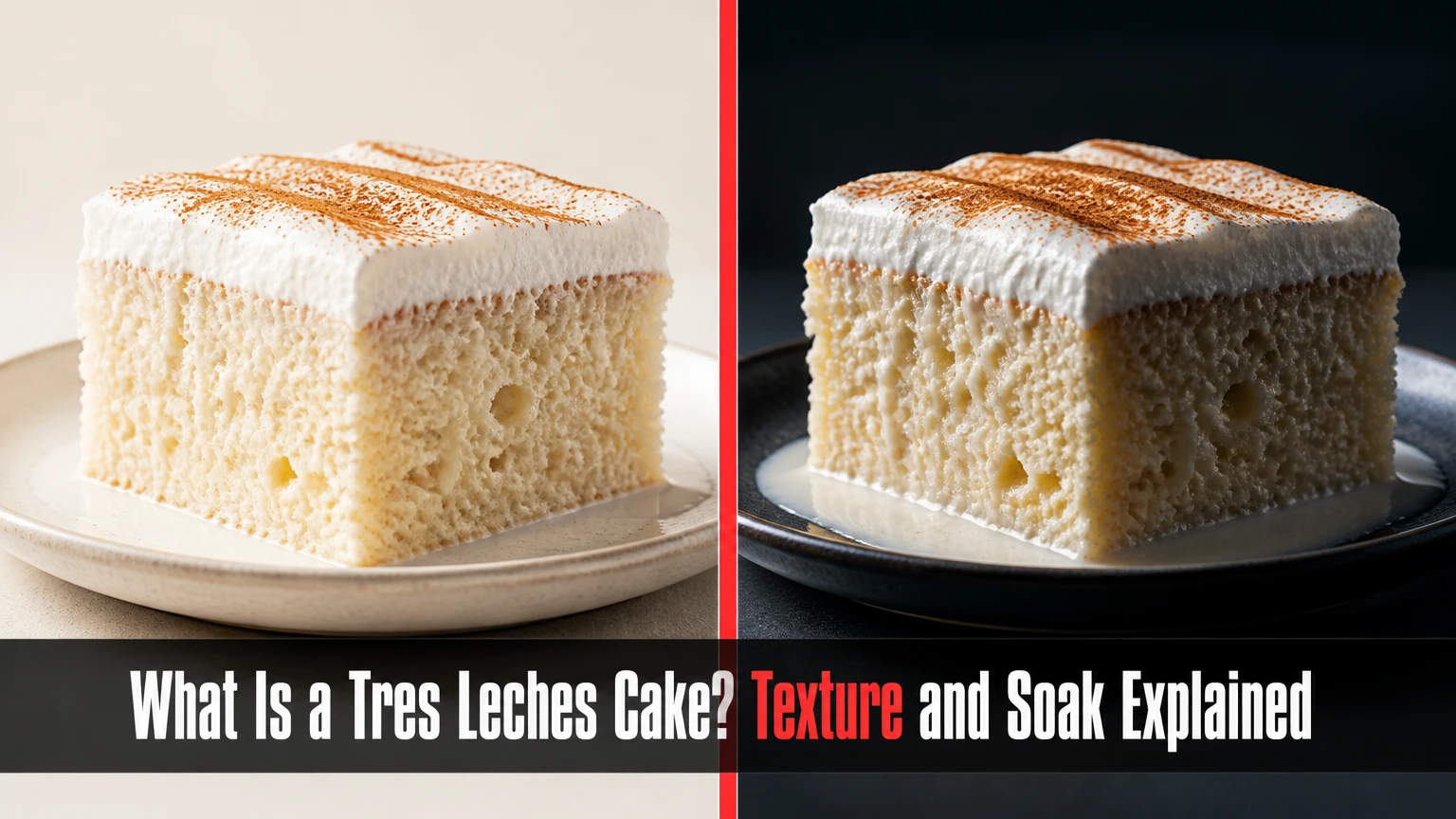
Tres leches cake is a Latin American sponge cake soaked with three kinds of milk, usually evaporated milk, sweetened condensed milk, and heavy cream or whole milk. The cake is chilled until the liquid distributes through its porous crumb, then finished with whipped cream, meringue, cinnamon, or fruit. Its proper texture is moist and tender, not wet or collapsing.
Tres leches cake, defined
Tres leches cake is a baked sponge dessert saturated with a sweet dairy mixture and served cold. The Spanish name means “three milks,” referring to the three milk products used in the soaking liquid, although recipes vary by country, family, and bakery.
The cake usually begins with a fat-light sponge called bizcocho. Bakers beat eggs with sugar to create volume, fold in flour, and bake the mixture until the crumb sets around thousands of air cells. After baking, they pierce the surface and pour the milk mixture over the cake in stages.
Whipped cream provides the most common topping because its mild dairy flavor balances the concentrated sweetness below. Mexican cinnamon, strawberries, mango, toasted coconut, and meringue are also common finishing choices. A properly chilled slice may release a small amount of milk on the plate without being structurally broken.
Where did tres leches cake originate?
Tres leches cake has a disputed national origin, with Mexico, Nicaragua, and other parts of Central America frequently associated with its development. The modern cake became widely recognizable across Latin America during the twentieth century, especially as canned milk products became easier to distribute.
Nestlé’s La Lechera condensed milk labels and regional recipe publications helped spread versions of the dessert, but a branded recipe campaign does not prove a single national inventor. Food historians generally treat tres leches as a shared Latin American tradition rather than a dish with an uncontested birthplace.
| Identity attribute | Typical value | Practical meaning |
|---|---|---|
| Spanish name | Tres leches | “Three milks” |
| Primary cake style | Fat-light sponge | Absorbs liquid without a greasy crumb |
| Soak volume | 2.5-3.5 cups for a 9-by-13-inch cake | Produces a fully saturated center |
| Serving temperature | 35-40°F | Keeps the crumb firm and topping stable |
| Common topping | Whipped cream | Adds lightness and reduces perceived sweetness |
| Typical serving size | 2-by-3-inch piece | Yields about 15-20 portions |
What are the three milks?
The three milks are typically evaporated milk, sweetened condensed milk, and heavy cream or whole milk. Evaporated milk contributes concentrated dairy flavor, condensed milk supplies sweetness and viscosity, and cream or whole milk loosens the mixture so it can penetrate the sponge.
The phrase “three milks” describes the recipe category, not a legally fixed formula. Some cooks replace cream with whole milk, while others use coconut milk, regular milk, or a smaller amount of cream. The finished cake remains recognizable when the soak preserves three distinct dairy or milk-like components.
| Milk component | Typical amount | Primary function | Flavor contribution |
|---|---|---|---|
| Evaporated milk | 12 fluid ounces | Adds concentrated liquid dairy | Cooked milk and mild caramel notes |
| Sweetened condensed milk | 14 fluid ounces | Adds sugar, body, and viscosity | Dense caramel sweetness |
| Heavy cream | 0.5-1 cup | Thins the soak and increases richness | Fresh cream flavor |
| Whole milk alternative | 0.75-1 cup | Produces a lighter soak | Clean, mild dairy flavor |
| Coconut milk alternative | 0.75-1 cup | Adds tropical fat and aroma | Coconut and toasted-nut notes |
What does tres leches cake taste like?
Tres leches cake tastes sweet, milky, vanilla-rich, and lightly caramelized, with a soft custard-like crumb beneath an airy topping. The sponge itself is usually mild because its job is to carry the soak rather than compete with the dairy mixture.
Cold serving temperature suppresses some sweetness and firms the texture. Cinnamon adds aromatic warmth, strawberries add acidity, and coffee or cocoa can make the dessert taste less purely dairy-forward. A condensed-milk-heavy formula tastes considerably sweeter than one diluted with whole milk.
Why does tres leches cake not become soggy?
Tres leches cake avoids collapse when a porous, fat-light sponge absorbs a controlled amount of liquid and receives enough chilling time. Whipped eggs create a network of air cells, while the baked flour-and-egg structure provides walls that hold the absorbed milk.
Capillary action helps distribute the soak through small channels in the crumb. However, capillary action does not make an unsuitable cake base absorb unlimited liquid. A butter cake, underbaked sponge, or cake with tightly compressed crumbs can retain liquid at the bottom and turn pasty.
The most important structural detail is added fat. Oil and butter tenderize ordinary cakes, but excess fat can coat flour and weaken the crumb’s ability to take in a large liquid volume. Chiffon cake can work because its aerated egg structure remains open, although it often absorbs more slowly than a traditional fatless sponge.
How the soak moves through the crumb
- Egg proteins create volume. Whipped egg whites or whole eggs trap air before baking.
- Heat sets the framework. Flour starches gelatinize and egg proteins coagulate around those air cells.
- Pierced channels open the surface. Fork or skewer holes connect the top to the lower crumb.
- Liquid travels through narrow spaces. Surface tension and capillary forces pull the soak inward.
- Chilling stabilizes the result. Refrigeration firms the crumb and slows separation.
A useful practitioner rule is to use holes approximately 0.5 inch apart and reach nearly to the pan base. Wider spacing leaves dry zones; extremely aggressive stabbing can shred a delicate sponge and create a wet lower layer.
How do you make tres leches cake?
Making tres leches cake takes approximately 20-30 minutes of active work, 25-35 minutes of baking, and at least 4 hours of chilling. A 9-by-13-inch cake is easiest to manage because the shallow profile distributes the soak more evenly than a tall layer cake.
Before you start
| Requirement | Typical specification | Why it matters |
|---|---|---|
| Baking pan | 9-by-13-inch metal pan | Holds 15-20 portions and 2.5-3.5 cups of soak |
| Oven | 350°F | Sets the sponge without excessive browning |
| Active preparation | 20-30 minutes | Includes mixing and pouring |
| Baking time | 25-35 minutes | Depends on pan material and batter depth |
| Minimum chill | 4 hours | Allows initial distribution |
| Preferred chill | 12-24 hours | Produces the most even texture |
| Tools | Mixer, whisk, skewer, measuring cups | Supports aeration and uniform soaking |
Step 1: Bake an airy sponge
Prepare a sponge using eggs, sugar, flour, baking powder, vanilla, and salt. Separate the eggs when the recipe calls for maximum volume, whip the whites to firm peaks, and fold them gently into the yolk-and-flour mixture.
Bake at 350°F until the center springs back and a tester emerges with a few moist crumbs. A typical 9-by-13-inch sponge takes 25-35 minutes. Do not remove the cake solely because its edges are brown, since an underbaked center can collapse under the milk.
Success checkpoint: The center should spring back after light pressure.
Common mistake: Deflating the batter by stirring vigorously after adding whipped whites.
Step 2: Cool the cake briefly
Let the sponge cool in its pan for 10-15 minutes. The cake should feel warm or nearly room temperature, not steaming hot and not refrigerator-cold.
A warm crumb accepts liquid readily, but a piping-hot cake can soften excessively and damage the structure. If the cake has cooled completely, it can still work; use gradual pouring and allow extra time for absorption.
Success checkpoint: The pan is safe to handle, and the surface remains firm.
Common mistake: Pouring the soak over a cake that is still releasing visible steam.
Step 3: Pierce the entire surface
Use a fork, bamboo skewer, or narrow toothpick to make holes approximately 0.5 inch apart. Reach close to the bottom without scraping repeatedly across the pan.
Concentrate on the corners and edges, which otherwise remain drier than the center. A cake with 100-150 evenly distributed holes in a 9-by-13-inch pan usually absorbs more uniformly than one with a few deep punctures.
Success checkpoint: A skewer reaches the lower crumb across the whole surface.
Common mistake: Piercing only the center because the edges appear less porous.
Step 4: Mix and pour the milk soak
Whisk together 12 ounces of evaporated milk, 14 ounces of sweetened condensed milk, and 0.5-1 cup of heavy cream or whole milk. Add vanilla if desired, then pour the mixture slowly over the cake in three or four passes.
Pause for 1-2 minutes between passes when liquid begins pooling on the surface. That pause lets the first layer enter the crumb instead of forcing the full volume toward the bottom. Pouring around the perimeter prevents a dry border.
Success checkpoint: Most liquid disappears from the surface within 5-10 minutes.
Common mistake: Dumping the entire mixture into one central pool.
Step 5: Chill before topping
Cover the pan and refrigerate the soaked cake for at least 4 hours. Twelve hours produces a more even texture, while 24 hours often gives the cleanest slices because the crumb and dairy have fully stabilized.
Keep the refrigerator at 40°F or below. Tres leches cake contains perishable dairy and should not remain at room temperature for more than 2 hours, or 1 hour when the surrounding temperature exceeds 90°F.
Success checkpoint: A chilled knife cuts through the cake without the crumb sliding apart.
Common mistake: Adding whipped cream before the soak has finished distributing.
Step 6: Add the topping and garnish
Whip 1-2 cups of cold heavy cream with 2-3 tablespoons of powdered sugar, then spread it over the fully chilled cake. Add cinnamon, sliced strawberries, mango, or toasted coconut immediately before serving.
Meringue can replace whipped cream, but it changes the dessert’s texture and requires careful egg-white handling. For transport, stabilized whipped cream made with gelatin or cream cheese holds longer than plain whipped cream.
Success checkpoint: The topping stays level when the pan is gently moved.
Common mistake: Applying a soft topping to a warm or liquid-slick surface.
Which tres leches variations are worth choosing?
Traditional tres leches uses a vanilla sponge and dairy soak, while cuatro leches adds caramelized milk and flavored versions introduce coffee, cocoa, citrus, or coconut. The best variation depends on whether the priority is a clean milk flavor, deeper sweetness, or a stronger contrasting aroma.
| Variation | Added ingredient | Typical flavor | Structural consideration |
|---|---|---|---|
| Traditional | Vanilla and cinnamon | Sweet milk and light caramel | Most predictable absorption |
| Cuatro leches | 0.5-1 cup dulce de leche | Caramel and brown sugar | Higher viscosity and sweetness |
| Cinco leches | 0.75 cup coconut milk | Coconut and tropical dairy | Extra fat can slow absorption |
| Chocolate | 0.25-0.5 cup cocoa powder | Cocoa and condensed milk | Cocoa can make the sponge slightly drier |
| Coffee | 0.25-0.5 cup strong coffee | Roasted, bitter contrast | Extra liquid requires soak adjustment |
| Fruit | 1-2 cups berries or mango | Acidic, fresh, and sweet | Fruit moisture shortens storage time |
What is the difference between tres leches and cuatro leches?
Tres leches contains three milk components, whereas cuatro leches adds a fourth milk-based ingredient, most often dulce de leche. Cuatro leches cake is thicker, more caramel-forward, and usually sweeter because dulce de leche contributes both concentrated milk solids and sugar.
A baker can whisk dulce de leche into the soak or spread it between the sponge and topping. The spread method creates a defined caramel layer, while the mixed method distributes the flavor more evenly but increases the liquid’s viscosity.
How does tres leches compare with other soaked cakes?
Tres leches differs from ordinary sponge cake, chiffon cake, and bread pudding because the finished dessert remains cake-like while carrying a high volume of dairy soak. The base determines whether the result feels airy, creamy, dense, or mushy.
| Dessert or base | Added fat level | Liquid treatment | Finished texture | Best use |
|---|---|---|---|---|
| Fatless sponge | 0-5% of flour weight | 2.5-3.5 cups dairy soak | Airy and custard-soft | Traditional tres leches |
| Chiffon cake | 20-35% oil by flour weight | 2-3 cups soak | Soft and slightly elastic | Flavored variations |
| Butter cake | 40-60% butter by flour weight | 1-2 cups recommended | Rich but collapse-prone | Small soak adaptations |
| Angel food cake | 0% added fat | 1.5-2.5 cups light soak | Very airy and fragile | Low-fat presentation |
| Bread pudding | 5-20% fat | 3-5 cups custard | Dense and spoonable | Rustic baked dessert |
Is box cake suitable for tres leches?
Box cake can produce an acceptable shortcut version, but many standard mixes are too tender or chemically aerated to carry the full traditional soak. Use a white or sponge-style mix, bake it slightly drier than usual, and begin with 2-2.5 cups of liquid rather than the full 3.5-cup amount.
A scratch sponge gives better control over egg volume and crumb strength. Box cake is useful for a weekday dessert, but it is a poor choice when the goal is a clean slice after overnight soaking.
How long does tres leches cake last?
Tres leches cake lasts 3-5 days in a refrigerator held at 40°F or below, although the topping and fresh fruit usually decline before the soaked sponge does. The cake is generally at its best after 12-24 hours, when the liquid has distributed throughout the crumb.
Keep the cake covered to prevent it from absorbing refrigerator odors. Add fresh fruit close to serving because cut berries release water and can make the topping runny.
| Storage situation | Temperature | Typical limit | Quality result |
|---|---|---|---|
| Covered refrigerator storage | 40°F or below | 3-5 days | Best texture through day 2 |
| Room-temperature serving | 68-75°F | 2 hours maximum | Safe only for brief service |
| Hot outdoor service | Above 90°F | 1 hour maximum | Dairy risk rises quickly |
| Frozen sponge before soaking | 0°F | 1-2 months | Good make-ahead option |
| Frozen fully assembled cake | 0°F | 2-3 weeks | Topping may separate after thawing |
Freezing the unsoaked sponge is more reliable than freezing the finished cake. Thaw the sponge in its wrapping, prepare the soak afterward, and refrigerate the assembled dessert overnight.
How much does tres leches cake cost?
A typical 9-by-13-inch tres leches cake costs approximately $25-$45 from a bakery in the United States, while an individual café slice commonly costs $4-$8. Homemade ingredient costs often fall near $12-$25, excluding labor, decoration, and specialty fruit.
Prices vary with location, bakery reputation, portion size, and toppings. Fresh berries, pistachios, branded dairy products, and custom decoration can raise the retail price substantially.
| Purchase format | Typical quantity | Typical United States price | Serving capacity |
|---|---|---|---|
| Homemade basic cake | 9-by-13 inches | $12-$25 ingredients | 15-20 pieces |
| Bakery sheet cake | 9-by-13 inches | $25-$45 | 15-20 pieces |
| Café slice | 1 piece | $4-$8 | 1 serving |
| Decorated celebration cake | 10-inch round | $45-$90 | 12-16 pieces |
| Mini individual cake | 4-inch round | $6-$12 | 1-2 servings |
What are the most common tres leches problems?
The most common tres leches failures come from an unsuitable cake base, incomplete perforation, excessive soak volume, or insufficient refrigeration. Each problem has a recognizable symptom, and most can be prevented before the milk mixture is poured.
| Problem | Likely cause | Corrective action | Prevention |
|---|---|---|---|
| Mushy lower layer | Butter cake or excess liquid | Drain excess liquid and chill uncovered 30 minutes | Use fat-light sponge |
| Dry edges | Holes miss the perimeter | Add small holes and brush edges with soak | Pierce at 0.5-inch spacing |
| Milk pool remains | Holes are shallow or too few | Rest 15 minutes, then pour slowly again | Reach nearly to the base |
| Cake collapses | Underbaked center or weak crumb | Refrigerate and serve in the pan | Bake until center springs back |
| Topping slides | Warm or wet surface | Remove pooled liquid and rechill | Top after 4-12 hours |
| Cake tastes harshly sweet | Too much condensed milk | Add unsweetened cream to the next batch | Measure the 14-ounce can accurately |
Can you make tres leches cake with less sweetness?
You can reduce perceived sweetness by replacing part of the cream with whole milk, adding unsweetened coffee or cocoa, and using a thinner topping. Reducing condensed milk by more than one-quarter changes the soak’s viscosity and may leave the cake less cohesive.
A practical adjustment is to use 10-11 ounces of condensed milk with 12 ounces of evaporated milk and 1 cup of whole milk. The result remains sweet but tastes less concentrated than the standard formula.
Can tres leches cake be made without heavy cream?
Tres leches cake can be made without heavy cream by using whole milk, half-and-half, coconut milk, or evaporated milk as the third component. Whole milk creates a lighter soak, while coconut milk adds noticeable aroma and additional fat.
Avoid replacing all liquid with low-fat milk if a rich traditional texture is the goal. The cake will still absorb properly, but the mouthfeel becomes thinner and the topping carries more of the dessert’s richness.
How should you serve and transport tres leches cake?
Serve tres leches cake cold, directly from a refrigerated pan, with a sharp knife wiped clean between cuts. Transport the covered cake in an insulated carrier with frozen gel packs, and keep the pan level so the soak does not migrate to one corner.
For a buffet, cut portions before guests arrive and return unused pieces to refrigeration within 2 hours. A rimmed pan is safer than a flat platter because it contains residual milk. Transporting a tall, fully decorated layer cake is possible, but a shallow sheet cake is more stable.
FAQ
Is tres leches cake supposed to be wet?
Tres leches cake is supposed to be saturated, but the crumb should remain coherent when lifted with a fork. A small amount of milk on the plate is normal; liquid that pours from the slice or produces a paste-like lower layer indicates excess soak, weak structure, or insufficient baking.
Does tres leches cake need refrigeration?
Tres leches cake needs refrigeration because its soak and topping contain perishable dairy. Store the covered cake at 40°F or below, limit room-temperature service to 2 hours, and return leftovers to the refrigerator promptly.
Can tres leches cake sit overnight?
Tres leches cake can sit overnight in the refrigerator, and 12-24 hours is often the preferred soaking period. The cake should never sit overnight at room temperature because the milk mixture can support rapid bacterial growth.
Why is my tres leches cake dry?
A dry tres leches cake usually has too few holes, an under-measured soak, unusually dense crumb, or inadequate resting time. Pierce the entire surface, pour gradually, and refrigerate for at least 4 hours before deciding that the cake has failed.
Can tres leches cake be made ahead?
Tres leches cake can be made one day ahead, which often improves flavor distribution and slicing. Bake the sponge on the first day, soak and chill it overnight, then add whipped cream and fruit shortly before serving.
What is the best topping for tres leches cake?
Whipped cream is the best all-purpose topping because its mild flavor and airy texture balance the sweet, dense soak. Meringue creates a lighter, more structured finish, while fruit adds acidity that is useful when the milk mixture tastes especially rich.
The Bottom Line
What is a tres leches cake? It is a chilled Latin American sponge cake saturated with evaporated milk, sweetened condensed milk, and cream or whole milk, then finished with a light topping. Its defining technique is structural: an aerated, fat-light crumb accepts a large liquid volume while remaining sliceable. For the most reliable result, bake a firm sponge, pierce it thoroughly, pour the soak gradually, and chill the cake for 12-24 hours before decorating.
