

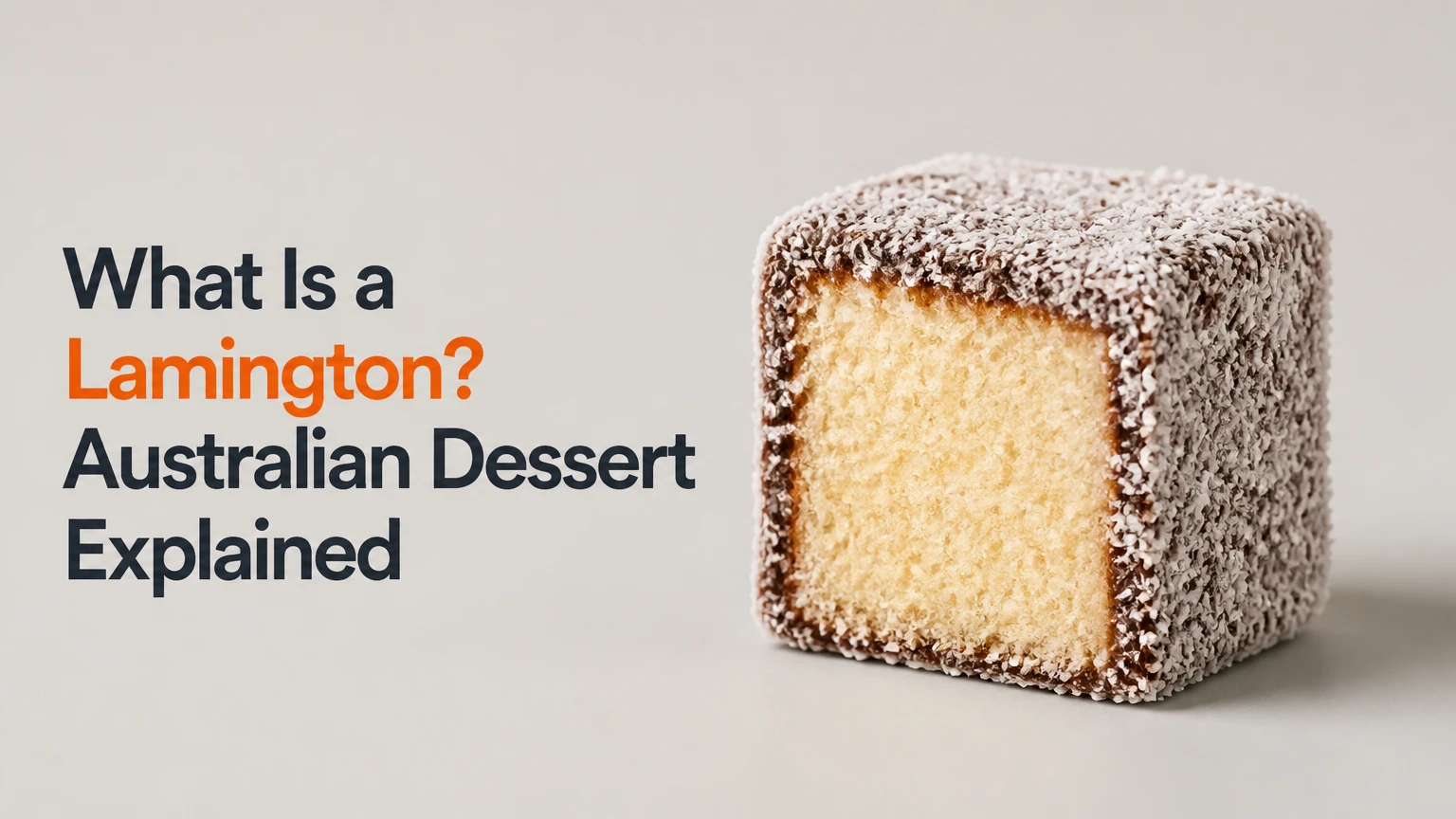
A lamington is a square of sponge or butter cake coated in chocolate icing and rolled in finely shredded desiccated coconut. The Australian dessert usually has a tender, slightly dry crumb that absorbs icing around the outside while retaining a distinct cake center, although jam-and-cream filled versions are also widely sold.
Key Facts About Lamingtons
- A traditional lamington contains cake, chocolate icing, and desiccated coconut.
- Lamingtons are associated with Queensland and named after Lord Lamington, who governed Queensland from 1896 to 1901.
- Day-old or briefly frozen cake is easier to coat because a firmer crumb sheds fewer pieces.
- A typical lamington is a 4-7 cm square, with 5 cm a common practical size.
- Plain lamingtons usually keep for 3-4 days in an airtight container at room temperature.
- Filled lamingtons containing cream require refrigeration and have a shorter useful life.
What Is a Lamington?
A lamington is a small Australian cake cube with three defining layers: a sponge or butter-cake center, a chocolate coating, and a coconut exterior. The coating is usually a thin icing made from cocoa, icing sugar, butter, and hot water or milk, rather than a hard chocolate shell.
The cake may be vanilla-flavored, but the word “lamington” describes the construction more than a single legally fixed recipe. Bakeries use yellow sponge, white sponge, butter cake, and occasionally a denser commercial cake that withstands dipping better.
| Component | Typical specification | Function |
|---|---|---|
| Cake base | 4-7 cm square, 2-5 cm high | Provides the crumb and structure |
| Chocolate icing | Warm, pourable, cocoa-based | Moistens and flavors the outer crumb |
| Coconut | Fine, unsweetened desiccated coconut | Adds texture and covers the icing |
| Filling | Raspberry jam, whipped cream, or both | Adds moisture, sweetness, and richness |
A good lamington is neither a dry cake cube nor a fully soaked petit four. The chocolate mixture should penetrate the outer few millimeters while the center remains recognizably cake. That contrast explains why the dessert remains popular at school fundraisers, bakery counters, afternoon teas, and Australia Day gatherings.
How Does a Lamington Get Its Texture?
A lamington gets its characteristic texture from controlled absorption: firm cake takes up a limited amount of warm icing, while dry coconut adheres before the coating runs off. The process creates a moist exterior, a soft but stable center, and a slightly fibrous outside.
Freshly baked cake contains more internal steam and has a weaker crumb than cooled cake. Resting the sponge overnight allows moisture to redistribute and the structure to firm. Brief freezing produces a similar handling advantage, although freezing does not “stale” the cake in exactly the same way.
Chocolate icing temperature also matters. Cold icing becomes thick and drags across the surface, while very hot icing can soften butter cake and make the coconut slide. A workable coating should flow from a spoon in a continuous ribbon and cover the cake without requiring vigorous rubbing.
The coconut is applied immediately. Its dry particles grip the wet icing, absorb surface moisture, and create the familiar rough finish. Fine desiccated coconut gives the most even coating; long coconut shreds produce a more open, chewy exterior.
Which Cake Base Works Best?
A firm vanilla sponge is the most traditional choice, while butter cake is the safer option for beginners and commercial production. Sponge gives a lighter bite and absorbs more icing, whereas butter cake offers greater resistance to cracking during handling.
| Cake base | Typical crumb | Coating behavior | Best use |
|---|---|---|---|
| Genoise-style sponge | Light, elastic, open | Absorbs icing quickly | Traditional homemade lamingtons |
| Butter cake | Dense, tender, stable | Holds shape during dipping | Beginners and café batches |
| Pound-style cake | Very dense, rich | Takes less icing, stays firm | Transport and retail display |
| Commercial slab cake | Variable, often tight | Predictable in large batches | Fundraisers and high-volume service |
A delicate sponge can be excellent when cut cold and handled with forks. It is a poor choice if the cake must be dipped while warm, transported far, or filled with a heavy layer of cream.
Who Invented the Lamington?
The lamington is named after Lord Lamington, Queensland’s governor from 1896 to 1901, but the dessert’s exact inventor and first preparation remain disputed. The commonly repeated story credits French-born chef Armand Galland, who worked at Government House in Brisbane, with coating leftover cake in chocolate and coconut.
That account is plausible, yet it is not settled historical fact. Other versions say the dessert was created for an unexpected group of visitors or devised to protect cake from heat and insects. A 2006 National Trust Queensland heritage listing helped preserve the Government House association, while food historians continue to distinguish documented evidence from later culinary folklore.
The naming link is stronger than the accident story. Lamingtons appeared in Australian newspapers and cookbooks in the early twentieth century, and the name became attached to the chocolate-and-coconut format. New Zealand also claims an early connection, particularly through a similar dessert called a “Wellington,” but Australia remains the country most closely associated with the lamington.
The National Museum of Australia describes the lamington as “one of Australia’s most famous cakes.” That cultural status is well established even though the kitchen-origin narrative is not.
| Historical point | Common account | Confidence |
|---|---|---|
| Namesake | Lord Lamington, Queensland governor, 1896-1901 | High |
| Queensland association | Government House in Brisbane | Strong association |
| Proposed chef | Armand Galland | Frequently reported |
| Accident narrative | Leftover cake coated for visitors | Unproven folklore |
| Early documentation | Australian newspaper and cookbook references | Established generally |
How Are Lamingtons Prepared?
Lamingtons are prepared in a two-day workflow: bake and cool the cake on the first day, then cut, coat, and set the squares on the second. Active work usually takes 45-75 minutes, while overnight resting improves structural reliability.
Before You Start
| Requirement | Typical amount or range | Practical specification |
|---|---|---|
| Cake | 1 slab, about 20 x 30 cm | Produces roughly 20-30 squares |
| Icing | 500-700 g | Enough for 20-30 medium pieces |
| Coconut | 250-400 g | Use a wide shallow tray |
| Resting time | 8-12 hours | Room temperature, wrapped |
| Tools | 2 forks, rack, knife, bowls | Keep wet and dry stations separate |
Step 1: Bake and Cool the Cake
Bake a vanilla sponge or butter cake in a lined rectangular pan until the center springs back lightly and a skewer emerges with only a few crumbs. Cool the slab completely before cutting; warm cake bends, sheds crumbs, and absorbs icing too aggressively.
You will know the cake is ready when the surface feels dry and the center no longer radiates heat. A typical 20 x 30 cm slab takes 25-35 minutes at approximately 175°C, depending on the recipe and pan depth.
Step 2: Rest or Freeze the Cake
Wrap the cooled cake and leave it overnight, or freeze the uncut slab for about 1-2 hours. Resting firms the crumb without making the cake brittle, while short freezing makes clean portioning easier.
Do not dip freshly baked cake. The most common beginner error is confusing softness with freshness value. Lamington coating requires a cake that can absorb surface icing without collapsing.
Step 3: Cut Uniform Squares
Trim the edges if necessary and cut the slab into 4-7 cm squares. A 5 cm cube is a useful middle size because it provides enough surface area for coating while remaining easy to lift with two forks.
Brush away loose crumbs before dipping. Excess crumbs quickly contaminate the icing and produce a rough, patchy finish.
Step 4: Make a Warm, Pourable Icing
Combine cocoa, icing sugar, melted butter, and hot liquid until smooth. Keep the bowl over warm water during coating, but do not allow steam or boiling water to enter the icing.
The mixture should be fluid enough to coat a square in approximately 2-3 seconds. If it thickens, add hot liquid by the teaspoon. If it becomes too thin, add sifted icing sugar and stir until the ribboning consistency returns.
Step 5: Dip and Drain Each Square
Lower one cake square into the icing with two forks, turn it once, and lift it above the bowl for several seconds. Avoid squeezing the cake or repeatedly rolling it through the mixture.
A successful piece has a continuous chocolate film with no exposed corners and no pool of icing at its base. If the cake immediately fractures, return the remaining squares to the freezer for 20-30 minutes.
Step 6: Coat With Coconut and Set
Transfer the wet square to the coconut tray and toss dry coconut over every side. Place the coated piece on a wire rack for 1-2 hours, until the exterior feels set rather than sticky.
Use one hand or one pair of tongs for icing and a clean hand for coconut. This simple separation prevents wet fingers from forming clumps in the coconut tray.
Which Lamington Variations Matter?
Traditional chocolate lamingtons remain the reference style, while filled, pink, and modern flavored versions change the balance between crumb, moisture, and sweetness. A variation is still recognizably a lamington when it retains the square cake format and external coating.
| Variation | Cake and coating | Filling or flavor | Main trade-off |
|---|---|---|---|
| Traditional | Vanilla sponge, cocoa icing, fine coconut | No filling | Clean handling and longest storage |
| Jam and cream | Sponge, chocolate icing, coconut | Raspberry jam and whipped cream | Richer taste, shorter shelf life |
| Pink lamington | Sponge, raspberry or pink coating | Optional jam | Brighter flavor and appearance |
| Gourmet | Sponge or butter cake, flavored icing | Passionfruit, caramel, or citrus curd | More complexity, higher cost |
| Coconut-free style | Sponge, chocolate icing, toasted crumbs | Optional fruit filling | Different texture and less traditional identity |
Filled lamingtons are usually split after coating or assembled from two cake layers before the final finish, depending on the bakery method. Cream should be added close to serving because it softens the crumb and makes transport more difficult.
A raspberry or pink lamington may use a pink icing, raspberry jelly-style coating, or a simple berry-flavored glaze. Naming varies between bakeries, so appearance alone does not establish a single standard.
How Does the Australian Style Compare With New Zealand Versions?
Australian lamingtons are usually recognized by chocolate icing and coconut, while New Zealand versions may use similar cake shapes and regional names. The distinction is cultural and customary rather than a universally enforced ingredient standard.
| Feature | Australian convention | New Zealand comparison | Practical implication |
|---|---|---|---|
| Common name | Lamington | Lamington or Wellington in some accounts | Names overlap historically |
| Exterior | Chocolate icing and coconut | Chocolate or berry-style coatings | Bakery recipes vary |
| Cake | Sponge or butter cake | Sponge-based squares are common | Texture depends on formula |
| Filling | Jam and cream increasingly common | Jam-based versions occur | Filled styles need refrigeration |
| Cultural association | Queensland and Australian fundraising | New Zealand tea-table baking | Both countries claim related traditions |
A buyer seeking the classic Australian style should look for a square sponge covered in cocoa icing and fine coconut. A berry coating or cream center signals a variation rather than a defect.
How Should Lamingtons Be Stored?
Plain lamingtons generally keep for 3-4 days in an airtight container at cool room temperature, while cream-filled pieces should be refrigerated and eaten within roughly 24-48 hours for best texture. Storage time depends on humidity, filling, icing moisture, and the cleanliness of handling.
Keep plain pieces in a single layer when possible. Stacking them can damage the coconut shell and transfer icing to neighboring pieces. Refrigeration is safe for plain lamingtons, but cold air can firm the crumb and dull its aroma.
| Lamington type | Storage location | Typical useful life | Main risk |
|---|---|---|---|
| Plain sponge | Airtight container, 18-22°C | 3-4 days | Drying at exposed edges |
| Plain butter cake | Airtight container, 18-22°C | 3-5 days | Icing becoming sticky |
| Jam-filled | Refrigerator, 1-5°C | 2-3 days | Moisture migration |
| Cream-filled | Refrigerator, 1-5°C | 24-48 hours | Food safety and sogginess |
| Uncoated cake | Freezer, wrapped | Up to 3 months | Freezer odor and drying |
Freeze plain, unfilled lamingtons in a sealed container with baking paper between layers. Thaw them while covered so condensation forms on the container rather than directly on the coconut surface.
Can Lamingtons Be Frozen?
Plain lamingtons freeze successfully for up to three months when wrapped tightly, while cream-filled lamingtons are poor freezing candidates because whipped cream can separate and the cake can become wet after thawing. Freeze the cake before filling whenever a make-ahead schedule matters.
For an event, bake and coat the plain pieces several days ahead, freeze them, thaw them covered overnight, and add fresh cream and jam shortly before service. This approach preserves the exterior while avoiding the soggy texture of a fully assembled frozen dessert.
What Causes Lamington Problems?
Lamington problems usually arise from a mismatch between cake firmness, icing viscosity, and handling speed. The most reliable correction is to change one variable at a time, beginning with cake temperature and icing consistency.
| Problem | Likely cause | Corrective action |
|---|---|---|
| Cake collapses | Warm or delicate crumb | Chill or freeze pieces before coating |
| Icing tears the surface | Coating too thick or cold | Warm gently and thin gradually |
| Center becomes mushy | Excessive dipping time | Coat for 2-3 seconds, then drain |
| Coconut falls away | Icing cooled or dried | Roll immediately after dipping |
| Bare corners appear | Insufficient turning | Rotate once with two forks |
| Sticky exterior after setting | Humid room or wet icing | Use less liquid and allow airflow |
A “mud bath” effect occurs when thick icing drags across the cake and pulls off crumbs. A bain-marie keeps the mixture workable, but direct heat can scorch cocoa or melt the cake surface.
Patchy coconut usually indicates delay between dipping and rolling. Coconut should contact the icing while the surface is wet. If the tray becomes damp and clumpy, replace part of the coconut rather than trying to sift every wet piece apart.
What Should Dietary and Serving-Conscious Buyers Know?
A standard lamington commonly contains wheat, egg, dairy, sugar, and coconut, while filled versions may contain additional dairy and fruit ingredients. Exact nutrition varies so widely by cake size and icing thickness that a bakery label or recipe calculation is more reliable than a universal calorie number.
A typical 5 cm plain piece weighs approximately 45-80 g, depending on cake density and coating. Filled pieces weigh more and often contain substantially more sugar and fat because of cream, jam, butter, and icing sugar.
| Concern | Common ingredient source | Suitable adjustment |
|---|---|---|
| Wheat | Flour in sponge or butter cake | Use a tested gluten-free cake |
| Egg | Sponge structure | Use a validated egg-free formula |
| Dairy | Butter, milk, whipped cream | Use plant-based fat and liquid |
| Coconut | Desiccated coconut | Use toasted crumbs or finely chopped nuts |
| Added sugar | Icing, jam, cake batter | Reduce filling and use thinner coating |
A coconut-free substitute changes the dessert’s identity and mouthfeel. Toasted biscuit crumbs, finely chopped nuts, or cocoa-dusted crumbs can provide an exterior coating, but the result should be described as a lamington-style cake rather than a conventional lamington.
How Much Do Lamingtons Cost?
Homemade plain lamingtons typically cost about A$0.50-A$0.80 each in ingredient terms when a batch yields 20-30 pieces, while bakery prices commonly range from A$4-A$7.50 per piece. Filled cream versions cost more because refrigeration, labor, and short shelf life increase the selling price.
Prices vary by city, size, packaging, and whether the piece comes from a supermarket, community stall, café, or specialty bakery. A large filled lamington can cost several times more than a small plain fundraising piece.
| Sales context | Typical price per piece | Typical size | Value driver |
|---|---|---|---|
| Homemade ingredients | A$0.50-A$0.80 | 4-5 cm | Bulk pantry ingredients |
| School or community sale | A$2-A$4 | 4-6 cm | Donation and local pricing |
| Supermarket bakery | A$2.50-A$5 | 4-6 cm | Pack size and production scale |
| Café or artisan bakery | A$4-A$7.50 | 5-7 cm | Filling, labor, presentation |
For a large event, plain lamingtons are easier to budget because they tolerate advance preparation and do not require cold display. Cream-filled pieces suit immediate service rather than long table sales.
How Do You Choose a Quality Lamington?
Choose a lamington with a square shape, an intact coconut coating, a moist outer crumb, and a center that still holds its cake structure. A quality piece should not feel wet throughout, leak filling, or leave a thick greasy layer on the fingers.
Look at the cut face when possible. Fine, even pores indicate a stable sponge, while large tunnels can make dipping uneven. The chocolate coating should cover the corners, and the coconut should adhere without large bare patches.
A practical tasting sequence is simple:
- Check structural firmness by lifting the piece from one corner.
- Examine whether the coating reaches every side.
- Bite through the exterior and center separately.
- Assess whether the coconut adds texture without overwhelming the cake.
- For filled styles, check whether jam and cream remain distinct rather than watery.
Lamingtons are poor choices for hot outdoor service when filled with cream. Plain versions travel better, especially in a rigid container with baking paper separating the layers.
FAQ
Is a lamington always made with sponge cake?
No. Sponge cake is traditional and gives a light, absorbent crumb, but butter cake and pound-style cake are also used. Dense cake is easier to dip and transport, while delicate sponge produces a softer contrast between the chocolate-coated edge and the center.
Are lamingtons served cold or at room temperature?
Plain lamingtons are usually best at cool room temperature because the cake feels softer and the chocolate aroma is clearer. Cream-filled lamingtons should remain refrigerated for food safety, then sit out only briefly before serving according to local food-handling guidance.
What does desiccated coconut mean?
Desiccated coconut is coconut meat that has been finely shredded and dried. Lamingtons generally use unsweetened desiccated coconut because the dry flakes adhere quickly to wet icing and provide a more even finish than moist, sweetened shredded coconut.
Why are lamingtons popular in Australia?
Lamingtons became associated with Australian domestic baking, Queensland history, school fundraising, and communal events. Their ingredients are inexpensive, the squares are easy to portion, and plain versions can be prepared ahead, making them practical as well as culturally recognizable.
Can I make lamingtons without a dipping fork?
Yes. Two ordinary forks work well for medium squares. Slide the forks beneath opposite sides, turn the cake once in the icing, drain it over the bowl, and move it immediately into the coconut. Tongs can crush a soft sponge if they grip too tightly.
What is the difference between a lamington and a chocolate coconut cake?
A lamington is an individual square or cube whose cake is coated on the outside with chocolate icing and coconut. A chocolate coconut cake may contain those flavors inside a whole layer cake, but it does not follow the lamington’s characteristic coated-square format.
The Bottom Line
A lamington is an Australian cake square made by coating sponge or butter cake with chocolate icing and desiccated coconut. Its defining skill is moisture control: rested cake absorbs the coating without collapsing, and immediate coconut coverage creates the dry, textured exterior. Plain lamingtons suit advance preparation, while jam-and-cream versions favor immediate refrigerated service.
