

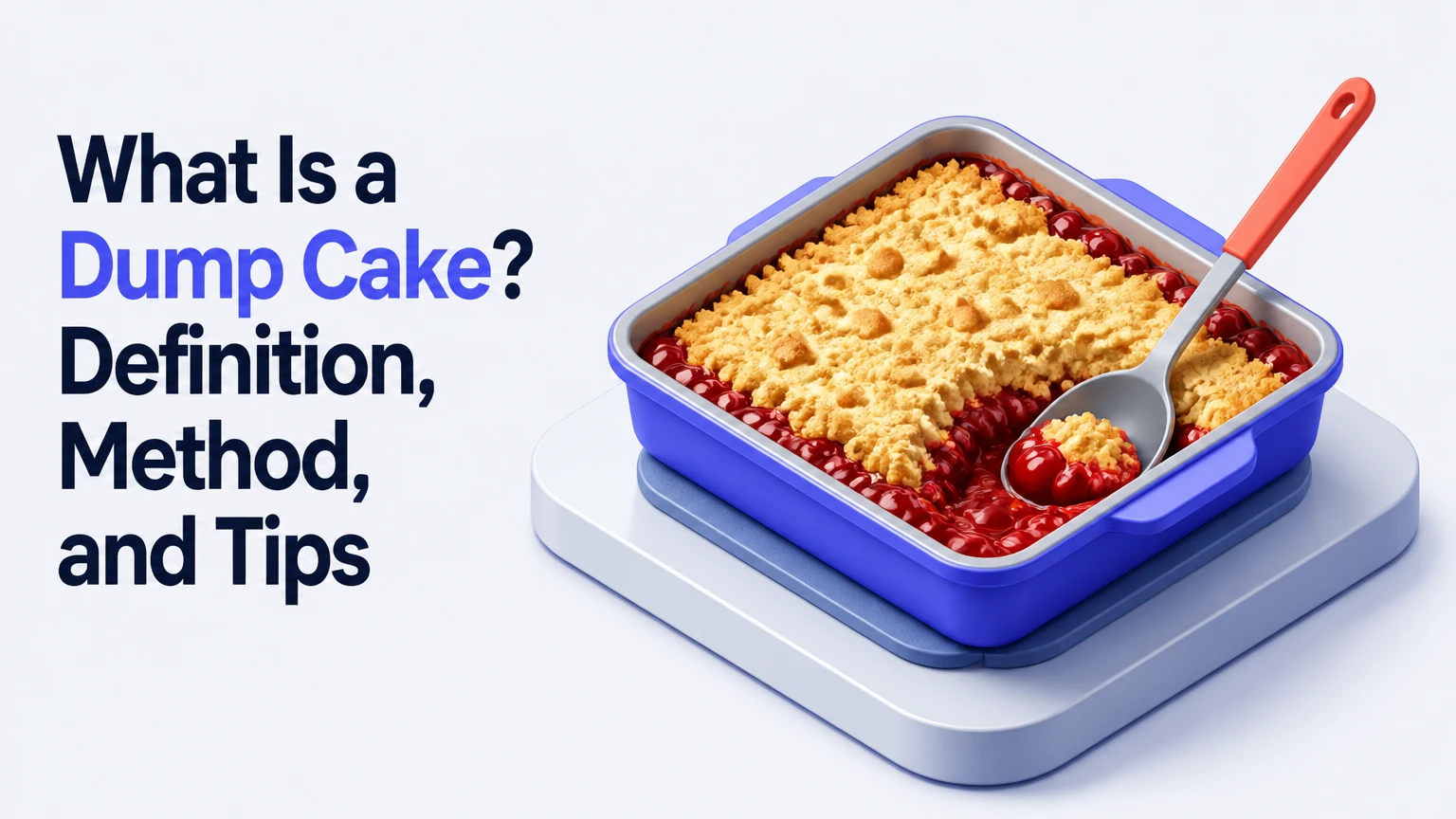
A dump cake is a simple American fruit dessert made by layering a moist fruit or pudding base, dry boxed cake mix, and butter in a baking dish, then baking without preparing a conventional batter. The result combines bubbly cobbler-like fruit with a tender, buttery cake or cookie-style crust.
Key Facts About Dump Cake
- A dump cake uses layered ingredients rather than a mixed cake batter.
- A typical recipe takes 5-10 minutes to assemble and 45-60 minutes to bake.
- The standard format uses a 9 x 13-inch dish, one box of dry cake mix, fruit, and butter.
- Butter and steam must reach most of the dry mix for an evenly baked topping.
- Dump cake is usually softer and more syrupy than traditional layer cake.
- The dessert commonly serves 10-15 people, depending on portion size.
What Is a Dump Cake?
A dump cake is a layered dessert that turns convenient pantry ingredients into a fruit-filled baked dish. The name describes the preparation method: cooks add the components directly to the pan instead of mixing flour, sugar, eggs, and liquid into a separate batter.
Most versions contain three functional layers. The bottom supplies fruit and moisture, the middle or top supplies dry cake mix, and butter supplies the fat needed to brown and bind the topping. Some recipes add pudding, nuts, oats, cream cheese, chocolate pieces, or spices, but the dump-and-bake structure remains the defining feature.
Dump cake is closer to a cobbler than to a conventional frosted cake. The fruit stays soft and syrupy, while the top becomes patchwork-like, with areas that may resemble cake, shortbread, or crisp cookie crust. Scooped portions are informal rather than neatly sliced.
Is a dump cake actually a cake?
A dump cake is a cake-style dessert, but it is not a traditional cake in the technical baking sense. A standard cake forms a uniform batter before baking, while a dump cake relies on dry mix, fruit moisture, butter, and oven heat to create separate but connected textures.
That distinction affects expectations. A dump cake should not have the even crumb, domed shape, or clean layers associated with a butter cake. Its appeal is fast assembly, strong fruit flavor, and a browned topping that can be served with ice cream or whipped cream.
How Does Dump Cake Work?
Dump cake works when moisture from the fruit and fat from the butter hydrate and bake the dry cake mix. Heat converts the fruit liquid into steam, melts the butter through the powder, and allows the mix’s starches, sugars, and leaveners to form a browned topping.
The process is forgiving, but it is not random. A wet fruit base must supply enough liquid, the dry mix must form a reasonably even layer, and the butter must cover the powder thoroughly. If one area receives little liquid or fat, that section can remain pale and floury after the surrounding crust is finished.
Cake mix contains more than flour. Commercial mixes generally include sugar, starch, leavening agents, flavoring, and sometimes powdered fat or milk ingredients. Because the mix already contains these components, the recipe does not need the eggs, milk, oil, or beating used in a conventional cake.
The baking chemistry in plain language
The fruit layer heats first and releases liquid. Butter melts at approximately 90-95°F, then moves into gaps in the dry mix as the pan temperature rises. Moisture hydrates the powder, starch thickens the filling, and the surface browns through caramelization and Maillard reactions.
The exact texture depends on the ingredients. Pie filling provides a thick, concentrated base; canned fruit in syrup supplies more free liquid; pudding adds a creamy starch-based layer; and fresh fruit varies widely in water content. Treating all fruit choices as interchangeable is a common reason for inconsistent results.
Which layer controls the final texture?
The fruit layer controls moisture and softness, while the butter layer controls browning and the amount of dry mix that becomes crust. Cake mix controls sweetness, flavor, and the tenderness of the topping. A dry mix cannot compensate for a base that contains too little liquid.
| Layer | Typical ingredients | Main function | Common failure |
|---|---|---|---|
| Bottom | 20-24 ounces pie filling | Supplies fruit, sugar, and thickened moisture | Overly thick or undersized base |
| Bottom | 15-ounce canned fruit with juice | Provides fruit pieces and steam | Dry topping if liquid is drained |
| Top | 15.25-ounce dry cake mix | Supplies flour, sugar, starch, and leavening | Powdery patches |
| Top | 8-12 tablespoons butter | Adds fat, browning, and moisture transfer | Pale or floury areas |
How Do You Make a Basic Dump Cake?
A basic dump cake requires four layers of action: prepare the pan, add the moist base, cover it with dry cake mix, distribute butter, and bake. Assembly usually takes 5-10 minutes, and success depends more on even coverage than on stirring.
Before You Start
| Item | Typical specification | Why it matters |
|---|---|---|
| Baking dish | 9 x 13 inches, 2-inch depth | Holds about 12 servings without overflow |
| Oven | 350°F, conventional setting | Browns the topping while the filling bubbles |
| Fruit base | 2 cans pie filling, about 42 ounces total | Supplies a consistent moisture level |
| Cake mix | 1 standard box, about 15.25 ounces | Creates the dry crust layer |
| Butter | 8 tablespoons, 1 stick, 113 grams | Covers much of the mix surface |
| Assembly time | 5-10 minutes | Requires no electric mixer |
| Bake time | 45-60 minutes | Varies with pan material and filling depth |
Step 1: Prepare the baking dish
Heat the oven to 350°F. Lightly grease a 9 x 13-inch glass or metal baking dish, using approximately 1 teaspoon of butter or neutral cooking spray.
A greased dish makes serving easier and reduces the amount of crust left behind. Place the dish on a rimmed baking sheet if the fruit base is especially liquid, because bubbling syrup can spill during baking.
Success checkpoint: The oven reaches temperature before the assembled dessert enters it.
Common mistake: Using a smaller dish without adding time. A deeper layer can leave the center wet while the top browns.
Step 2: Add the moist base
Spread two 21-ounce cans of fruit pie filling, or an equivalent fruit mixture, across the bottom. Keep the layer level and leave the ingredients unstirred unless the recipe specifically combines two components.
Cherry and apple pie fillings provide the most predictable starting point because their liquid is already thickened. If using canned peaches or pineapple, include the liquid specified by the recipe rather than draining automatically.
Success checkpoint: The base reaches all four corners in a layer about 1/2-3/4 inch deep.
Common mistake: Using dry fruit without adding enough liquid. The topping needs steam as well as butter.
Step 3: Spread the dry cake mix
Sprinkle one 15.25-ounce box of dry cake mix evenly over the fruit. Use a fork, spoon, or clean spatula to level the powder, but do not stir it into the fruit.
The dry mix should cover the base from edge to edge. Uneven piles create thick sections that need more moisture, while bare sections expose fruit and produce irregular browning.
Success checkpoint: No large areas of fruit remain visible through the powder.
Common mistake: Pressing the powder into a compact layer. A light, even layer allows liquid and steam to move upward.
Step 4: Distribute the butter
Cut 8 tablespoons of cold butter into thin slices and arrange them across the entire surface. Melted butter can also work, but it must be poured slowly in a grid pattern so the liquid reaches as much powder as possible.
Butter slices are often easier for beginners because they reveal uncovered areas. Aim for near-continuous coverage rather than relying on one thick pat in the center.
Success checkpoint: The surface has butter from corner to corner, with no broad dry zones.
Common mistake: Concentrating butter in the middle, where it melts first and leaves the edges powdery.
Step 5: Bake and cool
Bake for 45-60 minutes, until the top is golden and the fruit bubbles visibly around the edges and, ideally, in several areas near the center. Cool for 15-20 minutes before serving.
The cooling interval allows thickened fruit juices to settle. Cutting or scooping immediately produces a looser portion and can make a properly baked dessert appear underdone.
Success checkpoint: The topping feels set at the surface, while the fruit remains soft beneath it.
Common mistake: Extending the bake indefinitely to remove all softness. The fruit filling should remain syrupy, not dry.
Which Ingredients Make the Best Dump Cake?
The best ingredients are those that balance moisture, sweetness, and coverage. Thick pie filling is the easiest base, while canned fruit works when its juice or syrup is retained and the cake mix receives enough butter.
Fruit and filling choices
| Base choice | Typical quantity | Best cake mix pairing | Expected texture |
|---|---|---|---|
| Cherry pie filling | 2 cans, 21 ounces each | Yellow or white | Thick, tart-sweet, spoonable |
| Apple pie filling | 2 cans, 21 ounces each | Spice or yellow | Soft apple pieces with cinnamon notes |
| Peach slices in syrup | 2 cans, 15 ounces each | Yellow or white | Juicier, cobbler-like filling |
| Crushed pineapple in juice | 20 ounces | Yellow | Wet, fibrous, tropical fruit layer |
| Blueberry pie filling | 2 cans, 21 ounces each | Lemon or white | Dark, jammy filling |
| Pumpkin puree mixture | 15 ounces puree plus liquid | Yellow or spice | Custard-like, dense bottom |
A classic cherry-pineapple version uses 20 ounces of crushed pineapple with its juice and one 21-ounce can of cherry pie filling. Apple versions pair well with chopped pecans, but nuts add a separate allergen and should be labeled when serving guests.
Fresh fruit is possible, although it needs more testing than canned filling. Berries release liquid quickly, while apples may remain firm and release less moisture. A practical starting point is 5-6 cups of chopped or sliced fruit combined with 1/2 cup of sugar and 2 tablespoons of cornstarch, but the result depends on the fruit’s water content.
Cake mix choices
| Cake mix | Fruit pairing | Added flavor | Typical result |
|---|---|---|---|
| Yellow | Cherry, peach, pineapple | Vanilla and butter | Familiar cobbler-style crust |
| White | Blueberry, peach, pear | Mild and clean | Lets fruit dominate |
| Spice | Apple, pumpkin, pear | Cinnamon and warm spices | Denser, more aromatic topping |
| Chocolate | Cherry, raspberry, banana | Cocoa and caramel notes | Brownie-like, rich crust |
| Lemon | Blueberry, raspberry, lemon curd | Citrus acidity | Brighter, sharper dessert |
What Are the Main Dump Cake Variations?
The main variations differ in their moist base, cake-mix flavor, and finishing ingredients. Cherry-pineapple, apple spice, peach, pumpkin, lemon-blueberry, and chocolate versions cover most common pantry combinations.
| Variation | Moist base | Dry topping | Typical bake profile |
|---|---|---|---|
| Cherry-pineapple | 20 ounces pineapple plus 21 ounces cherry filling | Yellow mix and 8 tablespoons butter | 350°F for 50-60 minutes |
| Apple spice | 42 ounces apple pie filling | Spice mix and optional pecans | 350°F for 45-55 minutes |
| Peach cobbler | 30 ounces peaches with syrup | Yellow mix and butter | 350°F for 50-60 minutes |
| Lemon blueberry | 42 ounces blueberry filling | Lemon mix and butter | 350°F for 45-55 minutes |
| Chocolate cherry | 21 ounces cherry filling | Chocolate mix and butter | 350°F for 45-55 minutes |
| Pumpkin spice | Pumpkin, evaporated milk, eggs, and sugar | Yellow or spice mix | 350°F for 55-65 minutes |
Pumpkin versions are structurally different from simple canned-fruit cakes because the pumpkin base often contains eggs and dairy. The center should set like a soft custard, so a longer cooling period of 30 minutes improves portioning.
Chocolate versions can appear moist even when fully baked. Judge them by a set, browned top and bubbling fruit rather than by expecting a dry toothpick, since the filling will keep the interior soft.
Dump Cake vs. Cobbler vs. Crisp: What Is the Difference?
Dump cake uses dry cake mix and butter, cobbler uses biscuit dough or batter, and crisp uses a crumb topping commonly made with oats, flour, sugar, and butter. The three desserts share fruit filling but differ in preparation, topping texture, and control over sweetness.
| Feature | Dump cake | Traditional cobbler | Fruit crisp |
|---|---|---|---|
| Topping ingredients | Dry cake mix and butter | Biscuit dough or cake batter | Oats, flour, sugar, butter |
| Mixing required | Usually none | Usually required | Required |
| Assembly time | 5-10 minutes | 20-35 minutes | 20-30 minutes |
| Top texture | Soft, buttery, irregular | Biscuit, cakey, or tender | Crumbly and textured |
| Sweetness control | Limited by packaged mix | High in scratch recipes | High in scratch recipes |
| Best use case | Fast potluck dessert | Fresh-baked traditional topping | Oat-forward, less cake-like dessert |
A dump cake is the best choice when speed, low cleanup, and predictable pantry ingredients matter most. A scratch cobbler is better when you want a deliberate biscuit or batter topping, while a crisp gives more control over oats, sugar, nuts, and spice.
How Much Time and Money Does a Dump Cake Need?
A typical dump cake costs approximately $6-$12, takes 5-10 minutes to assemble, and requires 45-60 minutes in a 350°F oven. Costs vary by fruit brand, butter price, optional toppings, and whether the recipe uses one or two cans of filling.
| Planning factor | Typical range | Main variable |
|---|---|---|
| Ingredient cost | $6-$12 | Brand and fruit quantity |
| Assembly | 5-10 minutes | Slicing butter and leveling mix |
| Oven time | 45-60 minutes | Dish material and filling depth |
| Cooling | 15-30 minutes | Fruit thickness and serving style |
| Yield | 10-15 portions | Portion size |
| Cost per portion | $0.40-$1.20 | Ingredients and yield |
The figures are typical household estimates, not fixed retail prices. A version made with store-brand mix and canned pie filling usually costs less than one using premium fruit, fresh berries, nuts, and dairy toppings.
Why Is Dump Cake Dry, Runny, or Uneven?
Dump cake becomes dry when butter or fruit moisture fails to reach part of the cake mix, and it becomes runny when the fruit layer contains excess liquid or the dessert is served too soon. Uneven heat, an overfilled pan, and a compacted powder layer can produce both problems at once.
Dry or powdery patches
The leading cause is incomplete butter coverage. Thin butter slices distributed across the surface usually work better than a few thick pieces, and melted butter must be poured slowly rather than dumped in one location.
If dry spots appear late in baking, add small butter pieces to the affected areas and continue baking for 5-10 minutes. This recovery is imperfect, because late-added butter cannot always hydrate a thick, already-set layer.
A watery filling
Use the fruit liquid specified by the recipe. Draining all juice from canned fruit can produce a dry topping, but retaining every drop from a very liquid can create a soupy base.
Cooling is part of the recipe. Wait at least 15-20 minutes, then assess the consistency. If the dessert remains thin after cooling, the next batch needs less free liquid or a thicker pie-filling base.
Burned top with uncooked powder beneath
A dark surface and pale powder below usually indicate excessive top heat or a dish that is too deep. Cover the dessert loosely with foil and continue baking in 10-minute intervals, checking whether the filling is bubbling and the topping is setting.
Glass and dark metal pans can brown differently. The oven temperature may also be inaccurate, so an inexpensive oven thermometer is useful when the same recipe repeatedly burns before the center cooks.
Excessive sweetness
Boxed cake mix and canned pie filling both contain substantial sugar, so combining syrup-packed fruit with a sweet topping can produce a cloying result. Choose fruit packed in juice, use tart berries, add citrus zest, or serve smaller portions with unsweetened whipped cream.
Can Dump Cake Be Adapted for Different Diets?
Dump cake can be adapted for gluten-free, dairy-free, or reduced-sugar diets, but each substitution changes texture and may require a recipe designed for that product. The safest approach is to replace the cake mix with a labeled equivalent and verify every packaged filling.
| Dietary need | Practical substitution | What changes | Check before baking |
|---|---|---|---|
| Gluten-free | Certified gluten-free cake mix | Crust may be more fragile | Label and cross-contact statement |
| Dairy-free | Plant-based baking sticks | Browning and flavor may differ | Fat content and melting behavior |
| Egg-free | Usually unnecessary in fruit versions | Pumpkin formulas may need reformulation | Recipe-specific ingredient list |
| Lower sugar | Unsweetened fruit plus reduced-sugar mix | Filling may be tarter and thinner | Sweetener and moisture balance |
| Nut-free | Omit pecans and use seed-free toppings | Less crunch | Shared-equipment allergen risk |
Do not assume a dairy-free spread behaves like butter. Some spreads contain more water and less fat, which can leave the topping soft or patchy. A tested baking stick with a firm fat structure is usually more reliable than a soft tub spread.
Can You Use a Slow Cooker or Air Fryer?
A slow cooker can make dump cake when the ingredients fit below the recommended fill line, while an air fryer works best for a small batch in a shallow heatproof dish. Neither appliance produces exactly the same crust as a 9 x 13-inch oven-baked version.
| Appliance | Practical batch size | Typical setting | Typical time | Main limitation |
|---|---|---|---|---|
| Conventional oven | 9 x 13 inches | 350°F | 45-60 minutes | Requires preheating |
| Slow cooker | 4-6 quarts | High | 2-3 hours | Soft, less browned top |
| Air fryer | 6-8 inch dish | 320-350°F | 25-40 minutes | Small capacity and top browning |
| Toaster oven | 8 x 8 inch dish | 350°F | 35-50 minutes | Edge browning and shallow depth |
For a slow cooker, use a liner or grease the crock, leave the lid closed, and expect condensation to soften the top. An air fryer may need foil during the first part of baking if the surface browns before the fruit heats through.
How Should You Store and Serve Dump Cake?
Store cooled dump cake covered in the refrigerator for up to 3-4 days, following the United States Department of Agriculture’s general guidance for refrigerated leftovers. Reheat individual portions until hot, using a microwave for speed or a 325°F oven for a firmer topping.
Because fruit, butter, and some variations contain perishable ingredients, do not leave the dessert at room temperature for an extended period. The USDA recommends refrigerating perishable leftovers within 2 hours, or within 1 hour when the surrounding temperature exceeds 90°F.
Freeze portions in airtight containers for approximately 2-3 months for best texture. Thaw them in the refrigerator, then reheat uncovered. Freezing softens the crust, so frozen dump cake is practical for convenience but will not match the texture of a freshly baked batch.
Serve dump cake warm after the initial cooling period. Vanilla ice cream, plain yogurt, lightly sweetened whipped cream, toasted seeds, or a spoonful of cold cream can balance the hot fruit and buttery crust.
Expert Rules for More Reliable Results
Experienced dump-cake baking depends on moisture management rather than complicated technique. Three rules prevent most disappointing batches.
- Match the base to the topping. Thick pie filling is the safest choice for a first attempt; watery canned fruit needs its specified juice and a shallow, evenly spread layer.
- Treat butter coverage as a measurable target. If more than roughly 10-15% of the powder remains visibly dry before baking, redistribute the butter instead of trusting the oven to correct the gap.
- Judge the center by set and bubbling, not by a clean toothpick. Fruit filling makes the middle moist by design, so a toothpick test borrowed from layer cakes can falsely suggest underbaking.
- Cool before diagnosing texture. A hot filling is naturally loose, and cutting immediately can lead to unnecessary extra baking that dries the topping.
- Scale the dish, not only the ingredients. Halving the ingredients in an 8 x 8-inch dish usually reduces the depth, but using a small dish for a full recipe creates uneven cooking and overflow risk.
Dump cake is not a precision pastry. It is also not completely technique-free. Even coverage, correct liquid, and adequate cooling matter more than decorative skill.
Frequently Asked Questions
Do you have to stir a dump cake?
No, traditional dump cake does not require stirring the fruit, dry mix, and butter together. Spread the moist base evenly, level the dry cake mix lightly, and distribute butter across the surface. Stirring can move powder into the filling, change the intended layering, and create dense or gummy sections.
Can you make dump cake with fresh fruit?
Yes, fresh fruit can replace canned filling, but it needs added sugar and a thickener because fresh fruit does not provide a standardized syrup. Berries usually release more water than apples, while firm apples may need precooking. Use a tested fresh-fruit formula when possible rather than making a direct one-for-one substitution.
What happens if I use melted butter?
Melted butter can produce a good dump cake if poured evenly over the entire cake-mix layer. Pour it in thin lines or a grid pattern, then inspect the surface for broad dry patches. Sliced cold butter gives more visual control because each slice occupies a defined area as it melts.
Can dump cake be made without butter?
Butter is the most reliable fat, but plant-based baking sticks can replace it in many recipes. Oil is less dependable because it does not distribute through dry powder in the same way and may create a greasy, uneven crust. A recipe developed for oil is a better choice than an untested direct substitution.
Why is my dump cake still powdery after an hour?
Powdery topping usually means the mix did not receive enough butter or fruit steam. Check whether the dish was too deep, the fruit was drained, or butter was concentrated in the center. Add small butter pieces to dry areas, cover loosely if the top is dark, and continue baking in short intervals.
Is dump cake better warm or cold?
Dump cake is usually best warm or slightly cooled, when the fruit is soft and the topping retains some texture. Refrigerated portions are firmer and easier to cut, but the crust becomes less crisp. Reheat uncovered to restore some surface texture, then serve within the recommended storage period.
The Bottom Line
A dump cake is an American layered fruit dessert built from a moist base, dry cake mix, and butter, with no conventional batter mixing. The most dependable method uses a 9 x 13-inch dish, a 350°F oven, even butter coverage, and 15-20 minutes of cooling.
Choose pie filling for predictable results, canned fruit for flexibility, and fresh fruit only when you can control its moisture. Dump cake will not imitate a refined layer cake, but it delivers a fast, low-cleanup cobbler-style dessert with pantry ingredients. That is what makes what is a dump cake a method question as much as a definition question.
