

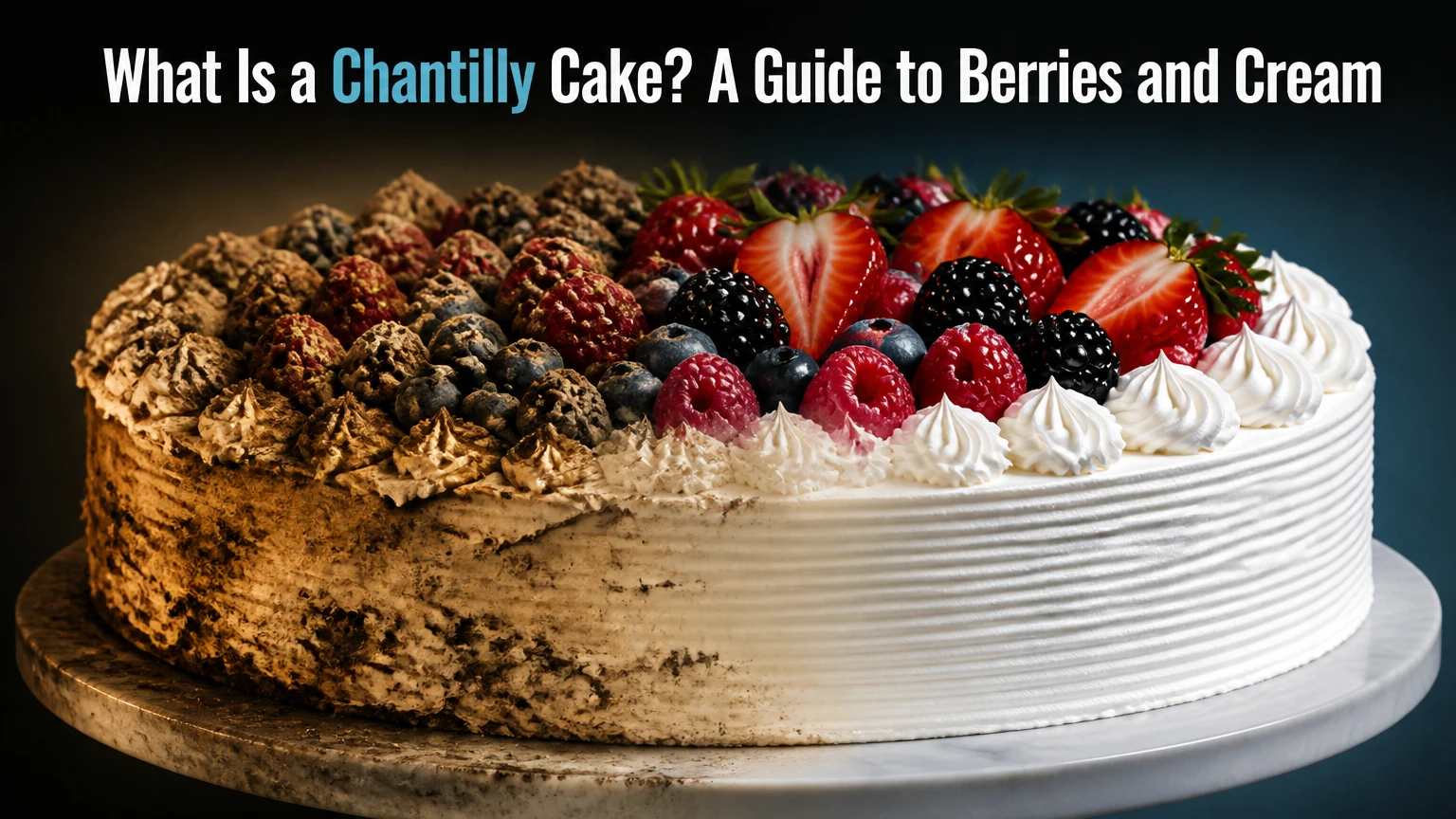
A Chantilly cake is a layered sponge or chiffon cake filled with fresh berries and covered with sweetened whipped cream, often enriched with mascarpone or cream cheese in the popular American version. The cake has a soft, airy crumb, moderate sweetness, creamy richness, and tart fruit that keeps each serving lighter than a buttercream cake.
What Is a Chantilly Cake?
Chantilly cake describes a family of cakes built around Chantilly cream and light cake layers rather than one globally standardized recipe. In American bakeries, the name usually means a vanilla cake with strawberries, blueberries, raspberries, or blackberries and a mascarpone-based whipped frosting.
The term Chantilly cream traditionally refers to sweetened whipped cream flavored with vanilla. Mascarpone, cream cheese, almond extract, and mixed berries are later adaptations that became especially familiar through American bakery versions. A cake labeled Chantilly may therefore differ substantially by country, bakery, or recipe writer.
Whole Foods Market helped make the American berry version widely recognizable, but the supermarket style should not be treated as the only authentic definition. A European pastry chef may use genoise, vanilla whipped cream, and one fruit, while a Hawaiian bakery may use a soft chiffon cake and a richer cream filling.
Key Facts at a Glance
- Chantilly cake is usually a layered sponge or chiffon cake with whipped cream and fruit.
- American berry Chantilly cake commonly contains strawberries, blueberries, raspberries, and blackberries.
- Mascarpone and cream cheese stabilize many modern frostings, but neither is required for every Chantilly cake.
- A finished cake normally requires continuous refrigeration and keeps about 2 days at best quality.
- An 8-inch bakery cake typically serves 10-14 people and often costs approximately $35-$60.
- Chantilly cake tastes lighter and less buttery than a traditional buttercream layer cake.
How Does a Chantilly Cake Work?
A Chantilly cake works because its components balance structure, moisture, fat, sweetness, and acidity. The sponge provides a flexible framework, the cream supplies richness, and berries add water and acid that sharpen the flavor.
Cake Base: Sponge, Chiffon, or Genoise
The base is commonly vanilla chiffon, vanilla sponge, or genoise. Chiffon cake uses vegetable oil, eggs, flour, sugar, and a chemical leavener; whipped egg whites provide lift, while oil keeps the crumb supple after refrigeration.
Genoise relies more heavily on aerated whole eggs and usually contains less added fat. It has a slightly springier, drier crumb, which makes it useful when a baker plans to add syrup. A conventional vanilla layer cake also works, but a dense butter cake can overpower the cream.
| Cake base | Typical fat source | Texture after chilling | Best use |
|---|---|---|---|
| Vanilla chiffon | 45-75 g neutral oil per 120 g flour | Soft and moist | American berry style |
| Genoise | 0-30 g butter per 120 g flour | Springy and absorbent | Syrup-soaked classic style |
| Angel food | 0 g added fat | Very airy and fragile | Low-fat fruit version |
| Butter cake | 100-150 g butter per 120 g flour | Dense and rich | Stable decorative cake |
Why Is Syrup Brushed Onto the Layers?
A light syrup protects sponge cake from drying in the refrigerator. A typical amount is 1-2 tablespoons per 8-inch layer, applied with a brush rather than poured directly onto the crumb.
Too little syrup leaves genoise firm and dry. Too much syrup creates sliding layers, especially when berries release juice. A practical rule is to moisten the cut surface until it feels supple but does not look wet.
What Makes Chantilly Frosting Different?
Chantilly frosting is sweetened whipped cream, usually flavored with vanilla. In modern American recipes, 225 g heavy cream may be whipped with approximately 115-225 g mascarpone, 60-115 g cream cheese, and 60-100 g powdered sugar, depending on the desired firmness and sweetness.
Mascarpone increases fat and body. Cream cheese adds acidity and protein, which help the frosting hold its shape while contributing a mild tang. Gelatin, instant pudding powder, or a small quantity of commercial stabilizer can also support whipped cream, especially for transport.
The main technical risk is over-whipping. Cream passes from soft peaks to firm peaks quickly, then becomes grainy as fat separates from liquid.
Why Do Berries Matter?
Berries cut through dairy richness with acidity, aroma, and varied texture. Strawberries provide volume, blueberries contribute gentle sweetness, and raspberries and blackberries deliver sharper acidity and seeds.
Maceration intensifies fruit flavor but also draws out liquid. For a layered cake, toss 450 g prepared berries with 1-2 tablespoons sugar and rest them for 10-15 minutes, then drain thoroughly before assembly. Unsweetened berries are often safer when the frosting is already sweet.
What Is Inside a Berry Chantilly Cake?
A standard American berry Chantilly cake contains four functional layers: light cake, optional syrup, stabilized whipped cream, and fresh fruit. Each ingredient affects the cake’s stability, so substitutions should preserve the same moisture and structural balance.
| Component | Typical quantity for an 8-inch cake | Function | Main risk |
|---|---|---|---|
| Cake layers | Two 8-inch layers, 4-5 cm each | Supports filling | Collapsing if warm |
| Heavy cream | 450-600 g | Whipped frosting volume | Melting above 24°C |
| Mascarpone | 115-225 g | Fat and structure | Graininess if overmixed |
| Mixed berries | 400-600 g | Acidity and filling | Excess juice |
| Powdered sugar | 75-150 g | Sweetness and body | Overly sweet cream |
| Simple syrup | 30-60 ml total | Moisture retention | Soggy crumb |
A bakery may add almond extract, vanilla bean paste, lemon zest, berry jam, or a thin pastry cream layer. These additions change the flavor and stability, so the finished product may still be called Chantilly even when it differs from the simplest version.
What Does Chantilly Cake Taste Like?
Chantilly cake tastes creamy, vanilla-forward, and fruit-bright, with a soft crumb rather than a dense buttery mouthfeel. The best versions have enough sweetness to support the berries without masking their acidity.
The texture changes across one bite. Soft sponge yields first, whipped cream follows, and berries provide either a juicy burst or a slight seed crunch. Refrigeration firms the cream and cake, so the dessert should sit for approximately 10-15 minutes before serving if the cake is very cold.
Common Flavor Profiles
| Version | Cake flavor | Cream profile | Fruit or garnish | Typical sweetness |
|---|---|---|---|---|
| Mixed berry | Vanilla | Mascarpone and vanilla | Four mixed berries | Medium |
| Strawberry | Vanilla or lemon | Plain Chantilly cream | Sliced strawberries | Medium-high |
| Chocolate | Cocoa or chocolate genoise | Vanilla or cocoa cream | Raspberries | Medium |
| Tropical | Coconut or vanilla | Lime cream | Mango and passion fruit | Medium-high |
| Classic European | Genoise | Vanilla whipped cream | Strawberries | Low-medium |
Which Chantilly Cake Variations Are Common?
The mixed-berry American version is the most recognizable modern style, while classic European interpretations use simpler fruit and cream combinations. Chocolate, tropical, citrus, and single-fruit variations are practical adaptations rather than separate technical categories.
- Berry Chantilly: Vanilla chiffon, mixed berries, and mascarpone whipped cream.
- Strawberry Chantilly: Vanilla sponge, strawberries, and lightly sweetened cream.
- Chocolate Chantilly: Chocolate sponge, cocoa cream, and raspberries or cherries.
- Tropical Chantilly: Coconut or vanilla cake with mango, passion fruit, and lime.
- Classic French-style version: Genoise, vanilla Chantilly cream, and one primary fruit.
The name has no single protected ingredient list. Ask a bakery whether its frosting contains cream cheese, mascarpone, gelatin, or another stabilizer before ordering.
How Do You Make and Assemble a Chantilly Cake?
A home baker can assemble an 8-inch Chantilly cake in about 90-120 minutes of active work, followed by at least 4 hours of chilling. Success depends more on cold ingredients, fully cooled cake, and drained fruit than on advanced decorating skill.
Step 1: Bake and Cool the Cake
Bake two 8-inch sponge or chiffon layers at approximately 175°C, or 350°F, until the center springs back and a tester emerges clean. Cool the layers completely before trimming or filling.
Chiffon layers may cool upside down when the pan design allows it, which reduces shrinkage. Do not frost warm cake. Heat softens the cream and causes the layers to slide.
Step 2: Prepare the Berries
Wash fruit quickly, dry it thoroughly, and remove stems before slicing. Combine 400-600 g berries with up to 2 tablespoons sugar and rest for 10-15 minutes only if the fruit needs sweetening.
Drain the berries in a sieve and blot them gently. The berries should look glossy, not sit in a pool of juice.
Step 3: Whip the Frosting
Chill the bowl, beaters, cream, mascarpone, and cream cheese for 15-20 minutes before mixing. Beat the cheese ingredients with powdered sugar and vanilla until smooth, then add the cold cream gradually and stop at firm peaks.
The frosting should hold a piped ridge without looking curdled. If the mixture becomes grainy, stop mixing immediately and fold in 1-2 tablespoons cold liquid cream.
Step 4: Fill the Layers
Place one cake layer on a board, brush it lightly with 1-2 tablespoons syrup, and pipe a ring of frosting around the edge. Spread cream inside the ring, then add a single even layer of drained berries.
The outer ring prevents fruit from pressing against the cake’s edge. Keep the filling 1-2 cm inside the perimeter to reduce bulging.
Step 5: Finish and Chill
Add the second layer, apply a thin crumb coat, and chill for 20-30 minutes. Cover the cake with the remaining frosting, decorate with berries, and refrigerate for at least 4 hours.
Overnight chilling improves slicing because the cream firms and the syrup distributes through the crumb. Keep the cake covered to reduce moisture loss and absorption of refrigerator odors.
How Much Does Chantilly Cake Cost?
A typical 8-inch Chantilly cake costs approximately $35-$60 from a U.S. bakery, while an individual slice commonly costs $5-$8. Prices increase with imported berries, custom decoration, larger diameters, and delivery.
Ingredient cost for a home-baked 8-inch cake usually falls near $18-$35, with berries and mascarpone creating the largest seasonal variation. A sheet cake often costs less per serving because assembly is faster and decoration is simpler.
| Format | Typical servings | Typical bakery price | Typical refrigerated weight |
|---|---|---|---|
| 6-inch round | 6-8 | $25-$40 | 1.2-1.8 kg |
| 8-inch round | 10-14 | $35-$60 | 2.0-3.0 kg |
| 10-inch round | 16-24 | $55-$90 | 3.2-4.5 kg |
| Quarter sheet | 20-30 | $50-$85 | 3.0-5.0 kg |
| Single slice | 1 | $5-$8 | 150-250 g |
Custom bakery prices vary by region, so these are typical planning ranges rather than fixed market rates.
How Long Does Chantilly Cake Last?
Chantilly cake is best within 24-48 hours because whipped cream gradually loses structure and fresh berries release moisture. Store the covered cake at 4°C, or 40°F, or colder, and return it to refrigeration immediately after serving.
The U.S. Department of Agriculture recommends refrigerating perishable foods within 2 hours, or within 1 hour when the surrounding temperature exceeds 32°C, or 90°F. That rule matters more than the cake’s decoration: a beautiful Chantilly cake is still a dairy-and-fruit perishable.
| Storage situation | Recommended limit | Expected result |
|---|---|---|
| Covered refrigerator at 4°C | 24-48 hours | Best texture and flavor |
| Refrigerator, uncovered | 8-12 hours | Cream absorbs odors and dries |
| Room temperature near 21°C | Up to 2 hours | Serve promptly |
| Outdoor setting above 32°C | Up to 1 hour | High melting and safety risk |
| Freezer, assembled cake | Not recommended | Berries become watery after thawing |
Freezing plain sponge layers is practical for up to 1 month when wrapped tightly. Freeze the cake without berries or whipped cream, thaw it wrapped in the refrigerator, and assemble near serving time.
Chantilly Cake vs. Other Layer Cakes
Chantilly cake is the better choice when the occasion favors fresh fruit, a cool dessert, and moderate sweetness. Buttercream is better for warm transport and elaborate piping, while tres leches is better for a deliberately saturated, custard-like crumb.
| Cake type | Main filling | Refrigeration need | Warm-weather tolerance | Texture |
|---|---|---|---|---|
| Chantilly | Whipped cream and berries | Continuous | 1-2 hours | Airy and juicy |
| American buttercream | Butter and sugar | Optional short term | 4-6 hours | Dense and smooth |
| Cream cheese cake | Cream cheese frosting | Continuous | 1-2 hours | Tangy and dense |
| Tres leches | Three-milk soak | Continuous | 1-2 hours | Saturated and custardy |
| Victoria sponge | Jam and whipped cream | Recommended | 2-3 hours | Light and tender |
Chantilly cake is poorly suited to outdoor weddings, long buffet displays, or vehicles without reliable cooling. A buttercream cake is usually the safer choice when refrigeration cannot be maintained.
What Problems Affect Chantilly Cake?
Most Chantilly cake failures come from excess water, insufficient cooling, or over-whipped dairy. The cake’s delicate structure leaves less room for correction than a dense butter cake.
| Problem | Likely cause | Immediate fix | Prevention |
|---|---|---|---|
| Soggy layers | Wet berries or excess syrup | Remove loose filling and chill | Drain fruit; use 1-2 tbsp syrup |
| Sliding layers | Warm cake or overfilled center | Chill 30 minutes and reset | Use a frosting border |
| Grainy frosting | Over-whipped cream | Fold in 1-2 tbsp cold cream | Stop at firm peaks |
| Runny frosting | Warm dairy or under-whipping | Chill bowl and mixture 15 minutes | Begin with cold ingredients |
| Dry sponge | No syrup or overbaking | Brush lightly with syrup | Check cake before full bake time |
| Dull berries | Oxidation or old fruit | Replace surface garnish | Decorate shortly before serving |
A counterintuitive rule matters here: adding more mascarpone does not always make frosting safer. Excess cheese can produce a heavy, dense filling and can turn grainy when beaten aggressively.
Can a Collapsed Cake Be Saved?
A collapsed Chantilly cake can usually be converted into a chilled trifle if the layers cannot be safely restacked. Cut the cake into cubes, layer it with cream and drained berries in a glass dish, and refrigerate for 2 hours.
If only the frosting has softened, remove the decoration, chill the cake for 30-45 minutes, and apply a fresh cold layer. Do not keep adding powdered sugar to runny cream because the result becomes excessively sweet before it becomes structurally reliable.
How Should You Choose or Serve One?
Choose Chantilly cake for birthdays, brunches, spring celebrations, and indoor events where the cake can remain cold. Choose another style for hot outdoor service, multi-hour transport, or highly detailed fondant decoration.
Ask a bakery four questions before ordering:
- Which cake base does the bakery use, chiffon, genoise, or butter cake?
- Does the frosting contain mascarpone, cream cheese, gelatin, or another stabilizer?
- Which berries are included, and are they fresh or frozen?
- How long can the cake remain refrigerated before pickup and serving?
For clean slices, chill the cake thoroughly and use a thin knife warmed in hot water, then wiped dry between cuts. Cut strawberries into small, even pieces; large pieces create voids that make the layers shift.
Is Chantilly Cake Suitable for Dietary Restrictions?
Chantilly cake is not automatically gluten-free, egg-free, dairy-free, or nut-free. Standard sponge contains wheat and eggs, whipped cream contains dairy, and some bakery recipes add almond extract or almond flour.
A gluten-free version can use a tested gluten-free sponge blend with enough starch and binder to support the filling. An eggless version requires a formulated egg replacer because simply omitting eggs removes most of the cake’s lift. A dairy-free version needs plant-based whipping cream and a compatible cake, but the finished texture varies widely by product.
Always ask about shared equipment when allergies are severe. A bakery’s ingredient list may exclude nuts while its preparation area still handles almond flour.
Frequently Asked Questions
Is Chantilly Cake the Same as Victoria Sponge?
No. Victoria sponge traditionally pairs two butter-rich sponge layers with jam and whipped cream, while Chantilly cake usually combines light sponge, sweetened whipped cream, and fresh berries. The two desserts overlap when strawberries or berry preserves are used, but their names describe different recipe traditions.
Can You Use Frozen Berries in Chantilly Cake?
You can use frozen berries in a cooked compote or thick fruit layer, but thawed frozen berries are risky as a fresh filling. Thawing releases more liquid and produces softer fruit, so drain it completely and use a reduced compote instead of loose berries.
Why Is My Chantilly Cake Too Sweet?
Excess powdered sugar, sweetened berries, and syrup often create the problem together. Reduce frosting sugar by 25-30%, skip maceration for ripe fruit, and use an unsweetened syrup or no syrup when the sponge is already moist.
Can Chantilly Cake Sit Out Overnight?
No. Chantilly cake should not sit out overnight because whipped cream, mascarpone, cream cheese, and fresh berries are perishable. Refrigerate the covered cake at 4°C or colder, and discard it if it has remained warm beyond recommended food-safety limits.
Does Chantilly Cake Need to Be Refrigerated?
Yes. Refrigeration protects both quality and food safety. Keep Chantilly cake covered in the refrigerator until approximately 10-15 minutes before serving, then return leftovers to cold storage promptly.
Which Cake Is Better for a Summer Party?
Chantilly cake is best for a summer party only when the event has dependable refrigeration and indoor service. For an outdoor gathering lasting several hours, a buttercream cake or a sturdy fruit-free sponge is more practical because whipped cream softens rapidly in heat.
The Bottom Line
What is a Chantilly cake? It is a light layered cake centered on sweetened whipped cream, usually paired with fresh berries and a sponge or chiffon base. The popular American version often adds mascarpone or cream cheese for stability, but Chantilly cake has no single universal formula. Choose it for a cool, fruit-forward dessert, keep it refrigerated, drain the berries carefully, and serve it within 24-48 hours for the best texture.
