

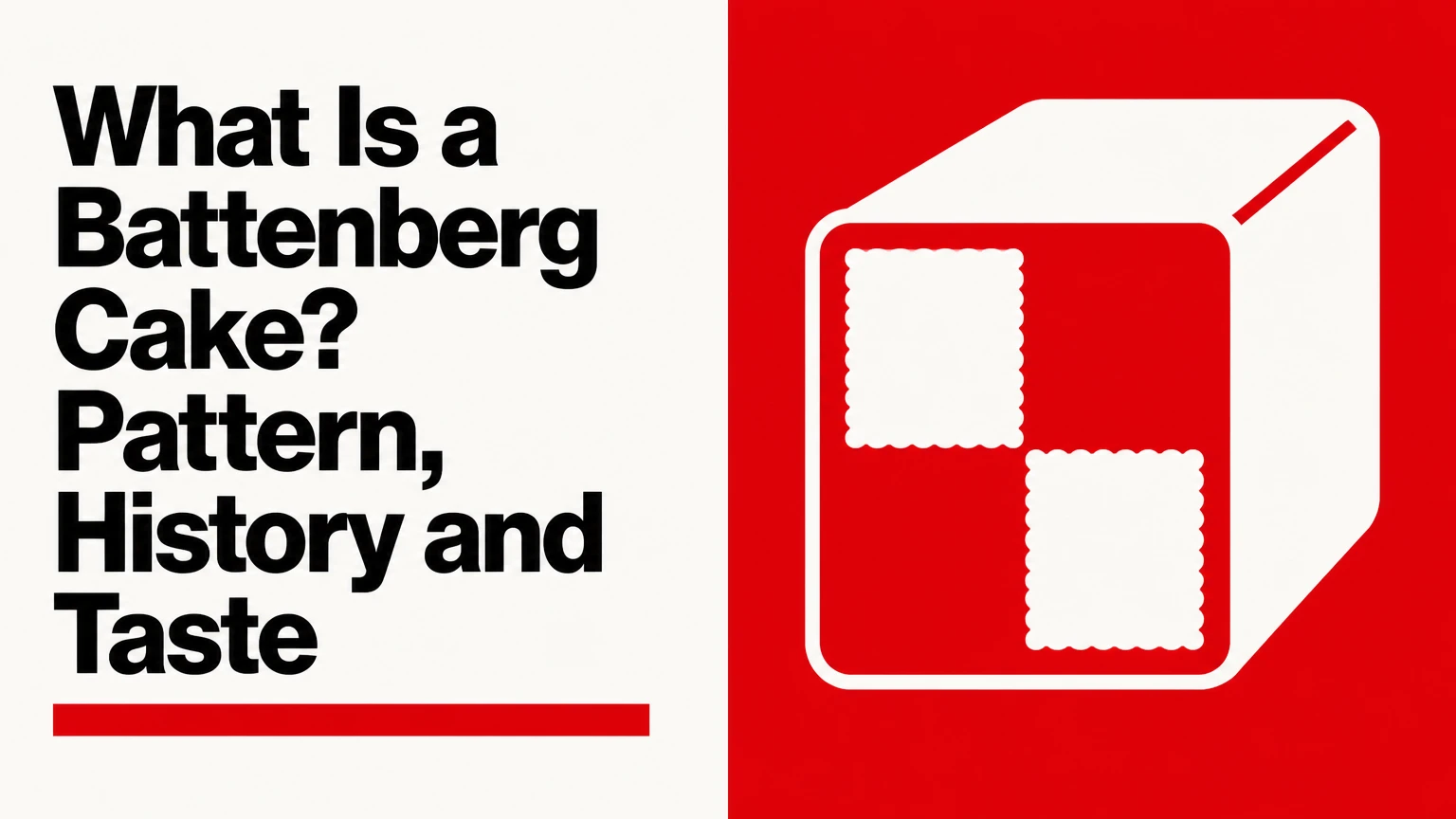
A Battenberg cake is a British rectangular sponge cake assembled from four colored sections in a two-by-two checkerboard pattern, bonded with apricot jam and enclosed in marzipan. The classic version combines pink and yellow almond sponge, producing a firm, sweet slice with a soft crumb, fruity filling, and distinctive almond coating.
Key Facts at a Glance
- A traditional Battenberg cake contains four sponge batons arranged as two pink and two yellow squares.
- Apricot jam bonds the sponge pieces and attaches the marzipan outer covering.
- Marzipan is made mainly from ground almonds and sugar, so classic Battenberg contains tree nuts.
- The cake is usually cut into rectangular slices to display its checkerboard cross-section.
- A homemade cake typically takes 90 minutes to 2 hours, including cooling and assembly.
- The 1884 royal-wedding origin is widely repeated, but the historical evidence does not establish the story beyond dispute.
What Is a Battenberg Cake Made Of?
A classic Battenberg cake is made from almond-flavored sponge, apricot jam, and marzipan. The sponge is baked in two colors, cut into matching strips, joined into a square log, and wrapped in a thin marzipan layer.
The cake needs a sponge that is firm enough to trim accurately without crumbling. Many traditional recipes use a creamed butter method with butter, sugar, eggs, self-raising flour, and ground almonds. Other versions use a genoise-style sponge, but the finished cake still needs enough structural strength to support cutting and wrapping.
The pink color is normally created with concentrated gel coloring rather than a large quantity of liquid dye. The yellow section may remain naturally pale, although some bakers add a small amount of yellow coloring for stronger contrast.
| Component | Typical ingredient | Function in the cake |
|---|---|---|
| Sponge | Butter, sugar, eggs, flour, ground almonds | Provides four firm cake batons |
| Pink coloring | Pink or red gel food coloring | Creates visual contrast |
| Filling | Smooth apricot jam | Bonds batons and seals the exterior |
| Covering | Almond marzipan, about 3-5 mm thick | Encloses and finishes the cake |
Apricot jam is traditional because its tart fruit flavor offsets the sweetness of marzipan. Raspberry, strawberry, or lemon curd can work in variations, but a wetter filling can weaken the structure and stain the sponge.
Why Does Battenberg Have a Checkerboard Pattern?
The checkerboard pattern comes from joining four equal square-section sponge batons in alternating colors. Two batons form the bottom layer, and the remaining two sit above them with the colors reversed, so every slice shows two pink and two yellow squares.
The pattern is structural as well as decorative. Bakers first create two larger sponge slabs, then remove the browned edges and cut each slab into two long strips. Accurate trimming determines whether the final cross-section looks like a clean grid or an uneven collection of rectangles.
A standard commercial-style cake often has a core around 5 cm square, with each baton measuring approximately 2.5 cm square. Those dimensions are typical targets, not a legal or universal definition. Homemade Battenberg cakes may be wider, shorter, or made with more than four pieces.
How the Assembly Holds Together
Apricot jam acts as an edible adhesive between the sponge pieces. A thin, warm layer grips the batons without adding enough moisture to make them slide.
Marzipan supplies compression around the finished log. When rolled and wrapped firmly, it presses the four pieces together while also protecting the sponge from air exposure. Too much jam creates movement; too little leaves gaps that become visible after slicing.
A useful pastry rule is to warm the jam only until spreadable, then sieve it if it contains fruit pieces. Hot, runny jam is less effective than warm, tacky jam because it lubricates the joints rather than bonding them.
Where Did Battenberg Cake Come From?
Battenberg cake is associated with England and the Battenberg family, and the familiar story says it was created in 1884 for the marriage of Princess Victoria, a granddaughter of Queen Victoria, to Prince Louis of Battenberg. Food historians and reference sources commonly repeat that account, although surviving evidence does not prove that a single cake was invented specifically for the wedding.
The name connects the cake with the Battenberg family, later associated with the Mountbatten name in Britain. The cake became strongly linked with British tea culture and commercial baking, especially after packaged versions made the geometric design familiar beyond specialist pastry shops.
The Oxford English Dictionary and historical food writing are useful for tracking the word and the cake’s cultural use, but the exact first recipe and inventor remain uncertain. A responsible description is “a British cake traditionally associated with the 1884 Battenberg marriage,” rather than an absolute claim that the wedding caused its invention.
| Historical point | Common account | More precise interpretation |
|---|---|---|
| Date | 1884 | The date comes from the royal marriage association |
| Namesake | Prince Louis of Battenberg | The family connection explains the name |
| Country | England | The cake became established in British baking |
| First inventor | Often presented as a royal baker | No definitive surviving proof identifies one inventor |
What Does Battenberg Cake Taste Like?
Battenberg cake tastes sweet, buttery, and distinctly almond-like, with apricot jam adding a thin layer of tart fruitiness. Marzipan gives the outer surface a chewy texture and concentrated almond sweetness, while the sponge remains softer and less dense than a traditional fruitcake.
The flavor balance depends heavily on the marzipan. A high-almond marzipan has a deeper, less sugary taste than inexpensive coverings with more sugar and stronger flavoring. Ground almonds in the sponge add richness and help produce the close crumb associated with the cake.
Battenberg is best served in small slices because the combination of sponge, jam, and marzipan is rich. Tea, coffee, and lightly sweetened dairy-based drinks pair more effectively than heavily flavored accompaniments that compete with the almond.
How Is Battenberg Cake Made?
A homemade Battenberg cake usually takes 30 minutes to prepare, 25-30 minutes to bake, and 30-45 minutes to cool, trim, and assemble. The decisive factor is not the coloring or marzipan technique, but producing two evenly baked slabs with straight edges.
Before You Start
| Requirement | Typical specification | Practical target |
|---|---|---|
| Baking tin | Battenberg tin or 20 cm square tin | Two equal compartments |
| Oven | Conventional oven | 180°C, or 160°C fan |
| Baking time | Two sponge sections | 25-30 minutes |
| Ingredient cost | Homemade batch | About £4-£8, typical range |
You will need butter, caster sugar, eggs, self-raising flour, ground almonds, pink gel coloring, apricot jam, and approximately 300-400 g marzipan. A ruler, serrated knife, pastry brush, rolling pin, baking parchment, and cooling rack make the assembly substantially easier.
Step 1: Divide the Baking Tin
Line a Battenberg tin with parchment, or create a central divider in a square tin using folded foil covered with parchment. Press the divider firmly into the base so batter cannot leak underneath.
You will know the divider is working when the two compartments remain separate after the batter is added. A loose divider produces thin edges and unequal slabs.
Step 2: Mix and Color the Batter
Cream equal weights of softened butter and sugar until pale, then add beaten eggs gradually. Fold in self-raising flour and ground almonds, divide the mixture evenly, and tint one portion pink with gel coloring.
A typical batter uses 100-125 g each of butter, sugar, flour, and ground almonds, plus two medium eggs, although recipe quantities vary with tin size. Stop mixing as soon as the flour disappears, because overmixing can produce a tough, peaked sponge.
Step 3: Bake the Sponge
Spread the pink and uncolored batters into their compartments and level the surfaces. Bake at 180°C in a conventional oven, or about 160°C in a fan oven, for 25-30 minutes.
The sponge is ready when the center springs back lightly and a skewer inserted into the middle comes out without wet batter. Cool the cakes completely before cutting. Warm sponge compresses under the knife and creates sloping batons.
Step 4: Trim and Cut the Batons
Remove the browned sides, top crust, and uneven ends with a serrated knife. Measure each slab, then cut it lengthwise into two strips with approximately square cross-sections.
The best checkpoint is four batons with matching height and width. Save the trimmings for trifles, cake pops, or a layered dessert rather than forcing irregular pieces into the final grid.
Step 5: Build the Checkerboard
Place one pink and one yellow baton side by side, brushing a thin layer of warm apricot jam on their contacting sides. Brush the upper surfaces, then place the remaining batons on top in the opposite color order.
Press only gently. Heavy pressure pushes jam out of the joints and distorts the square profile.
Step 6: Wrap the Cake in Marzipan
Roll the marzipan into a rectangle about 3-5 mm thick, using icing sugar or a suitable nonstick surface to prevent adhesion. Brush the marzipan-facing side with a very thin layer of jam, place the sponge log on it, and wrap the covering around the cake.
Seal the underside, trim the ends, and score or crimp the top edge if desired. Chill the finished cake for 20-30 minutes before slicing if the marzipan feels soft.
Which Battenberg Variations Are Worth Trying?
Traditional pink-and-yellow Battenberg remains the clearest expression of the cake because its colors, almond sponge, apricot jam, and marzipan are mutually recognizable. Variations work best when the replacement sponge and filling have similar moisture levels.
| Variation | Sponge pairing | Filling | Main trade-off |
|---|---|---|---|
| Traditional | Almond and almond | Apricot jam | Strongest classic identity |
| Chocolate and vanilla | Cocoa and vanilla | Apricot jam or ganache | Cocoa can make one baton drier |
| Lemon and raspberry | Lemon and vanilla | Raspberry jam | Brighter flavor, softer filling |
| Coffee and walnut | Coffee and walnut | Coffee buttercream | Richer profile, less stable at warmth |
Chocolate versions often use chocolate sponge for one color and vanilla sponge for the other. Ganache gives a strong cocoa flavor but softens more quickly at room temperature than jam.
Lemon and raspberry versions deliver sharper acidity, while pistachio and blackberry versions offer a more modern flavor combination. Those cakes may still use the Battenberg assembly method, but they are variations rather than the traditional form.
How Does Battenberg Compare With Similar Cakes?
Battenberg differs from a Victoria sponge, a Swiss roll, a fondant-covered cake, and a marzipan-covered fruitcake through its four-piece internal construction. The checkerboard cross-section, rather than the almond flavor alone, identifies the cake.
| Cake | Internal structure | Outer finish | Typical texture |
|---|---|---|---|
| Battenberg | Four colored sponge batons | Marzipan | Firm, close crumb |
| Victoria sponge | Two round sponge layers | Cream and jam | Light, tender crumb |
| Swiss roll | One rolled sponge sheet | No required covering | Flexible and soft |
| Fruitcake | One dense baked mass | Marzipan or icing | Heavy and chewy |
A Victoria sponge is generally too delicate for precise Battenberg cutting unless the recipe is modified. A Swiss roll has a rolled spiral rather than a geometric grid. A fruitcake shares marzipan in some versions but has dried fruit and a much denser interior.
Fondant can replace marzipan for decoration, but the result loses the characteristic almond flavor and may become more difficult to slice cleanly. For an authentic Battenberg, marzipan is the meaningful choice.
How Much Does Battenberg Cake Cost and How Long Does It Last?
A homemade Battenberg typically costs £4-£8 in the United Kingdom, depending on the price of marzipan and almonds, while bakery and supermarket prices range widely from about £2 for a packaged small cake to £12 or more for a large artisan version. Storage life depends on ingredients and packaging.
| Measure | Homemade typical range | Commercial typical range |
|---|---|---|
| Preparation and assembly | 60-90 minutes | 0 minutes for the buyer |
| Total elapsed time | 90 minutes-2 hours | Same-day purchase |
| Cost for a small cake | £4-£8 | £2-£12 |
| Best eating period | 2-4 days | Follow package date |
Store Battenberg in an airtight container at cool room temperature, away from direct sunlight and heat. A homemade cake commonly remains acceptable for 5-7 days, although the sponge may dry and the marzipan may harden before that point.
Refrigeration can make marzipan firmer and may introduce condensation when the cake returns to room temperature. If refrigeration is necessary because of a perishable filling, wrap the cake tightly and allow it to sit sealed until the surface temperature rises.
What Allergens Does Battenberg Cake Contain?
Traditional Battenberg contains almonds, eggs, dairy, and wheat, so it is unsuitable for people with almond or other tree-nut allergies unless a professionally formulated alternative is used. Commercial recipes may also include soya, preservatives, or traces from shared production lines.
Marzipan cannot be treated as a nut-free decoration because its defining ingredient is ground almond. A fondant coating can remove the almond covering, but the sponge may still contain ground almonds, and replacing every almond ingredient changes the recipe’s texture.
Gluten-free Battenberg is possible with a tested gluten-free flour blend and careful cross-contamination control. The blend should contain a suitable starch and binder, and the baker should verify that the marzipan, jam, and decorations are also gluten-free.
What Are the Best Alternatives to Marzipan?
Fondant is the easiest visual substitute for marzipan, while modeling chocolate provides a richer finish but can become soft and difficult to cut. Neither replacement reproduces the almond flavor of traditional Battenberg.
| Covering | Almond content | Handling | Flavor result |
|---|---|---|---|
| Marzipan | Usually present | Flexible, slightly sticky | Sweet almond |
| Fondant | Usually absent | Smooth, very sweet | Vanilla-like sugar |
| Modeling chocolate | Usually absent | Firm when cool | Cocoa or white chocolate |
| Thin ganache | Usually absent | Requires chilling | Rich chocolate |
Use fondant when the priority is avoiding nuts or creating a colored finish. Use modeling chocolate when the cake will be served chilled and a less sugary coating is preferred. Use ganache only with a sponge pairing designed for chocolate, because its weight and softness can disrupt a small checkerboard log.
Why Does Battenberg Fall Apart?
Battenberg usually falls apart because the sponge pieces are uneven, the jam layer is too thick or runny, or the cake is assembled before cooling. Structural accuracy matters more than decorative skill.
- Sliding batons: Reduce the jam to a thin film and allow it to become tacky before joining.
- Cracked marzipan: Roll it thicker, keep it cool, and avoid stretching it over sharp corners.
- Rounded corners: Trim the crust and dome with a ruler and serrated knife before assembly.
- Unequal squares: Measure the sponge slabs before cutting rather than relying on visual judgment.
- Bleeding color: Use gel coloring and cool the sponge fully before slicing.
- Dry sponge: Reduce baking time slightly, check oven accuracy, and seal the cake after cooling.
A professional rule of thumb is to treat trimming as part of the recipe, not as cosmetic waste. Removing 5-10 mm from a domed edge can turn a collapsing assembly into a stable square, while keeping every crumb often creates gaps and tilted layers.
How Should Battenberg Cake Be Served and Cut?
Cut Battenberg with a sharp serrated or plain knife after the cake has rested for at least 20 minutes. Use a gentle sawing motion for firm marzipan, wipe the blade between cuts, and make slices about 1-2 cm thick.
Serve the cake at cool room temperature, when the sponge is tender and the marzipan is still firm enough to hold the pattern. Very thin slices show the geometry clearly but can break at the jam joints; thicker slices are easier to handle and better suited to afternoon tea.
For a formal display, place slices upright so the pink-and-yellow grid faces the guest. The cut ends can be brushed with a little jam before serving, but excess moisture will make the edges sticky.
Is Homemade or Store-Bought Battenberg Better?
Homemade Battenberg is usually better for fresh almond flavor and customization, while store-bought Battenberg is better for convenience, consistent dimensions, and low cost. The best choice depends on whether the buyer values craftsmanship or immediate, predictable portioning.
| Decision factor | Homemade cake | Packaged cake |
|---|---|---|
| Typical price | £4-£8 | About £2-£5 for small formats |
| Almond flavor | Adjustable with almond content | Fixed by manufacturer |
| Shape consistency | Depends on trimming skill | Machine-controlled |
| Ingredient control | High | Limited to label information |
| Time required | 90 minutes-2 hours | 5 minutes to open and serve |
Packaged examples often use longer ingredient lists, glucose syrups, vegetable fats, or flavorings to improve shelf stability. That does not automatically make them poor cakes, but the texture is often softer or sweeter than a fresh bakery version.
Homemade Battenberg is not a sensible choice when a large quantity of identical portions is needed quickly. Store-bought cake is not the best option when a guest has a serious allergy, because shared-facility warnings and recipe changes require label checking.
Frequently Asked Questions
Is Battenberg Cake Always Pink and Yellow?
No. Pink and yellow are the traditional colors, but Battenberg cake can use any two contrasting sponge colors arranged in the same four-piece checkerboard structure. Chocolate and vanilla, lemon and raspberry, and pistachio and blackberry are common modern directions, although the flavor and coating may differ from the classic recipe.
Can You Freeze Battenberg Cake?
Yes, Battenberg cake can usually be frozen for about 1-2 months when wrapped tightly in film and placed in a rigid container. Freeze it before slicing if possible, thaw it overnight in the refrigerator, then bring it to room temperature while still wrapped to reduce condensation on the marzipan.
Does Battenberg Cake Need Refrigeration?
Traditional Battenberg does not normally need refrigeration because its sponge, jam, and marzipan are shelf-stable for several days. Refrigerate versions containing fresh cream, custard, or perishable buttercream, but seal them carefully because exposed marzipan can absorb moisture and become sticky.
Why Is It Called Battenberg?
The cake is called Battenberg because it is associated with the Battenberg family, particularly Prince Louis of Battenberg. The popular story links its creation with the 1884 marriage of Prince Louis and Princess Victoria, but the exact origin and first baker are not conclusively documented.
Is Battenberg Cake the Same as Checkerboard Cake?
No. Battenberg cake is a specific British cake made from joined sponge batons, traditionally covered in marzipan and bonded with apricot jam. Checkerboard cake is a broader style that may contain round cake layers, buttercream, or fondant and does not require the Battenberg family of ingredients.
The Bottom Line
A Battenberg cake is a British almond sponge formed from four alternating colored batons, joined with apricot jam, and wrapped in marzipan. Its identity comes from the precise checkerboard cross-section as much as from its flavor. The widely repeated 1884 royal connection explains the name’s cultural history, but the cake’s exact invention remains uncertain. For a reliable homemade result, bake firm equal slabs, cool them fully, trim with a ruler, use a thin layer of tacky jam, and wrap the log in marzipan about 3-5 mm thick.
