

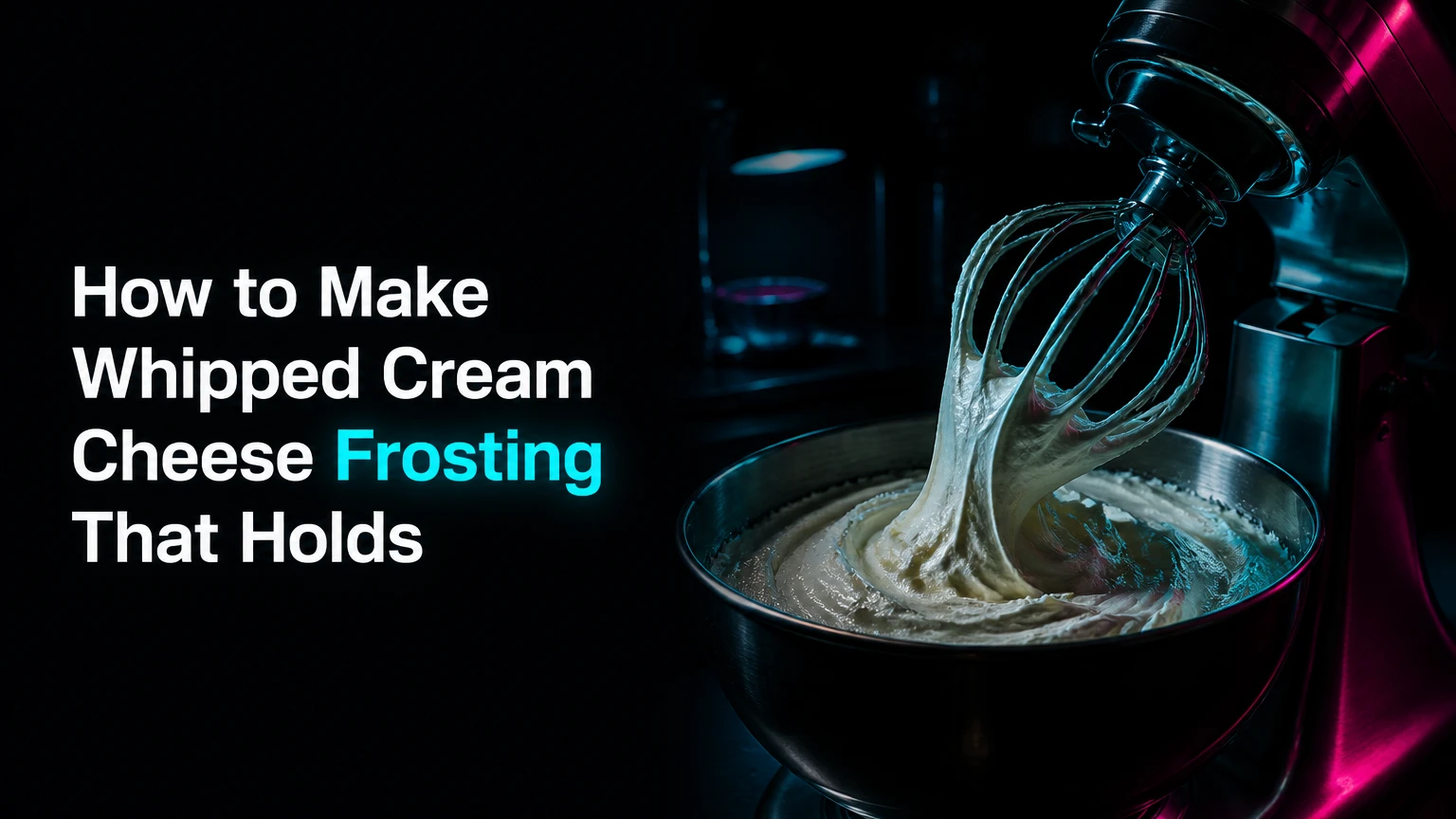
Whipped cream cheese frosting combines full-fat cream cheese, powdered sugar, vanilla, and cold heavy cream into a light, tangy frosting in about 10 minutes. The most reliable method beats the cream cheese smooth first, adds cold cream gradually, then stops at stiff peaks before the foam becomes grainy.
Key Facts at a Glance
Use 226 g full-fat brick cream cheese and 240 ml heavy cream containing at least 36% milk fat.
Chill the bowl and whisk, but soften the cream cheese to about 18°C so the base becomes smooth.
The standard batch uses 120 g powdered sugar and yields about 720-800 ml of frosting.
Whip for roughly 2-3 minutes after adding the cream, checking every 20 seconds near stiff peaks.
Refrigerate finished frosting at 4°C or below and use it within 3 days for best texture.
Whipped cream cheese frosting is lighter than buttercream, but it is less heat-resistant and less suitable for elaborate decorations.
What Is Whipped Cream Cheese Frosting?
Whipped cream cheese frosting is a chilled, aerated frosting made from cream cheese and whipped heavy cream rather than a large quantity of butter. The result is tangy, softly sweet, and mousse-like, with enough structure for cupcakes, sheet cakes, fillings, and simple layer-cake decoration.
Traditional cream cheese frosting usually depends on butter and powdered sugar for body. Whipped cream cheese frosting gets additional volume from air incorporated into cold dairy cream, so it can taste less dense even when the ingredient quantities appear similar.
The texture should be smooth and spreadable immediately after mixing. Properly whipped frosting holds a peak that bends slightly at the tip, while an over-whipped mixture looks dull, grainy, or curdled.
What desserts pair with it?
Carrot cake, red velvet cake, banana cake, spice cake, cinnamon rolls, pumpkin cupcakes, and chocolate cupcakes pair well with the frosting because their stronger flavors balance the dairy tang. The frosting also works between cake layers when each layer is chilled before assembly.
Whipped cream cheese frosting is less suitable for a cake that must sit outdoors for several hours. Heat softens cream cheese and destabilizes whipped cream, even when the original mixture was perfectly made.
Why Does the Frosting Become Light and Airy?
Heavy cream creates the airy structure, while cream cheese provides tang, dairy solids, and a thick base that helps hold the bubbles. Cold cream fat partially solidifies during whipping, allowing fat globules to surround air bubbles and create a stable foam.
Cream cheese contains substantial water, so beating it alone does not create the same stable foam as heavy cream. Powdered sugar contributes sweetness and some body, while the starch in many commercial powdered sugars can modestly reduce moisture migration.
Temperature controls the balance. Cream cheese should be soft enough to become lump-free, but heavy cream, bowl, and whisk should remain cold enough for the cream fat to whip.
A practical rule is to soften cream cheese for 20-30 minutes at room temperature, then return the bowl to the refrigerator if the mixture feels warm. Do not leave dairy ingredients unattended at room temperature.
Ingredients and Equipment
The standard recipe below makes approximately 720-800 ml, depending on how much air the cream retains. That amount typically fills 12 cupcakes generously, spreads over one 20 cm two-layer cake, or fills a 23 x 33 cm sheet cake with a moderate layer.
Standard ingredient formula
| Ingredient | Weight or volume | Required specification |
|---|---|---|
| Full-fat cream cheese | 226 g, 8 oz | Solid brick, about 30-35% fat |
| Heavy whipping cream | 240 ml, 1 cup | Cold, at least 36% milk fat |
| Powdered sugar | 120 g | Sifted, approximately 1 cup |
| Vanilla extract | 5 ml, 1 tsp | Pure or imitation vanilla |
| Fine salt | 1 g, 1/8 tsp | Optional, but improves flavor balance |
Use brick cream cheese, not spreadable tub cream cheese. Tub products often contain more water and added stabilizers, producing a softer base that may remain loose after whipping.
Do not substitute light cream cheese when you need firm piping. Lower-fat cream cheese has less fat available to support the mixture, and the reduced solids can make the frosting slack.
What tools are needed?
A hand mixer works well for a standard batch, while a stand mixer provides more control during longer whipping. Use a paddle attachment to smooth the cream cheese and a whisk attachment to aerate the cream.
| Tool | Recommended specification | Purpose | Preparation |
|---|---|---|---|
| Mixing bowl | 2-3 litre capacity | Holds the full batch | Chill 10-15 minutes |
| Mixer | Hand or stand mixer | Beats and aerates | Use paddle, then whisk |
| Digital scale | 1 g increments | Measures dairy and sugar | Weigh ingredients directly |
| Silicone spatula | Flexible, 25 cm | Scrapes bowl and folds | Keep clean and dry |
| Piping bag | 40-45 cm length | Decorates cupcakes | Fit a 1M or 2D tip |
A digital scale is more reliable than cup measures for cream cheese and powdered sugar because packing changes volume. Sift powdered sugar if it contains visible lumps.
How to Make Whipped Cream Cheese Frosting
The one-bowl method takes about 5 minutes of active mixing after ingredients are ready. Success depends more on temperature and stopping at the correct peak than on a particular mixer brand.
Step 1: Chill the bowl and whisk
Place the mixing bowl and whisk attachment in the refrigerator for 10-15 minutes. Keep the heavy cream refrigerated until the moment you measure it.
The bowl should feel cold, not wet with condensation. A cold metal bowl is especially useful in a kitchen above 24°C.
You will know it worked when: the bowl remains cool after handling for several seconds.
Common mistake: chilling the bowl while leaving the cream on the counter.
Step 2: Smooth the cream cheese base
Add 226 g softened brick cream cheese, 120 g sifted powdered sugar, 5 ml vanilla, and 1 g salt to the bowl. Beat with the paddle on medium speed for about 2 minutes, scraping the sides once.
The base must be completely smooth before cream is added. Any cream cheese lump becomes harder to remove after the mixture is diluted.
You will know it worked when: the mixture looks glossy and no pale cream cheese flecks remain.
Common mistake: using cream cheese directly from the refrigerator, which leaves lumps, or warming it until glossy and loose.
Step 3: Add the cold cream gradually
Switch to the whisk attachment. Set the mixer to low and pour in 240 ml cold heavy cream in a thin stream over approximately 30 seconds.
Adding the cream gradually allows the cream cheese base to absorb it without forming watery pockets. Scrape the bottom and sides of the bowl once if the mixture looks uneven.
You will know it worked when: the mixture is uniformly thick and liquid-free after about 30 seconds.
Common mistake: pouring the cream in all at once and creating a loose mixture that takes longer to aerate.
Step 4: Whip to stiff peaks
Increase the mixer to medium-high and whip for 2-3 minutes. Check the frosting every 20 seconds after the first 90 seconds because peak formation accelerates near the end.
Stop when the whisk leaves clear ridges and a lifted whisk produces a stiff peak that remains upright. The texture should resemble thick shaving cream, not dry cottage cheese.
You will know it worked when: the frosting holds a sharp peak and looks smooth.
Common mistake: walking away from the mixer and whipping past the stable stage.
Step 5: Chill before decorating
Cover the bowl and refrigerate the frosting for 20-30 minutes before piping or spreading it on cake. Use a spatula to stir it gently once after chilling, rather than beating it again at high speed.
Chilling improves handling because the dairy fat firms as its temperature drops. Frost only completely cooled cake layers, or the frosting will soften against the warm surface.
You will know it worked when: a spatula can make a clean groove without the frosting flowing back immediately.
Common mistake: applying frosting to warm cake and blaming the formula for melting.
How Much Frosting Do You Need?
A standard batch covers cupcakes more generously than a layer cake because piping uses more frosting per serving. The following figures are typical estimates for a moderate coat, not tall bakery-style decoration.
| Dessert format | Standard batch coverage | Typical frosting amount | Assembly condition |
|---|---|---|---|
| 12 cupcakes | 12 tall swirls | 45-60 ml each | Cupcakes completely cool |
| 24 cupcakes | 24 low swirls | 25-35 ml each | Use a 1M tip |
| 20 cm, 2-layer cake | Sides and top | 650-800 ml | Chill layers 30 minutes |
| 23 x 33 cm sheet cake | Thin top layer | 500-650 ml | Spread with offset spatula |
| 20 cm cake filling | One filling layer | 350-450 ml | Add a frosting dam |
For a double batch, use two separate batches if your mixer bowl holds less than 4 litres. Overfilling a small bowl reduces air incorporation and makes scraping difficult.
| Batch size | Cream cheese | Heavy cream | Powdered sugar | Typical yield |
|---|---|---|---|---|
| Half batch | 113 g | 120 ml | 60 g | 350-400 ml |
| Standard batch | 226 g | 240 ml | 120 g | 720-800 ml |
| One-and-a-half batch | 339 g | 360 ml | 180 g | 1.1-1.2 litres |
| Double batch | 452 g | 480 ml | 240 g | 1.45-1.6 litres |
Which Whipping Method Should You Use?
The one-bowl method is the best default for cupcakes and everyday cakes because it is fast and has fewer opportunities for folding air out. The separate-whip method creates more volume, while gelatin or mascarpone improves stability at the cost of a less delicate texture.
| Method | Mixing time | Texture | Best application | Main limitation |
|---|---|---|---|---|
| One-bowl | 5 minutes | Dense, airy, smooth | Cupcakes and sheet cakes | Moderate heat resistance |
| Separate-whip | 8-10 minutes | Lightest, mousse-like | Fruit tarts and fillings | Folding can deflate foam |
| Gelatin-stabilized | 15-20 minutes | Firm, slightly elastic | Warm rooms and tall layers | Temperature-sensitive process |
| Mascarpone blend | 7-10 minutes | Rich, dense, stable | Sharp piping and layers | Less tangy, higher cost |
When is the separate-whip method better?
Whip the heavy cream separately when maximum volume matters more than speed. Beat the cream with half of the powdered sugar until stiff peaks, beat the cream cheese with the remaining sugar and flavorings, then fold the whipped cream into the cheese mixture in two additions.
The separate-whip method produces a lighter foam, but folding must be gentle and complete. Use a broad silicone spatula and rotate the bowl rather than stirring aggressively.
How do you stabilize it for warm weather?
For a warm kitchen or a cake that needs sharper piping, dissolve 1 teaspoon powdered gelatin in 1 tablespoon cold water, let it hydrate for 5 minutes, then warm it gently until liquid. Cool it until barely warm and stream it into cream that has reached soft peaks before finishing the whip.
Gelatin should not be poured in hot, because heat melts the developing foam. It also creates a firmer, slightly less creamy texture.
A mascarpone blend is another option. Replace 113 g of the cream cheese with 113 g mascarpone, keeping the total dairy base at 226 g. Mascarpone adds fat and richness but reduces the characteristic cream cheese tang.
Can You Pipe Whipped Cream Cheese Frosting?
Whipped cream cheese frosting pipes well for rosettes, shells, stars, borders, and simple swirls after chilling. It does not match American buttercream for intricate flowers, sharp ruffles, or decorations that must remain firm in direct heat.
Fill the piping bag no more than halfway, because hand warmth softens the frosting. Pipe onto chilled cupcakes, then return the finished cupcakes to the refrigerator for 15-20 minutes before transporting them.
For the cleanest ridges, use a metal 1M star tip and keep the bag at a consistent angle. If the frosting drags or loses definition, chill the filled bag for 10 minutes rather than adding a large amount of extra sugar.
How Do You Adjust Flavor and Sweetness?
Powdered sugar can be reduced from 120 g to 90 g for a tangier frosting, but the mixture will be softer and less sweet. Reducing sugar below 75 g usually produces a loose frosting unless another dry stabilizer or a firmer dairy ingredient compensates.
| Variation | Added ingredient | Quantity for 1 batch | Flavor result |
|---|---|---|---|
| Lemon | Finely grated lemon zest | 1 lemon | Bright, sharp citrus |
| Cinnamon spice | Ground cinnamon | 1-1 1/2 tsp | Warm, aromatic finish |
| Chocolate | Unsweetened cocoa powder | 20-25 g | Bitter cocoa, darker color |
| Orange | Orange zest and extract | 1 tsp zest plus 1/2 tsp extract | Sweet citrus aroma |
| Berry | Freeze-dried berry powder | 20-30 g | Concentrated fruit flavor |
Add liquid flavorings sparingly. An extra tablespoon of juice can loosen the emulsion, while zest and extracts add flavor with little moisture.
Powdered monk fruit blends can replace sugar by volume only when the product is designed for a one-to-one substitution. Different blends contain different bulking agents, and some create a cooling aftertaste or a gritty finish.
Common Mistakes and How to Fix Them
Whipped cream cheese frosting usually fails because of temperature, ingredient selection, or over-whipping rather than insufficient sugar. Recovery is possible when the emulsion is loose, but fully separated frosting often has to be remade.
| Problem | Likely cause | Immediate correction | When to remake |
|---|---|---|---|
| Runny frosting | Warm cream or tub cheese | Chill 20-30 minutes, then whip 30 seconds | Still fluid after chilling |
| Lumps | Cold cream cheese | Beat base again on medium speed | Lumps remain after 2 minutes |
| Grainy texture | Over-whipping | Add 15-30 ml cold cream, beat low 10-15 seconds | Liquid pools and curds persist |
| Too sweet | 120 g sugar feels excessive | Add 30-60 g cream cheese, then chill | Flavor remains unbalanced |
| Weeping | Storage warmth or weak foam | Refrigerate uncovered 15 minutes, then cover | Visible liquid returns repeatedly |
What should you do if the frosting is runny?
Refrigerate the entire bowl for 20-30 minutes, then whip on medium speed for 30-45 seconds. If the mixture remains loose, add 1 tablespoon sifted instant pudding mix or 1 tablespoon sifted cornstarch, chill again, and assess the texture.
Do not add a large amount of sugar as the first response. Extra sugar changes flavor and can make the frosting pasty without repairing a warm cream emulsion.
What should you do if the frosting is grainy?
Stop the mixer immediately and add 15-30 ml cold unwhipped heavy cream. Beat on low speed for 10-15 seconds, then inspect the texture.
This repair can smooth early over-whipping. If the frosting has separated into firm curds and clear liquid, the fat network has broken extensively, and a new batch is more dependable.
Why is the frosting lumpy?
Lumpy frosting usually contains cream cheese that was too cold or was not beaten smooth before the cream entered. Warm the outside of the bowl with a towel for 5-10 seconds, then beat the base gently until smooth.
Never pour hot cream into the bowl. A small temperature correction is safer than heating the entire mixture.
Storage, Serving, and Food Safety
Refrigerate whipped cream cheese frosting in an airtight container at 4°C or below and use it within 3 days. Keep frosted cakes refrigerated until shortly before serving because both cream cheese and whipped cream are perishable dairy foods.
| Storage situation | Temperature | Typical limit | Best practice |
|---|---|---|---|
| Covered frosting in refrigerator | 4°C or below | 3 days | Stir gently before use |
| Frosted cake during serving | 20-22°C | 2 hours | Keep shaded and covered |
| Frosted cake in warm room | 24-27°C | About 1 hour | Serve immediately |
| Frozen unfrosted cake layer | -18°C | 2 months | Wrap twice before freezing |
| Frozen finished frosting | -18°C | 1 month | Thaw overnight, then stir |
Freezing finished whipped cream cheese frosting is possible, but thawing can reduce volume and create a softer texture. Freeze it only when convenience matters more than perfect piping definition.
Do not leave a frosted cake in a hot car or direct sunlight. Refrigeration is the reliable solution, not additional whipping after the cake has softened.
Cost and Time Expectations
A standard batch takes 5 minutes to prepare and about 5 minutes to mix, excluding chilling. Typical ingredient cost ranges from approximately $5-$10 in the United States, depending mainly on cream cheese brand and local heavy-cream pricing.
| Cost scenario | Cream cheese price | Cream price | Sugar and flavorings | Typical batch total |
|---|---|---|---|---|
| Budget supermarket | $2.00-$3.00 | $1.50-$2.50 | $0.50-$1.00 | $4.00-$6.50 |
| Standard branded dairy | $3.00-$4.50 | $2.50-$4.00 | $0.75-$1.25 | $6.25-$9.75 |
| Premium dairy | $4.50-$6.00 | $4.00-$6.00 | $1.00-$1.75 | $9.50-$13.75 |
| Mascarpone blend | $3.00 cream cheese | $2.50-$4.00 | $3.00-$5.00 mascarpone | $9.25-$14.75 |
The strongest practitioner rule is to spend attention on cream temperature before spending money on specialty stabilizers. Cold 36% cream and full-fat brick cream cheese usually outperform expensive ingredients handled while warm.
Whipped Cream Cheese Frosting FAQ
Can I make whipped cream cheese frosting without butter?
Yes. The standard formula contains no butter because heavy cream supplies the aerated fat structure. The result is lighter and less dense than butter-based cream cheese frosting, but it also softens faster at room temperature and should remain chilled until serving.
Can I use cream cheese spread from a tub?
Tub cream cheese can work for a soft dip-like topping, but it is a poor choice for firm frosting. Extra water and stabilizers make the mixture looser, especially when combined with heavy cream. Use a full-fat brick whenever the frosting must hold a piped shape.
Can I make it less sweet?
Use 90 g powdered sugar instead of 120 g for a tangier batch, then chill the frosting before judging its final texture. Add lemon zest, cinnamon, or unsweetened cocoa for stronger flavor without adding more sugar or liquid.
Can I frost a warm cake with it?
No. Cool cake layers completely before frosting, then chill the assembled cake for at least 30 minutes. Warm cake softens the dairy fat and can cause sliding layers, melted piping, and moisture loss even when the frosting was whipped correctly.
Why did my frosting turn into butter?
Over-whipping breaks the foam and forces fat globules to join into larger particles, leaving a grainy mixture with liquid separation. Add 15-30 ml cold cream and beat briefly on low speed if the damage is early; remake the frosting if clear liquid and firm curds remain.
Is whipped cream cheese frosting good for a wedding cake?
It is suitable for a refrigerated cake with simple piping and controlled serving conditions. It is not the safest choice for intricate flowers, prolonged outdoor display, or transport without refrigeration, where Swiss meringue buttercream, American buttercream, or ganache provides greater structural tolerance.
The Bottom Line
To make whipped cream cheese frosting, beat 226 g full-fat brick cream cheese with 120 g powdered sugar, vanilla, and salt, stream in 240 ml cold heavy cream, and whip to stiff peaks in about 10 minutes. Chill the frosting before piping, refrigerate it within 2 hours, and choose a stabilizer when heat or long transport is unavoidable.
