

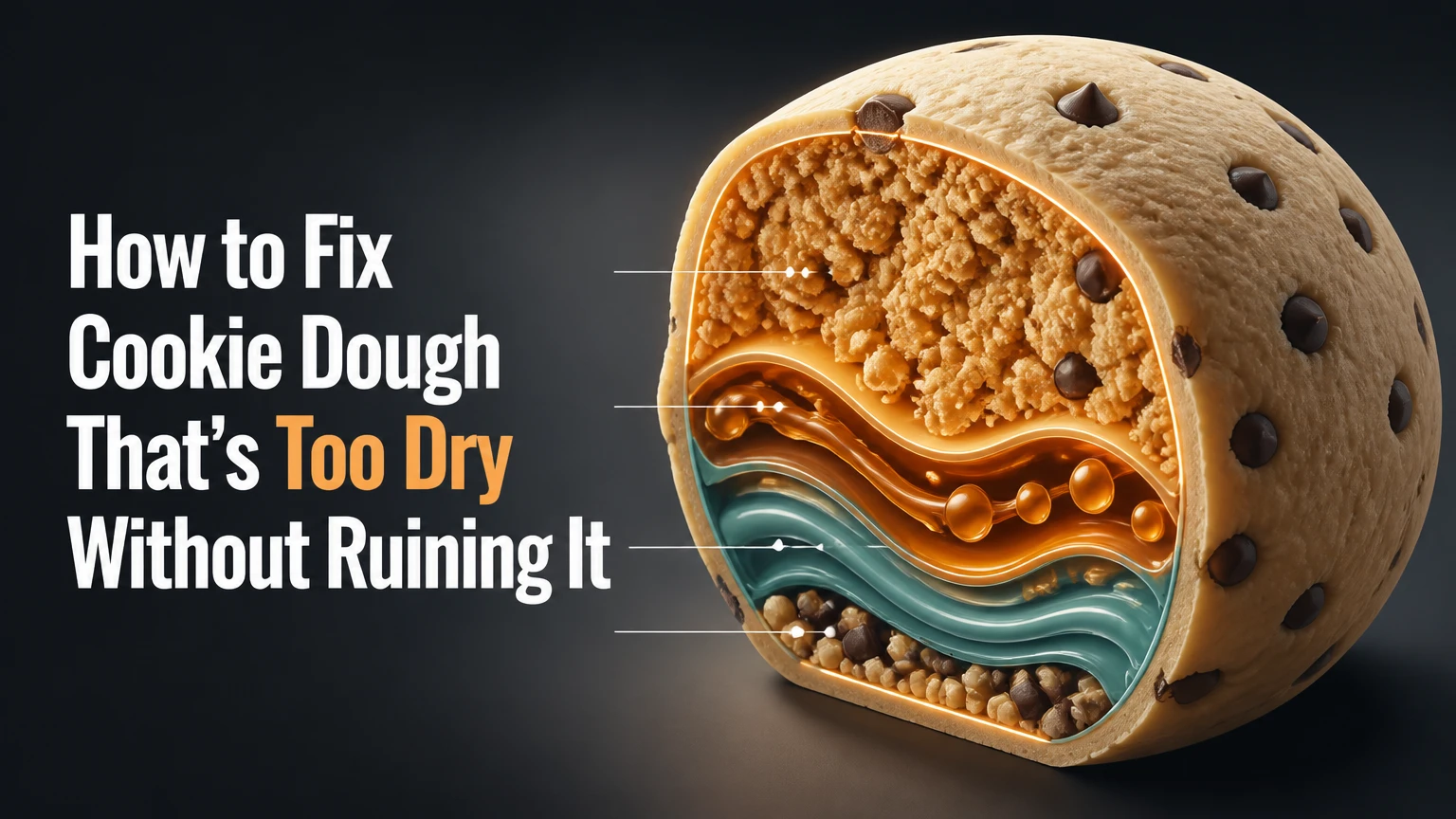
To fix cookie dough that’s too dry, add a compatible binder in 1-teaspoon increments, fold the dough gently, and rest it for 10-15 minutes before testing again. Start with milk or water when the recipe needs hydration, or use softened or melted butter when the dough lacks fat, then stop as soon as the dough holds together without feeling sticky.
Key Facts at a Glance
- Dry cookie dough usually contains too much flour or too little moisture and fat for the intended recipe.
- Add 5 milliliters, or 1 teaspoon, of binder at a time rather than pouring in a tablespoon.
- A repaired dough ball should hold its shape and show only shallow surface cracks when pressed.
- Resting the dough for 10-15 minutes lets flour absorb the added moisture more evenly.
- Melted butter can rescue richness but may increase cookie spread if the dough becomes warm.
- A test cookie reveals the final effect more reliably than dough texture alone.
How to Fix Cookie Dough That’s Too Dry
Dry cookie dough is fixed by restoring cohesion gradually, not by kneading it until the crumbs disappear. Pinch a portion first, add 1 teaspoon of a suitable binder, fold only until incorporated, and wait 10-15 minutes before deciding whether another teaspoon is necessary.
Before You Start
| Requirement | Typical amount or value | Practical specification |
|---|---|---|
| Repair time | 15-30 minutes | Includes one or two resting periods |
| Difficulty | Beginner | No mixer required |
| First binder dose | 1 teaspoon, 5 ml | Use for a batch containing 250-350 g flour |
| Tools | 1 spatula, 1 teaspoon, plastic wrap | A bowl and kitchen scale improve control |
| Test portion | 25-30 g dough | Bake one cookie before the full batch |
- Diagnose the dough. Press a handful firmly. Dough that forms a ball but cracks slightly may need no liquid, while dough that falls apart immediately needs a measured correction.
- Choose a matching binder. Select milk for a neutral hydration boost, melted butter for richer dough, egg yolk for chew, or neutral oil for dairy-free recipes.
- Add 1 teaspoon, or 5 milliliters. Drizzle the binder over several points of the dough instead of one spot. This prevents a wet center and dry edges.
- Fold gently. Press and fold with a silicone spatula or your fingertips for 20-30 seconds. Stop when no liquid remains visible.
- Rest the dough. Cover it at room temperature for 10-15 minutes. If the original recipe was chilled, use a cool room rather than a warm kitchen.
- Test the texture. Roll 25-30 g into a ball. The dough should stay together when lifted and should not leave a greasy film on your fingers.
- Repeat only if necessary. Add another 1 teaspoon, fold, and rest again. Most standard batches need 1-3 teaspoons; a larger correction indicates a measurement or substitution problem.
You will know the repair worked when the dough can be shaped without crumbling, the surface has no large fissures, and a small test cookie spreads within the recipe’s expected range. The most common mistake is adding enough liquid to make the dough immediately smooth, because flour continues absorbing moisture during the rest.
Why Does Cookie Dough Become Too Dry?
Cookie dough becomes too dry when flour, cocoa, oats, or other absorbent ingredients exceed the recipe’s available butter, egg, or liquid. The most frequent causes are excess flour from cup measurement, accidental ingredient substitutions, dry weather, and dough that has remained uncovered long enough for surface moisture to evaporate.
| Cause | Typical symptom | Corrective action |
|---|---|---|
| Excess flour | Dough crumbles before shaping | Add 1 teaspoon milk or water, then rest |
| Scooped flour | 15-25% more flour by volume is possible | Weigh flour at 120-130 g per US cup, according to recipe |
| Added cocoa or oats | Dark or oat dough cracks sharply | Add 1 teaspoon milk, yolk, or butter |
| Cold butter | Pebbly dough with dry pockets | Warm 5-10 minutes, then press together |
| Flour substitution | Whole-wheat or coconut flour absorbs more | Use the original flour or add liquid cautiously |
| Uncovered dough | Dry surface skin and crumbly edges | Cover immediately and rest before correcting |
A US cup of all-purpose flour commonly weighs about 120-130 grams, but brand, packing, and measuring method change the result. A recipe written for 360 grams of flour can become substantially drier when three loosely intended cups are packed into the bowl.
Cocoa powder and rolled oats also alter the balance. Unsweetened cocoa absorbs moisture without adding the gluten structure that flour provides, while oats continue hydrating during resting. A dough that looks dry immediately after mixing may become workable after 15 minutes without any added ingredient.
Which Binder Should You Add?
The best binder depends on whether the recipe needs moisture, fat, or both. Milk is the safest first choice for many drop cookies, melted butter suits rich doughs, egg yolk supports chewiness, and water works only when the batch needs a very small hydration correction.
| Binder | Starting dose | Best cookie types | Main risk |
|---|---|---|---|
| Whole milk or plant milk | 1 teaspoon per addition | Oatmeal, sugar, spice cookies | Excess liquid can create spread |
| Water | 1/2-1 teaspoon per addition | Plain sugar cookies, low-fat dough | Can produce a harder, crisper cookie |
| Melted butter, cooled | 1 teaspoon per addition | Shortbread, chocolate chip cookies | Warm fat can cause greasy spreading |
| Softened butter | 5 g per addition | Creamed-butter recipes | Uneven incorporation if dough is cold |
| Egg yolk, whisked | 1 teaspoon per addition | Chewy chocolate or peanut cookies | More color and richness |
| Neutral oil | 1/2 teaspoon per addition | Vegan and dairy-free dough | Greasy texture if overused |
Is Milk Better Than Melted Butter?
Milk is better when the dough has adequate fat but lacks hydration; melted butter is better when the dough tastes floury, lacks richness, or was made with too little butter. Milk changes water availability more directly, while butter adds approximately 80% fat and roughly 15-18% water, depending on the product.
Use room-temperature milk in dough made with creamed butter. Cold milk can firm butter particles and create uneven lumps, although the dough can usually be restored by letting it stand for several minutes.
Melted butter must cool until warm rather than hot, usually about 30-35°C. Hot butter softens sugar and fat too rapidly, changing the dough’s structure before baking. For shortbread, softened butter is generally safer than melted butter because shortbread depends on a stable fat-flour matrix.
King Arthur Baking’s cookie troubleshooting guidance uses the practical rule, “add a teaspoon or two of liquid,” which captures the right scale for a small correction. The method matters more than the exact liquid: small additions preserve the recipe’s original balance.
When Should You Use Egg Yolk or Oil?
Use egg yolk when a rich, chewy cookie can accept extra color and fat; use neutral oil when the recipe is vegan or dairy-free and the dough needs lubrication rather than much water. Whisk the yolk first, then add it by teaspoon, because an entire egg can add too much protein and liquid.
Egg white contains substantial water and protein. In a cookie formula, a whole additional egg may make the baked result cakey, puffy, or rubbery rather than tender. Egg yolk contains emulsifying lecithin and fat, so it usually produces a denser and more flexible correction.
Oil remains liquid after cooling, unlike butter. That quality helps bind vegan dough but can leave the finished cookie greasy and reduce crisp edges. Add oil in 1/2-teaspoon increments and bake a test portion before correcting the entire batch.
How Much Binder Does a Batch Need?
A typical 250-350 gram flour batch needs 1-3 teaspoons of added binder, although unusually dry dough may need up to 1 tablespoon. The correct stopping point is physical: the dough must hold together under pressure without becoming glossy, wet, or difficult to portion.
| Flour in original batch | First addition | Usual total correction | Test-cookie size |
|---|---|---|---|
| 125-200 g | 1/2 teaspoon | 1-2 teaspoons | 20-25 g |
| 201-350 g | 1 teaspoon | 1-3 teaspoons | 25-30 g |
| 351-500 g | 1 teaspoon | 2-4 teaspoons | 30-40 g |
| More than 500 g | 1 teaspoon | 1 teaspoon per assessment | 40-50 g |
These are practitioner starting ranges, not rigid formula replacements. A dough containing molasses, honey, brown sugar, or mashed fruit may need less added liquid than a dough made with white sugar and cocoa.
Do not add a tablespoon at the beginning. One tablespoon equals 3 teaspoons, enough to overshoot a small batch and create sticky dough. Once excess water has entered the flour, restoring the intended ratio may require additional flour, which can make the final cookie tough.
Should You Rest Dry Dough Before Adding More?
Resting for 10-15 minutes after each small correction is usually more accurate than adding several teaspoons at once. Flour particles absorb liquid over time, and the dough often becomes cohesive after the first rest even though the initial mixture still looks crumbly.
Cover the bowl with plastic wrap, a lid, or a dampened reusable cover. A dry surface loses moisture quickly, especially in an air-conditioned room or during winter heating. Keep butter-based dough below about 24°C during correction when possible.
A chilled dough behaves differently. Let it sit for 5-10 minutes until it can be pressed without breaking, add the binder, then chill it again for 20-30 minutes before shaping. Do not leave dough containing raw egg at room temperature for extended periods; return it to refrigeration after the correction.
What If the Dough Is Sticky After You Fix It?
Sticky cookie dough usually means that too much liquid or warm fat was added, not that the dough needs aggressive kneading. Chill the dough for 20-30 minutes first, then reassess before adding any flour.
| Symptom after correction | Likely cause | Recovery |
|---|---|---|
| Glossy and sticky | Excess milk or water | Chill 20-30 minutes, then add flour only if needed |
| Soft and greasy | Warm melted butter or oil | Refrigerate 30 minutes, then portion cold |
| Dry inside, wet outside | Binder was poorly distributed | Press and fold gently for 20 seconds |
| Sticky but stretchy | Excess mixing after hydration | Stop mixing, chill, and bake a test cookie |
| Sticky with floury taste | Too much corrective flour | Add no more liquid; rest and test bake |
If flour is genuinely necessary, add 1 teaspoon or about 3-4 grams at a time. Fold it through the dough and wait 5 minutes before deciding whether to add more. A large dusting of flour can fix stickiness while recreating the original dryness.
How Do You Rescue Oily, Crumbly, or Flat-Baking Dough?
Oily, crumbly dough needs incorporation and temperature control before it needs more binder. Warm the dough slightly until the fat can coat the flour, press it together through plastic wrap, and chill shaped portions before baking.
If the dough contains visible butter streaks, leave it at room temperature for 5 minutes, then fold it with a spatula. If it contains liquid oil, press the crumbs together firmly rather than kneading. Oil does not solidify in the refrigerator as firmly as butter, so use smaller additions during repair.
Bake one test cookie on parchment at the recipe’s stated temperature. If it spreads into a thin, greasy disc, chill the remaining portions for 20-30 minutes. If the test cookie remains domed and cracks heavily, the dough still needs a small hydration correction or more resting time.
A freezer is useful for a short emergency chill, but 10-15 minutes is usually enough for portioned dough. Freezing the entire bowl can harden the outside while leaving the center soft, making later mixing uneven.
What Are the Best Fixes for Special Doughs?
Special cookie doughs need ingredient-specific corrections because gluten-free flours, vegan fats, whole-grain flour, and refrigerated dough absorb or release moisture differently. Use half-teaspoon additions for fragile formulas and bake a test cookie before changing the full batch.
Gluten-Free Cookie Dough
For gluten-free dough, add 1/2 teaspoon milk, plant milk, or water at a time, then rest for 15-20 minutes. Gluten-free flour blends often contain rice flour, starch, xanthan gum, or psyllium, and those ingredients can continue absorbing water after mixing.
Do not correct gluten-free dough by kneading. The dough may become cohesive only after the starches hydrate, so early additions should be conservative. If the recipe contains coconut flour, expect a much higher liquid requirement than a wheat-flour equivalent, and follow the recipe’s stated ratio rather than applying a standard cookie formula.
Vegan Cookie Dough
For vegan dough, use plant milk for hydration or 1/2 teaspoon neutral oil for lubrication. Choose a plant milk with a flavor and protein level compatible with the recipe; unsweetened soy milk adds more protein than many nut-based beverages.
Vegan butter varies substantially in water and fat content. A firm baking block generally behaves more like dairy butter than a soft tub spread, which may contain more water and produce a looser dough. Do not add extra oil until the dough has been chilled and tested.
Whole-Wheat or Oat-Based Dough
Whole-wheat flour and oats absorb water more slowly and can make dough seem dry immediately after mixing. Rest the dough for 20-30 minutes before adding a second correction, especially when the recipe includes rolled oats.
If the dough still cracks after resting, add 1 teaspoon milk or water. Whole-grain particles can produce a pleasantly textured cookie, but excessive liquid may make the cookie dense rather than tender.
What If the Cookies Are Already Baked and Dry?
Baked cookies cannot be returned to raw-dough texture, but their perceived dryness can often be reduced with controlled humidity or a filling. Store cooled cookies in an airtight container with a soft slice of bread for 4-12 hours, keeping the bread from direct contact with the cookies.
| Baked-cookie problem | Rescue method | Time or temperature |
|---|---|---|
| Slightly stale cookies | Airtight container with bread | 4-12 hours |
| Hard sandwich cookies | Add buttercream or ganache filling | Serve after 30 minutes |
| Dry but structurally sound cookies | Warm briefly before serving | 150°C oven, 3-5 minutes |
| Overbaked edges | Crumble for cheesecake base or topping | Process after cooling |
| Very dry cut-outs | Brush with syrup before layering | 1/2 teaspoon per cookie |
Do not add water directly to baked cookies. Surface water creates sogginess and can dissolve sugar without evenly softening the interior. Avoid microwaving for more than 5-8 seconds at a time because sugar and fat heat unevenly and can make the center rubbery.
How Can You Prevent Dry Cookie Dough Next Time?
Prevent dry cookie dough by weighing flour, measuring additions separately, and checking dough hydration before refrigeration. A digital scale reduces the largest avoidable error, while a short rest reveals whether oats or cocoa have changed the final consistency.
| Prevention practice | Specific target | Benefit |
|---|---|---|
| Weigh all-purpose flour | 120-130 g per US cup | Limits packed-flour variation |
| Cream butter and sugar | 2-4 minutes at medium speed | Distributes fat and aerates dough |
| Scrape bowl during mixing | 2 times | Prevents dry pockets |
| Rest oat dough | 20-30 minutes | Allows delayed absorption |
| Refrigerate shaped dough | 20-60 minutes | Controls spread without drying surface |
| Cover unused dough | Within 2 minutes | Prevents moisture loss |
Measure flour by spooning it into a cup and leveling it when a recipe gives volume measurements. Never compact flour by shaking or tapping the cup. When a recipe provides grams, use the gram amount rather than converting it to cups.
Check ingredient substitutions before mixing. Coconut flour, whole-wheat flour, extra cocoa, and ground nuts do not replace all-purpose flour at equal volume without changing hydration and structure. Brown sugar also contributes more moisture than white sugar, so replacing it with white sugar can produce a drier dough.
Common Mistakes and Expert Rules
Mistake 1: Adding Flour Before Resting
A dough that looks loose immediately after liquid addition may firm within 10 minutes. Adding flour during that interval can create a second imbalance and produce thick, dry cookies.
Mistake 2: Using Heat to Soften Cold Dough
Microwaving butter-based dough can melt isolated fat pockets while the flour remains cold. Let the dough stand for 5-10 minutes instead, then press and fold it.
Mistake 3: Correcting the Whole Batch Without a Test Cookie
Dough texture predicts shaping performance, but it does not fully predict spread. Bake one 25-30 gram portion first, then adjust chilling time or binder choice for the remaining dough.
Mistake 4: Kneading Until Smooth
Cookie dough does not need the smooth elasticity expected from bread dough. Once dry pockets disappear, stop mixing. Further mechanical action can develop gluten and make wheat-based cookies firm.
Practitioner Rules of Thumb
- Use the smallest effective correction. A teaspoon is a measurement, not a suggestion to pour freely.
- Change one variable at a time. If you add milk, extra butter, and flour together, you cannot identify which correction worked.
- Judge the baked sample. A cookie that holds its shape before baking may still spread excessively if the butter is warm.
- Match the correction to the missing component. A low-fat dough benefits from butter or yolk; a correctly rich dough usually needs only hydration.
FAQ
Can I fix dry cookie dough with water?
Yes, water can fix a small hydration shortage in plain cookie dough, but use 1/2-1 teaspoon at a time. Water adds no fat or flavor, so excessive amounts can produce harder cookies. Milk is usually more forgiving when the recipe already contains dairy or a tender crumb.
Can I add an extra egg to crumbly cookie dough?
An entire extra egg is usually too much for a standard cookie batch. Egg white adds water and structural protein, which can make cookies cakey or rubbery. Whisked egg yolk, added 1 teaspoon at a time, provides a more controlled combination of fat, moisture, and emulsifying power.
Can refrigerated cookie dough become too dry?
Yes. Refrigerated dough can seem dry because butter hardens and flour continues absorbing moisture. Let the dough stand for 5-10 minutes, press a portion together, and rest it covered before adding any binder. Add 1/2-1 teaspoon only if the dough still fractures when shaped.
Why is my cookie dough crumbly but oily?
Crumbly, oily dough usually contains fat that has not coated the flour evenly or has separated because of temperature differences. Let it warm for about 5 minutes, fold it gently until uniform, and chill it for 20-30 minutes. Add liquid only after the fat is fully incorporated.
How do I fix dry chocolate cookie dough?
Add 1 teaspoon milk, cooled melted butter, or egg yolk, depending on the recipe’s fat level. Cocoa powder absorbs moisture, so rest the dough for 15 minutes before adding more. Bake a small test cookie because chocolate dough can look dry yet spread normally once heated.
Is dry cookie dough safe to eat raw?
Raw cookie dough can contain harmful bacteria from uncooked flour and eggs. Bake the repaired dough according to the recipe, and do not rely on freezing or refrigeration to make raw flour safe. If you need an edible dough, use heat-treated flour and an egg-free formula designed for that purpose.
The Bottom Line
To fix cookie dough that’s too dry, identify whether the batch lacks hydration, fat, or both, then add 1 teaspoon of a compatible binder and rest the dough for 10-15 minutes. Milk suits most neutral corrections, butter restores richness, egg yolk increases chew, and oil supports vegan dough. Stop when the dough holds together, then bake one test cookie before committing the full batch.
