

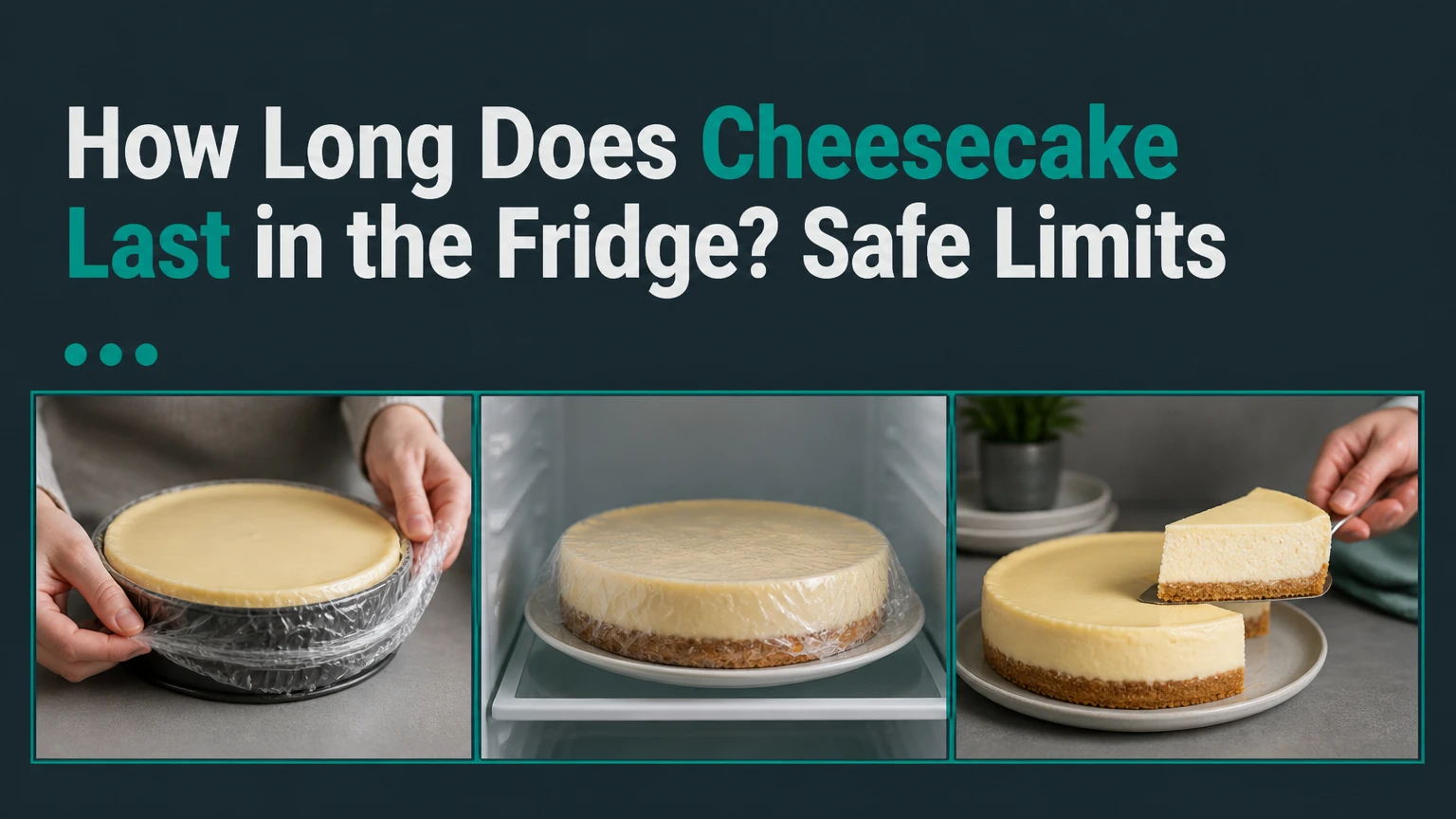
Cheesecake lasts 3-5 days in the refrigerator when it is covered promptly and kept at 40°F (4°C) or colder. A plain baked cheesecake may retain good quality for up to 5-7 days, while no-bake cheesecake and cakes with fresh fruit usually have shorter practical limits. Discard cheesecake that sat out too long, developed mold, or passed the manufacturer’s storage date.
Key Facts at a Glance
Homemade cheesecake should generally be eaten within 3-5 refrigerated days.
Plain baked cheesecake can often remain good for 5-7 days when continuously kept at 40°F or below.
Fresh berries, whipped cream, custard, and cut fruit can reduce the best-quality window to 1-3 days.
Perishable cheesecake should not remain above 40°F for more than 2 hours, or 1 hour above 90°F.
An airtight container or tightly sealed wrap protects cheesecake from contamination, drying, and refrigerator odors.
Freezing preserves cheesecake for about 1-2 months at best quality, but freezing does not make spoiled cheesecake safe.
How Long Does Cheesecake Last in the Fridge?
Cheesecake lasts 3-5 days in a properly cold refrigerator, measured from the day it was baked, assembled, opened, or thawed. The 3-5 day range is the safest practical answer for most homemade cakes because cheesecake contains moist dairy ingredients, and many recipes also contain eggs.
A plain, fully baked New York-style cheesecake has the best chance of retaining acceptable texture through day 5 and sometimes day 7. That longer range is a quality estimate, not a guarantee of safety. A warm refrigerator, repeated serving, loose wrapping, or contaminated utensils can shorten it.
The U.S. Food and Drug Administration recommends keeping a refrigerator at 40°F or below. The FDA also uses the two-hour rule for perishable foods: refrigerated foods should not remain in the temperature danger zone, 40°F-140°F, for more than 2 hours, or more than 1 hour when the surrounding temperature exceeds 90°F.
Refrigerator Life by Cheesecake Type
| Cheesecake type | Typical refrigerator limit | Main limiting factor |
|---|---|---|
| Plain baked cheesecake | 5-7 days | Dairy filling quality and surface drying |
| Baked cheesecake with fresh berries | 2-3 days | Fruit moisture, mold, and juice migration |
| No-bake cheesecake | 3-5 days | High moisture and weaker structure |
| Cheesecake with whipped cream | 1-3 days | Cream collapse and contamination after serving |
| Commercial unopened cheesecake | Package date and instructions | Manufacturer’s validated packaging |
| Commercial opened cheesecake | 3-5 days | Air exposure and handling |
The table gives typical household guidance rather than a laboratory guarantee. Manufacturer instructions override general rules for packaged products, especially when a product has a use-by date, modified-atmosphere package, or specific thawing instruction.
Why Does Cheesecake Spoil in the Refrigerator?
Cheesecake spoils because refrigeration slows microbial growth without eliminating it, while moisture, dairy proteins, sugar, eggs, and exposed cut surfaces create favorable conditions for quality loss and contamination. Baking reduces the number of organisms initially present, but it does not make cheesecake shelf-stable.
A cheesecake’s crust can appear dry while the filling remains moist enough to support spoilage. Fresh toppings add another variable: berries release water, cut fruit carries surface microorganisms, and whipped cream introduces a fragile high-moisture layer.
Baking also does not justify extending the refrigerator window indefinitely. The claim that baking substantially lowers water activity enough to make cheesecake safe for a week is unreliable because finished water activity varies by recipe, baking method, filling thickness, and storage conditions.
The FDA’s temperature rule matters more than whether a cake is baked. A refrigerator thermometer provides better evidence than a dial setting, because many home refrigerators run above 40°F in crowded areas or during frequent door opening.
Safety Versus Quality
| Condition | Likely effect | Recommended action |
|---|---|---|
| Day 1-3, sealed at 38°F | Good safety and texture | Eat normally |
| Day 4-5, sealed at 38°F | Usually acceptable quality | Inspect and serve promptly |
| Day 6-7, plain and continuously cold | Quality may decline | Use caution; discard if uncertain |
| Any day with visible mold | Possible deep contamination | Discard the entire cake |
| Any day after prolonged warming | Pathogen growth may be invisible | Discard rather than taste-test |
A sour smell, slimy filling, or mold is a clear discard signal, but normal smell does not prove safety. Foodborne pathogens can multiply without producing an obvious odor, flavor, or visual change.
How Should You Store Cheesecake in the Fridge?
Store cheesecake by cooling it promptly, sealing it against air, and placing it on a cold interior shelf at 40°F or below. A covered whole cake usually retains texture better than repeatedly exposed slices, while individually wrapped slices make portioning and freezing easier.
Step 1: Cool a Baked Cheesecake Safely
Cool a freshly baked cheesecake until it is no longer steaming, then refrigerate it within 2 hours of leaving the oven. A gradual cooling period can reduce cracking, but leaving the cake on the counter overnight is unsafe.
Do not seal a visibly hot cake in a completely airtight container if heavy condensation will collect on the lid. Instead, allow brief cooling, use a loose protective cover initially if needed, and seal the cheesecake once its surface is cool.
Checkpoint: The center may still feel slightly warm, but the cake should not release visible steam.
Common mistake: Treating a long cooling period as a texture technique after the two-hour safety limit has passed.
Step 2: Remove or Separate Fragile Toppings
Keep fresh berries, sliced fruit, whipped cream, and wet sauces separate whenever the cake will be stored for more than one day. Add those toppings shortly before serving to protect the crust and reduce moisture transfer.
Fruit compote can remain on the cake longer than raw berries when it was cooked, cooled promptly, and refrigerated, but its acidity does not make the dairy filling shelf-stable.
Checkpoint: The filling and crust remain visibly distinct rather than surrounded by pooling juice.
Common mistake: Assuming sugar or lemon juice preserves fresh fruit enough to extend the entire cheesecake’s safe life.
Step 3: Create a Primary Seal
Cover the cake tightly with plastic wrap, or place slices in shallow airtight containers. Keep wrap from pressing into soft decorations, because damaged surfaces expose more filling and create wet contact points.
A cake carrier with a secure lid works well for a whole cheesecake. Cardboard bakery boxes protect the shape but do not create an airtight barrier, so the box should be placed inside a larger sealed container when odor and drying matter.
Step 4: Use a Cold Interior Shelf
Place cheesecake on an interior shelf rather than the refrigerator door. The back of a middle or lower shelf usually experiences fewer temperature swings than the door, although the coldest location varies by refrigerator design.
Keep cheesecake away from raw meat, unwashed produce, leaking containers, and strong-smelling foods. Separate storage reduces cross-contamination and prevents cream cheese from absorbing savory odors.
Step 5: Label the Date
Write the baking, opening, or thawing date on the container. A date label prevents the common mistake of counting from the serving date when the cheesecake was actually prepared several days earlier.
| Storage method | Typical preparation | Practical result |
|---|---|---|
| Whole cake, sealed container | 5 minutes to cover | Lowest exposed surface area |
| Individual slices, wrap plus container | 10-15 minutes | Convenient portions, more cut edges |
| Bakery box only | 1 minute | Shape protection, weak odor barrier |
| Plastic wrap only | 2-5 minutes | Good short-term seal, decoration risk |
| Wrap plus airtight container | 5-10 minutes | Best refrigerator protection |
Do Toppings Change How Long Cheesecake Lasts?
Fresh toppings shorten cheesecake’s practical refrigerator life because they add water, handling, and additional perishable ingredients. Plain baked cheesecake may remain acceptable for 5-7 days, while cheesecake with berries, whipped cream, pastry cream, or cut fruit is usually best within 1-3 days.
| Topping or filling addition | Typical best-quality window | Storage recommendation |
|---|---|---|
| Fresh strawberries or raspberries | 1-2 days | Add shortly before serving |
| Blueberry or cherry compote | 3-5 days | Chill cooked topping separately when possible |
| Whipped cream | 1-3 days | Add fresh cream on serving day |
| Lemon curd | 3-5 days | Use a clean utensil and sealed container |
| Chocolate ganache | 4-7 days | Keep covered; inspect for condensation |
| Sour cream topping | 3-5 days | Refrigerate immediately after cooling |
A topping can fail before the cheesecake filling does. For example, a berry layer may become watery on day 2 even though the plain filling remains intact, so separating components gives a more reliable quality result.
Discard the whole dessert when mold appears on a topping. Moist foods cannot be made safe by removing only the visibly affected area.
How Long Does Store-Bought Cheesecake Last?
Store-bought cheesecake lasts according to the manufacturer’s package instructions while unopened, then generally 3-5 days after opening if it remains at 40°F or below. A sealed commercial product may have validated packaging, preservatives, or a controlled production process that homemade cheesecake does not have.
A best-by date primarily communicates expected quality, while a use-by instruction can carry a stronger safety meaning. Do not automatically add 3-5 days after a package’s use-by date, and do not ignore a label that says to consume within a stated period after opening.
For bakery-counter cheesecake, ask when the cake was prepared and whether it was continuously refrigerated. A display case does not reveal the product’s full age.
Opened, Unopened, and Delivered Cheesecake
| Product situation | Starting point for the clock | Typical guidance |
|---|---|---|
| Homemade baked cake | Time it finished cooling | 3-5 days |
| Unopened packaged cake | Printed package instruction | Follow label |
| Opened packaged cake | Opening date | 3-5 days |
| Bakery-counter slice | Purchase date, if preparation is unknown | Eat within 1-2 days |
| Refrigerated delivery | Arrival, if still 40°F or colder | Follow seller’s instruction |
| Delivered warm or with melted ice packs | Time above 40°F is uncertain | Contact seller or discard |
The package date cannot correct poor temperature control. If a delivered cheesecake arrives warm, damaged, or without adequate cold packing, record the condition and contact the retailer rather than relying on its printed date.
Can You Freeze Cheesecake?
Cheesecake can be frozen for about 1-2 months at best quality, although a well-wrapped plain baked cheesecake may remain usable for up to 2-3 months with gradual texture decline. Freezing stops active microbial growth while the dessert remains frozen, but it does not destroy all pathogens or repair cheesecake that was already mishandled.
Plain baked cheesecake freezes more reliably than no-bake cheesecake because its structure is firmer. Gelatin-set fillings may thaw acceptably, while whipped cream, fresh fruit, and high-water sauces commonly weep or become soft.
Refrigerator and Freezer Comparison
| Storage option | Usable timeframe | Texture result | Best use |
|---|---|---|---|
| Refrigerator at 38°F | 3-5 days | Creamy, freshest crust | Immediate leftovers |
| Freezer at 0°F | 1-2 months best quality | Slightly softer crust | Batch storage |
| Freezer beyond 3 months | Safety depends on continuous freezing | Dryness and freezer burn increase | Only tightly wrapped cake |
| Counter at 70°F | Maximum 2 hours | Rapid softening | Serving period only |
How to Freeze Cheesecake Correctly
- Chill the cheesecake completely. Refrigerate the cake for at least 4 hours, preferably overnight, so the filling is firm before wrapping.
- Freeze portions uncovered briefly. Place slices on a lined tray for 1-2 hours, until the cut surfaces are firm.
- Add an airtight barrier. Wrap each portion in plastic wrap, then foil or a freezer container. Remove as much trapped air as practical.
- Label the date and variety. Record whether the slice contains fruit, cream, or sauce because those additions affect thawed texture.
- Thaw in the refrigerator. A slice generally needs 2-4 hours, while a whole cake may need 8-12 hours. Keep it covered during thawing to reduce condensation.
Do not refreeze cheesecake that has fully thawed at room temperature. Refreezing can worsen texture and follows an unsafe temperature history.
How Long Can Cheesecake Sit Out?
Cheesecake can sit at room temperature for up to 2 hours, or up to 1 hour when the surrounding temperature exceeds 90°F. The time includes transport, display, serving, and the period before leftovers return to the refrigerator.
A 30-60 minute serving period is usually compatible with the two-hour limit when the cake began fully chilled. A warm car, outdoor table, sunny room, or crowded buffet can push the surface above 40°F faster than expected.
| Situation | Maximum room-temperature exposure |
|---|---|
| Indoor room at 70°F | 2 hours |
| Outdoor temperature above 90°F | 1 hour |
| Insulated cooler with ice, food at 40°F or below | Not counted as room-temperature exposure |
| Overnight counter storage | Discard |
| Power outage with refrigerator above 40°F | Use the documented time limit |
When a refrigerator loses power, the USDA advises keeping the door closed and using a food thermometer. A full refrigerator generally stays cold longer than a half-empty one, but cheesecake should be discarded if it has been above 40°F for more than 2 hours and no safe cold history exists.
How Can You Tell if Cheesecake Has Gone Bad?
Discard cheesecake with mold, a rotten or sharply fermented odor, slimy filling, unusual discoloration, or a known unsafe temperature history. Do not taste cheesecake to test safety, because harmful bacteria may be present without changing flavor.
| Sign | Possible explanation | Decision |
|---|---|---|
| Small beads of water on surface | Condensation after chilling | Usually quality-related if within date |
| Liquid around fruit | Juice migration or syneresis | Remove topping only if fresh and otherwise safe |
| Dry, cracked edges | Air exposure and staling | Quality decline, not automatic spoilage |
| Fuzzy green, white, or black growth | Mold | Discard the entire cheesecake |
| Sour, yeasty, or rotten odor | Spoilage activity | Discard |
| Slimy or unusually sticky filling | Microbial or structural breakdown | Discard |
| Normal smell after 7 days | No visible warning | Do not assume safety |
Liquid separation alone does not prove that bacteria are breaking down the cheesecake. Syneresis can result from gelatin, temperature changes, acidic fruit, overmixing, or a recipe imbalance. The safe response depends on the cake’s age and temperature history, not liquid alone.
Mold should not be cut away from cheesecake. The USDA treats moist foods as poor candidates for surface mold removal because invisible growth can extend below the visible patch.
Which Cheesecake Storage Mistakes Matter Most?
The most serious cheesecake storage mistakes are exceeding the two-hour room-temperature limit, relying on smell as the only safety test, and storing the dessert uncovered in a warm refrigerator. Texture mistakes, such as adding berries too early, usually reduce quality rather than create immediate danger, but they can make spoilage harder to judge.
- Counting from the serving date: Count from baking, assembly, opening, or thawing, whichever applies first.
- Using the refrigerator door: Door temperatures fluctuate more than interior shelves.
- Wrapping a warm cake tightly: Trapped condensation can soften the crust and wet toppings.
- Freezing decorated cheesecake: Whipped cream and fresh berries often thaw poorly.
- Serving with a dirty knife: Repeated cuts transfer crumbs and microorganisms across the surface.
- Scraping off mold: Moist dairy desserts require whole-cake disposal.
- Trusting a strong refrigerator setting: Measure actual temperature with an appliance thermometer.
A practical rule from professional pastry handling is to cut only the portions needed for service, then reseal the remaining whole cake immediately. Fewer exposed cut surfaces generally mean slower drying and fewer opportunities for contamination.
Is Older Cheesecake Safe for High-Risk Diners?
Pregnant people, young children, adults over 65, and people with weakened immune systems should use the conservative end of the storage range and avoid cheesecake with uncertain temperature history. For these diners, serve freshly prepared or commercially packaged cheesecake within its label instructions rather than stretching homemade leftovers to day 6 or day 7.
Egg-containing cheesecake should be fully cooked according to a tested recipe, and unpasteurized dairy should be avoided by people advised to avoid it. Refrigeration does not remove risks from raw eggs, contaminated ingredients, or prolonged warming.
The safest household policy is simple: keep the cake at 40°F or below, eat homemade cheesecake within 3-5 days, and freeze portions before the refrigerator window closes.
FAQ
Can I Eat Cheesecake After Seven Days in the Fridge?
Seven-day-old cheesecake may still look normal, but appearance and smell cannot confirm safety. A plain baked cake kept continuously at 40°F or below has a better quality history than a topped or frequently handled cake, yet the conservative choice is to discard homemade cheesecake after 5 days when its temperature history is uncertain.
Does Cheesecake Need to Be Refrigerated Overnight?
Cheesecake needs refrigeration overnight because its dairy filling and frequent egg content make it perishable. Leaving cheesecake on the counter overnight exceeds the FDA’s two-hour room-temperature limit, even if the cake smells normal the next morning.
Can I Freeze Cheesecake With Fruit on Top?
You can freeze cheesecake with fruit on top, but thawed fruit often becomes soft and releases liquid into the filling and crust. Freeze the plain cake when possible, thaw it covered in the refrigerator, and add fresh fruit shortly before serving.
Why Is My Cheesecake Watery After Refrigeration?
Watery cheesecake can result from condensation, syneresis, thawed gelatin, acidic fruit, or a weakly set filling. Pooling liquid does not automatically mean bacterial spoilage, but discard the dessert if it also has mold, a sharp odor, sliminess, an uncertain temperature history, or an excessive storage age.
How Long Does Cheesecake Last After Thawing?
Thawed cheesecake should remain refrigerated and is best eaten within 3-5 days, provided it thawed continuously in the refrigerator. A cake thawed on the counter for more than 2 hours should not be returned to storage for later consumption.
Does a Cheesecake Box Keep It Fresh?
A cardboard cheesecake box protects the cake from impacts but does not provide an airtight seal. Place the boxed cake inside a covered container or wrap exposed portions to reduce drying, odor absorption, condensation, and contact with other refrigerator foods.
The Bottom Line
The safest answer to how long does cheesecake last in the fridge is 3-5 days at 40°F or below. Plain baked cheesecake may retain good quality for 5-7 days, but fresh fruit, whipped cream, no-bake fillings, repeated handling, and uncertain temperature history shorten that window. Refrigerate cheesecake within 2 hours, seal it well, freeze portions before day 5, and discard any cake with mold, spoilage odor, sliminess, or prolonged warming.
