

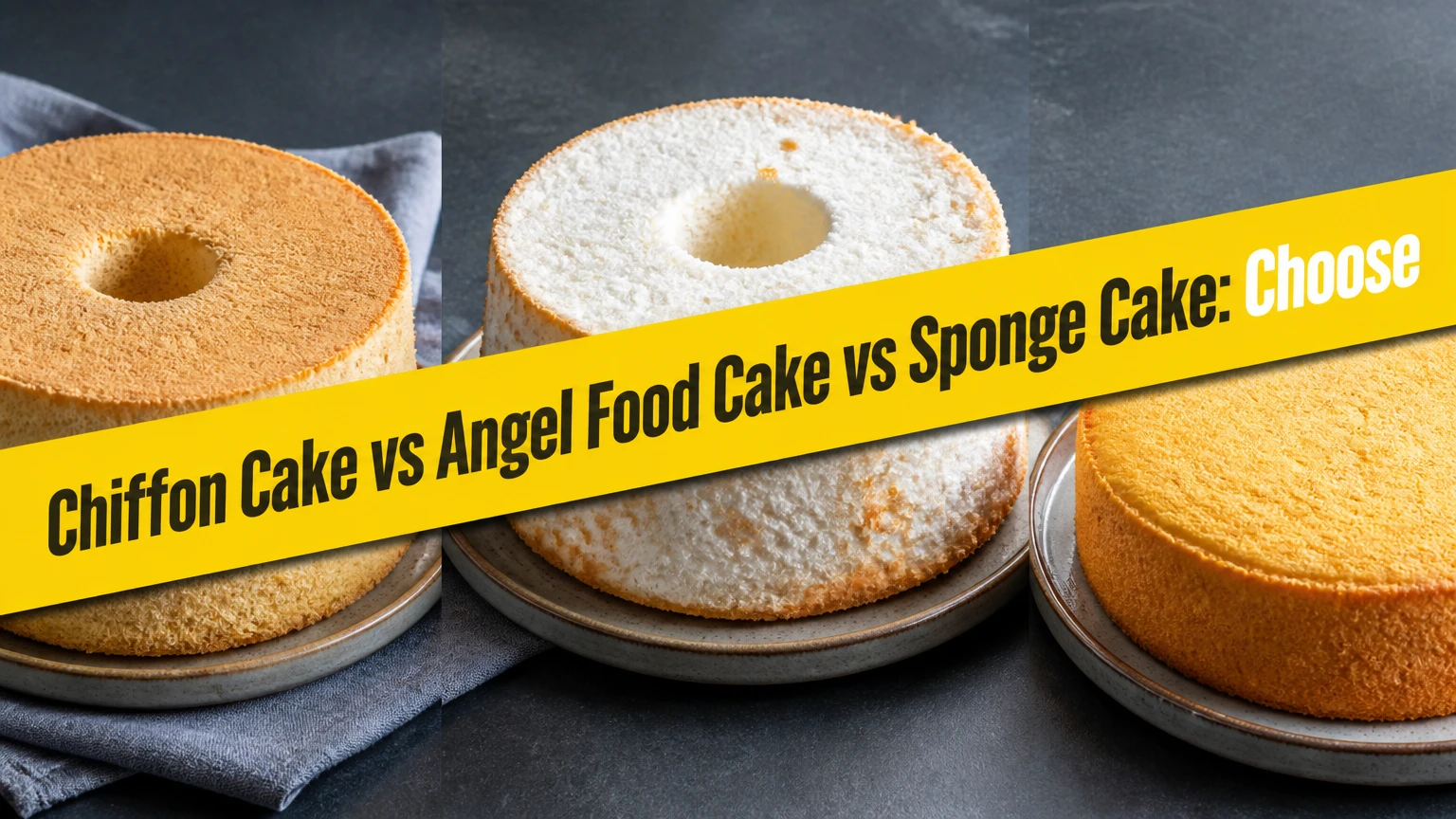
Chiffon cake is the moistest and most forgiving of the three, angel food cake is the lightest and strictly fat-free, and sponge cake, especially genoise, is the strongest for layered desserts and syrup. Choose chiffon for a tender everyday cake, angel food for an airy low-fat dessert, and sponge for structured filled cakes.
Key Facts at a Glance
- Chiffon cake combines separated eggs, liquid vegetable oil, flour, sugar, and baking powder.
- Angel food cake contains whipped egg whites and no egg yolks, butter, or oil.
- Genoise sponge cake aerates whole eggs and sugar, usually without chemical leavening.
- Angel food requires an ungreased tube pan and upside-down cooling to prevent collapse.
- Chiffon remains soft when chilled because liquid oil stays fluid below room temperature.
- Genoise absorbs syrup and supports fillings more reliably than angel food or chiffon.
How Do the Three Cake Families Differ?
Chiffon, angel food, and genoise sponge cakes are all foam cakes, but they build their structure from different egg systems and fat levels. Chiffon separates the eggs and adds oil, angel food uses whites alone, and genoise whips whole eggs warm before flour and optional butter enter the batter.
The distinction affects more than ingredient lists. Fat tenderizes and moistens chiffon, while yolk fat would weaken an angel food meringue. Whole-egg foam gives genoise a flexible but relatively dry crumb that accepts syrup. The cakes also differ in handling: chiffon and angel food typically need tube-pan support, whereas genoise often bakes in a shallow round or sheet pan.
| Attribute | Chiffon cake | Angel food cake | Genoise sponge cake |
|---|---|---|---|
| Egg system | Separated whites and yolks | Egg whites only | Whole eggs |
| Added fat | Typically 20-35% oil by flour weight | 0 g added fat | 0-20% butter by flour weight |
| Chemical leavener | Usually baking powder | None in classic formulas | Usually none |
| Main lift | Meringue, steam, baking powder | Meringue and steam | Warm whole-egg foam and steam |
| Typical crumb | Moist, fine, springy | Porous, cottony, lightly chewy | Elastic, open, absorbent |
| Best pan | 8-10 inch tube pan | 9-10 inch tube pan | 8-10 inch round or sheet pan |
| Cooling method | Often inverted | Inverted until cold | Upright on a rack |
| Typical use | Plain slices, fruit, glaze | Plain slices, berries | Layer cakes, roulades, petits fours |
What Does “Sponge Cake” Mean Here?
“Sponge cake” is a broad category, not one universal recipe. This comparison uses genoise, the classic European sponge made from whipped whole eggs and sugar, because genoise matches the reference’s warm-whipped whole-egg method.
In some regions, “sponge cake” may mean a foam cake with separated eggs, baking powder, or oil. Victoria sponge, Japanese castella, chiffon, and American-style yellow sponge therefore cannot be judged by genoise rules alone. A recipe’s egg method and fat level identify the actual cake more accurately than the label.
Which Cake Is Moistest, Lightest, or Strongest?
Chiffon is usually the moistest, angel food is usually the lightest by mouthfeel, and genoise is usually the strongest for stacking after controlled syrup application. These are structural tendencies, not absolute laboratory rankings, because flour quantity, egg size, baking time, and filling weight can change the result.
Chiffon’s oil coats flour particles and remains liquid after cooling, producing a soft crumb on the second day. Angel food has no fat to tenderize its protein network, so its crumb feels drier but exceptionally airy. Genoise has fewer tenderizing ingredients, yet its fine egg cells and flexible crumb give it useful strength.
| Texture measure | Chiffon cake | Angel food cake | Genoise sponge cake |
|---|---|---|---|
| Perceived moisture | High, often 25-35% oil-based formula | Moderate, water-rich but fat-free | Low to moderate before syrup |
| Cell structure | Fine and even | Very fine with elongated pores | Fine to medium, flexible cells |
| Bite | Soft and bouncy | Airy, cottony, slightly chewy | Resilient and springy |
| Chilling effect | Remains tender | Becomes firmer and drier | Firms noticeably |
| Syrup capacity | Moderate, 30-60 g per layer typical | Low to moderate | High, 60-120 g per layer typical |
| Heavy filling tolerance | Moderate | Low | High when properly supported |
A practical rule follows: select the cake based on the finished dessert, not the baked slice alone. A plain slice rewards chiffon or angel food, while a multilayer cake often needs genoise’s absorbent, resilient crumb.
How Do Fat and Eggs Change the Result?
Fat makes chiffon tender and moist, while the absence of fat protects angel food’s meringue and gives it its distinctive cottony structure. Genoise occupies the middle ground: whole-egg yolks provide some natural fat, and melted butter may be added for flavor, but excessive butter reduces foam volume.
Egg whites supply albumen proteins that unfold during whipping and form a network around air bubbles. Acid from cream of tartar can improve foam stability, although clean equipment and correct whipping matter more than acid alone. Egg yolks contribute emulsifiers and fat, which help chiffon form a smooth liquid batter but interfere with a high-volume white meringue.
| Ingredient function | Chiffon cake | Angel food cake | Genoise sponge cake |
|---|---|---|---|
| Egg whites | Separate foam, typically 4-8 whites | Main structural foam, typically 8-12 whites | Whole-egg foam contains whites |
| Egg yolks | Emulsion, color, flavor, tenderness | Excluded | Provide emulsifiers and richness |
| Oil or butter | Oil commonly 60-120 g per 4-6 eggs | Excluded | Butter commonly 20-60 g per 4-6 eggs |
| Sugar role | Sweetness and foam support | Foam stabilization and tenderness | Foam volume and tenderness |
| Flour role | Sets the oil-rich crumb | Provides a light protein scaffold | Sets an elastic, syrup-friendly crumb |
A non-obvious practitioner rule is that angel food is not automatically “dry” when correctly baked. A properly whipped and timed cake retains substantial water, but its fat-free crumb loses moisture faster than chiffon during refrigeration or uncovered storage.
How Are the Cakes Leavened?
Chiffon receives lift from whipped egg whites, water vapor, and usually baking powder; angel food depends on whipped whites and steam; genoise relies mainly on whole-egg foam and steam. Baking powder gives chiffon a second lift mechanism, but it cannot rescue a severely deflated batter.
Air cells expand as the batter heats. Water turns to steam, proteins coagulate, and starch gelatinizes, converting temporary bubbles into a set crumb. Chemical leavening releases additional gas in chiffon, while angel food and genoise require more precise foam handling because they lack that backup.
| Leavening feature | Chiffon cake | Angel food cake | Genoise sponge cake |
|---|---|---|---|
| Baking powder | 1-2 teaspoons per 120-180 g flour, typical | 0 teaspoons | 0 teaspoons in classic genoise |
| Whipped whites | Yes | Yes, essential | No separate whites |
| Whole-egg whipping | No | No | Yes, essential |
| Steam contribution | High | High | High |
| Foam tolerance | Moderate | Low | Low to moderate |
| Main failure from under-aeration | Short, heavy crumb | Collapsed or rubbery crumb | Dense, tight sponge |
The reference temperature ranges are useful starting points, but oven behavior varies. Typical home-baking ranges are 160-175°C for chiffon, 160-175°C for angel food, and 170-180°C for genoise, with pan depth and recipe formula determining the final setting.
What Is the Best Pan and Cooling Method?
Chiffon and angel food perform best in ungreased tube pans because the batter must grip the vertical sides while rising. Genoise can use a lined round or sheet pan, but a loose-bottomed pan needs careful handling because thin batter may leak before the foam sets.
Do not grease the sides of an angel food or classic chiffon tube pan. A removable base is useful, but the pan should sit level and the center tube should be firmly attached. Angel food needs immediate inversion and must remain suspended until completely cool, often 1-2 hours.
| Pan and handling factor | Chiffon cake | Angel food cake | Genoise sponge cake |
|---|---|---|---|
| Side preparation | Dry, ungreased metal | Dry, ungreased metal | Parchment base; sides often ungreased |
| Preferred diameter | 20-25 cm tube pan | 23-25 cm tube pan | 20-25 cm round or 23 x 33 cm sheet |
| Inversion | Recommended for tall cakes | Required | Not recommended |
| Cooling period | 60-90 minutes typical | 90-120 minutes typical | 30-60 minutes typical |
| Doneness cue | Springy top, firm center | Dry top, springy surface | Ribbon-like batter set, light rebound |
| Release method | Knife around sides and tube | Knife around sides and tube | Warm briefly, then unmold |
Greasing a foam-cake pan is a counterintuitive mistake. Grease makes release easier after baking but removes the friction that supports upward expansion, so a tall cake can shrink and slide from its pan during cooling.
How Is Each Cake Made Successfully?
Chiffon requires a liquid yolk batter, a glossy white meringue, and gentle folding; angel food requires staged dry-ingredient folding into whites; genoise requires warm whole-egg aeration and careful butter tempering. Typical active preparation takes 25-45 minutes, followed by 30-55 minutes of baking and extended cooling.
Chiffon Cake Method
- Whisk flour, sugar, baking powder, and salt together.
- Mix yolks, neutral oil, water or milk, and flavoring into the dry ingredients until smooth.
- Whip whites with cream of tartar to medium-stiff, glossy peaks.
- Fold one-quarter of the whites into the yolk batter to loosen it.
- Fold in the remaining whites in two additions with a broad spatula.
- Pour into a dry tube pan and bake at approximately 165°C until the top springs back.
- Invert the pan immediately and cool for at least 60 minutes.
A typical checkpoint is a batter that falls in thick ribbons from the spatula but still contains visible, evenly distributed foam. Overmixing creates a short cake; undermixing leaves white clumps that form tunnels or a dense lower layer.
Angel Food Cake Method
- Sift cake flour with part of the sugar two or three times.
- Whip room-temperature whites until foamy, then add cream of tartar and gradually add the remaining sugar.
- Stop at glossy soft-to-medium peaks that bend slightly at the tip.
- Fold the dry mixture into the whites in four or five additions.
- Scrape the batter into an ungreased tube pan without tapping it hard.
- Bake at approximately 165-175°C until the top is dry, golden, and springy.
- Invert immediately and leave suspended until cold.
Angel food meringue should look smooth rather than grainy. Dry, chunky peaks indicate over-whipping, and those clumps do not distribute evenly through flour. A large hollow tunnel often begins at this stage.
Genoise Sponge Method
- Combine whole eggs and sugar in a heatproof bowl.
- Warm the mixture over simmering water to approximately 38-43°C while whisking.
- Whip until pale, thick, and able to form a ribbon that remains visible for about 3 seconds.
- Sift flour over the foam and fold with controlled strokes.
- Mix a small portion of batter into warm melted butter before returning that mixture to the bowl.
- Bake in a lined round or sheet pan at approximately 170-180°C.
- Cool upright, then trim and apply syrup after the crumb has stabilized.
Tempering the butter is essential. Pouring warm butter directly onto the foam creates a heavy pocket that sinks, producing a greasy, compressed base even when the upper sponge looks successful.
Which Cake Works Best for Layers, Fruit, and Cream?
Genoise is the best choice for tall layered cakes, chiffon is the best choice for moist fruit-and-cream desserts, and angel food is best with light toppings added shortly before serving. Filling weight, moisture migration, and refrigeration determine the practical winner more than flavor alone.
Genoise tolerates brushing with citrus syrup, coffee-free flavored syrup, fruit purée, or lightly sweetened milk because its open crumb absorbs liquid. Chiffon can support whipped cream and soft fruit, but thick layers require a stable filling and broad support. Angel food compresses under dense pastry cream or heavy stacked fruit.
| Finished dessert | Best choice | Typical filling load | Reason |
|---|---|---|---|
| Two-layer celebration cake | Genoise | 150-300 g filling | Strong crumb and syrup capacity |
| Berry and cream cake | Chiffon | 100-200 g filling | Moist crumb and soft bite |
| Plain fruit-topped dessert | Angel food | 50-120 g topping | Delicate foam stays visible |
| Rolled sponge | Genoise | 100-180 g filling | Flexible sheet structure |
| Citrus glaze cake | Chiffon | 60-120 g glaze | Oil keeps crumb tender |
| Tall chilled cake | Genoise | 200-400 g filling | Better resistance to compression |
Genoise is not ideal when the goal is a naturally moist, tender slice with no syrup. Angel food is not ideal for a heavily decorated tiered cake. Chiffon is not ideal for very thin, sharply trimmed layers because its soft crumb can tear under a knife.
Which Cake Should You Choose?
The best cake depends on the dessert’s required texture, structural load, and dietary constraints. Beginners often have the easiest experience with chiffon, layer-cake builders generally benefit from genoise, and people avoiding added fat should choose angel food if they accept its delicate handling.
Choose Chiffon for Moistness and Flexible Flavoring
Chiffon suits a home baker who wants a soft cake with a forgiving oil-based crumb. Citrus zest, pandan, vanilla, tea, cocoa, and fruit purées can enter the liquid base, although excess purée must be balanced because added water weakens the foam.
Choose chiffon for a tall plain cake, a glazed tea cake, or a dessert served with whipped cream. Skip it for dense stacked decorations, sharp carved shapes, or recipes requiring a dry sponge that absorbs substantial syrup.
Choose Angel Food for a Fat-Free, Airy Dessert
Angel food suits a fat-free formula and an airy texture with minimal ingredient complexity. The trade-off is technical sensitivity: yolk contamination, grease, underbaking, or weak whites can destroy the structure.
Choose angel food for berries, fresh fruit, and a light topping served the same day. Skip it when you need buttercream-heavy layers, strong refrigeration performance, or a substitute for a rich birthday cake.
Choose Genoise for Layer Cakes and Syrup
Genoise suits a baker building a filled cake, roulade, or small layered dessert. The sponge tastes relatively plain before flavoring, but that neutral profile lets syrup, cream, fruit, and curd define the finished dessert.
Choose genoise when the cake must be trimmed, stacked, soaked, and transported. Skip it when you want maximum moisture without syrup or when whole-egg whipping equipment is unavailable.
How Much Time and Money Do These Cakes Require?
A typical home baker spends 25-45 minutes on active preparation and 2-4 hours on the full project, including cooling. Ingredient costs commonly fall between $5 and $14 in the United States, depending mainly on egg quantity, specialty flavorings, and whether butter is used.
Egg prices create the largest variation. Angel food uses many whites, so a formula requiring 10-12 eggs may cost more than its fat-free label suggests, especially if the yolks are discarded. Genoise costs more when butter and premium eggs enter the formula, while chiffon usually uses inexpensive oil.
| Cost and time factor | Chiffon cake | Angel food cake | Genoise sponge cake |
|---|---|---|---|
| Active preparation | 30-40 minutes | 30-45 minutes | 25-40 minutes |
| Baking time | 40-55 minutes | 35-50 minutes | 25-40 minutes |
| Cooling time | 60-90 minutes | 90-120 minutes | 30-60 minutes |
| Typical ingredient cost | $5-$10 | $6-$14 | $6-$14 |
| Main equipment cost | $15-$35 tube pan | $15-$35 tube pan | $10-$30 pan |
| Skill level | Intermediate | Intermediate to advanced | Intermediate |
These are typical household ranges, not fixed prices. Local egg costs, pan size, oven calibration, and recipe yield can shift the total substantially.
What Causes Collapse, Tunnels, or a Dense Bottom?
Collapse usually results from underbaking, a greased support surface, weak foam, or premature movement. A dense bottom usually indicates settled fat or flour, while large tunnels often indicate over-whipped meringue, uneven folding, or excessive trapped air.
Collapse After Inversion
A chiffon or angel food cake that falls from the pan often lacks a fully set internal structure. Bake until the center springs back and the surface shows no wet, trembling patch, then invert immediately on a stable support.
Grease is a separate cause. Even a well-baked foam cake may slide from a greased tube pan because the batter cannot cling to the sides during expansion.
Dense or Rubbery Bottom Layer
A dense lower layer usually comes from poorly incorporated heavy batter. In chiffon, yolk batter containing oil can sink if the meringue is folded too aggressively at first and left unmixed below; in genoise, butter can sink when it is added without tempering.
Fold from the bottom, rotating the bowl after each stroke. Scrape the bowl’s curved base deliberately, because unincorporated liquid often remains there.
Large Holes and Tunnels
Large holes commonly result from dry meringue clumps or air pockets created during pouring. Stop whipping at glossy peaks, sift dry ingredients in stages, and run a thin skewer through the filled pan only when a recipe specifically allows it.
Do not bang an angel food pan on the counter. That can rupture the foam network and remove the small bubbles needed for a fine crumb.
Wet Center or Shrinkage
A wet center indicates insufficient baking, excessive liquid, an inaccurate oven, or a pan that is too small. Use an oven thermometer when possible, because household ovens can differ from the dial by 10-25°C.
A slight shrinkage is normal after cooling. Severe shrinkage means the internal protein and starch network did not set strongly enough to hold the expanded cells.
Can You Substitute One Cake for Another?
Chiffon, angel food, and genoise cannot be substituted at equal volume without changing the recipe because their egg structures, fat levels, flour ratios, and leavening systems differ. A chiffon formula cannot become angel food by removing yolks and oil, and a genoise cannot become chiffon by adding baking powder alone.
Useful substitutions are limited. A genoise can replace a layer-cake sponge when the filling and syrup are adjusted. Chiffon can replace a plain sponge when tenderness matters more than stacking strength. Angel food can replace a fat-free dessert base, but not a butter-rich cake requiring a firm crumb.
| Desired change | Safer option | Required adjustment | Main risk |
|---|---|---|---|
| More moisture | Genoise to chiffon | Use a tested chiffon formula | Weak structure |
| Fat-free cake | Chiffon to angel food | Rebuild with whites-only method | Collapse |
| Stronger layers | Chiffon to genoise | Use whole-egg foam and syrup | Drier bite |
| More flavor absorption | Angel food to genoise | Use a syrup-friendly sponge | Loss of airy texture |
| Sheet-cake format | Tall chiffon to genoise | Reduce depth and baking time | Overbaking |
| Gluten-free version | Any cake to tested GF formula | Add starch and binder as specified | Fragile crumb |
Flour replacement deserves special caution. Replacing wheat flour with an equal quantity of almond flour adds fat and removes the gluten-forming structure, so the original chiffon, angel food, or genoise method will not behave predictably.
How Should You Store Each Cake?
Chiffon keeps its tender texture for approximately 2 days at room temperature when tightly covered, angel food keeps best for 1-2 days, and genoise can hold for 2 days before filling or for several weeks frozen when wrapped correctly. Refrigeration firms all three cakes, especially genoise and angel food.
Wrap completely cooled cake in plastic or an airtight container before storage. Refrigerate cakes with cream, custard, or cut fruit according to food-safety requirements, then allow chiffon or genoise to sit briefly at room temperature before serving.
| Storage condition | Chiffon cake | Angel food cake | Genoise sponge cake |
|---|---|---|---|
| Room-temperature quality | About 2 days covered | 1-2 days covered | 1-2 days unfilled |
| Refrigerated quality | 3-4 days with stable filling | 2-3 days, firmer texture | 3-4 days filled |
| Frozen quality | 1 month well wrapped | 1 month, texture may dry | 1-2 months, usually reliable |
| Best wrapping | Film plus airtight box | Film or sealed container | Film, foil, freezer bag |
| Thawing method | Wrapped at room temperature | Wrapped at room temperature | Wrapped overnight in refrigerator |
Freeze genoise before soaking and filling when possible. The crumb cuts cleanly after thawing, while syrup and cream can make a frozen assembled cake more vulnerable to sliding or water migration.
Frequently Asked Questions
Is chiffon cake healthier than sponge cake?
Chiffon cake is usually higher in added fat than lean genoise because oil is a defining ingredient. Sponge cake may contain little or no added butter, but nutrition depends on serving size, sugar, filling, and the specific recipe. Angel food is the clearest choice when avoiding added fat, although it still contains sugar.
Why does angel food cake use an ungreased pan?
Angel food cake uses an ungreased pan so the expanding meringue can grip the metal sides and climb upward. Greasing reduces friction and can allow the cake to slide down after baking. The cake must also cool inverted because its delicate protein network cannot support its own height while warm.
Can chiffon cake be baked in a regular round pan?
Chiffon cake can be baked in a round pan if the recipe is designed for that format, but a tall ungreased tube pan gives better support and heat circulation. A greased round pan can encourage shrinkage, and a shallow pan may require a shorter bake to prevent a dry edge.
Which cake is best with whipped cream and berries?
Chiffon cake is usually the best match for whipped cream and berries because its moist, tender crumb balances fresh fruit without requiring heavy syrup. Angel food also works for a lighter dessert, while genoise is preferable when the berries and cream will be stacked into a structured layer cake.
Can you make these cakes without cream of tartar?
You can make all three cakes without cream of tartar, but the meringue-based versions may have slightly less foam stability. Use clean, grease-free equipment and add the sugar gradually. Lemon juice can provide acidity in some recipes, but the quantity should follow a tested formula rather than a direct one-to-one assumption.
Which cake freezes best?
Genoise generally freezes best because its flexible crumb tolerates wrapping, thawing, trimming, and later syrup application. Chiffon also freezes well for about one month when tightly wrapped. Angel food can be frozen, but its fat-free texture is more likely to become dry or slightly gummy after thawing.
The Bottom Line
Chiffon cake vs angel food cake vs sponge cake is ultimately a choice among tenderness, airiness, and structural strength. Choose chiffon for a moist, oil-based cake; angel food for a fat-free, cloudlike slice; and genoise sponge for syrup, fillings, stacking, and transport. Pan preparation and foam handling determine whether each formula reaches its intended texture.
