

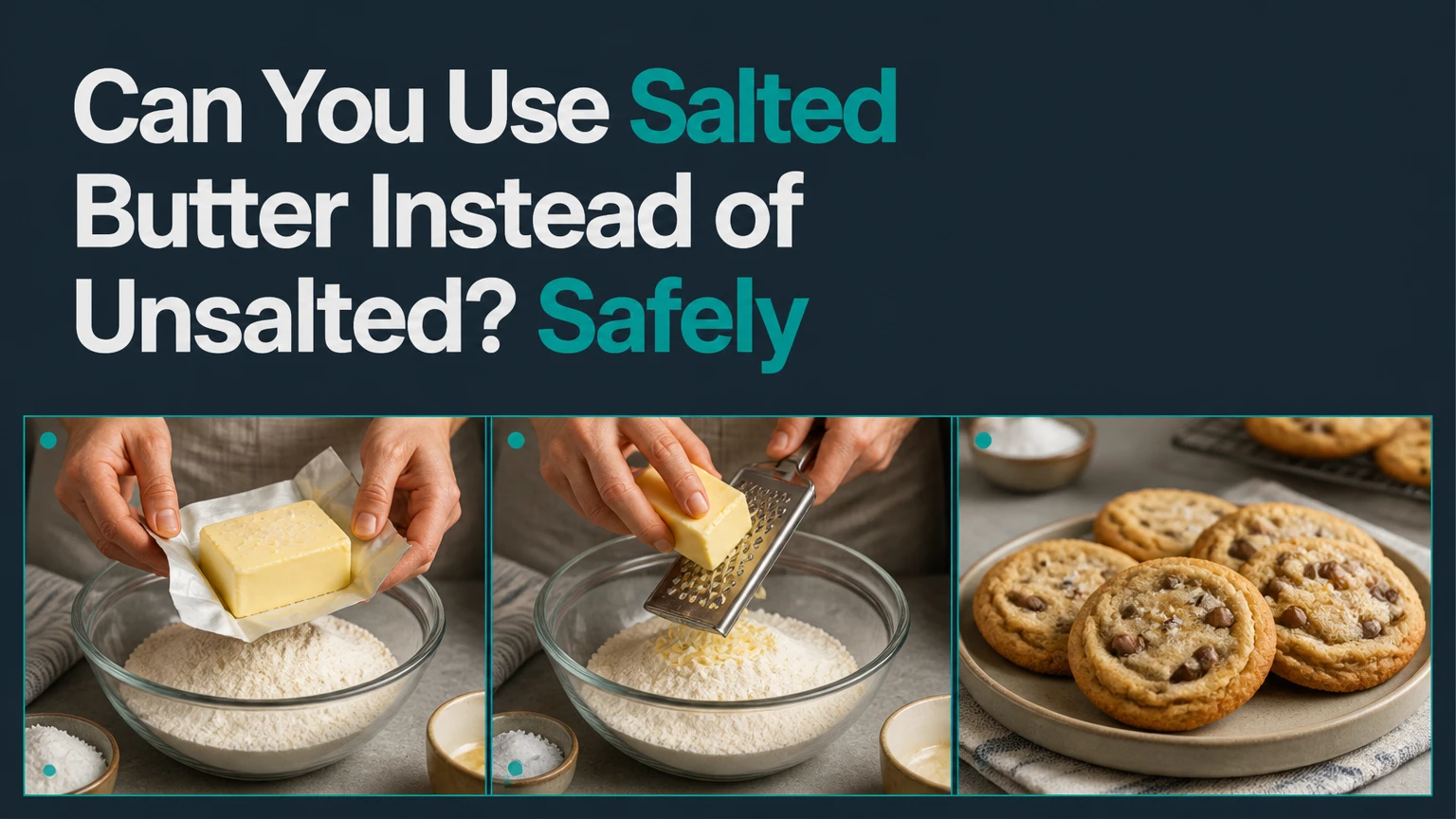
Yes, you can use salted butter instead of unsalted butter in most recipes. Use the same amount of butter, then reduce the recipe’s added salt by the amount listed on the butter label; if no sodium or salt information is available, a typical estimate is 1/4 teaspoon per 113 grams, or one U.S. stick.
Key facts at a glance
Salted butter and unsalted butter contain the same basic butter ingredients, but salted butter includes added salt.
Salt content varies substantially by brand, usually around 1%-2% of the butter’s weight.
One 113-gram U.S. stick of salted butter often contributes about 1/4 teaspoon of salt, but the package label is more reliable.
Salted butter works most predictably in sautéing, sauces, cookies, brownies, muffins, and quick breads.
Unsalted butter gives better seasoning control in delicate cakes, buttercream, pastry, and recipes with highly precise salt ratios.
Do not remove salt automatically from yeast bread. Reduce it only after accounting for the butter’s labeled salt content.
Can You Use Salted Butter Instead of Unsalted?
Salted butter can replace unsalted butter at a 1:1 quantity in nearly every ordinary recipe, provided the added salt is adjusted. The substitution changes seasoning more than it changes the butter’s fat and water balance, so the main risk is an overly salty result rather than a failed recipe.
The exception is a formula where salt is part of a tightly controlled process, such as a professional laminated dough, a very delicate buttercream, or a recipe that uses a large amount of butter but very little flour or liquid. Even there, salted butter is usually workable when the salt content is known and the dough temperature, hydration, and mixing method remain unchanged.
The practical rule is simple: weigh the butter, read its salt information, and subtract that salt from the recipe’s added salt. If the package reports sodium instead of salt, the label may require an estimate because sodium is only one component of salt.
What Is the Difference Between Salted and Unsalted Butter?
Unsalted butter has no intentionally added salt, while salted butter has salt mixed into the butter during processing. Both products are generally made from cream and contain approximately 80%-82% milkfat in standard U.S. butter, with the remainder consisting mainly of water and milk solids.
The U.S. Food and Drug Administration standard for butter requires at least 80% milkfat. Actual fat and moisture percentages vary by product and country, so a salted butter’s texture cannot be predicted from salt alone. European-style butter, for example, often contains at least 82% milkfat and may have less water than standard American butter.
Salt is added primarily for flavor and preservation. Salted butter does not automatically contain enough salt to season an entire dish, and unsalted butter is not chemically “pure” fat because it still contains water and milk solids.
| Butter attribute | Typical standard butter | Typical European-style butter | Why the difference matters |
|---|---|---|---|
| Milkfat | 80%-82% | 82%-85% | Higher fat can produce richer pastry texture |
| Water | About 16%-18% | Often about 14%-16% | Water affects steam and dough hydration |
| Added salt | 0% in unsalted | About 1%-2% in salted | Changes the recipe’s total salt |
| Milk solids | About 1%-2% | About 1%-2% | Brown-butter flavor depends on these solids |
| Common package size | 113 g stick | 227 g or 250 g block | Weight is safer than volume for conversion |
| Typical flavor | Sweet cream | Sweet cream or cultured | Culture adds tang independent of salt |
How Much Salt Is in Salted Butter?
Most salted butter contains roughly 1%-2% salt by weight, but the amount is not standardized tightly enough for a universal conversion. A typical 113-gram stick may contain about 1.1-2.3 grams of salt, which is approximately 1/5-2/5 teaspoon depending on the salt’s crystal size and density.
Many American baking references use 1/4 teaspoon per stick as a practical midpoint. That estimate is useful when a label provides no salt information, but it should not be treated as a guaranteed specification. Some brands contain less, while strongly salted or regional products contain more.
A nutrition label may list sodium rather than total salt. A rough kitchen conversion is 1 gram of sodium equal to about 2.5 grams of salt, although the exact calculation depends on the compound represented by the label. For routine baking, use the manufacturer’s stated salt amount when available.
| Salted butter amount | Typical butter weight | Estimated salt range | Practical recipe adjustment |
|---|---|---|---|
| 1 tablespoon | 14 g | 0.14-0.28 g | Reduce added salt by a small pinch |
| 1/4 cup | 57 g | 0.6-1.1 g | Reduce by about 1/8 teaspoon |
| 1/2 cup, 1 stick | 113 g | 1.1-2.3 g | Often reduce by about 1/4 teaspoon |
| 1 cup, 2 sticks | 226 g | 2.3-4.5 g | Often reduce by about 1/2 teaspoon |
| 250 g block | 250 g | 2.5-5 g | Calculate from the package label |
| 454 g package | 454 g | 4.5-9.1 g | Use weight-based recipe math |
How Should You Convert Unsalted Butter to Salted Butter?
To substitute salted butter, use the same butter weight and subtract the butter’s estimated salt from the recipe’s added salt. The process takes less than a minute when the butter label gives a salt percentage or sodium amount.
Step 1: Match the butter quantity
Measure the amount of salted butter required by weight whenever possible. If the recipe calls for 1/2 cup, use 113 grams in the United States; markings on wrapped sticks are acceptable when the package uses standard 113-gram sticks.
Step 2: Read the package
Look for a salt percentage, sodium quantity, or manufacturer guidance. A label that says 1.5% salt means 1.5 grams of salt per 100 grams of butter.
Step 3: Calculate the salt contribution
Use this formula:
Butter weight in grams × salt percentage ÷ 100 = grams of salt from butter
For 226 grams of butter labeled at 1.5% salt:
226 × 0.015 = 3.39 grams of salt
That amount is approximately 1/2 teaspoon of fine table salt, although measuring by grams is more accurate.
Step 4: Subtract only from added salt
If the recipe calls for 6 grams of salt and the butter contributes 3.4 grams, add approximately 2.6 grams separately. Do not remove salt from ingredients such as baking soda, baking powder, cheese, cured meat, or stock unless the recipe specifically permits that change.
Step 5: Recheck before mixing
If the recipe contains salted ingredients, reduce the added salt conservatively. A chocolate chip cookie with salted butter, salted nuts, and 2 teaspoons of added salt needs a different adjustment from a plain shortbread with no other salty ingredients.
| Recipe added salt | Butter used | Butter label assumption | Approximate salt to add separately |
|---|---|---|---|
| 1/4 tsp, about 1.4 g | 113 g | 1.5%, about 1.7 g | Add none |
| 1/2 tsp, about 2.8 g | 113 g | 1.5%, about 1.7 g | Add about 1/4 tsp |
| 1 tsp, about 5.7 g | 226 g | 1.5%, about 3.4 g | Add about 1/4-3/8 tsp |
| 1 1/2 tsp, about 8.5 g | 226 g | 1.5%, about 3.4 g | Add about 7-9 g, depending on salt |
| 2 tsp, about 11.4 g | 454 g | 1.5%, about 6.8 g | Add about 3/4-1 tsp |
A useful practitioner rule is to avoid adjusting salt by volume when the recipe is large or expensive. Salt crystals differ in density, and 1 teaspoon of fine table salt does not weigh the same as 1 teaspoon of coarse kosher salt.
Does Salted Butter Work in Baking?
Salted butter works well in cookies, brownies, muffins, pancakes, quick breads, and many loaf cakes. Unsalted butter remains preferable when the recipe has a narrow margin for seasoning or when the butter’s salt level would represent a large share of the formula.
Salt affects more than taste in baked goods. In yeast dough, salt moderates fermentation and strengthens dough structure. In pastry, salt seasons the dough but does not normally create the main flaky structure. In cakes and cookies, the added salt level influences flavor balance, but the butter substitution itself usually does not create a major change in rise.
Cookies and brownies
Salted butter is usually a low-risk substitute for drop cookies and brownies. Chocolate, caramel, oats, and nuts can tolerate modest salt variation, and many bakers prefer the contrast created by salted butter.
Reduce the separate salt by about 1/4 teaspoon per stick as a starting point, then check whether the recipe includes pretzels, peanut butter, salted nuts, or chocolate with added salt. Those ingredients can contribute more sodium than the butter.
Cakes and cupcakes
Salted butter works in a basic cake when the added salt is adjusted. Use unsalted butter for a delicately flavored sponge, genoise, white cake, or buttercream where a small seasoning difference is easy to notice.
The water difference between two butter brands is usually smaller than the variation created by measuring flour by volume. Accurate flour weighing and correct creaming often matter more than choosing salted or unsalted butter.
Pie crust and shortbread
Salted butter works in pie dough and shortbread, but the recipe’s existing salt must be reduced carefully because these formulas can contain a high proportion of butter. A salty shortbread is difficult to disguise.
European-style butter can also change pastry handling because higher milkfat generally means slightly less water. That is a separate variable from salt. Do not attribute every difference in flakiness to salted butter.
Yeast bread
Salted butter can replace unsalted butter in enriched bread, brioche, rolls, and some sandwich loaves. Reduce the recipe’s added salt only after calculating the butter contribution, because salt controls yeast activity and dough strength.
Bread recipes with 30 grams of butter and 10 grams of salt will show little seasoning change from a typical salted butter substitution. A brioche with 250 grams of butter and only 8 grams of added salt requires more careful calculation.
| Baked application | Salted butter suitability | Main adjustment | Unsalted butter advantage |
|---|---|---|---|
| Chocolate chip cookies | High | Reduce salt by 1/4 tsp per stick, typical | Exact seasoning control |
| Brownies | High | Check salted chocolate and nuts | Cleaner cocoa balance |
| Plain sponge cake | Moderate | Measure salt precisely | Delicate flavor control |
| Buttercream | Moderate to low | Omit or reduce added salt | Predictable sweetness |
| Pie crust | Moderate | Reduce salt in the dough | More consistent seasoning |
| Shortbread | Moderate | Calculate all salt carefully | Lower risk of harsh saltiness |
| Brioche | Moderate | Account for butter salt and yeast salt | Easier formula control |
| Muffins | High | Reduce added salt modestly | No major structural advantage |
When Is Unsalted Butter the Better Choice?
Unsalted butter is the better choice when a recipe’s salt level is small, when other ingredients already contain salt, or when the finished food has a delicate flavor. Unsalted butter also helps professional kitchens standardize results across brands and production batches.
Use unsalted butter for pastry creams, buttercream, shortbread with a measured salt finish, laminated doughs, and recipe testing. The reason is control, not that salted butter is inherently inferior. A known salt quantity lets the cook separate seasoning decisions from butter selection.
Salted butter is often the better everyday choice for pan-frying, finishing vegetables, spreading on bread, and making a quick sauce. In those applications, the cook can taste and adjust the dish after the butter melts.
| Situation | Recommended butter | Reason | Adjustment needed |
|---|---|---|---|
| Recipe includes cheese | Unsalted | Cheese may supply substantial salt | Add salt after tasting |
| Recipe includes 2 or more teaspoons salt | Either | Butter salt is a smaller percentage | Reduce by label amount |
| Buttercream or custard | Unsalted | Sweet flavors expose salt differences | Control seasoning precisely |
| Sautéed vegetables | Salted | Seasoning occurs during cooking | Add less additional salt |
| Croissant production | Unsalted | Formula and dough control matter | Follow baker’s percentage |
| Toast or table use | Salted | Salt is part of the eating experience | No conversion required |
| Recipe lacks a salt quantity | Unsalted | Prevents accidental over-seasoning | Season to taste |
| Brand salt content is unknown | Unsalted | Removes a variable | Use recipe amount directly |
Can Salted Butter Be Used for Brown Butter?
Salted butter can be browned, but unsalted butter is easier to monitor and measure because salt may foam, sputter, and settle in the pan. Salted butter is safe for browning when the recipe can tolerate its added salt and the cook plans to scrape the browned milk solids from the pan.
Brown butter loses water as it cooks, so the final weight is lower than the starting weight. A common kitchen method begins with 113 grams of butter and finishes with roughly 85-95 grams, depending on evaporation and the desired degree of browning. The exact yield changes with pan width, heat, and cooking time.
Browned salted butter can taste excellent in cookies, pasta, vegetables, and sauces. For cakes or frosting, use unsalted butter if the recipe’s sweetness and salt balance are tightly specified.
Does Salted Butter Have More Water?
Salted butter does not reliably have more water than unsalted butter. The water content depends mainly on the butter’s formulation and manufacturing standard, while added salt can change labeling and moisture behavior without creating a predictable, brand-independent difference.
The claim that salted butter always contains more water is therefore too broad. Butter sold under the same national standard may have similar fat and water limits whether it is salted or unsalted. European-style butter, cultured butter, and specialty products can differ more because of their fat percentage and processing.
For most home recipes, salt adjustment matters more than a small water variation between ordinary brands. In croissants, puff pastry, and pâte brisée, compare the butter’s fat percentage and handling temperature as well as its salt status.
How Do American, European-Style, and Cultured Butters Compare?
American sweet-cream butter is the most predictable everyday option, European-style butter often has higher milkfat, and cultured butter has a tangier flavor from fermented cream. Salted or unsalted status is an additional attribute, so “European-style” does not mean unsalted and “cultured” does not mean more salty.
| Butter type | Typical fat level | Flavor profile | Best substitution use |
|---|---|---|---|
| American sweet cream | 80%-82% | Mild, clean dairy flavor | Cookies, cakes, sauces |
| European-style | 82%-85% | Richer, sometimes nutty | Pastry, finishing, laminated dough |
| Cultured butter | About 80%-85% | Tangy, complex dairy flavor | Toast, vegetables, composed sauces |
| Clarified butter | Nearly all butterfat | Toasted, clean fat flavor | High-heat cooking |
| Whipped butter | Variable by volume | Mild, airy texture | Spreading, not precise baking |
| Plant-based stick | Variable | Product-dependent | Dairy-free formulas only |
Choose butter by the variables the recipe needs. A laminated dough may benefit from a pliable, high-fat block, while a cookie recipe may benefit more from ordinary butter with a familiar water content.
What If the Recipe Is Already Too Salty?
If a mixed batter or dough is too salty, the safest fix is dilution, not adding sugar or water alone. Increase every major formula ingredient proportionally when possible, because a one-sided change can damage hydration, spread, rise, or texture.
For a cookie dough, make a half or full additional batch without salt and combine it with the salty dough. For soup or sauce, add unsalted liquid, starch, vegetables, cream, or another unseasoned base, then rebalance thickness.
Do not add 10% more flour automatically. That remedy can make cookies dry, bread dense, and cakes tough because flour changes structure as well as dilution.
| Problem | Likely cause | Best recovery | Avoid |
|---|---|---|---|
| Salty cookie dough | Butter plus added salt | Mix in unsalted dough | Adding water alone |
| Salty soup | Salted butter plus stock | Add unsalted stock or vegetables | Adding sugar as the main fix |
| Salty frosting | Salted butter | Add unsalted butter and powdered sugar proportionally | Adding large amounts of milk |
| Salty bread dough | Butter and recipe salt combined | Make an unsalted dough addition | Removing salt after fermentation |
| Salty pie dough | High butter ratio | Blend with an unsalted dough portion | Overworking the pastry |
| Salty pan sauce | Salted butter reduced with stock | Add unsalted liquid, then reduce carefully | Continuing to reduce before dilution |
How Should You Store Salted Butter?
Salted butter generally keeps its quality longer in the refrigerator than unsalted butter, but the exact period depends on temperature, packaging, exposure to air, and the product’s sell-by guidance. Salt slows microbial growth, yet it does not make butter shelf-stable.
Store butter tightly wrapped at 4°C or below, the refrigerator temperature recommended by the U.S. Department of Agriculture for perishable foods. Keep butter away from strong odors because milk fat readily absorbs refrigerator smells.
A typical unopened package may retain good quality for several weeks beyond purchase when refrigerated, while opened butter is best assessed by smell, flavor, and visible condition. Freezing at 0°F, or -18°C, preserves butter for longer storage, although freezer odors and texture changes can develop.
| Storage condition | Typical quality window | Packaging | Quality check |
|---|---|---|---|
| Refrigerator, unopened | Several weeks to a few months | Original wrapper plus container | Use package date and smell |
| Refrigerator, opened | About 2-6 weeks | Airtight wrap or box | Check for rancid odor |
| Freezer, wrapped | About 6-12 months | Foil, freezer bag, airtight box | Check freezer odor and discoloration |
| Counter, cool room | About 1-2 days | Covered butter dish | Use only when temperature is controlled |
| Warm kitchen | Less than 1 day | Covered container | Refrigerate promptly |
The preservative benefit of salt is real but limited. Salted butter can still become rancid through oxidation, especially when warm, exposed to light, or stored beside aromatic foods.
Common Mistakes When Substituting Butter
Treating 1/4 teaspoon as a law
The 1/4-teaspoon-per-stick rule is a typical estimate, not a universal standard. Brand labels, country standards, butter weight, and salt crystal density can all change the actual contribution.
Removing salt from every recipe
Salted butter does not require removing all salt. Bread, cakes, cookies, and sauces often need some additional salt for flavor and function after the butter contribution is counted.
Confusing salted butter with salted ingredients
Salted butter is only one source of sodium. Stock, cheese, nut butter, chocolate, cured meat, baking mixes, and seasoning blends may dominate the final flavor.
Measuring a butter block by the wrapper alone
A 250-gram block is not the same quantity as two U.S. sticks, which usually total 226 grams. Weigh international butter blocks when the recipe specifies cups or sticks.
Blaming salt for a pastry failure
Tough or tear-prone pastry is more often linked to excess water, warm butter, excessive mixing, or insufficient resting. Salt can affect dough strength, but salted butter does not make every pastry structurally defective.
Using volume math for large batches
For production baking, calculate salt in grams and express it as a baker’s percentage. This prevents a brand change from silently altering the formula.
Frequently Asked Questions
Can I use salted butter in a recipe that does not list salt?
Yes, but taste the finished mixture when the recipe allows it and avoid adding salt until other ingredients are combined. In a small-batch shortbread or frosting, salted butter may provide nearly all the seasoning required; in bread or savory cooking, the recipe may still need additional salt.
Is salted butter better for cookies?
Salted butter is often excellent in cookies because chocolate, sugar, oats, and nuts tolerate moderate seasoning variation. Reduce the recipe’s added salt by about 1/4 teaspoon per 113-gram stick as a starting point, then account for salted nuts, peanut butter, pretzels, or salted chocolate.
Can I use salted butter in buttercream?
Yes, but unsalted butter is usually easier to control in buttercream. Salted butter can balance very sweet frosting, yet the final result depends on the brand’s salt level and the amount of powdered sugar. Omit any added salt first, then add more only after tasting.
Can salted butter replace unsalted butter in pancakes?
Yes. Use the same amount of salted butter and reduce the batter’s added salt modestly, especially if the pancakes will be served with salted toppings. Melted butter in the batter and butter used on the pan should both be included in the substitution calculation.
Can I use salted butter for pastry cream?
Yes, but unsalted butter is the more precise option because pastry cream has a mild flavor and a small amount of salt can become noticeable. If using salted butter, omit added salt initially and taste after the cream cools, since chilling changes flavor perception.
Does salted butter expire later than unsalted butter?
Salted butter often maintains acceptable quality longer under refrigeration because salt slows some microbial activity. Salt does not prevent rancidity, mold, odor absorption, or quality loss, so follow the package guidance and discard butter with a sour, paint-like, or stale smell.
The Bottom Line
Can you use salted butter instead of unsalted? Yes, use it in the same quantity and subtract its labeled salt from the recipe’s added salt. For an unlabelled 113-gram stick, 1/4 teaspoon is a practical typical estimate, while unsalted butter remains the better choice when precise seasoning, delicate flavor, or professional formula consistency matters.
