

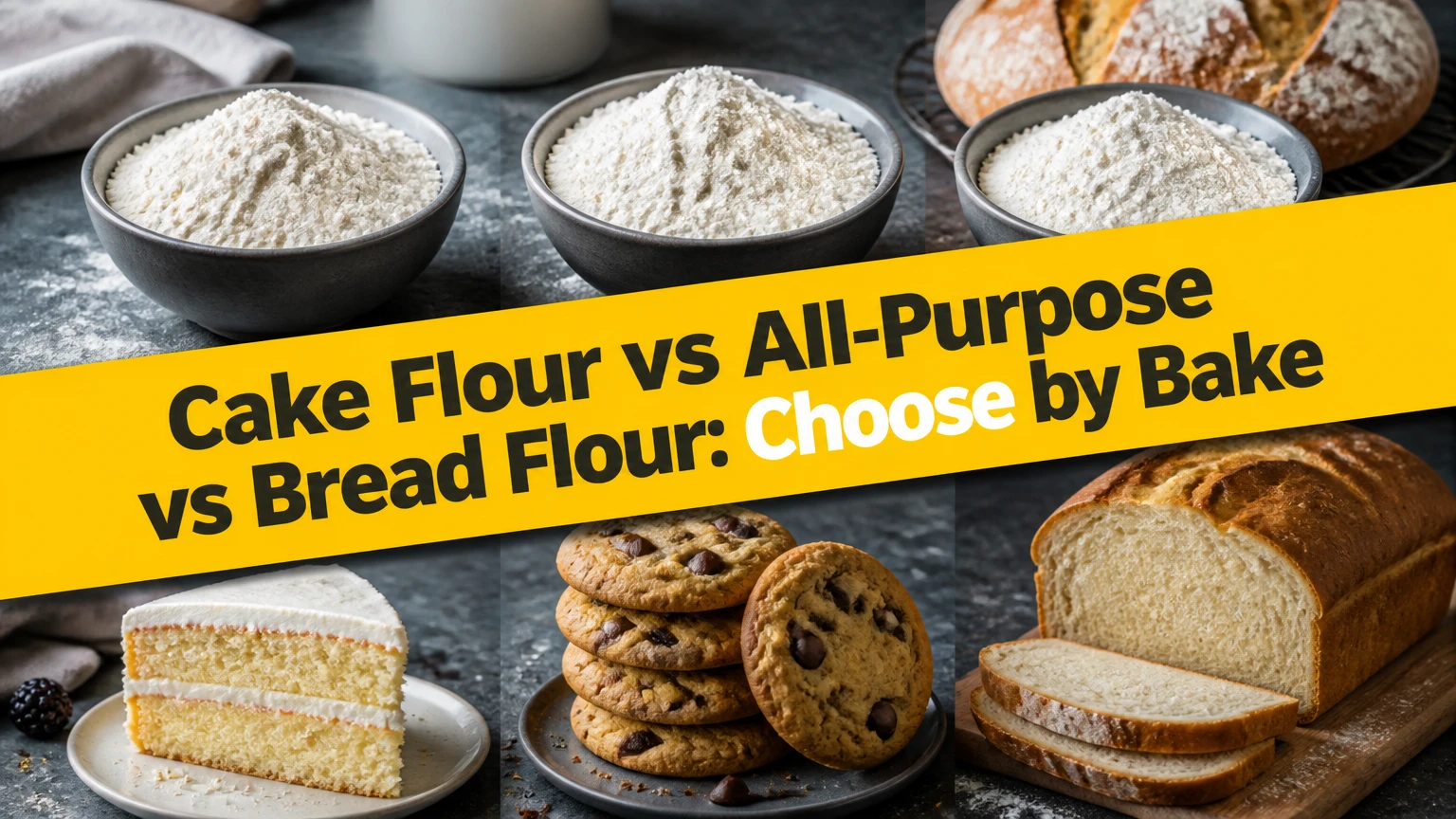
Cake flour creates the most delicate crumb, all-purpose flour offers the broadest balance, and bread flour produces the strongest, chewiest structure. The best choice depends on the baked good, desired texture, hydration, and mixing method. Protein percentage predicts gluten potential, but bleaching, milling, brand formulation, and recipe technique also affect the final result.
Key Facts
Cake flour typically contains 7-9% protein, all-purpose flour 10-12%, and bread flour 12-14%.
Cake flour suits tender cakes, all-purpose flour suits versatile everyday baking, and bread flour suits yeast doughs.
Bread flour can make cakes, cookies, and pie crusts tougher when mixing or hydration is not adjusted.
All-purpose flour can replace cake flour in many recipes when 2 tablespoons per cup are replaced with cornstarch.
All-purpose flour can replace bread flour, but the loaf may have slightly less chew and height.
A flour label does not guarantee one universal protein value because brands and countries use different wheat blends and testing methods.
What Is the Difference Between the Three Flours?
Cake flour, all-purpose flour, and bread flour differ mainly in wheat hardness, protein content, milling treatment, and the amount of gluten structure they can develop. Cake flour is engineered for tenderness, all-purpose flour for balance, and bread flour for strength. The categories describe tendencies, not absolute performance guarantees.
When flour meets water, gliadin contributes extensibility while glutenin contributes elastic strength. Mixing aligns those proteins into a gluten network. Yeast dough needs that network to retain carbon dioxide, while a cake batter usually needs enough structure to hold its cells without becoming rubbery.
Protein is measured as a percentage of flour weight. A 12% protein flour contains approximately 12 grams of protein per 100 grams of flour, although the protein will not all form gluten. Bran, acidity, sugar, fat, eggs, mixing intensity, and available water all change how much structure develops.
Master Comparison Table
| Flour type | Typical protein | Wheat and treatment | Typical texture | Best uses |
|---|---|---|---|---|
| Cake flour | 7-9% | Soft wheat, usually finely milled; often bleached | Fine, tender, delicate | Layer cake, angel food cake, chiffon |
| All-purpose flour | 10-12% | Hard and soft wheat blend; bleached or unbleached | Balanced, moderately tender | Cookies, muffins, brownies, pie |
| Bread flour | 12-14% | Hard wheat, often higher gluten potential | Chewy, elastic, substantial | Yeast bread, bagels, pizza, pretzels |
How Do the Three Flours Build Structure?
Cake flour forms the weakest gluten network, all-purpose flour forms an intermediate network, and bread flour forms the strongest network under comparable hydration and mixing. That difference controls whether a baked product feels soft and fine or resilient and chewy.
Cake flour’s low protein limits gluten formation. Its fine particles and, in many brands, chlorination also support rapid absorption of liquid and fat. Chlorinated cake flour can produce a stable, fine crumb in high-sugar formulas because the treatment changes starch behavior and lowers flour pH.
All-purpose flour is the practical middle ground. Unbleached AP flour often gives cookies slightly more spread resistance and chew, while bleached AP flour can produce a softer, paler result in some cakes and cookies.
Bread flour needs adequate water and development. Kneading, folding, or machine mixing allows its proteins to create a resilient network that holds gas during fermentation. More protein alone does not guarantee a better loaf. A dry dough made with bread flour can still bake dense.
Practitioner rule: Flour protein predicts potential strength, while dough hydration and mechanical development determine how much of that potential appears in the finished food.
Specification and Behavior Table
| Attribute | Cake flour | All-purpose flour | Bread flour |
|---|---|---|---|
| Typical protein range | 7-9% | 10-12% | 12-14% |
| Gluten potential | Low | Medium | High |
| Common color | Very pale | Cream to pale | Cream to light tan |
| Water need in lean dough | Low | Moderate | Higher |
| Preferred mixing | Brief, low agitation | Moderate | Kneading or folding |
| Main sensory result | Soft and fine | Balanced | Chewy and elastic |
Which Flour Is Best for Cakes?
Cake flour is usually the best choice for tender layer cakes, angel food cake, chiffon cake, and cupcakes where a fine, soft crumb matters most. All-purpose flour works well for denser butter cakes, chocolate cakes, muffins, and recipes with enough eggs or fat to soften the structure.
Cake flour is not automatically the best flour for every cake. A pound cake needs enough strength to support a high proportion of butter, sugar, and eggs. A chocolate cake may use AP flour because cocoa powder already changes liquid absorption and structure. A recipe developed with unbleached AP flour may become too fragile if converted entirely to cake flour.
Cake Applications by Desired Result
| Desired result | Recommended flour | Typical recipe example | Main risk |
|---|---|---|---|
| Fine, pale crumb | Cake flour | Vanilla layer cake | Collapse from excessive softness |
| Moist chocolate crumb | AP flour | Chocolate sheet cake | Slightly firmer crumb |
| Tall, chewy muffin top | AP flour | Blueberry muffin | Toughness from overmixing |
| Light foam structure | Cake flour | Angel food cake | Fragility during cooling |
| Dense, rich slice | AP or pastry flour | Pound cake | Cake flour may lack support |
Cake flour also interacts with leavening. Because low-protein flour provides less structural support, accurate baking powder, egg, and sugar ratios become more important. Underbaking a cake made with cake flour can leave the center unable to support its own moisture.
Which Flour Is Best for Bread and Pizza?
Bread flour is usually the best choice for lean yeast doughs that need height, chew, and gas retention, including sourdough, baguettes, bagels, pretzels, and many pizza styles. All-purpose flour is often preferable for soft sandwich bread, dinner rolls, and thin-crust pizza when a less chewy bite is wanted.
Bread flour can absorb more water than cake flour, but published package protein values do not directly predict a fixed hydration percentage. Typical home-baking formulas may use 60-75% hydration for bread, while bagels often fall near 50-60% and pizza dough commonly ranges from 60-70%, depending on flour and method.
Bread and Pizza Selection Table
| Product | Preferred flour | Typical hydration range | Desired structure |
|---|---|---|---|
| Baguette | Bread flour | 65-75% | Open crumb and elastic walls |
| Bagel | Bread flour | 50-60% | Dense, chewy crumb |
| Soft dinner roll | AP flour | 55-65% | Tender, pull-apart crumb |
| Thin pizza | AP or bread flour | 60-68% | Crisp edge with moderate chew |
| Sourdough loaf | Bread or strong AP | 68-85% | Gas retention and extensibility |
The same flour can behave differently after a long fermentation. Enzymes gradually modify starch and proteins, while hydration time softens the dough. A strong bread flour may feel tight after mixing but become more extensible after a 20-60 minute rest.
Expert insight: A flour with 14% protein is not automatically superior for pizza. Very strong flour can produce a tight, rubbery dough unless fermentation, hydration, and resting time are increased.
Which Flour Fits Cookies, Pie, Biscuits, and Muffins?
All-purpose flour is the safest default for cookies, brownies, pie crust, biscuits, pancakes, and muffins because its intermediate protein supports shape without requiring specialized adjustments. Cake flour produces a softer, more fragile result, while bread flour increases chew and can make pastry tough.
The recipe’s fat, sugar, and mixing method matter as much as the flour. Cookie dough mixed briefly with bread flour may remain pleasant, while a pie crust made with AP flour can become tough after repeated rolling and warm handling.
Common Bake Decision Table
| Bake | Best default | Softer alternative | Stronger alternative |
|---|---|---|---|
| Chocolate chip cookies | AP flour | Cake flour blend | Bread flour for extra chew |
| Brownies | AP flour | Cake flour for softer edges | Bread flour is rarely useful |
| Pie crust | AP or pastry flour | Cake flour blend | Bread flour usually increases toughness |
| Biscuits | AP or pastry flour | Cake flour blend | Bread flour for chewier biscuits |
| Pancakes | AP flour | Cake flour for delicate texture | Bread flour can become rubbery |
| Muffins | AP flour | Cake flour for finer crumb | Bread flour for dense chew |
A cookie recipe with a high butter ratio may spread more when made with cake flour because the lower-protein flour offers less resistance. If the dough spreads excessively, chilling can help, but chilling cannot fully replace the structural difference between flours.
Does Bleached Flour Matter?
Bleached flour can produce a softer, paler crumb and may behave differently from unbleached flour in cakes, cookies, and pastries. The effect is usually more noticeable in delicate cakes than in rustic bread, but brand formulation and recipe ratios still matter more than the word bleached alone.
Chemical bleaching reduces flour aging time and changes flour color and functional properties. Chlorinated cake flour is a specialized example. It is not the same as simply using a lower-protein unbleached flour, because chlorination also affects starch and acidity.
Bleached AP flour may suit soft cookies and cakes. Unbleached AP flour often gives more color and a slightly firmer bite. Neither option is universally better. A recipe written for one type may need a small adjustment when the other is used.
Bleached and Unbleached Comparison
| Feature | Bleached flour | Unbleached flour |
|---|---|---|
| Typical appearance | Whiter, especially cake flour | Creamier, warmer color |
| Common use | Cakes, soft cookies, pastry | Bread, cookies, general baking |
| Flavor difference | Usually subtle | Slightly fuller wheat flavor |
| Structural effect | Often softer in delicate formulas | Often slightly firmer |
| Best substitution approach | Use in same weight first | Adjust mixing only if texture changes |
Why Does Measurement Matter?
A cup of flour commonly weighs 120-130 grams, but the actual mass changes with brand, humidity, sifting, and whether the flour is scooped or spooned. Weighing flour in grams is the most reliable way to preserve a recipe’s intended protein, starch, and hydration ratios.
The frequently used 120-gram cup convention is a practical standard, not a chemical constant. A packed cup can exceed 150 grams, adding enough flour to make cake dry or bread excessively stiff.
Use the following sequence:
- Place the bowl on a digital scale.
- Tare the scale to zero.
- Add flour by the recipe’s gram weight.
- If using cups, spoon flour into the cup and level it without compacting.
- Keep the measurement method consistent when comparing substitutions.
Typical Flour Weights
| Measurement method | Cake flour | AP flour | Bread flour |
|---|---|---|---|
| 1 level cup, typical range | 110-120 g | 120-130 g | 125-135 g |
| 1 tablespoon, typical range | 6-8 g | 7-8 g | 8-9 g |
| 100 g volume estimate | 0.83-0.91 cup | 0.77-0.83 cup | 0.74-0.80 cup |
| Main error risk | Fragile cake formula | Dry cookies or cake | Stiff dough |
How Can You Substitute AP Flour for Cake or Bread Flour?
All-purpose flour can replace cake flour by replacing part of the AP flour with cornstarch, or replace bread flour directly with a modest texture change. Substitution is most predictable by weight, and the result will imitate protein dilution or gluten strength, not every property of the original flour.
To Approximate Cake Flour
For each 120 grams of cake flour required:
- Weigh 105 grams of all-purpose flour.
- Add 15 grams of cornstarch.
- Whisk thoroughly or sift once or twice.
- Use the blend at the same total weight.
The common volume method is 1 cup AP flour minus 2 tablespoons, replaced by 2 tablespoons cornstarch. The weight method is more reliable because tablespoons of flour and cornstarch do not always weigh the same.
Cornstarch contains no gluten-forming wheat protein, so the blend lowers protein concentration. The substitution does not reproduce the exact starch damage, acidity, or particle size of commercial chlorinated cake flour.
To Approximate Bread Flour
For each 120 grams of AP flour:
- Add approximately 4-5 grams of vital wheat gluten.
- Remove 4-5 grams of AP flour if maintaining the original total weight.
- Mix the dry ingredients completely.
- Add water gradually and assess dough consistency.
Vital wheat gluten is typically around 75-80% protein, but the needed amount depends on the AP flour’s starting protein and the target dough. Adding too much can create a rubbery, overly elastic loaf.
Substitution Outcomes
| Original flour | Substitute | Quantity basis | Expected result |
|---|---|---|---|
| Cake flour | 105 g AP + 15 g cornstarch | Per 120 g flour | Slightly firmer, still tender |
| Cake flour | 120 g AP | Same weight | More gluten, stronger crumb |
| Bread flour | 120 g AP | Same weight | Slightly less chew and height |
| Bread flour | 115 g AP + 5 g gluten | Per 120 g total | Stronger dough, less authentic flour behavior |
| AP flour | Cake flour | Same weight | Softer, potentially more fragile |
What These Substitutions Cannot Do
Cornstarch cannot make wheat flour gluten-free, and vital wheat gluten cannot make AP flour identical to bread flour. Gluten-free baking requires a formulated blend containing suitable starches, proteins, binders, and hydration adjustments.
A cake-flour substitute also cannot guarantee the same performance in angel food cake or high-ratio cake formulas. Commercial cake flour may have controlled acidity and starch behavior that affect emulsification, volume, and crumb stability.
A bread-flour substitute cannot correct weak yeast, inadequate fermentation, poor shaping, or insufficient baking. If dough lacks strength, first check kneading, hydration, proofing, and flour freshness before adding gluten.
What Do These Flours Cost?
Typical United States grocery prices range from about $0.50-$1.00 per pound for store-brand AP flour, $0.80-$1.60 for bread flour, and $1.20-$2.50 for cake flour. Organic, specialty-milled, small-bag, and certified products can cost considerably more.
Cost per recipe is usually modest. A cake using 300 grams of flour may use $0.35-$0.70 of AP flour or $0.75-$1.50 of specialty cake flour, depending on package price.
Typical Retail Cost and Storage
| Flour | Typical price per pound | Pantry peak quality | Freezer quality |
|---|---|---|---|
| Store-brand AP | $0.50-$1.00 | 6-12 months | 12-24 months |
| Bread flour | $0.80-$1.60 | 6-12 months | 12-24 months |
| Cake flour | $1.20-$2.50 | 6-12 months | 12-24 months |
| Whole-wheat flour | $0.90-$2.00 | 1-3 months | 6-12 months |
The storage figures are typical quality windows, not safety guarantees. White flour lasts longer than whole-wheat flour because wheat germ contains oils that oxidize more quickly. The United States Department of Agriculture recommends cool, dry storage and checking flour for rancid odors, insects, moisture, or mold.
Store flour in an airtight container away from heat and sunlight. Refrigerated or frozen flour should return close to room temperature before mixing when a recipe depends on accurate dough temperature.
Why Do Flour Labels Vary by Country?
Flour names are not globally standardized. In the United Kingdom, plain flour often resembles lower-to-medium protein AP flour, while strong bread flour resembles American bread flour; Australian and European protein ranges also vary by mill and product.
The label is less informative than the nutrition panel and product specification. Compare protein grams per 100 grams when available, but remember that nutrition-label protein and baking performance are related rather than identical measurements.
Label Translation Guide
| Label or region | Approximate American equivalent | Typical protein | Important caution |
|---|---|---|---|
| US cake flour | Cake flour | 7-9% | Often chlorinated |
| US all-purpose | AP flour | 10-12% | Bleached status varies |
| US bread flour | Bread flour | 12-14% | Brand strength varies |
| UK plain flour | AP or pastry flour | 9-11% | Product-specific |
| UK strong white flour | Bread flour | 12-14% | Often designed for yeast dough |
| Italian 00 flour | Not one fixed type | Variable | “00” describes milling grade |
Which Flour Should You Choose?
Choose cake flour for a delicate cake, all-purpose flour for a general-purpose pantry, and bread flour for a chewy yeast dough. The best flour is the one whose structural strength matches the recipe’s desired texture and process.
For the Beginner Baker
Choose unbleached or bleached all-purpose flour in a 2- to 5-pound bag. AP flour covers cookies, brownies, pancakes, muffins, pie crust, quick bread, and many yeast recipes without requiring separate hydration calculations.
For the Cake Baker
Choose cake flour for angel food, chiffon, and light layer cakes. Keep AP flour available for pound cake, chocolate cake, muffins, and recipes that need more support.
For the Bread Baker
Choose bread flour for bagels, lean sourdough, baguettes, and high-hydration dough. Choose AP flour for soft rolls and less chewy sandwich bread.
For the Small Kitchen
Buy AP flour first, then add cake flour or bread flour only when a recipe repeatedly demands a specific crumb. A single AP bag is often more economical than keeping three partly used bags that lose freshness.
Troubleshooting Flour Problems
Flour choice can cause texture problems, but mixing, hydration, fermentation, and baking errors often create the same symptoms. Diagnose the process before changing flour.
Failure and Recovery Table
| Symptom | Likely cause | Flour connection | Recovery |
|---|---|---|---|
| Cake is rubbery | Overmixing or strong flour | AP or bread flour developed excess gluten | Mix only until combined |
| Cake collapses | Underbaking or weak structure | Cake flour can be fragile | Bake to an internal center temperature near 200-210°F |
| Bread is dense | Weak development or low hydration | Cake flour cannot hold gas well | Use AP or bread flour; knead and hydrate fully |
| Pie crust is tough | Warm fat or repeated rolling | AP flour formed excess gluten | Chill dough and minimize handling |
| Cookies spread | Low structure or warm dough | Cake flour offers less resistance | Chill dough or use AP flour |
| Dough feels rubbery | Excess gluten or low hydration | Bread flour is highly elastic | Rest, add water carefully, reduce gluten |
A collapsed cake is not automatically proof that cake flour failed. Excess liquid, underbaking, an opened oven door, weak egg foam, or insufficient cooling can produce the same result.
A short loaf is not automatically proof that AP flour is too weak. Underproofing, dead yeast, low dough temperature, or poor shaping can prevent volume even with strong bread flour.
How Should You Store and Replace Flour?
Store white flour airtight in a cool, dark pantry for best quality within roughly 6-12 months, or freeze it for approximately 12-24 months. Replace flour when it smells sour, oily, musty, or paint-like, or when insects and moisture appear.
Write the purchase date on the container. Keep whole-wheat flour in the refrigerator or freezer when it will not be used within several weeks. Thaw frozen flour in its sealed container to prevent condensation from wetting the powder.
Never use storage time as the only test. Smell, appearance, and dryness provide more useful signals than a printed date alone.
FAQ
Can bread flour be used for cake?
Bread flour can be used for cake in an emergency, but the crumb may become firmer and chewier because bread flour contains more gluten-forming protein. Reduce mixing to the minimum, avoid extra stirring after flour hydration, and expect less tenderness than a recipe made with cake or AP flour.
Is cake flour the same as pastry flour?
Cake flour and pastry flour are related but not identical. Cake flour usually contains about 7-9% protein, while pastry flour often falls near 8-10%. Pastry flour is a useful compromise for biscuits, pie crust, and tender cookies, while cake flour better suits fine, delicate cakes.
Should I use bleached or unbleached flour for cookies?
Use either, but expect a small texture and color difference. Bleached AP flour can produce a softer, paler cookie, while unbleached AP flour may give more browning and a slightly firmer bite. Dough temperature, butter consistency, sugar ratio, and bake time usually have a larger effect.
Can I mix cake flour and bread flour?
You can mix cake flour and bread flour to create an intermediate-strength blend, although the exact protein level depends on each product. Equal weights of 8% cake flour and 14% bread flour would average approximately 11% protein before other ingredients, which is close to many AP flours.
Does more protein always mean more gluten?
More protein generally creates greater gluten potential, but not every flour protein behaves identically. Wheat variety, protein quality, hydration, acidity, salt, sugar, fat, fermentation, and mixing determine the final gluten network. A high-protein flour can still produce weak dough if it is underhydrated or poorly developed.
Can I use these flours in gluten-free baking?
No. Cake flour, AP flour, and bread flour are wheat flours containing gluten-forming proteins. Gluten-free baking requires a wheat-free flour blend and usually needs a binder such as xanthan gum, psyllium husk, or eggs to replace gluten’s structure.
The Bottom Line
Cake flour vs all-purpose vs bread flour is a choice between tenderness, balance, and strength. Use cake flour for fine cakes, AP flour for the widest range of recipes, and bread flour for chewy yeast doughs. Substitutions work when you adjust protein, hydration, and handling, but no shortcut perfectly reproduces a flour’s milling and treatment. For most home kitchens, AP flour is the best first purchase; add cake or bread flour when a specific texture justifies it.
