

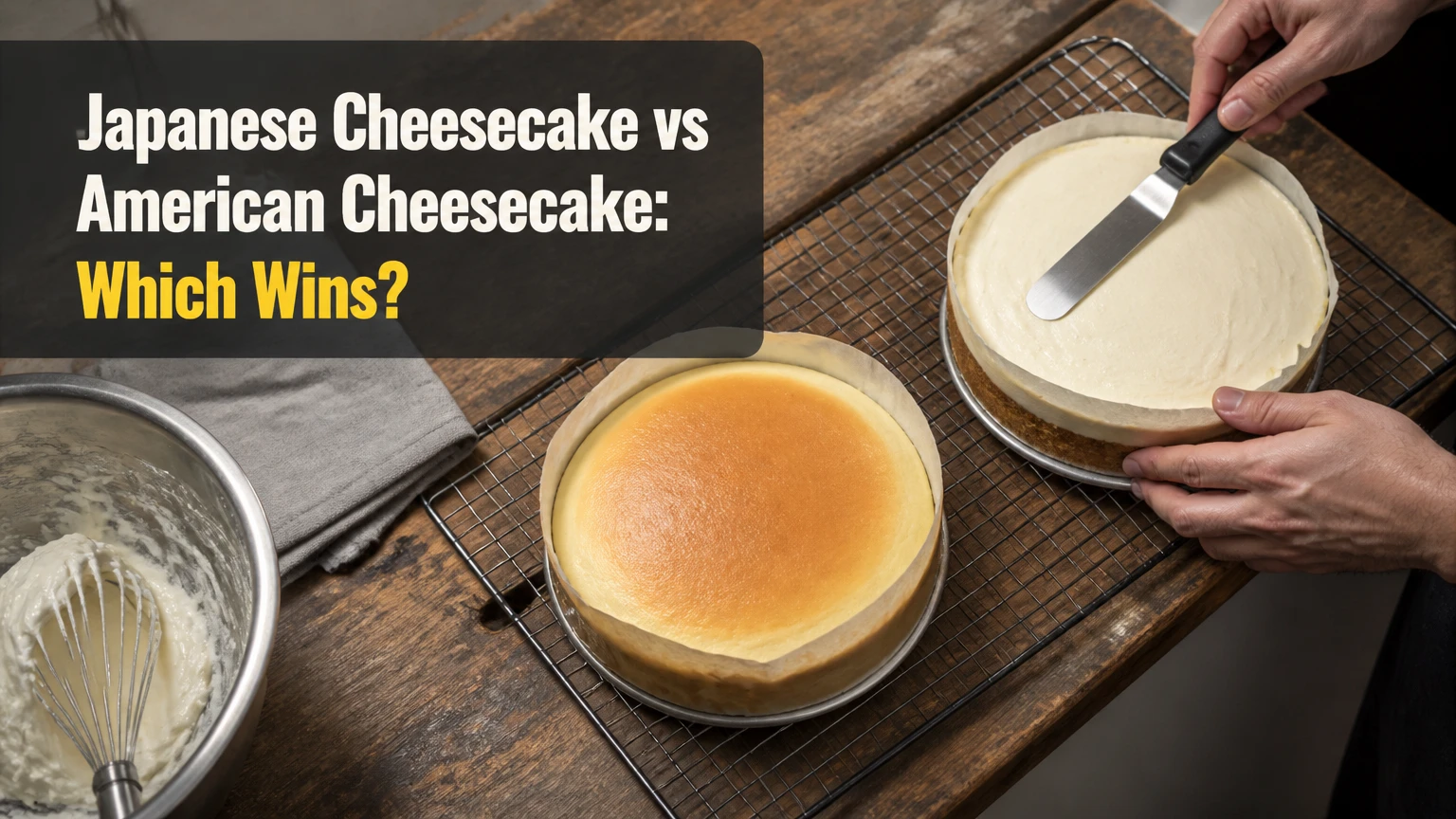
Japanese cheesecake is airy, mildly sweet, and soufflé-like, while American cheesecake is dense, creamy, and usually built on a cookie crust. Japanese cheesecake wins for a light texture and delicate flavor; American cheesecake wins for richness, clean slices, toppings, and make-ahead reliability. The better choice depends on texture, occasion, and baking experience.
Key Facts at a Glance
- Japanese cheesecake gets most of its lift from whipped egg whites, while American cheesecake sets primarily through cream-cheese, egg, and sugar coagulation.
- Japanese cheesecake is usually crustless and baked in a humid water bath at approximately 140-160°C (285-320°F).
- American cheesecake commonly includes a graham-cracker crust and requires 4-12 hours of refrigeration for its firmest texture.
- Japanese cheesecake tastes less sweet and less intensely cheesy because its batter contains more milk, butter, eggs, and flour relative to cream cheese.
- A lighter mouthfeel does not automatically make Japanese cheesecake low-calorie, because portion size and the recipe’s butter, sugar, and cream content still determine energy density.
- American cheesecake generally travels and supports heavy toppings better than Japanese cheesecake, whose soufflé structure can compress during handling.
Japanese Cheesecake vs American Cheesecake: Core Differences
Japanese cheesecake and American cheesecake differ mainly in structure, moisture, and the proportion of cream cheese to aerated ingredients. Japanese cheesecake behaves like a cheese-flavored sponge cake, whereas American cheesecake behaves like a baked custard supported by cream cheese, eggs, and sometimes cream or sour cream.
The contrast is culinary rather than absolute. An American no-bake cheesecake may be mousse-like, and a Japanese baked cheese tart may be firm, so the comparison below uses classic Japanese soufflé cheesecake and conventional baked American cheesecake as reference points.
| Criterion | Japanese cheesecake | American cheesecake |
|---|---|---|
| Typical height | 4-7 cm after cooling | 3-6 cm filling above crust |
| Main lift | Whipped egg-white meringue | Steam and egg proteins, with limited intentional aeration |
| Cream cheese proportion | Approximately 20-35% of batter by weight | Approximately 40-60% of filling by weight |
| Crust | Usually none | Graham cracker, digestive biscuit, or cookie crust |
| Texture | Cotton-soft, springy, wobbly | Dense, creamy, custard-like |
| Sweetness | Mild to moderate | Moderate to high |
| Typical bake | 60-90 minutes in a water bath | 55-100 minutes, often with a water bath |
| Best serving temperature | Room temperature or chilled | Thoroughly chilled |
| Typical refrigerator life | 2-4 days for best texture | 4-6 days when covered |
| Topping tolerance | Light fruit, glaze, powdered sugar | Fruit, ganache, caramel, nuts, and thick sauces |
What Does Each Cheesecake Taste Like?
Japanese cheesecake tastes milky, eggy, and gently tangy, with a soft sweetness that lets vanilla, citrus, matcha, or chocolate remain noticeable. American cheesecake tastes more concentrated because cream cheese, sugar, and a buttery crust occupy more of each bite.
Acidity also changes the impression. Sour cream or lemon juice can make American cheesecake taste sharper, while Japanese cheesecake often gets balance from cream cheese and a small amount of citrus without the same heavy dairy finish.
How Does Each Cheesecake Set?
American cheesecake sets through an egg-and-dairy custard network, while Japanese cheesecake depends on both that cooked batter and a mechanically created meringue network. The American cake becomes firm as proteins coagulate and fats solidify during chilling; Japanese cheesecake must retain enough air cells to stay tall and spongy after cooling.
American Cheesecake: Custard and Emulsion
A conventional baked American cheesecake combines softened cream cheese with sugar, eggs, and often heavy cream, sour cream, flour, or cornstarch. Smooth mixing creates an emulsion, and gentle heat coagulates the eggs without scrambling the dairy.
The center should usually remain slightly wobbly when the pan leaves the oven. Carryover heat continues cooking the custard, and refrigeration completes the firming process. A cheesecake removed only when the center looks completely rigid is often overbaked, with a dry edge and a grainier middle.
Japanese Cheesecake: Meringue and Moisture
Japanese cheesecake begins with a warm cream-cheese custard containing milk or butter, egg yolks, and a small amount of flour or starch. Separately whipped egg whites provide the air cells that produce the characteristic height, jiggle, and spring.
Soft to medium peaks are the practical target. A meringue with weak foam cannot support the batter, but stiff, dry peaks are difficult to fold evenly and expand aggressively in the oven, which increases splitting and later collapse.
Which Style Has the Better Texture?
Japanese cheesecake has the lighter texture, but American cheesecake has the more substantial and stable texture. Choose Japanese cheesecake for a cloudlike bite that compresses easily under a fork; choose American cheesecake for a thick, cool slice that holds its shape and feels rich on the palate.
| Texture attribute | Japanese cheesecake | American cheesecake |
|---|---|---|
| Fork resistance | Low, compresses quickly | Medium to high, cuts cleanly |
| Moisture perception | Milky and moist | Creamy and dense |
| Crust contrast | None in the classic form | Crisp, buttery, or crumbly |
| Cooling effect | Becomes firmer but remains springy | Becomes markedly firmer and creamier |
| Collapse risk | Moderate after rapid cooling | Low after proper chilling |
| Topping support | 10-30 g light topping per slice | 30-80 g topping per slice is typical |
A counterintuitive baking truth is that Japanese cheesecake can feel lighter while still containing substantial butter, sugar, eggs, and cream cheese. Air changes volume and mouthfeel; it does not erase the calories in the ingredients.
Which Style Is Easier to Bake?
American cheesecake is usually easier for a first-time baker because the recipe has fewer high-risk stages. Japanese cheesecake demands accurate egg separation, controlled meringue whipping, gentle folding, a leak-proof water bath, and gradual cooling.
| Baking factor | Japanese cheesecake | American cheesecake |
|---|---|---|
| Active preparation | 40-60 minutes | 20-35 minutes |
| Main technical risk | Meringue collapse or uneven folding | Cracks, lumps, or overbaking |
| Ingredient temperature | Warm cheese mixture, room-temperature eggs | Room-temperature cream cheese and eggs |
| Mixing tolerance | Low after meringue addition | Moderate at low speed |
| Cooling requirement | Gradual cooling, usually 30-60 minutes in oven | Slow cooling plus 4-12 hours refrigeration |
| Equipment preference | Deep pan, mixer, parchment, water bath | Springform pan, mixer, roasting pan |
| Beginner success factor | Peak control and folding | Ingredient temperature and oven timing |
American cheesecake is more forgiving of appearance defects. A shallow crack can be covered with fruit or sour cream, while a Japanese cheesecake with a collapsed center may lose the texture that defines the style.
What Are the Main Styles Within Each Category?
American cheesecake is a broad family that includes regional and no-bake versions, while classic Japanese cheesecake is a narrower category centered on the soufflé method. The label “American cheesecake” should therefore be treated as a style group rather than one fixed formula.
| Style | Defining ingredients | Texture | Typical preparation |
|---|---|---|---|
| New York | Cream cheese, eggs, sugar, often sour cream or heavy cream | Very dense and rich | Baked, then chilled 6-12 hours |
| Philadelphia | Cream cheese, eggs, sugar, vanilla | Dense but often less heavy than New York versions | Baked in a crust or without one |
| Chicago | Cream cheese, eggs, sugar, regional recipe variations | Firm edge with creamy center | Baked, commonly with a crust |
| No-bake American | Cream cheese, whipped cream or gelatin, sugar | Chilled mousse or soft custard | Refrigerated 4-8 hours |
| Classic Japanese soufflé | Cream cheese, milk, butter, yolks, flour, whipped whites | Airy, springy, and moist | Baked in a water bath |
| Japanese matcha | Soufflé base plus matcha powder | Airy with bitter tea notes | Matcha sifted into the yolk batter |
| Japanese chocolate | Soufflé base plus cocoa or melted chocolate | Soft and airy, usually denser | Chocolate blended into the base |
Philadelphia-style terminology varies by recipe writer and bakery. It does not guarantee a specific texture, and the presence or absence of sour cream is not a reliable classification rule by itself.
How Much Time and Money Does Each Require?
A home-baked Japanese cheesecake typically takes 2-3 hours from preparation through initial cooling, while American cheesecake takes about 2 hours of active and oven work but often needs 6-12 additional hours to chill. Typical ingredient costs range from $10-$22 for a home cake, depending on cream cheese, eggs, butter, and toppings.
| Cost or time item | Japanese cheesecake | American cheesecake |
|---|---|---|
| Typical home diameter | 15-18 cm, 6-7 inches | 20-23 cm, 8-9 inches |
| Active preparation | 40-60 minutes | 20-35 minutes |
| Oven time | 60-90 minutes | 55-100 minutes |
| Initial cooling | 30-60 minutes | 45-90 minutes |
| Best chilling period | 2-6 hours, optional for softer serving | 6-12 hours |
| Typical home ingredient cost | $10-$18 | $12-$22 |
| Typical bakery slice | $4-$8 | $6-$12 |
| Typical bakery whole cake | $18-$35 | $35-$70 |
Retail prices are location-specific estimates, not universal market prices. Japanese cakes are often smaller and sold whole, while American slices may cost more because they are larger, heavily topped, or made with premium cream cheese.
Is Japanese Cheesecake Healthier Than American Cheesecake?
Japanese cheesecake is often lighter per bite and may contain less cream cheese and sugar than a rich New York cheesecake, but Japanese cheesecake is not automatically healthier or low-calorie. The comparison requires the same serving weight and recipe information because butter, sugar, flour, cream, and toppings can narrow the nutritional difference.
Texture creates a misleading visual cue. A tall, airy slice may contain fewer grams of filling than a dense American slice, yet recipes vary widely. A cream-heavy American cheesecake with a thick crust will generally be more energy-dense than a plain Japanese cake, but a small Japanese portion is not a nutritional free pass.
For food safety, the USDA advises, “Refrigerate perishable food within 2 hours,” with a one-hour limit when ambient temperatures exceed 90°F (32°C). That guidance applies to both cakes because both contain perishable dairy and eggs.
| Nutrition-related variable | Japanese cheesecake | American cheesecake |
|---|---|---|
| Main calorie drivers | Butter, sugar, yolks, cream cheese | Cream cheese, sugar, crust, cream |
| Flour or starch | Commonly 10-20% of batter | Usually 0-8% of filling |
| Crust contribution | 0% in classic recipes | Often 10-20% of finished weight |
| Typical portion weight | 70-110 g | 100-160 g |
| Perceived heaviness | Low to moderate | Moderate to high |
| Topping effect | Fruit adds modestly; cream changes it sharply | Caramel, ganache, and nuts can add 80-250 calories |
For dietary restrictions, Japanese cheesecake commonly contains wheat flour, eggs, dairy, and sometimes cornstarch. American cheesecake can be made gluten-free by replacing the crust and verifying that flavorings and packaged ingredients are gluten-free, but neither style is naturally dairy-free.
Which Cheesecake Travels and Stores Better?
American cheesecake travels better because chilling gives the filling structural strength and the crust protects the base. Japanese cheesecake should remain level, cold, and lightly boxed, since vibration, warmth, and pressure can compress its meringue-supported interior.
Refrigerator and Freezer Storage
Cover both styles without pressing plastic wrap onto the surface. American cheesecake generally keeps its best texture for 4-6 days in a refrigerator at 4°C (40°F) or below; Japanese cheesecake is usually best within 2-4 days because its crumb gradually loses resilience.
American cheesecake freezes more predictably for up to 1-2 months when wrapped in plastic and foil. Japanese cheesecake can be frozen for approximately 2-4 weeks, but thawing may produce moisture beads and a less elastic crumb.
Serving and Transport Rules
Serve American cheesecake cold, usually after at least 6 hours of chilling. Japanese cheesecake can be served chilled for a firmer bite or at room temperature for a softer aroma, but refrigeration is safer whenever the cake will sit longer than a brief serving period.
Use a rigid cake carrier for either style. Keep the cake below 4°C (40°F) during longer transport, and avoid stacking anything on Japanese cheesecake.
What Causes the Most Common Baking Failures?
American cheesecake most often fails through lumps, cracks, or overbaking, while Japanese cheesecake most often fails through unstable meringue, poor folding, or rapid cooling. Each failure has a different recovery strategy, and appearance alone does not always identify the cause.
| Failure | Likely cause | Practical correction |
|---|---|---|
| American lumps | Cold cream cheese | Soften for 60-90 minutes and mix before adding eggs |
| American surface cracks | Excess air or high heat | Mix eggs on low speed and bake in a humid bath |
| American grainy center | Overbaking above a set custard point | Remove when the center still moves slightly |
| Japanese collapse | Stiff meringue or sudden cooling | Use curved soft peaks and cool in the switched-off oven |
| Japanese dense bottom | Meringue not fully incorporated | Fold from the bottom until no white streaks remain |
| Japanese wet center | Low oven heat or oversized pan | Extend baking in 10-minute increments |
| Soggy base | Water entered a loose pan or condensation accumulated | Use a solid pan or wrap the outside with two foil layers |
| Burnt Japanese top | Excessive upper heat | Lower the temperature or use a loose foil shield |
An expert rule of thumb is to judge Japanese meringue by shape rather than by the mixer’s clock. When the whisk lifts, the peak should bend gently and retain a smooth surface; a dry peak with a sharp hook usually needs to be corrected before folding.
Another practitioner rule is to reserve a small amount of meringue for loosening the heavy cheese batter first. Once the mixture becomes lighter, the remaining foam incorporates with fewer strokes and loses less air.
Can You Modify Either Style?
You can modify both styles, but each alteration changes the structural system. A crust, heavy topping, extra cocoa, or fruit puree adds weight or moisture, so the baker must adjust pan size, flour, gelatin, or baking time rather than treating the change as cosmetic.
| Variation | Safer style | Required adjustment | Expected result |
|---|---|---|---|
| Berry topping | American | Add after chilling | Stable, colorful slices |
| Matcha flavor | Japanese | Sift 5-10 g powder into yolk batter | Tea aroma with slight bitterness |
| Chocolate flavor | American | Replace part of filling with melted chocolate | Denser, richer set |
| Gluten-free version | Either | Use certified gluten-free flour or crust | Similar texture if starch balance remains |
| Mini portions | American | Bake 18-30 minutes in muffin cups | Faster chilling and clean portions |
| Crusted Japanese cake | Japanese with caution | Prebake a thin crust and reduce moisture | Heavier base, less classic crumb |
Fruit puree is especially risky in Japanese cheesecake because excess water weakens the meringue and delays setting. Fold in concentrated puree sparingly, or use fruit as a topping after baking.
Which Should You Choose?
The right choice depends on whether you value lightness, richness, transport, or technical challenge. Japanese cheesecake is the better choice for delicate texture and moderate sweetness, while American cheesecake is the better choice for dense flavor, customization, and reliable serving.
Choose Japanese Cheesecake If You Want a Light Dessert
Japanese cheesecake suits diners who dislike heavy cream cheese flavor or dense crusts. Its airy crumb also works well after a substantial meal, when a rich New York slice may feel excessive.
Choose it when the cake will be served within one or two days and transported carefully. Avoid it for a hot outdoor event, rough travel, or a dessert table requiring tall layers of topping.
Choose American Cheesecake for Richness and Toppings
American cheesecake is the stronger option for chocolate, caramel, berries, citrus curd, nuts, and decorative piping. Its cold, compact filling gives pastry chefs a more stable platform for toppings and sharp portioning.
Choose it when the cake must be prepared one day ahead. The required chilling period becomes an advantage because the flavor and texture improve as the filling firms.
Choose American Cheesecake as a Beginner Baker
A baked Philadelphia-style cheesecake is usually the better first project because the batter does not depend on preserving hundreds of fragile air cells. Room-temperature ingredients, low-speed mixing, and careful baking matter more than advanced folding technique.
A first-time baker should still use a thermometer, a leak-proof water bath, and a springform pan wrapped externally with foil. A cracked top is a presentation issue; a raw center is a doneness issue.
Choose Japanese Cheesecake for a Technical Baking Challenge
Japanese cheesecake is appropriate for an experienced baker who wants to practice meringue control, folding, and oven management. The recipe rewards precision but offers less visual recovery when the center collapses.
Use a stand mixer or reliable hand mixer, a digital scale, parchment, and a solid deep pan. Weighing egg whites and flour is more dependable than relying on egg counts because egg sizes differ.
Choose American Cheesecake for Parties and Transport
American cheesecake is the practical event dessert when the cake must be sliced, boxed, decorated, and held cold. It tolerates heavier garnishes and remains structurally firm after several hours of refrigeration.
The limitation is temperature. American cheesecake should not sit at room temperature for hours, even though its firm texture makes it appear stable.
The Bottom Line
Japanese cheesecake vs American cheesecake is a choice between an airy soufflé-style cake and a dense baked custard. Japanese cheesecake wins for a springy crumb, mild sweetness, and a lighter eating experience; American cheesecake wins for concentrated cream-cheese flavor, crust contrast, toppings, transport, and make-ahead service.
For a first bake or a large gathering, choose American cheesecake. For a delicate bakery-style dessert and a more technical project, choose Japanese cheesecake. Neither style is universally healthier, and both require refrigeration because dairy and egg ingredients remain perishable.
FAQ
Does Japanese cheesecake taste like regular cheesecake?
Japanese cheesecake tastes like a lighter, milder version of cream-cheese cheesecake, with noticeable egg, milk, and vanilla notes. The flavor is less concentrated because whipped egg whites and flour increase volume without adding equivalent cream cheese. Chilling makes the tang more pronounced and the crumb slightly firmer.
Can Japanese cheesecake be made without a water bath?
Japanese cheesecake can sometimes be baked without a water bath, but the surface and edges are more likely to dry, split, or brown quickly. A water bath moderates heat and supplies humidity, which helps the meringue expand gradually. A separate pan of boiling water provides some humidity but less even heat control.
Why does American cheesecake need to be chilled overnight?
American cheesecake needs extended chilling because the cooked egg-and-cream-cheese filling continues firming as fats cool and moisture redistributes. Four hours can produce a sliceable cake, but 6-12 hours usually gives cleaner cuts and a more cohesive flavor. Cutting while warm often creates a soft, smeared center.
Can I use a graham-cracker crust with Japanese cheesecake?
You can use a thin graham-cracker crust, but the result will be heavier and less characteristic than classic Japanese cheesecake. The crust adds fat and weight beneath a meringue-supported batter, so prebake it, keep it shallow, and protect it from bathwater. A parchment-lined solid pan reduces leakage risk.
Which cheesecake is better with coffee or tea?
Japanese cheesecake pairs especially well with unsweetened tea because its mild sweetness and soft dairy flavor do not overpower delicate aromas. American cheesecake pairs better with strong coffee or unsweetened black tea because acidity and bitterness balance its dense cream cheese, sugar, and buttery crust.
Can either cheesecake be made gluten-free?
Both styles can be made gluten-free with suitable substitutions, but the recipe must be checked ingredient by ingredient. Replace a graham crust with gluten-free biscuits or nuts for American cheesecake, and replace wheat flour in Japanese cheesecake with a measured starch or gluten-free flour blend designed for cakes.
