

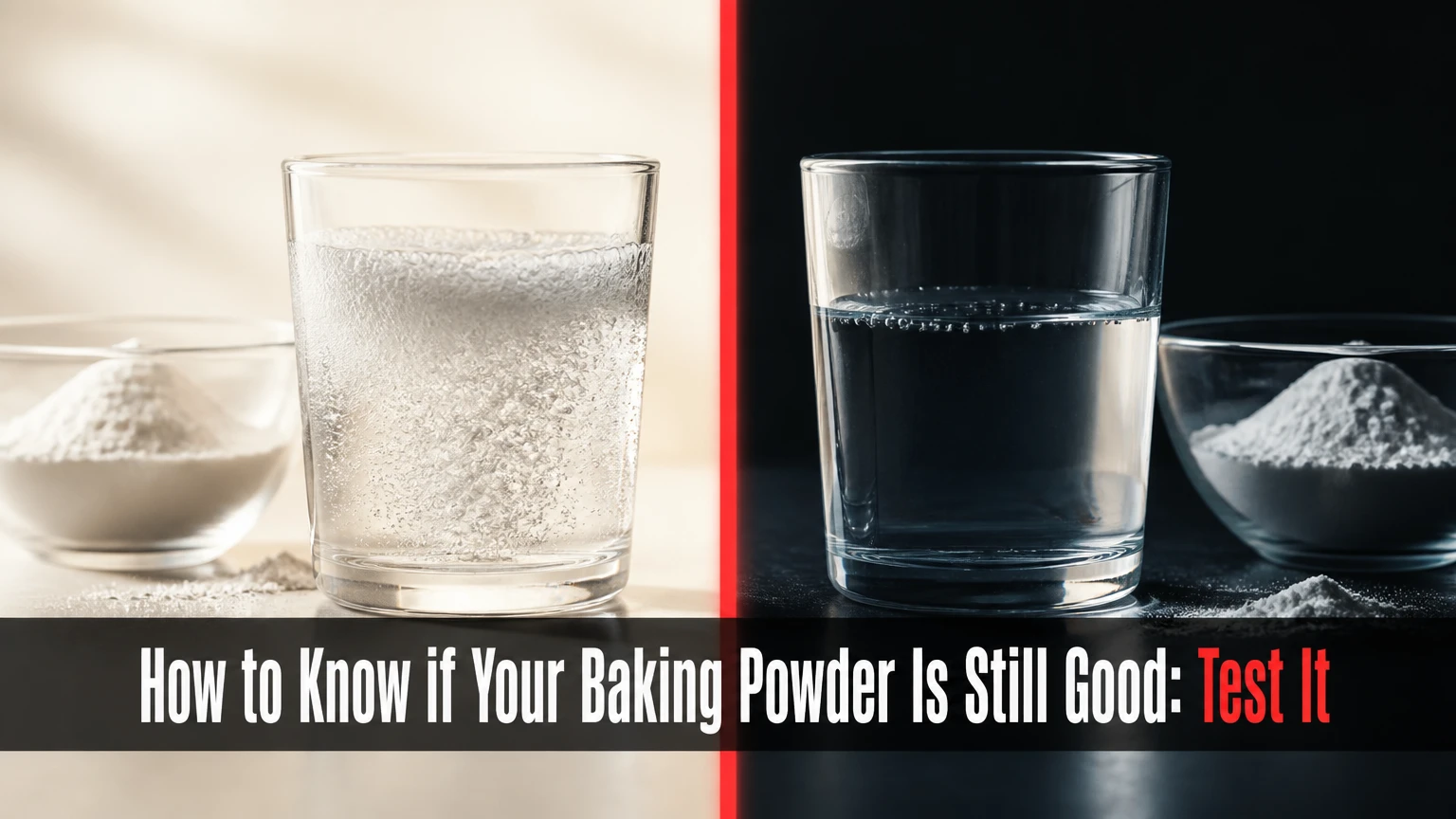
To know if your baking powder is still good, stir 1/2 teaspoon into 3 tablespoons of warm water and watch immediately for vigorous bubbling. Strong, rapid fizz means the powder still releases carbon dioxide; weak, delayed, or absent bubbling indicates reduced potency, so replace it before relying on the powder in an important bake.
Key Facts at a Glance
Baking powder should fizz immediately and actively in warm water when its chemical leavening system remains potent.
The practical test uses 1/2 teaspoon of baking powder and 3 tablespoons of warm water.
A printed best-by date describes expected quality, while humidity and heat can reduce potency sooner.
Double-acting baking powder reacts when moistened and again in the oven, so a water test measures activity but not exact cake lift.
Clumps usually indicate moisture exposure; a completely hard, damp, or faintly reacting powder should be discarded.
Baking soda is not an interchangeable substitute because it needs an acidic ingredient to produce carbon dioxide.
How to Know if Your Baking Powder Is Still Good
The warm-water test is the fastest household check because baking powder contains both an alkaline base and a powdered acid. When water dissolves those ingredients, they react and release carbon dioxide gas, producing visible bubbles without needing lemon juice, vinegar, or another acidic ingredient.
Use a clean, dry measuring spoon and a transparent cup. Warm tap water is sufficient; it should feel warm rather than hot, because extreme heat is unnecessary and can make observations less consistent. The result is qualitative, not a laboratory strength measurement.
What You Need for the Freshness Test
| Item | Required amount or condition | Why it matters |
|---|---|---|
| Baking powder | 1/2 teaspoon | Provides a consistent test sample |
| Warm water | 3 tablespoons, about 45 milliliters | Dissolves the acid and base |
| Cup or bowl | 1 small, transparent container | Makes surface bubbling visible |
| Measuring spoon | 1 clean, completely dry spoon | Prevents added moisture and dosage error |
| Observation time | First 5-10 seconds | Captures the immediate reaction |
Step 1: Pour Warm Water Into a Cup
Measure 3 tablespoons of warm water into a small transparent cup. Water around normal warm tap temperature works well, and no additional acid should be added because baking powder already contains its own acid component.
You will know this step worked when: the water is warm, clear, and deep enough to cover the powder as it settles.
Common mistake: using cold water and then calling a slow reaction a failure. Cold water can slow dissolution, making a marginal reaction harder to judge.
Step 2: Add 1/2 Teaspoon of Baking Powder
Scoop 1/2 teaspoon from the center of the container and tip it into the water. Do not pack the powder tightly, and do not use a wet spoon from a sink or dishwasher.
You will know this step worked when: the entire sample contacts the water and begins reacting without stirring.
Common mistake: testing only a tiny dusting from the lid or a dry surface crust. Take a representative sample, particularly when the container has visible layers or clumps.
Step 3: Watch the First Few Seconds
Observe the surface and the water immediately after adding the powder. Fresh, potent baking powder usually produces rapid fizzing, foam, or a noticeable stream of bubbles across much of the sample.
You will know it worked when: bubbling begins at once and remains visibly active for several seconds.
Common mistake: waiting a full minute for a delayed reaction. Delayed bubbling suggests reduced activity or poor dissolution, not the vigorous performance expected from a dependable leavener.
Step 4: Classify the Reaction
Use the reaction categories below rather than treating every bubble as proof of full strength. Small bubbles from trapped air can occur when powder sinks or is stirred, but they are different from sustained chemical fizzing.
| Test result | What you observe | Practical interpretation | Baking decision |
|---|---|---|---|
| Strong | Immediate foam and vigorous bubbles | Active leavening system | Use for ordinary recipes |
| Moderate | Clear fizz, but limited foam | Some potency remains | Replace for cakes or guests |
| Weak | Few bubbles after several seconds | Reduced carbon dioxide release | Replace before baking |
| Delayed | Little activity at first, then faint fizz | Slow or compromised reaction | Do not trust for a risen bake |
| None | Flat water with settled powder | Inactive or severely degraded powder | Discard and replace |
Why Does Baking Powder Fizz?
Baking powder fizzes because moisture allows an alkaline carbonate or bicarbonate and a dry acid to dissolve and react. The reaction releases carbon dioxide, and those gas bubbles later expand inside batter as heat increases.
Most commercial baking powder also contains starch, commonly cornstarch, which absorbs incidental moisture and keeps the reactive ingredients separated during storage. Once humidity enters the container, some of the acid and base may react prematurely, releasing gas into the pantry instead of the oven.
Single-Acting and Double-Acting Powder
Double-acting baking powder is the standard household type in many markets. It produces some gas when wet and additional gas when heated, which gives the baker more time between mixing and baking.
Single-acting powder releases most of its gas after liquid is added. Recipes using it generally need immediate baking, because waiting allows more of the available carbon dioxide to escape before the batter sets.
| Powder type | Main reaction stages | Typical household use | Timing implication |
|---|---|---|---|
| Double-acting | Wet stage and heated stage | Cakes, muffins, biscuits, quick breads | More tolerant of short delays |
| Single-acting | Primarily wet stage | Immediate-bake commercial formulas | Put batter in the oven promptly |
| Aluminum-free double-acting | Wet stage and heated stage | Cakes, cookies, muffins | May reduce metallic flavor concerns |
| Homemade mixture | Primarily wet stage | Emergency replacement | Mix immediately before use |
The warm-water test cannot tell you precisely how much second-stage lift a double-acting powder will provide in the oven. It answers a narrower question: whether the powder still has a visible reactive capacity.
How Long Does Baking Powder Last?
An opened container commonly performs best for about 6 months when kept dry, while an unopened container may retain useful potency for roughly 12-18 months under cool, dry pantry conditions. These are practical quality ranges, not guarantees, because package size, formulation, humidity, and closure quality change the outcome.
The date printed on the container should be treated as a quality guide. Baking powder is usually a low-moisture pantry ingredient, so age primarily affects performance rather than creating the same spoilage pattern associated with perishable food. Replace it when the reaction is weak, the powder smells abnormal, or moisture has visibly altered it.
| Storage situation | Typical useful period | Main risk | Recommended action |
|---|---|---|---|
| Unopened, cool pantry | 12-18 months | Gradual potency loss | Test after the printed date |
| Opened, tightly sealed | About 6 months | Humidity entering after use | Date the lid and test periodically |
| Opened near a stove | Sometimes less than 6 months | Heat and steam exposure | Replace if unused for months |
| Bulk bag opened repeatedly | Variable, often under 6 months | Large surface exposed to air | Transfer to a sealed container |
| Damp or wet container | Indeterminate | Premature chemical reaction | Test immediately and usually discard |
Is Expired Baking Powder Unsafe?
Expired baking powder is generally a performance problem rather than an automatic food-safety hazard, provided it stayed dry, clean, and free from contamination. A container that smells musty, contains insects, shows mold, or became wet should be discarded regardless of its bubbling test.
A flat result means the powder may fail to raise batter. It does not mean the container contains a dangerous toxin. The practical consequence is a dense, heavy, or uneven bake, which makes replacement sensible because baking powder is inexpensive compared with the ingredients and time in a finished cake.
What Do Clumps Say About Baking Powder?
Small loose clumps do not prove that every granule has failed, but hard, damp, or fused clumps indicate meaningful moisture exposure. Breakage can also result from compression during shipping, so appearance should guide testing rather than replace it.
Sift a lightly clumped sample only if the powder remains dry and free-flowing after crushing. If the clumps feel damp, the canister has a wet bottom, or the water test produces weak fizz, do not attempt to rescue it for a recipe that depends on reliable lift.
| Appearance | Likely cause | Test implication | Best use decision |
|---|---|---|---|
| Fine, loose powder | Normal dry storage | Normal test sample | Suitable if reaction is strong |
| A few soft lumps | Compression or mild humidity | Test after crushing | Use only after a strong reaction |
| Hard pale chunks | Moisture entered container | Potency may be uneven | Replace for important baking |
| Wet paste or caked mass | Direct water exposure | Chemical activity likely lost | Discard |
| Discolored or contaminated powder | Poor storage or foreign material | Freshness test is irrelevant | Discard |
How Should You Store Baking Powder?
Store baking powder sealed in its original container or a clean airtight container in a cool, dry pantry away from the stove, kettle, dishwasher, and sink. Always use a dry spoon, close the lid immediately, and write the opening month on the container.
Refrigeration is usually unnecessary and can introduce condensation when the container moves between cold storage and a humid kitchen. A dry cabinet is more practical. Keep the powder away from strong-smelling ingredients because starch-containing powders can pick up odors over time.
A Practical Storage Routine
- Wipe the outside of the lid before opening the container.
- Use a completely dry measuring spoon.
- Level the spoon over the container or a dry bowl.
- Seal the lid before returning the powder to the pantry.
- Record the opening month with a permanent marker.
- Test powder that has been open for about 6 months.
- Replace powder exposed to steam, spills, or repeated wet handling.
One practitioner rule matters more than buying a premium brand: container size should match usage. A person who bakes twice a year will usually preserve quality better with a small 4-ounce container than with a large bulk package opened dozens of times.
Baking Powder vs. Baking Soda: Which One Do You Need?
Baking powder contains an acid and can react with added liquid, while baking soda is primarily sodium bicarbonate and needs an acidic ingredient such as buttermilk, yogurt, molasses, brown sugar, lemon juice, or natural cocoa. The two leaveners change both rise and flavor, so they are not equal-volume replacements.
Baking soda is more concentrated by volume and can leave a soapy, bitter taste when a recipe lacks enough acid to neutralize it. Baking powder is formulated to supply its own acid balance, although the exact formula varies by manufacturer.
| Ingredient | Contains its own dry acid? | Needs external acid? | Typical recipe role | Direct replacement? |
|---|---|---|---|---|
| Baking powder | Yes | No, for basic activation | Controlled rise in cakes and muffins | Use the recipe amount |
| Baking soda | No | Yes | Browning, spread, and rapid leavening | No, not by equal volume |
| Cream of tartar | Acid only | Needs an alkaline base | Component of homemade powder | No, use with baking soda |
| Self-rising flour | Usually powder plus salt | Powder supplies acid | Flour, salt, and leavener combined | Only by recipe redesign |
The recipe’s other ingredients determine the correct choice. A buttermilk pancake recipe may use both baking soda and baking powder, because soda neutralizes acidity and encourages browning while powder supplies additional lift.
What Can Replace Baking Powder?
A common emergency substitute combines 2 parts cream of tartar with 1 part baking soda, using the mixture immediately after combining. The homemade blend is effectively single-acting and lacks the commercial starch system that improves storage stability.
For a recipe calling for 1 teaspoon of baking powder, a typical substitute is 1/2 teaspoon cream of tartar plus 1/4 teaspoon baking soda. That ratio provides the two reactive components, but the final result can vary because commercial formulas use different acids and may include additional ingredients.
| Substitute option | Typical amount for 1 teaspoon powder | Acid requirement | Main limitation |
|---|---|---|---|
| Cream of tartar plus baking soda | 1/2 tsp plus 1/4 tsp | Built into the mixture | Single-acting and immediate-use |
| Self-rising flour adjustment | Depends on flour quantity | Built into flour | Requires changing the recipe’s flour |
| Buttermilk plus baking soda | Recipe-specific | Buttermilk supplies acid | Changes liquid and flavor |
| Yogurt plus baking soda | Recipe-specific | Yogurt supplies acid | Changes thickness and acidity |
| Lemon juice plus baking soda | Recipe-specific | Lemon juice supplies acid | Adds noticeable citrus acidity |
Do not replace baking powder with baking soda alone. If the recipe contains little acidity, the substitution can produce poor rise and an alkaline taste even when the batter browns quickly.
Should You Use a Weakly Bubbling Batch?
Use a weakly bubbling batch only when the recipe is forgiving, the quantity is small, and a dense result would not matter. For sponge cakes, cupcakes, biscuits, soufflé-like quick breads, or a celebration cake, replace the powder rather than gambling on partial activity.
A strong water test supports ordinary use, but it does not guarantee correct measuring, proper oven temperature, or perfect batter handling. A weak test creates avoidable uncertainty, especially because the powder’s remaining activity may be uneven throughout a damp container.
A Small-Batch Decision Rule
- Important cake or large batch: replace any weak or delayed powder.
- Low-risk pancakes: use a moderate result only if the batter will be cooked immediately.
- Recipe with additional baking soda: test the powder, then confirm the recipe has enough acid for the soda.
- Older powder with no printed date: test a representative sample and label the replacement.
- Powder with contamination or wet clumps: discard without relying on the test.
Why Did My Cake Stay Flat if the Powder Fizzed?
A fizzing test proves that baking powder can react in water, but a flat cake can result from incorrect measurement, overmixing, a low oven temperature, an oversized pan, or batter that waited too long before baking. The test does not diagnose every stage of leavening.
Double-acting powder needs correct heat exposure after the batter enters the oven. If the oven runs cool, the gas may escape before the structure sets. An oven thermometer is more informative than the dial, because domestic ovens can differ substantially from their displayed setting.
| Symptom in the bake | More likely cause | Check next time | Corrective action |
|---|---|---|---|
| Dense throughout | Too little powder or excessive flour | Weigh flour and level powder | Retest ingredients and measure accurately |
| Large holes, then collapse | Too much leavener or weak structure | Verify recipe quantity | Use exact amount and avoid overmixing |
| Flat, pale top | Low oven temperature | Use an oven thermometer | Preheat longer and verify temperature |
| Bitter or metallic flavor | Excess powder or formulation flavor | Recheck teaspoon measurement | Reduce excess and consider aluminum-free powder |
| Uneven rise | Poor mixing or uneven powder distribution | Sift dry ingredients | Mix dry ingredients thoroughly |
| Good rise, then sinking | Underbaking or excess liquid | Check center temperature and timing | Bake until the structure is set |
Expert insight: adding extra baking powder rarely rescues an uncertain batch. Too much powder can create rapid gas production, coarse cells, bitter flavor, and collapse, so replacement is safer than compensating by guesswork.
Does Aluminum-Free Baking Powder Work Differently?
Aluminum-free baking powder can provide effective leavening, but the reaction speed and flavor depend on its specific acid system. The phrase “aluminum-free” describes an ingredient choice, not a guaranteed freshness level or a universal performance profile.
Some bakers prefer aluminum-free products in lightly flavored foods where a metallic note would be noticeable. Other formulations perform similarly in ordinary cakes and muffins. The label does not eliminate the need for dry storage or a bubbling test.
| Selection factor | Standard double-acting powder | Aluminum-free double-acting powder | Practical consequence |
|---|---|---|---|
| Reaction design | Wet plus heat stages | Wet plus heat stages | Both can suit general baking |
| Aluminum-containing acids | May be present | Excluded by label | Flavor preference may differ |
| Best recipe range | Cakes, biscuits, muffins | Cakes, cookies, muffins | Follow the package and recipe |
| Freshness requirement | Requires dry storage | Requires dry storage | Aluminum-free does not mean shelf-stable |
| Buying decision | Broad availability | Flavor-focused choice | Select based on recipe and preference |
How Much Does Replacement Cost?
A small household container commonly costs about $2-$5, depending on brand, package size, and location. Replacement is usually cheaper than wasting flour, eggs, dairy, sugar, and oven time in a large failed batch.
Per-ounce prices can rise when buying very small containers, but bulk purchasing becomes uneconomical if the powder remains open for years. Compare package size with actual usage, not only the shelf price.
| Purchase format | Typical size | Typical price range | Suitable user |
|---|---|---|---|
| Small canister | 4 ounces | $1.50-$3.00 | Occasional baker |
| Standard canister | 8 ounces | $2.00-$5.00 | Monthly or weekly baker |
| Large container | 16 ounces | $4.00-$8.00 | Frequent baker |
| Bulk bag | 2-5 pounds | $8-$25 | High-volume kitchen with sealed storage |
Prices vary by country and retailer. The useful economic rule remains stable: buy the smallest package likely to be used within its best-performance period.
Expert Rules for Avoiding Failed Bakes
Three practical rules prevent most baking powder mistakes:
- Test before high-cost recipes. A 10-second water test is worthwhile before a wedding cake, holiday batch, or recipe using expensive nuts and fruit.
- Do not judge strength by appearance alone. A bright white powder can be inactive, while a lightly clumped sample can still react strongly.
- Do not test with vinegar or lemon juice. Those acids can make baking soda fizz and may confuse the result; water alone is the appropriate basic test for baking powder.
- Do not keep a marginal container for “someday.” Once a batch produces weak fizz, its remaining performance is uncertain and replacement costs little.
- Mix dry ingredients evenly. Fresh powder cannot lift areas of batter where it was not distributed.
A useful limitation is worth stating plainly: the household test cannot quantify carbon dioxide output, identify the exact acid formulation, or predict the finished crumb. It is a screening test for activity, not a substitute for controlled baking trials.
Frequently Asked Questions
Can Baking Powder Be Used After the Best-By Date?
Yes, baking powder can sometimes remain usable after its best-by date if the container stayed sealed and dry. Test 1/2 teaspoon in 3 tablespoons of warm water before baking. Strong immediate bubbling supports use, while weak or delayed fizz means the powder may not raise the recipe reliably.
Does Baking Powder Need Refrigeration?
Baking powder normally does not need refrigeration. A cool, dry pantry is preferable because moving a cold container into humid kitchen air can create condensation inside the lid. Keep baking powder sealed, away from steam, and use a dry measuring spoon every time.
Can I Test Baking Powder Directly in Batter?
Testing directly in batter is unreliable because flour, sugar, fat, eggs, acidity, mixing, and oven heat affect the result. The warm-water test isolates the powder’s basic reaction. For an important recipe, test the powder separately before measuring ingredients for the batter.
Why Does My Baking Powder Smell Strange?
A musty, chemical, or foreign odor can indicate moisture exposure, contamination, or odor absorption from nearby pantry ingredients. Fresh baking powder has little noticeable odor. Discard a container with an abnormal smell, especially when the powder also has hard clumps or weak bubbling.
Is Homemade Baking Powder as Good as Commercial Powder?
A fresh mixture of 2 parts cream of tartar and 1 part baking soda can work in an emergency, but it behaves more like single-acting powder and should be mixed immediately before use. Commercial double-acting powder provides more controlled timing and usually includes starch for stability.
The Bottom Line
The most dependable answer to “How to know if your baking powder is still good” is a simple water test: combine 1/2 teaspoon baking powder with 3 tablespoons of warm water and watch for immediate, vigorous bubbling. Replace powder that fizzes weakly, reacts late, contains damp clumps, or has been stored poorly, because a new container costs less than a failed bake.
