

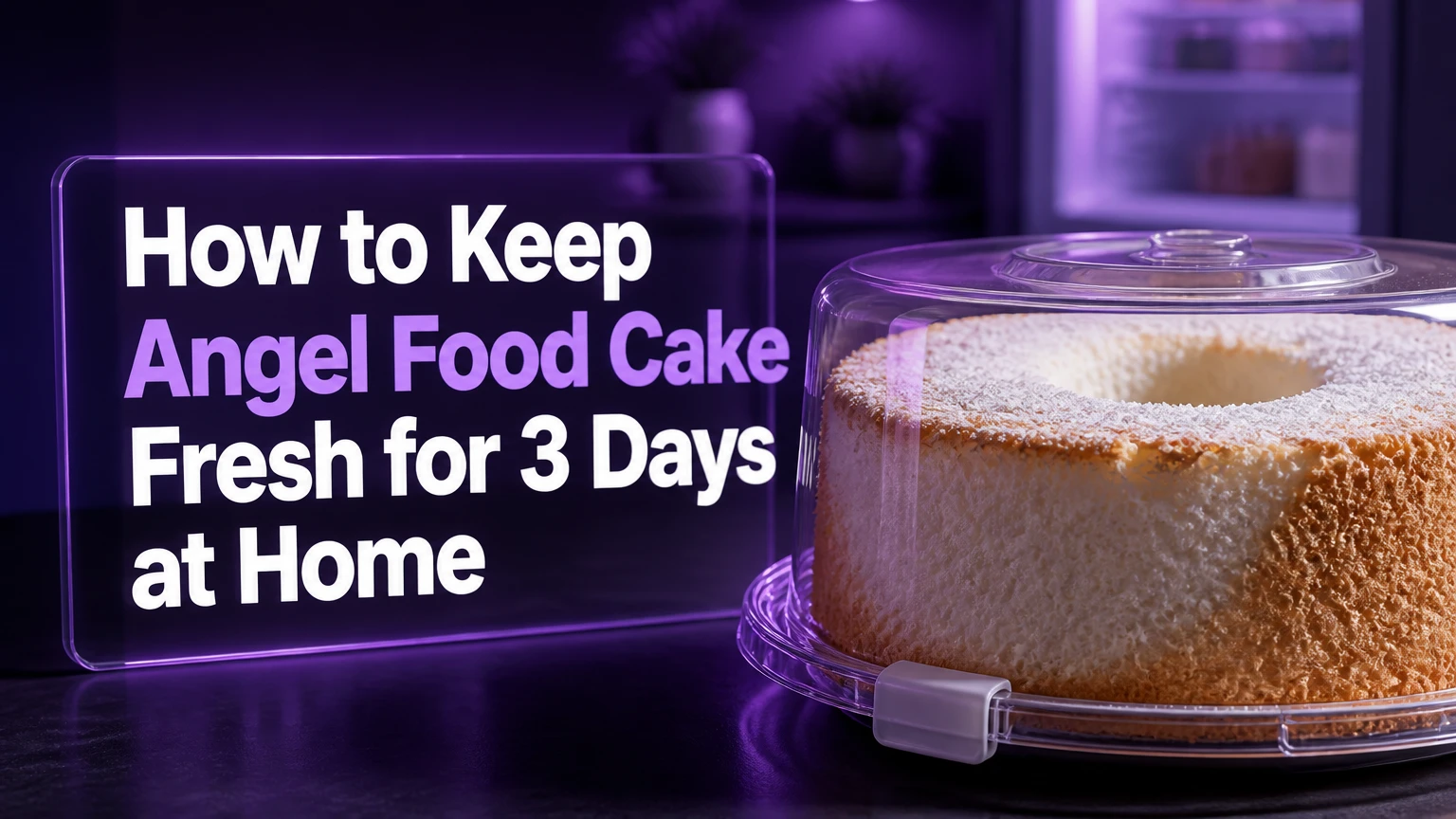
Angel food cake stays freshest when cooled completely, wrapped airtight, and kept at room temperature for up to 3 days. Refrigerate it for about 5 days only when heat, humidity, dairy toppings, or fruit make chilling necessary, and freeze tightly wrapped slices for up to 3 months for the best long-term quality.
Key Facts at a Glance
Plain angel food cake keeps its best texture for 2-3 days at cool room temperature when sealed against air.
Angel food cake should cool upside down in its pan for approximately 2 hours before removal and wrapping.
Refrigeration slows mold growth but can make the crumb firmer and drier unless the package is airtight.
Frozen angel food cake keeps good eating quality for approximately 3 months when wrapped in plastic film and freezer packaging.
Whipped cream, custard, cream cheese, and cut fruit change plain-cake storage into a refrigerated food-safety decision.
Mold, sour odors, unexplained wetness, or a slimy surface means the cake should be discarded.
What Makes Angel Food Cake Different?
Angel food cake is a fat-free foam cake made primarily from whipped egg whites, sugar, flour, and flavoring. The whipped whites create a delicate network of air cells, while sugar stabilizes the foam and contributes sweetness and moisture retention.
Traditional butter cakes have fat that coats flour particles and gives the crumb a softer, more resilient eating quality. Plain angel food cake has little or no added fat, so exposed surfaces lose moisture quickly when air circulates around them.
The cake’s unusual structure also explains why storage begins before wrapping. A freshly baked foam cake is fragile and can compress under its own weight until the proteins set and the interior cools. A tube pan supports the batter during baking, and inverted cooling prevents the tall cake from collapsing.
Why Does Angel Food Cake Dry Out So Quickly?
Angel food cake dries quickly because its open, low-fat crumb allows moisture to move toward exposed surfaces. Once that moisture reaches the surface, room air carries it away, producing a firm, rubbery, or cardboard-like texture before visible spoilage occurs.
Staling and spoilage are different problems. Staling is mainly a quality change caused by moisture migration and starch changes. Mold and bacterial growth are safety concerns influenced by temperature, humidity, handling, toppings, and contamination.
The United States Department of Agriculture recommends following package directions and using refrigeration for perishable toppings and fillings. That guidance matters because a plain cake and a cake covered with whipped cream do not have the same storage requirements.
A sealed package reduces moisture loss, but it cannot restore moisture already lost. Storage therefore works best when the cake is wrapped soon after it has cooled completely.
How to Keep Angel Food Cake Fresh
The most reliable method uses four actions: cool the cake inverted, remove it gently, seal every exposed surface, and select storage based on toppings and serving time. For a plain cake eaten within 2-3 days, airtight room-temperature storage usually gives a softer crumb than refrigeration.
Before You Start
| Item | Typical requirement | Practical specification |
|---|---|---|
| Cooling time | 2-3 hours | Cake fully cool before wrapping |
| Plastic wrap | 1-2 sheets | Enough to cover the whole cake without gaps |
| Outer container | 1 | Airtight cake carrier or large food-storage bag |
| Freezer packaging | 1 bag plus foil | Required for storage beyond 3 days |
| Storage temperature | 18-24°C | Cool room temperature, away from sunlight |
| Refrigerator temperature | 4°C or below | Use a refrigerator thermometer if available |
Step 1: Cool the Cake Upside Down
Leave the baked angel food cake upside down in its pan for about 2 hours, or until the pan feels close to room temperature. Use the pan’s feet, a bottle, or another support method designed to keep the rim elevated while air circulates.
Cooling inverted protects the foam structure because gravity pulls the cake away from the base rather than compressing it. Do not wrap a warm cake. Trapped steam condenses inside the package and can create a wet, sticky surface.
You will know the cake is ready when the center no longer feels warm through the pan and the cake holds its height without visible sinking. A cake that still feels warm needs more cooling time.
Common mistake: Removing the cake immediately after baking. The result can be a compressed center, torn sides, or a damp package.
Step 2: Remove the Cake Without Tearing It
Run a thin, flexible knife or cake spatula around the outer edge, then release the center tube and base according to the pan design. Work slowly because torn crumb exposes more surface area and creates weak points for moisture loss.
A two-piece tube pan is helpful, but the cake may cling to an ungreased surface by design. Avoid greasing the pan for a traditional recipe because the batter needs traction to rise and remain tall.
Set the released cake on a clean board or plate. If the base is still attached, separate it with short, controlled movements rather than pulling the cake upward.
Common mistake: Cutting aggressively around the pan. Deep cuts remove the protective crust and make later wrapping less effective.
Step 3: Wrap Every Exposed Surface
Wrap the whole cake tightly in plastic wrap, pressing the film gently against the sides without crushing the crumb. Seal the top, bottom, center hole, and any cut face, because one uncovered area can dry faster than the rest.
For a whole cake, use overlapping sheets rather than stretching one sheet too thin. For slices, wrap each portion individually, then place the portions in an airtight container or zip-top bag.
A reusable silicone bag or lidded food container can replace plastic wrap when its seal is strong enough to limit air exchange. A decorative dome is suitable for brief serving display, but it is less effective than close-contact wrapping for overnight storage.
Common mistake: Wrapping only the top. The cut base and center hole often become the driest parts first.
Step 4: Add a Secondary Barrier
Place the wrapped cake in an airtight cake keeper, rigid container, or properly sealed storage bag. The second barrier protects the cake from refrigerator odors, freezer burn, accidental pressure, and air movement.
Choose a container with enough headspace that the lid does not touch the top. A crushed top is difficult to repair because the cake’s foam structure does not spring back like a dense butter cake.
For a cake carrier, check the latch and gasket before relying on it. A loose dome can preserve shape during a short party display, but it should not be treated as airtight packaging.
Step 5: Choose the Storage Location
Keep plain, completely wrapped angel food cake at room temperature when you expect to serve it within 2-3 days. Refrigerate cakes with perishable toppings, or plain cake in a hot, humid kitchen when mold risk is more concerning than slight texture loss.
Freeze the cake when the serving date is more than 3 days away. Label the package with the freezing date, because a clear date prevents forgotten portions from developing freezer burn.
Which Storage Method Keeps Angel Food Cake Freshest?
Airtight room-temperature storage gives the best short-term texture, refrigeration provides a better option for perishable toppings or very humid conditions, and freezing is the best choice for longer storage. The correct method depends on whether the cake is plain, sliced, topped, or filled.
| Storage method | Best-quality timeframe | Temperature | Main trade-off |
|---|---|---|---|
| Airtight room temperature | 2-3 days | 18-24°C | Best softness, shorter protection |
| Refrigerator | About 4-5 days | 0-4°C | Safer for perishable toppings, firmer crumb |
| Freezer | About 3 months | -18°C | Longest storage, thawing required |
| Cake dome display | 4-8 hours | 18-24°C | Convenient serving, more air exposure |
Room-Temperature Storage
Room-temperature storage is the preferred option for plain angel food cake served within 3 days. Keep the sealed cake in a cool cupboard away from sunlight, an oven, a dishwasher, steam, and strong-smelling foods.
Room temperature is not a fixed safety guarantee. A kitchen above approximately 27°C increases softening, condensation, and mold risk, particularly when the cake has been handled repeatedly or contains added moisture.
Do not place the cake in a paper bag. Paper allows air exchange and can draw moisture from the crumb. Keep the cake away from bananas, onions, spices, and other foods whose odors can pass into an absorbent foam crumb.
Refrigerated Storage
Refrigeration is appropriate for angel food cake with whipped cream, pastry cream, custard, cream cheese frosting, or cut fresh fruit. Store the cake covered at 4°C or below and serve it within the topping’s own safe-use window.
Plain cake can also be refrigerated for roughly 4-5 days, but the crumb may become firmer. The cooler environment slows some spoilage processes while increasing the perception of dryness, especially when the wrapping is loose.
Bring a refrigerated plain cake to room temperature for about 30-60 minutes before serving. Keep cream-topped cake chilled until service, and return leftovers to the refrigerator promptly.
Freezer Storage
Freezing preserves angel food cake best when portions are wrapped tightly before ice crystals can form. Slice the cooled cake into serving portions, wrap each slice in plastic film, place the slices in a freezer bag, press out excess air, and add an outer foil layer for storage beyond several weeks.
| Freezer preparation | Quantity or time | Quality purpose |
|---|---|---|
| Individual slice thickness | 2-3 cm | Faster, more even thawing |
| Inner wrap | 1 tight layer | Limits surface moisture loss |
| Freezer bag | 1 sealed bag | Reduces air and odor transfer |
| Thawing time | 30-60 minutes | Allows crumb to soften gradually |
| Best quality period | Up to 3 months | Limits freezer burn and odor pickup |
Thaw wrapped portions at room temperature for 30-60 minutes, depending on thickness. Keep the wrapping on during thawing so condensation forms on the package rather than directly on the cake.
Do not refreeze a fully thawed slice. Freeze only plain cake or cake with toppings that are known to tolerate freezing, because gelatin-based or high-water toppings can separate after thawing.
How Should Sliced Angel Food Cake Be Stored?
Sliced angel food cake should be wrapped piece by piece, with plastic film pressed against every cut face. Individual wrapping limits exposed surface area and lets you thaw or serve one portion without repeatedly opening the whole cake.
A serrated knife usually creates fewer compressions than a straight blade. Cut only the number of portions needed for the next meal when the cake will remain at room temperature, because an intact cake has fewer exposed surfaces.
| Cake condition | Packaging sequence | Recommended use time |
|---|---|---|
| Whole, plain cake | Wrap, then airtight container | 2-3 days |
| Two to four plain slices | Wrap each, then sealed bag | 2 days |
| Frozen slices | Wrap, bag, then foil | Up to 3 months |
| Cake with whipped cream | Covered container, refrigerator | 1-2 days |
| Cake with fresh fruit | Covered container, refrigerator | 1-2 days |
A cut face that feels dry can be covered with fruit or yogurt at serving, but adding moisture during storage can create a soggy boundary. Keep sauces, berries, and whipped cream separate until shortly before eating whenever possible.
Does Humidity Change the Storage Decision?
Humidity changes angel food cake storage by increasing condensation, surface stickiness, and mold risk. In a humid kitchen, cool the cake fully, use two airtight barriers, and choose refrigeration when the room remains warm or the cake will sit for more than 24 hours.
High humidity does not mean the cake should be wrapped while warm. The opposite is true. Warm wrapping traps steam, while proper cooling prevents internal condensation from being sealed into the package.
For humid climates, place the wrapped cake in a rigid container before refrigeration. Remove only the portion needed for serving, and let that portion warm while still covered to reduce condensation on the crumb.
What Changes When the Cake Has Toppings?
Whipped cream, custard, cream cheese frosting, mousse, and cut fruit require refrigeration even when the underlying cake is plain. These additions supply moisture and nutrients that can support microbial growth more readily than the dry, airy cake alone.
Store toppings separately when advance preparation is important. Keep the plain cake airtight at room temperature or frozen, then add cream or fruit close to serving.
| Addition | Storage location | Typical practical limit |
|---|---|---|
| Plain cake | Airtight pantry | 2-3 days |
| Jam or thick fruit spread | Cool storage if label permits | 2-3 days |
| Whipped cream | Refrigerator at 4°C or below | 1-2 days |
| Pastry cream or custard | Refrigerator at 4°C or below | 1-2 days |
| Fresh berries | Refrigerator, covered | 1-2 days after assembly |
Commercial cakes may contain stabilizers, preservatives, or a manufacturer’s sealed package. Follow the package date and storage instructions when they are more restrictive than general guidance.
What Are the Most Common Storage Mistakes?
The most damaging storage errors are wrapping the cake while warm, leaving cut surfaces exposed, using a loose container, and refrigerating without an airtight barrier. Each mistake changes either moisture movement, condensation, odor absorption, or contamination risk.
- Wrapping before cooling: Unwrap the cake if condensation appears, let it cool on a clean rack, then rewrap it dry.
- Using a paper bag: Transfer the cake to plastic film and an airtight container as soon as possible.
- Leaving a sliced base uncovered: Cover the cut face with close-contact wrap before sealing the full portion.
- Using a loose dome overnight: Replace the dome with plastic wrap and a sealed container.
- Freezing without removing air: Rewrap freezer-burned portions with a tight inner layer and use them soon.
- Adding wet fruit too early: Separate the fruit, drain it well, and assemble shortly before serving.
A counterintuitive practitioner rule is that a slightly imperfect seal is worse in a refrigerator than on a counter. Cold, moving refrigerator air accelerates perceived dryness, so refrigerator storage requires tighter packaging than short room-temperature storage.
Another useful rule is to freeze the cake before it becomes stale. Freezing preserves the cake’s current condition; it does not reverse a crumb that has already become dry.
How Can You Tell Whether Angel Food Cake Is Still Good?
A plain angel food cake with no mold, sour odor, slime, or unexplained wet patches may remain usable after its best texture has passed, but quality declines quickly. Discard the entire cake when any visible mold appears because the porous crumb can contain unseen growth below the surface.
| Sign | Likely cause | Action |
|---|---|---|
| Firm, dry crumb | Moisture loss and staling | Toast, layer, or serve with fruit |
| Sticky outer surface | Condensation or high humidity | Assess odor and discard if sour or slimy |
| Sour or fermented odor | Microbial spoilage | Discard entire cake |
| Green, blue, black, or white fuzzy spots | Mold growth | Discard entire cake |
| Wet center with no topping | Underbaking or trapped condensation | Do not serve if odor or slime develops |
| Freezer-dry edges | Poor freezer seal | Trim only if no spoilage is present |
Mold growth varies with humidity, handling, and ingredients, so a universal “safe for exactly seven days” rule is unreliable. The 2-3 day room-temperature recommendation is primarily a quality target for plain cake, while perishable toppings require stricter refrigeration and shorter use windows.
Can You Revive Dry Angel Food Cake?
Dry angel food cake can be softened temporarily with moisture at serving, but no method fully restores the original foam structure. A lightly warmed slice, fresh berries, yogurt, or a small amount of sauce can improve eating quality without further wetting the stored cake.
For a quick revival, place one slice on a microwave-safe plate beside a small cup of water and heat at low power for 5-10 seconds. Check the texture before adding another short interval, because excessive heating makes egg-white foam tough.
To repurpose a noticeably stale cake, cut it into cubes for a trifle, layer it with fruit and yogurt, or toast it lightly for a crisp dessert component. Avoid trying to revive moldy, sour-smelling, or slimy cake.
How Should You Store Angel Food Cake for a Party?
For a party, keep a plain cake wrapped and sealed until 30-60 minutes before serving, then place it on a stable cake stand or covered carrier. Add whipped cream and fruit shortly before service, and do not leave perishable toppings at room temperature for extended periods.
Transport the cake in a rigid carrier with enough clearance above the top. Keep the carrier level, prevent direct sunlight, and use a chilled transport method when the cake contains dairy or custard.
| Situation | Preparation time | Storage choice | Serving instruction |
|---|---|---|---|
| Plain cake, same-day event | 1-8 hours | Sealed container at room temperature | Unwrap 30-60 minutes before serving |
| Plain cake, next-day event | 12-24 hours | Airtight room-temperature storage | Keep sealed until display |
| Cream-topped cake | 1-24 hours | Refrigerator at 4°C or below | Chill until service |
| Event more than 3 days away | 4-12 weeks | Individually wrapped freezer portions | Thaw covered for 30-60 minutes |
FAQ
Can I Leave Angel Food Cake Out Overnight?
Yes, plain angel food cake can remain out overnight when fully cooled, tightly wrapped, and kept in a cool, dry room. Refrigerate the cake instead if it has whipped cream, custard, cream cheese frosting, or fresh fruit, because those ingredients are perishable.
Should I Store Angel Food Cake in a Cake Box?
A cake box protects shape but does not always create an airtight seal. For overnight freshness, wrap the cake first and place it inside the box or carrier; use the box alone only for brief display or transport.
Can I Freeze a Whole Angel Food Cake?
Yes, a whole angel food cake can be frozen, but individual slices are easier to wrap, thaw, and serve. Use close-contact wrapping followed by a freezer bag or foil, and use the cake within about 3 months for the best texture.
Why Is My Stored Angel Food Cake Wet?
A wet angel food cake usually results from wrapping before complete cooling, condensation in humid air, underbaking, or wet toppings. Remove the packaging, inspect the odor and surface, and discard the cake if it is slimy, sour, or moldy.
How Long Can Angel Food Cake Sit With Strawberries?
Angel food cake assembled with fresh strawberries should generally be refrigerated and used within 1-2 days for the best texture. Drain excess berry juice and add the fruit shortly before serving to prevent a soggy crumb.
Is Refrigeration Better Than Freezing?
Refrigeration is better for cakes with perishable toppings, while freezing is better for preserving a plain cake beyond several days. Refrigeration can firm the crumb, but freezing retains better quality when the cake is sealed before staling begins.
The Bottom Line
To keep angel food cake fresh, cool it upside down, remove it gently, wrap every surface tightly, and add a sealed outer container. Keep plain cake at room temperature for 2-3 days, refrigerate topped cake at 4°C or below, and freeze well-wrapped slices for up to 3 months. Choose the method based on the cake’s toppings, room conditions, and serving date rather than using refrigeration automatically.
