

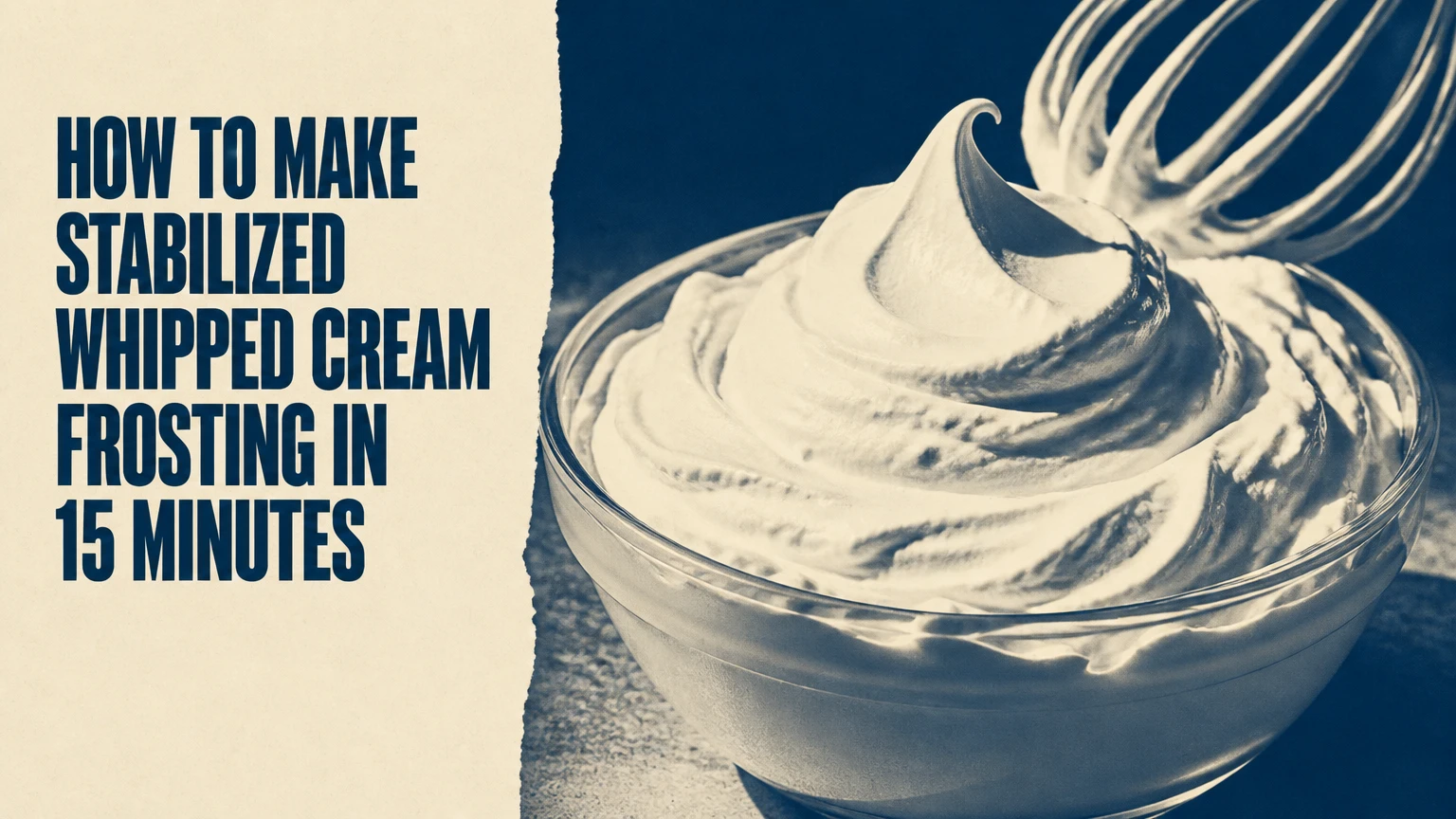
Stabilized whipped cream frosting combines cold heavy cream, sugar, and a structural stabilizer such as gelatin or instant pudding mix. The most dependable method uses 1 teaspoon gelatin per 1 cup cream, while instant pudding mix offers a faster option with less temperature control and a softer, slightly flavored finish.
Key Facts at a Glance
Heavy cream containing 36%-40% milk fat produces the strongest whipped structure.
One cup of liquid cream typically yields about 2 cups of finished frosting.
Gelatin-stabilized whipped cream usually holds its shape for 2-4 days when refrigerated.
A chilled bowl, cold cream, and gradual stabilizer addition prevent most texture failures.
Stabilized whipped cream remains a perishable dairy frosting and should stay at 4°C or below.
One cup of cream covers a small 15 cm cake lightly or pipes roughly 12-18 standard cupcakes.
What Is Stabilized Whipped Cream Frosting?
Stabilized whipped cream frosting is an aerated cream foam reinforced with an additional ingredient that slows collapse, liquid separation, and loss of piping definition. Standard whipped cream can soften within several hours, whereas a properly made stabilized version usually retains useful volume for 2-4 refrigerated days.
Whipping performs two jobs at once. The whisk incorporates air, and the mechanical action disrupts some milk-fat globules. The exposed fat partially joins around air cells, creating a flexible network that supports the foam. Milk proteins and the cream’s water phase also contribute, but the fat network supplies most of the immediate structure.
The network remains fragile because the foam contains a large amount of air and water. Gravity, warmth, vibration, and time encourage liquid to drain from the bubbles. Gelatin creates a fine gel throughout the water phase, while starches, sugar, and soft cheese increase viscosity or add a second physical framework.
Stabilization does not turn whipped cream into buttercream. The frosting remains lighter, less sweet, and more temperature-sensitive than butter-based frostings. It is excellent for chilled layer cakes, cream puffs, fruit cakes, and soft piping, but it is a poor choice for a cake displayed for hours in direct sun.
How Does Stabilized Whipped Cream Work?
Stabilized whipped cream frosting holds longer because a fat-supported air network receives additional support from a gel, thickener, or concentrated dairy matrix. The stabilizer reduces water movement and makes it harder for neighboring air cells to merge or drain.
Cream temperature matters more than mixer speed. Cold fat is firm enough to build a stable network; warm fat becomes softer and less effective at supporting peaks. A practical working range is approximately 2-7°C for the cream, with the bowl and whisk chilled before mixing.
The frequently repeated rule that all cream must remain below 4°C is useful for storage, but whipping can succeed slightly above that point if the cream is very cold and the room is cool. The 22°C threshold is also a practical warning rather than a precise failure line. Cream can lose definition earlier in a warm kitchen, especially during prolonged piping.
Gelatin must be fluid but never hot when added. Hot gelatin melts the developing fat structure, while cool gelatin can seize into elastic threads. The correct point is warm, clear, and pourable, added slowly into moving beaters.
Which Stabilizer Should You Use?
Gelatin is the best overall choice for sharp piping and a neutral flavor, while instant pudding mix is the easiest choice for beginners. Mascarpone or cream cheese creates the richest, thickest frosting, and agar or xanthan gum suits plant-based recipes when measured carefully.
| Stabilizer | Typical amount per 240 ml cream | Refrigerated quality window | Main trade-off |
|---|---|---|---|
| Unflavored gelatin | 1 tsp plus 1 tbsp water | 2-4 days | Animal-derived unless certified otherwise |
| Instant pudding mix | 1 tbsp | 2-3 days | Adds sweetness, flavor, and possible color |
| Powdered sugar | 30 g | 12-24 hours | Weak support and higher sweetness |
| Mascarpone | 60-90 g | 2-3 days | Richer flavor and heavier mouthfeel |
| Cream cheese | 60-90 g | 2-3 days | Tangy flavor and denser texture |
| Cornstarch | 1-2 tsp, preferably cooked | 1-2 days | Can feel chalky when under-hydrated |
| Agar powder | Approximately 0.5-1 g, recipe-dependent | 2-3 days | Must be boiled to hydrate; may set firmly |
| Xanthan gum | Approximately 0.2-0.5 g | 2-3 days | Easy to overuse and create gumminess |
Gelatin: best for clean piping
Use gelatin for wedding-style borders, rosettes, tall swirls, and cakes that need to remain presentable overnight. The flavor stays close to ordinary whipped cream, and the finished frosting has a smooth, elastic texture when the gelatin is dispersed correctly.
Check the package label when dietary or religious requirements matter. Gelatin sources vary, and certified halal or vegetarian products may use different ingredients. Gelatin is also unsuitable for people avoiding animal-derived ingredients.
Instant pudding mix: easiest method
Instant pudding mix thickens the cream without a separate heating step. Vanilla pudding produces a familiar dessert flavor, while white chocolate pudding can give a slightly sweeter and fuller result. Use the dry instant product, not a cooked pudding mix.
Pudding mix can create a faint ivory color or tiny particles if it is not dispersed at low speed first. The method works especially well for cupcakes, sheet cakes, and fillings where a small flavor change is acceptable.
Mascarpone, cream cheese, and starch
Mascarpone produces a smooth, mild, rich frosting that spreads easily between cake layers. Cream cheese supplies more tang and a denser body. Both are useful when the dessert already contains fruit, spice, or chocolate and the dairy flavor supports the design.
Cornstarch is less reliable than gelatin unless it is properly hydrated. Mixing raw cornstarch directly into cream can leave a powdery sensation. If using it, cook the starch with a small amount of milk or cream, cool the mixture completely, then whip it into the cream.
How to Make Stabilized Whipped Cream Frosting
The gelatin method takes approximately 15 minutes of active work and produces about 480 ml, or 2 cups, of frosting from 240 ml cream. The most important success factor is matching the gelatin and cream temperatures before the gelatin enters the moving whisk.
Before You Start
| Requirement | Recommended specification | Typical amount or cost |
|---|---|---|
| Heavy whipping cream | 36%-40% milk fat, very cold | 240 ml, typically $2-$5 |
| Unflavored gelatin | Powdered, food-grade | 1 tsp, typically $0.10-$0.40 |
| Cold water | For blooming gelatin | 15 ml, 1 tbsp |
| Powdered sugar | Finely milled icing sugar | 30 g, about 1/4 cup |
| Mixing bowl | Stainless steel or glass | 1 chilled bowl |
| Mixer | Stand or hand mixer | Medium speed setting |
| Storage | Covered container or cake box | Refrigerator at 4°C or below |
The 4 teaspoons of water sometimes paired with 1 teaspoon gelatin create a softer bloom, but 1 tablespoon is easier to incorporate in a small batch. More water can produce a looser final texture unless the gelatin quantity also increases.
Step 1: Chill the Cream and Equipment
Refrigerate the cream for at least 8 hours, then place the mixing bowl and whisk attachment in the freezer for 10 minutes. Measure the powdered sugar before whipping so the cream does not wait at room temperature while you prepare ingredients.
You will know the setup is ready when the bowl feels distinctly cold and the cream pours slowly from the refrigerator. The common mistake is chilling the bowl but leaving the cream on the counter.
Step 2: Bloom the Gelatin
Sprinkle 1 teaspoon gelatin over 1 tablespoon cold water in a heatproof cup. Leave it undisturbed for 5 minutes, until the powder absorbs the water and forms a soft, swollen mass.
Blooming hydrates the gelatin granules before heat dissolves them. Dry gelatin added directly to cream can form persistent specks because the surrounding cold liquid cools the granules before they disperse.
Step 3: Melt the Gelatin Gently
Heat the bloomed gelatin for 5-8 seconds in a microwave, or warm it over a small pan of water, until clear and fluid. Do not boil gelatin, because excessive heat can weaken its setting power.
Let the melted gelatin cool for approximately 2-4 minutes. The correct consistency resembles thin syrup. If the gelatin begins to thicken, warm it briefly again rather than adding it in a semi-set state.
Step 4: Whip the Cream to Soft Tracks
Pour 240 ml cold heavy cream into the chilled bowl. Whip on medium speed for approximately 60-90 seconds, then add 30 g powdered sugar and continue until the beaters leave visible tracks and the cream forms soft peaks.
The cream should still look smooth and slightly flexible. You will know it is ready for gelatin when the whisk marks remain for several seconds but the peak bends over. Adding gelatin before any structure forms can reduce volume; waiting until stiff peaks can make streaming difficult.
Step 5: Stream in the Warm Gelatin
Reduce the mixer to medium-low and pour the fluid gelatin in a thin, steady stream directly into the path of the beaters. Continue mixing for 20-40 seconds after the gelatin disappears into the cream.
The mixture should remain glossy and free of rubbery threads. The most common mistake is pouring gelatin onto the bowl wall, where it cools into a solid strip instead of dispersing through the foam.
Step 6: Whip to Stiff Peaks
Increase the mixer to medium or medium-high and stop as soon as the frosting forms stiff peaks that stand upright. This usually takes 30-90 seconds after the gelatin addition, depending on cream temperature and mixer power.
A finished peak keeps its shape when the whisk is lifted, while the frosting remains smooth rather than grainy. Transfer the frosting to a piping bag or covered container immediately and refrigerate it.
What Is the Fastest Pudding Mix Method?
Instant pudding stabilized whipped cream requires 240 ml cold heavy cream, 1 tablespoon instant pudding powder, and 15 g powdered sugar. The method takes about 5 minutes and avoids gelatin temperature matching, but the frosting tastes sweeter and may hold slightly less precise piping detail.
Add the cream, pudding mix, and powdered sugar to a chilled bowl. Mix on low for 20-30 seconds to prevent powder from escaping, then increase to medium-high and whip until stiff peaks form.
Stop promptly. Pudding mix thickens progressively, so an apparently soft mixture can become firm after a short rest. Refrigerate the frosting for 15-20 minutes before detailed piping if the kitchen is warm.
The pudding method is particularly practical for beginners and quick cupcakes. It is less suitable when the final frosting must taste like unsweetened cream, remain pure white, or support very fine lace piping.
How Much Frosting Does Each Batch Make?
One cup of liquid heavy cream typically produces about 2 cups of stabilized whipped cream, although over-whipping, sugar quantity, and cream brand affect the final volume. The following amounts use the gelatin ratio and provide practical starting points for common cake sizes.
| Liquid cream | Gelatin | Powdered sugar | Finished frosting |
|---|---|---|---|
| 240 ml | 1 tsp | 30 g | About 480 ml |
| 480 ml | 2 tsp | 60 g | About 960 ml |
| 960 ml | 4 tsp | 120 g | About 1.9 L |
| 1.44 L | 6 tsp | 180 g | About 2.9 L |
| Dessert application | Typical frosting needed | Cream starting amount |
|---|---|---|
| 12 standard cupcakes, piped swirls | 500-700 ml | 240-360 ml |
| 20 cm two-layer cake, filling and light exterior | 1.2-1.6 L | 600-800 ml |
| 23 cm sheet cake, thin spread | 1.2-1.8 L | 600-900 ml |
| 15 cm tall cake, filling and piping | 1.8-2.4 L | 900 ml-1.2 L |
| 23 cm pie topping | 350-500 ml | 180-250 ml |
These are typical practitioner estimates, not fixed recipe yields. A large open star tip uses more frosting than a small round tip, and a thick layer consumes substantially more than a skim coat.
How Should You Store and Transport It?
Store stabilized whipped cream frosting in a covered container at 4°C or below, and use it within 2-4 days for best texture. Refrigeration slows microbial growth and fat softening, but stabilization does not make dairy frosting shelf-stable.
| Situation | Recommended limit | Practical instruction |
|---|---|---|
| Refrigerator at 4°C or below | 2-4 days | Keep covered to prevent odor absorption |
| Room temperature around 20-22°C | 1-2 hours | Return to refrigeration promptly |
| Warm room above 27°C | About 30-60 minutes | Avoid outdoor display |
| Insulated transport with ice packs | 1-3 hours | Keep the container shaded and closed |
| Freezer storage | Up to 1 month, quality varies | Freeze piped portions, then thaw in the refrigerator |
Freezing can preserve whipped cream portions, but thawed frosting may lose volume or release water. Freeze small piped rosettes on a lined tray, transfer them to an airtight container, and thaw them in the refrigerator before placing them on a cake.
Stabilized whipped cream is not a safe substitute for a shelf-stable decorating frosting. For an outdoor event lasting several hours, use a chilled display, reduce direct sunlight, and consider a frosting designed for ambient conditions.
What Are the Most Common Failures?
Most stabilized whipped cream failures come from temperature mismatch, insufficient fat, or stopping at the wrong whipping stage. Diagnose the texture before adding more ingredients, because extra stabilizer cannot reliably repair cream that has already turned into butter.
| Problem | Likely cause | Best response | Prevention |
|---|---|---|---|
| Soft, loose peaks | Warm cream or under-whipping | Chill 15 minutes, then whip briefly | Start with cream below 7°C |
| Grainy texture | Over-whipping | Fold in 1-2 tbsp cold cream by hand | Stop at upright peaks |
| Yellow, buttery appearance | Fat network collapsed | Use immediately if possible; do not keep whipping | Use medium speed near the finish |
| Rubber strands | Cold or concentrated gelatin | Warm gently, re-chill, and re-whip cautiously | Stream warm fluid gelatin slowly |
| Liquid pooling | Low-fat cream or drainage | Chill, then re-whip briefly; add measured stabilizer | Use 36%-40% cream |
| Pudding flecks | Powder added too quickly | Mix on low before increasing speed | Sift or disperse dry mix first |
How do you fix grainy whipped cream?
Add 1-2 tablespoons of fresh, cold heavy cream and whisk gently by hand until the texture smooths. This can rescue early over-whipping, but cream that has separated into visible yellow butter granules may not return to a fully smooth frosting.
Over-whipping is easier with a stand mixer because the final change happens quickly. Reduce speed when stiff peaks begin, watch the surface closely, and stop before the whisk creates a dull, clotted appearance.
How do you fix gelatin pieces?
Small gelatin threads may soften if the mixture is warmed very gently, then chilled completely before cautious re-whipping. Large rubbery pieces usually cannot be removed without losing volume, so prevention is more reliable than repair.
Gelatin pieces form when the melted stabilizer is too cool, too concentrated, or poured against the cold bowl. A thin stream into moving beaters gives the gelatin enough dispersion to avoid local solidification.
How do you fix runny frosting?
Chill runny whipped cream for 15-20 minutes before deciding that it needs more stabilizer. If the cream remains loose, whip it briefly and add a small amount of instant pudding mix, mascarpone, or properly hydrated gelatin, depending on the original recipe.
Do not dump in several tablespoons of cornstarch or powdered sugar as an emergency fix. Powder can remain gritty, and additional sugar changes flavor without supplying the same structural support as a gel or dairy thickener.
Which Variations Fit Different Desserts?
Gelatin suits sharp decoration, pudding mix suits fast casual baking, and mascarpone suits rich layer fillings. Choosing the stabilizer according to the dessert prevents a common mistake: selecting maximum firmness when the recipe actually needs a light, neutral cream.
| Dessert or situation | Best method | Reason | Avoid when |
|---|---|---|---|
| Wedding-style piping | Gelatin | Smooth finish and strong peaks | Guests require vegetarian ingredients |
| Cupcakes for next day | Instant pudding | Fast, forgiving, flavored | Pure cream flavor is required |
| Fruit layer cake | Mascarpone | Rich body supports juicy fillings | A very light texture matters |
| Chocolate cake | Gelatin or mascarpone | Neutral or rich pairing | Chocolate color must remain pale |
| Vegetarian dessert | Agar or mascarpone | Avoids animal gelatin | A very soft whipped texture is essential |
| Vegan dessert | Coconut cream plus tested plant stabilizer | No dairy ingredients | Coconut flavor conflicts with dessert |
Vegetarian and plant-based options
Agar is not a direct 1:1 replacement for gelatin. Agar generally requires boiling in a water-based liquid to hydrate, then cooling to a pourable temperature before incorporation. Its gel is firmer and more brittle, so an untested substitution can create a set, gummy texture.
Xanthan gum works at much lower quantities than gelatin. A practical starting range is 0.2-0.5 g per 240 ml plant cream, but the correct amount depends on the product’s existing gums and solids. Weighing is preferable to using a teaspoon.
For vegan frosting, chill a high-fat coconut cream or a commercial plant whipping cream overnight. Coconut cream adds a noticeable flavor and can separate in the can, while commercial plant creams often contain emulsifiers that already provide significant stability.
What Are the Expert Rules for Better Results?
Professional results depend more on controlling the last minute of whipping than on using the most powerful stabilizer. Three rules consistently improve texture, efficiency, and piping definition.
- Treat temperature as a process variable. Keep the cream cold, but bring melted gelatin down from hot to warm and fluid. The goal is not identical temperatures, but enough compatibility to prevent melting or seizing.
- Scale the stabilizer with the cream. Doubling the cream while leaving gelatin unchanged creates a weaker foam; doubling gelatin without doubling cream creates a firmer, potentially rubbery texture. Use the batch table rather than estimating by eye.
- Separate filling and piping requirements. A soft filling can taste better, while a piped border needs more structural support. Make one batch with a lighter stabilizer for the layers and a firmer batch for exterior decoration when the cake design demands both.
One limitation deserves emphasis: stabilized whipped cream cannot provide the same heat tolerance as American buttercream, Swiss meringue buttercream, or a professionally formulated non-dairy topping. It wins on freshness and lightness, not on prolonged exposure to heat.
How Do You Choose Between the Main Methods?
Choose gelatin when piping precision and a neutral flavor matter most, instant pudding when speed matters most, and mascarpone or cream cheese when a richer flavor is part of the dessert. No method is universally best because each changes firmness, sweetness, flavor, and dietary suitability.
| Decision factor | Gelatin | Instant pudding | Mascarpone or cream cheese | Agar or xanthan |
|---|---|---|---|---|
| Active preparation time | 10-15 minutes | 5 minutes | 8-12 minutes | 10-20 minutes |
| Flavor change | Minimal | Vanilla or white chocolate | Tangy or rich | Minimal to variable |
| Fine piping | Excellent | Good | Good, denser | Variable |
| Skill requirement | Moderate | Low | Low-moderate | Moderate-high |
| Vegetarian suitability | Depends on label | Usually yes | Usually yes | Yes |
| Vegan suitability | No | Product-dependent | No | Yes |
| Typical ingredient cost per cup | $2.50-$6 | $2.75-$6.50 | $4-$9 | $3-$8 |
The table uses typical household pricing in the United States and excludes specialty imported creams or commercial bakery stabilizers. Local prices can vary substantially, especially where heavy cream is sold in small cartons.
Can You Use Stabilized Whipped Cream Under Fondant?
Stabilized whipped cream is generally unsuitable as the sole undercoat beneath fondant. Its high water content and soft structure can cause fondant to slide, soften, or develop surface irregularities, particularly during warm transport.
Use a firmer, low-moisture coating beneath fondant, then use stabilized whipped cream as a refrigerated filling if the cake design allows it. A thin barrier of chocolate ganache or buttercream provides a more dependable surface for fondant.
Can You Color and Flavor It?
Gelatin-stabilized whipped cream can be colored and flavored, but liquid additions must remain modest. Use gel food coloring, sifted cocoa, espresso powder dissolved in a teaspoon of cream, or finely sieved fruit reduction rather than large amounts of free liquid.
For a vanilla version, add 1-2 teaspoons vanilla extract with the powdered sugar. For chocolate frosting, replace part of the sugar with 15-25 g sifted cocoa powder per 240 ml cream, then adjust sweetness after the cocoa disperses.
Fold delicate ingredients by hand after stiff peaks form. Excessive mixing after coloring or flavoring can push the frosting from smooth to grainy.
Frequently Asked Questions
Can I make stabilized whipped cream without gelatin?
Yes. Instant pudding mix, mascarpone, cream cheese, properly hydrated cornstarch, agar, and xanthan gum can stabilize whipped cream without standard gelatin. Instant pudding is the simplest household alternative, while mascarpone offers dependable body and a richer flavor. Check every package when vegetarian, halal, or vegan requirements apply.
Why does my whipped cream melt in the refrigerator?
Whipped cream can soften in the refrigerator when the cream contains too little fat, the foam was under-whipped, or the stabilizer was poorly dispersed. A refrigerator warmer than 4°C also shortens the quality window. Chill the bowl, use 36%-40% cream, and stop whipping at firm peaks.
Can I use regular whipping cream instead of heavy cream?
Regular whipping cream containing about 30% milk fat can whip, but it usually produces softer peaks and less reliable piping than heavy cream at 36%-40% fat. It may work for a pie topping served soon after preparation, but gelatin or another stabilizer becomes more important.
How long should stabilized whipped cream sit before piping?
Gelatin-stabilized frosting can usually be piped immediately after stiff peaks form. A 10-20 minute refrigeration period can firm pudding-based or mascarpone-based frosting, especially in a warm kitchen. Do not leave the finished mixture uncovered, because refrigerator air can dry the exposed surface.
Can I make the frosting ahead of time?
Yes. Prepare stabilized whipped cream 1-2 days ahead, store it covered at 4°C or below, and pipe it directly from a sealed container or piping bag. Stirring after storage can reduce volume, so remix only briefly if the frosting has softened.
Does powdered sugar stabilize whipped cream?
Powdered sugar provides mild stabilization because its fine sugar and small starch content increase the viscosity of the water phase. It does not create the strong structural support of gelatin or soft cheese, so plain sweetened whipped cream is best used within 12-24 hours.
The Bottom Line
To make stabilized whipped cream frosting, chill 240 ml heavy cream, bloom 1 teaspoon unflavored gelatin in 1 tablespoon cold water, melt it gently, whip the cream with 30 g powdered sugar to soft peaks, stream in warm fluid gelatin, and finish at stiff peaks. Refrigerate the frosting at 4°C or below and use it within 2-4 days for the best piping quality. For the easiest alternative, use 1 tablespoon instant pudding mix per cup of cream.
