

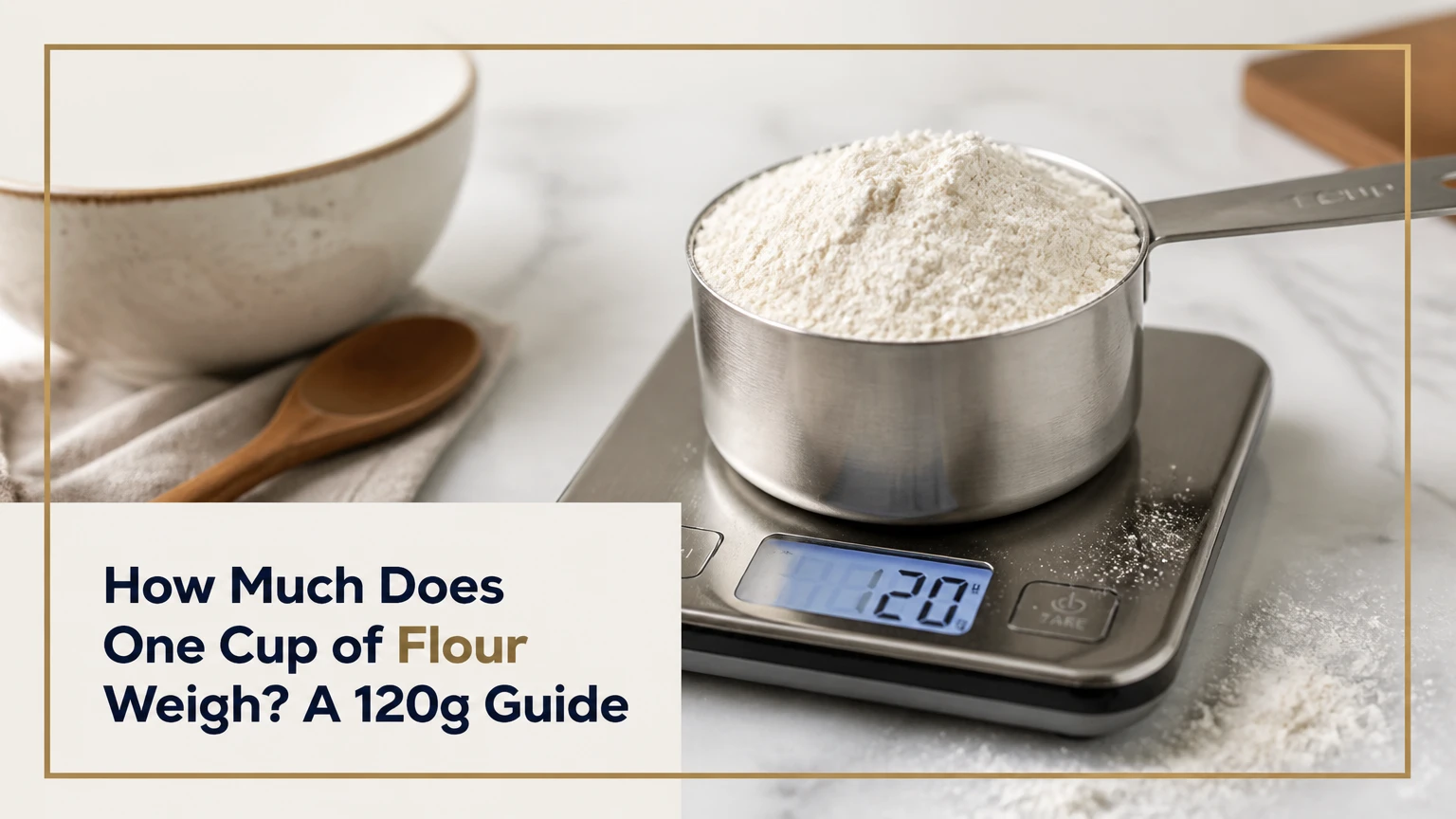
One US cup of all-purpose flour weighs 120 grams, or about 4.25 ounces, when measured by the spoon-and-level method. A cup is not a fixed mass, however: scooping, tapping, sifting, flour type, and storage can move the result from roughly 110 grams to 160 grams.
Key Facts at a Glance
- 120 grams is the standard working weight for one US cup of all-purpose flour measured by spooning and leveling.
- 4.25 ounces is the approximate avoirdupois equivalent of 120 grams.
- Directly dipping a dry cup into flour commonly produces 140-160 grams because the flour becomes compacted.
- A digital scale measures mass directly and is more repeatable than any volume method.
- One US customary cup holds 236.6 milliliters, while a metric cup holds 250 milliliters, so cup-based conversions can differ.
- Flour type, milling, bran content, and moisture can change the weight of a level cup.
How Much Does One Cup of Flour Weigh?
One cup of flour weighs 120 grams when the flour is all-purpose flour and the cup is filled with a spoon, then leveled. That figure is a recipe convention rather than a physical constant, because flour contains air spaces and those spaces change when the particles settle or become compressed.
King Arthur Baking publishes 120 grams as its standard cup weight for all-purpose flour, while other recipe publishers use values from approximately 120 to 130 grams. The correct priority is the recipe’s own gram specification when one is provided. If the recipe gives only cups, use 120 grams for a level US cup of all-purpose flour unless the recipe author states another standard.
A 120-gram portion equals approximately 4.23 ounces by mass. Kitchen scales usually display grams more precisely than ounces, so grams are the better unit for baking formulas.
Standard conversions for all-purpose flour
| Volume of all-purpose flour | Spoon-and-level weight | Approximate ounces | Approximate pounds |
|---|---|---|---|
| 1/4 US cup | 30 g | 1.06 oz | 0.066 lb |
| 1/2 US cup | 60 g | 2.12 oz | 0.132 lb |
| 3/4 US cup | 90 g | 3.17 oz | 0.198 lb |
| 1 US cup | 120 g | 4.23 oz | 0.265 lb |
| 2 US cups | 240 g | 8.47 oz | 0.529 lb |
| 4 US cups | 480 g | 16.93 oz | 1.058 lb |
Why Does Flour Weight Change in a Cup?
Flour weight changes because a cup measures occupied space, while a scale measures the amount of matter in that space. Loose flour contains more air between particles; settled or compressed flour contains less air, allowing more flour particles to fit into the same cup.
Flour is also hygroscopic, meaning it can absorb water from surrounding air. In ordinary household storage, the effect is usually smaller than the effect of packing. A humid environment may increase the mass of flour in a given volume, but it does not create a reliable conversion factor because flour temperature, container exposure, milling, and local humidity all differ.
Shipping and storage can settle flour before measurement. Stirring restores some looseness, but it does not make every brand identical. Bran particles, particle size, protein content, and whether the flour was milled finely or coarsely also affect bulk density.
The main variables
| Variable | Typical effect on one cup | Why it matters | Practical response |
|---|---|---|---|
| Spoon-and-level filling | 115-125 g | Preserves more air between particles | Use for cup-based baking recipes |
| Direct dip-and-sweep | 140-160 g | The cup compresses flour during entry | Avoid unless the recipe specifies it |
| Sifted, then spooned | 110-115 g | Sifting increases aeration | Weigh after sifting if the recipe says “sifted flour” |
| Repeated tapping | Adds 5-20 g or more | Settling removes trapped air | Never tap a filled dry cup |
| High-moisture storage | Variable, often a few grams | Flour absorbs ambient water | Store sealed and weigh for precision |
| Coarse or bran-rich flour | Brand-dependent | Larger particles pack differently | Follow the package or recipe weight |
The 110-160 gram range should not be treated as a guaranteed laboratory limit. It is a practical household range that illustrates how dramatically technique can affect a cup.
What Does One Cup of Each Flour Type Weigh?
One cup of flour does not have one universal weight across flour categories. A spoon-and-level cup typically weighs about 114 grams for cake or pastry flour, 120 grams for all-purpose flour, 127 grams for bread flour, and approximately 102-120 grams for rye or whole wheat flour, depending on milling and brand.
The table below provides useful kitchen reference values, not immutable standards. A recipe that names a particular brand may use a different cup convention, especially when the flour contains substantial bran, germ, or added ingredients.
| Flour type | Typical weight per US cup | Approximate ounces | Main density factor |
|---|---|---|---|
| Cake flour | 114 g | 4.02 oz | Fine, starch-rich, low-protein milling |
| Pastry flour | 114 g | 4.02 oz | Fine soft-wheat particles |
| All-purpose flour | 120 g | 4.23 oz | Medium-protein wheat blend |
| Whole wheat flour | 120 g | 4.23 oz | Bran and germ increase variation |
| Bread flour | 127 g | 4.48 oz | Higher protein and often denser milling |
| Rye flour | 102 g | 3.60 oz | Low-gluten flour with variable particle size |
Bread flour is often heavier per cup than all-purpose flour, but the difference is not guaranteed for every brand. Whole wheat flour may weigh close to all-purpose flour by cup even though its bran and germ change how it absorbs water and behaves in dough.
Does sifted flour weigh less?
Sifted flour usually occupies more volume and therefore weighs less per cup when it is measured after sifting. A sifted cup may weigh about 110-115 grams, compared with approximately 120 grams for a normally loosened cup of all-purpose flour.
The wording of a recipe determines the sequence. “One cup sifted flour” means sift first and measure afterward. “One cup flour, sifted” means measure one cup of flour first, then sift it. The second instruction starts with approximately 120 grams, although sifting may change the final volume.
Modern recipes often sift for distribution and lump removal rather than to create a specific low-density measurement. Weighing removes that ambiguity.
Which Flour Measurement Method Is Most Accurate?
The spoon-and-level method is the most reliable volume method, while weighing flour on a digital scale is the most accurate practical method. Spoon-and-level measurement usually takes less than a minute and produces a repeatable result when the flour is loosened and the cup is not tapped.
Method comparison
| Method | Typical AP flour weight per cup | Equipment | Best use |
|---|---|---|---|
| Digital scale | 120 g target | 1-g kitchen scale | Bread, pastry, cakes, repeatable results |
| Spoon and level | 115-125 g | Dry measuring cup, spoon, straight edge | Recipes written in cups |
| Sift, spoon, and level | 110-115 g | Sieve, spoon, dry cup | Recipes explicitly requiring post-sift measurement |
| Dip and sweep | 140-160 g | Dry measuring cup | Only when the recipe specifically defines it |
| Loose scoop from container | 125-140 g | Dry measuring cup | Less consistent casual cooking |
How do you measure flour with a spoon and level?
- Loosen the flour. Stir the flour in its container for several seconds to break up settled areas.
- Fill the cup gently. Spoon flour into a dry measuring cup until it forms a slight mound above the rim.
- Do not shake the cup. Shaking settles the particles and increases the mass.
- Level the surface. Sweep a knife or other straight edge across the rim, returning excess flour to the container.
- Transfer promptly. Flour left exposed in a humid kitchen can gradually absorb moisture.
You will know the method worked when the flour is level with the rim, the cup was never pressed into the container, and the removed excess forms a light, loose pile rather than a compacted strip.
Is a Digital Scale Better Than Measuring Cups?
A digital kitchen scale is better for precision, while dry measuring cups remain adequate for forgiving recipes when the method is consistent. A scale becomes especially valuable when flour represents a large proportion of the formula or when a small hydration error changes the result.
America’s Test Kitchen has repeatedly recommended weighing ingredients for greater consistency, and professional baking formulas use mass because baker’s percentages require a defined flour weight. King Arthur Baking’s 120-gram all-purpose standard provides a practical bridge between cup recipes and gram-based recipes.
| Tool or method | Typical purchase cost | Resolution | Setup time | Precision for flour |
|---|---|---|---|---|
| Basic digital scale | $10-$20 | 1 g | 1 minute | High |
| Larger baker’s scale | $25-$60 | 1 g | 1-2 minutes | High, greater capacity |
| Dry measuring cup set | $5-$15 | Volume only | 1 minute | Moderate |
| Spoon and straight edge | $1-$5 | Volume only | 1-2 minutes | Moderate when consistent |
| Liquid measuring jug | $5-$15 | Volume with meniscus | 1-2 minutes | Low for flour |
A scale also reduces dishwashing because ingredients can be added sequentially to one bowl. Most kitchen scales use common batteries, weigh in 1-gram increments, and occupy less counter space than a full cup set.
A scale is not automatically better for every task. A cup is sufficient for thickening a soup or making a casual batter where several grams will not affect the outcome. A scale is less useful when a recipe’s author has not supplied dependable gram weights and the user must still interpret an inconsistent cup convention.
How Should You Convert a Cup-Based Recipe to Grams?
Convert one US cup of all-purpose flour to 120 grams unless the recipe supplies a different weight or identifies a specific flour. Multiply the number of cups by 120 for a quick conversion, then adjust only when the flour type or recipe instructions require another value.
| Recipe volume | AP flour at 120 g per cup | Bread flour at 127 g per cup | Cake flour at 114 g per cup |
|---|---|---|---|
| 1/3 cup | 40 g | 42 g | 38 g |
| 2/3 cup | 80 g | 85 g | 76 g |
| 1 1/4 cups | 150 g | 159 g | 143 g |
| 1 1/2 cups | 180 g | 191 g | 171 g |
| 2 1/2 cups | 300 g | 318 g | 285 g |
| 3 cups | 360 g | 381 g | 342 g |
For a recipe that calls for 2 1/2 cups of all-purpose flour, begin with 300 grams. If the recipe also says “sifted,” determine whether sifting occurs before or after measurement instead of automatically reducing the weight.
Recipes from the United States generally assume a US customary cup. A metric cup holds 250 milliliters rather than 236.6 milliliters, a difference of about 5.7 percent. That distinction matters when a recipe uses volume without defining its region.
When Does a Flour Weight Error Matter?
A flour weight error matters most in bread, laminated pastry, macarons, and small-batch cakes, where a 20-gram difference changes hydration or the ratio of flour to fat, sugar, or liquid. The same error is less consequential in gravies, dredging, and large-volume batters that can be adjusted visually.
A 1-cup recipe measured at 150 grams instead of 120 grams contains 25 percent more flour than intended. That can produce dry cookies, stiff cake batter, dense quick bread, or dough that fails to spread.
Bread formulas expose the problem clearly. If a dough contains 500 grams of water and the intended flour weight is 700 grams, hydration is 71.4 percent. Accidentally adding 150 grams extra flour lowers the practical ratio to 58.8 percent, creating a much stiffer dough before mixing variables are considered.
Baker’s percentage example
| Formula ingredient | Intended weight | Weight after 150 g flour error | Consequence |
|---|---|---|---|
| Flour | 700 g | 850 g | Base quantity rises 21.4% |
| Water | 500 g | 500 g | Liquid stays unchanged |
| Intended hydration | 71.4% | 58.8% | Dough becomes much firmer |
| Salt at 2% | 14 g | 14 g | Salt percentage falls to 1.65% |
| Yeast at 1% | 7 g | 7 g | Fermentation ratio also falls |
The practitioner rule is simple: if a recipe contains more than about 2 cups of flour, or if the dough must reach a defined consistency, weigh the flour. Small volume errors multiply across a large formula.
What Are Common Flour-Measuring Mistakes?
The most common errors are dipping the cup into the flour, tapping the filled cup, using a liquid jug, and confusing “sifted flour” with “flour, sifted.” Each error changes either the flour’s density, the intended measurement sequence, or the reading method.
| Mistake | Likely result | Recovery for an unbaked mixture | Prevention |
|---|---|---|---|
| Dip and sweep | 140-160 g per cup | Add liquid only cautiously after assessing texture | Spoon into the cup |
| Tap the cup | Settled, overfilled flour | Reweigh or remake the dry mixture | Keep the cup still |
| Use a liquid jug | Uneven surface and parallax | Recheck by weight if possible | Use flat-rimmed dry cups |
| Pack flour into a cup | Dense, dry baked goods | Remove excess before mixing when practical | Never press the flour |
| Ignore sift sequence | Wrong volume or density | Follow the recipe’s exact wording | Read punctuation carefully |
| Store flour open | Variable moisture and clumping | Break clumps and weigh the needed amount | Use an airtight container |
If a cake batter already contains too much flour, do not automatically add water. Extra liquid changes sugar concentration, fat balance, gluten development, and bake time. For a forgiving batter, adjust gradually; for a delicate cake or pastry, remaking the dry mixture is safer.
How Should Flour Be Stored Before Weighing?
Store flour in an airtight container in a cool, dry cupboard, and keep the container away from steam, direct sunlight, and frequent temperature changes. Proper storage reduces clumping, insect exposure, odor transfer, and moisture variation, although it cannot eliminate natural differences between flour brands.
A paper bag is acceptable for short-term unopened storage, but an airtight food-safe container gives better protection after opening. Label the container with the flour type and opening date. Whole wheat flour contains more oil-rich germ and generally has a shorter storage life than refined all-purpose flour; refrigeration or freezing can extend freshness when the container is tightly sealed.
Bring chilled flour to room temperature if a recipe depends on ingredient temperature, especially yeast dough or pastry. Cold flour does not automatically weigh less, but condensation during handling can add moisture to the surface and create clumps.
Can You Measure Flour Without a Scale?
You can measure flour without a scale by using the spoon-and-level method with a dry cup, but the result will usually be less consistent than a gram measurement. Fluff the flour, fill the cup with a spoon, avoid tapping, and level it with a straight edge.
If a recipe gives a weight and you lack a scale, use the recipe’s stated cup equivalent rather than substituting a generic conversion. If no equivalent appears, use 120 grams per US cup for all-purpose flour and accept that the result may vary.
No-scale situations
- One tablespoon: Use a level measuring spoon, not a heaped spoon.
- Partial cup: Spoon and level the cup, then use the appropriate fractional measure.
- Large formula: Measure each cup separately instead of compressing flour into one oversized vessel.
- Sifted flour: Sift first only when the recipe says “sifted flour.”
- Metric recipe: Confirm whether the stated cup is 236.6 milliliters or 250 milliliters.
A tablespoon conversion is approximately 7.5 grams for all-purpose flour when based on 120 grams per US cup. That figure remains a working approximation because a tablespoon can also be overfilled or compressed.
What Should You Do When a Recipe Lists a Different Weight?
Use the recipe’s stated gram weight when it differs from 120 grams, provided the recipe identifies the flour and comes from a tested source. Recipe authors may use a house standard, a national cup size, a sifted measurement, or a particular brand whose published density differs from the generic conversion.
| Recipe wording | Recommended interpretation | Working AP reference |
|---|---|---|
| 1 cup flour | Spoon and level unless stated otherwise | 120 g |
| 1 cup sifted flour | Sift, then measure | 110-115 g |
| 1 cup flour, sifted | Measure, then sift | About 120 g |
| 1 cup packed flour | Use only if explicitly specified | 140-160 g |
| 1 cup bread flour | Use the recipe’s gram value first | About 127 g |
| 1 cup flour, 125 g | Weigh 125 g | 125 g |
The recipe’s gram value takes precedence because it reveals the author’s intended mass. Replacing 125 grams with 120 grams may seem insignificant, but a difference of 5 grams per cup becomes 25 grams in a five-cup bread formula.
How Do Flour Weights Affect Different Recipes?
Flour weight affects recipes through structure, hydration, spread, and tenderness. Cookies may spread less when excess flour absorbs available liquid, cakes may become dense when gluten-forming proteins receive too much flour, and bread dough may require additional water or longer mixing.
| Recipe type | Typical flour sensitivity | Common symptom of excess flour | Best measurement |
|---|---|---|---|
| Cookies | Medium | Thick, dry, limited spread | Scale or careful spoon-and-level |
| Layer cakes | High | Dense crumb and reduced rise | Scale |
| Pie pastry | High | Tough crust and poor flakiness | Scale |
| Pancakes | Low to medium | Thick batter and dry edges | Spoon-and-level |
| Yeast bread | Very high | Stiff dough and low expansion | Scale with baker’s percentages |
| Gravy thickener | Low | Overly thick sauce | Spoon or adjust by texture |
Flour weight is only one variable. Baking powder age, oven calibration, flour protein, mixing time, and pan dimensions can also alter results. A perfect 120-gram measurement cannot correct a recipe with a mismatched flour type or an inaccurate oven.
FAQ
Is 120 grams always equal to one cup of flour?
No. One US cup of all-purpose flour is commonly standardized at 120 grams when spooned and leveled, but flour type and measurement method change the result. Bread flour may be near 127 grams, while sifted cake flour may be near 114 grams. A recipe’s stated gram weight overrides a generic conversion.
How many ounces are in one cup of flour?
One US cup of all-purpose flour weighs approximately 4.25 ounces when measured by spoon and level. The mass may rise to 5-5.6 ounces when flour is dipped and swept because the cup compresses the particles. Fluid ounces measure volume and should not be substituted for ounces by weight.
Should I sift flour before or after measuring?
Follow the recipe wording. “One cup sifted flour” means sift before measuring, while “one cup flour, sifted” means measure first and sift afterward. The first method usually produces a lighter cup. Weighing the flour removes most of the ambiguity, but the recipe may still require sifting for texture.
Does bread flour weigh more than all-purpose flour?
Bread flour often weighs more per cup than all-purpose flour, with approximately 127 grams compared with 120 grams for all-purpose flour. The difference depends on milling and brand, so bread formulas should use the listed gram weight. Protein content affects dough strength, but protein percentage alone does not determine bulk density.
What is the best way to measure flour for sourdough?
Use a digital scale and measure flour, water, salt, and starter in grams. Sourdough formulas depend on baker’s percentages, so a packed cup can change hydration enough to alter mixing, fermentation, and shaping. Record the flour brand and keep the scale on a stable, level surface.
Can humidity make a cup of flour heavier?
Humidity can make flour heavier by allowing it to absorb moisture, but packing usually causes a larger immediate change in cup weight. Flour stored in a damp environment may clump and behave differently even when the scale reading changes only modestly. Airtight storage and weighing provide the most consistent results.
The Bottom Line
One US cup of all-purpose flour weighs 120 grams, or about 4.25 ounces, when spooned into a dry measuring cup and leveled. The same cup can weigh approximately 140-160 grams when dipped directly into a flour container, so technique determines whether a cup-based recipe receives the intended amount. For cakes, pastry, bread, and any formula requiring repeatability, weigh the flour in grams. When no scale is available, loosen the flour, spoon it into the cup, and level it without tapping. Use the recipe’s own gram specification whenever one exists, because how much does one cup of flour weigh depends on the flour, the cup standard, and the measurement method.
