

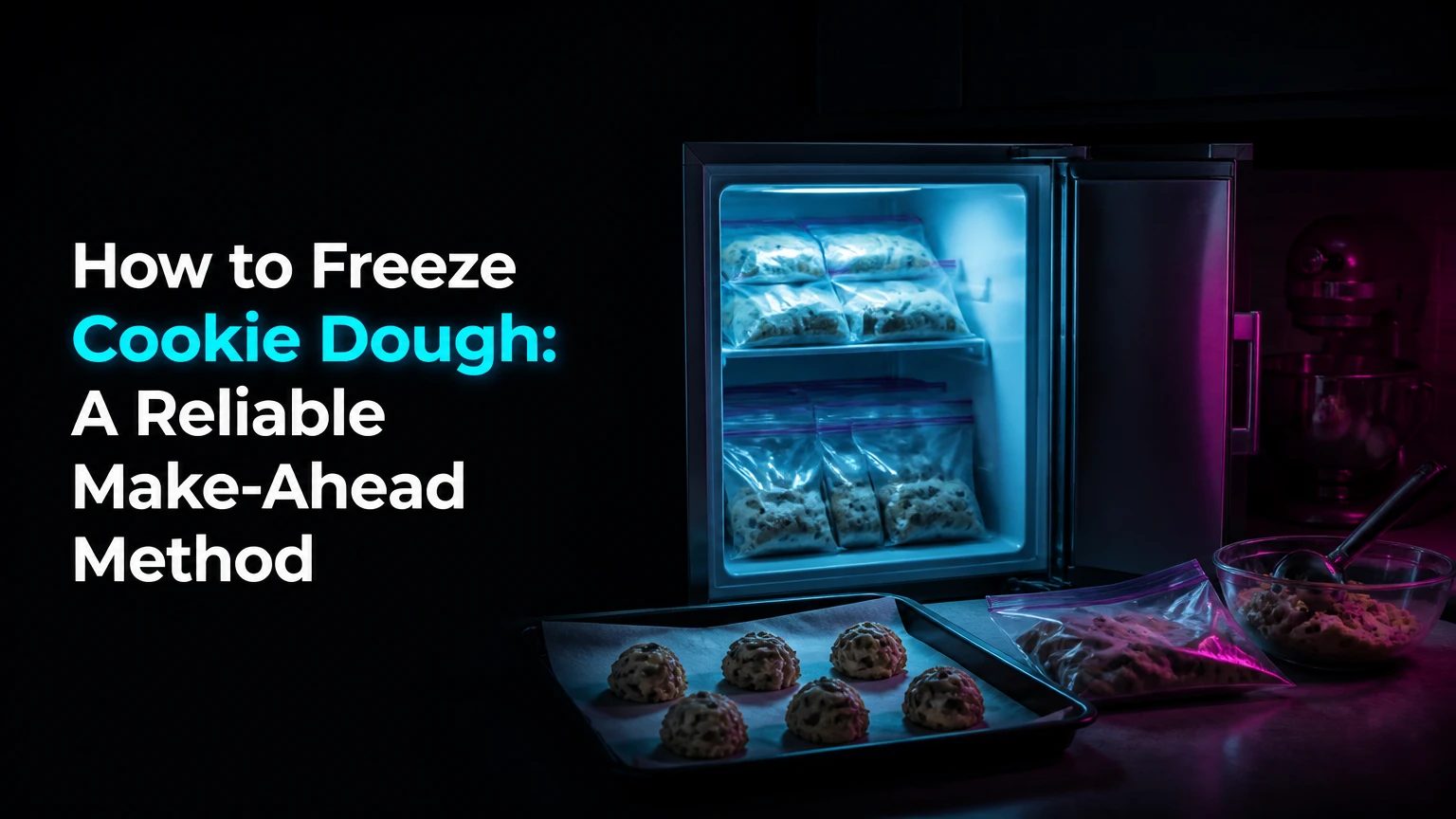
To freeze cookie dough, portion or shape the freshly mixed dough, freeze pieces uncovered on a parchment-lined tray, then pack them airtight at 0°F (-18°C). Label the package with the dough type and baking instructions. Most cookie dough keeps its best flavor and texture for 2-3 months in a consistently cold home freezer.
Key Facts at a Glance
Cookie dough should be frozen at 0°F (-18°C) or colder for dependable long-term storage.
Pre-portioned dough can usually bake directly from frozen, with extra baking time.
A refrigerator freezer gives approximately 2-3 months of best quality; a stable deep freezer may preserve quality for 3-6 months.
Flash-freezing dough pieces for 1-2 hours prevents them from sticking together.
Airtight packaging prevents freezer burn, odor absorption, and surface drying.
Dough containing delicate meringue or high-liquid structures may need a different freezing strategy.
How to Freeze Cookie Dough
The most reliable method takes about 2 hours of active and inactive time, including 1-2 hours for the first freeze. The process has seven core actions: portion, tray-freeze, pack, remove air, label, store, and bake with a calibrated time adjustment. Dough size, packaging quality, and freezer temperature determine the result more than the brand of freezer bag.
Before You Start
| Requirement | Typical amount or setting | Why it matters |
|---|---|---|
| Freezer temperature | 0°F (-18°C) or colder | Limits microbial growth and protects quality |
| Parchment paper | 1 sheet per standard tray | Prevents dough from sticking |
| Freezer bag | 1 heavy-duty bag per 12-24 cookies | Reduces air and odor exposure |
| Tray-freezing time | 1-2 hours | Hardens individual portions |
| Best-quality storage | 2-3 months | Preserves flavor and texture in most home freezers |
You need a baking sheet, parchment paper, cookie scoop or tablespoon, freezer-safe bag or rigid container, marker, and the original recipe. A kitchen scale improves consistency when cookies must bake evenly, especially when each portion weighs 30-45 grams.
Step 1: Finish and Chill the Dough Briefly
Mix the cookie dough according to the recipe, then refrigerate very soft dough for 20-30 minutes before portioning. A short chill makes sticky mixtures easier to shape and reduces butter smearing during handling.
You will know the dough is ready when a scoop holds its shape for at least 10 seconds. A common mistake is freezing warm, glossy dough that spreads across the tray before it hardens.
Step 2: Portion the Dough Before Freezing
Scoop drop-cookie dough into the same size portions you would place on a baking sheet. Roll cut-out dough into a flat disc or roll and cut the shapes before freezing if you want the fastest future baking session.
| Dough type | Portion or shape | Typical individual size | Best later method |
|---|---|---|---|
| Chocolate chip | Round scoop | 30-45 g | Bake from frozen |
| Oatmeal | Round scoop | 30-40 g | Bake from frozen |
| Shortbread | Log | 4-5 cm diameter | Slice after partial thaw |
| Sugar cookie | Disc or cut shape | 6-8 mm thick | Roll or bake from frozen |
Uniform portions are more valuable than perfect roundness. Pieces with different weights finish at different times, so the smaller cookies may brown before the larger centers set.
Step 3: Flash-Freeze the Pieces on a Tray
Line a baking sheet with parchment and arrange the portions in one layer without touching. Place the tray flat in the freezer for 1-2 hours, until every piece feels hard when pressed lightly through its surface.
You will know the flash freeze worked when pieces lift individually without bending or leaving soft dough on the parchment. Do not place freshly portioned dough directly into a bag, because contact points freeze together and create one difficult block.
Step 4: Pack the Frozen Dough Airtight
Transfer the solid pieces to a heavy-duty freezer bag or rigid freezer container. Press out excess air without crushing the dough, seal the package, and add a second bag or wrap when storage will exceed 8 weeks.
| Packaging method | Typical cost | Practical storage period | Main strength |
|---|---|---|---|
| Thin storage bag | $0.05-$0.15 | Up to 4 weeks | Lowest cost |
| Heavy-duty freezer bag | $0.15-$0.30 | 2-3 months | Good air and moisture barrier |
| Double-wrapped bag | $0.30-$0.60 | 3-6 months | Better burn and odor protection |
| Vacuum-sealed bag | $0.50-$1.00 | Up to 6 months | Minimal trapped air |
Vacuum sealing protects hard frozen portions well, but vacuum pressure can deform soft discs or cut-out shapes. Freeze the shapes solid before sealing, and leave enough space around fragile edges.
Step 5: Label the Package Completely
Write the cookie name, portion weight, freezing date, oven temperature, expected baking time, and any thawing instruction on the package. A label prevents the most common make-ahead error: forgetting whether dough should go into the oven frozen or partially thawed.
For example, label a bag: “Oatmeal raisin, 35 g each, freeze 12 January, bake at 350°F, frozen, add 2-4 minutes.” Recipe instructions disappear surprisingly quickly when several holiday doughs share one freezer shelf.
Step 6: Freeze and Store the Package Flat
Keep the sealed package flat until the dough is fully frozen, then stack bags vertically or horizontally according to the available space. Avoid the freezer door, where temperature changes are greater than in the back or center of the compartment.
A stable 0°F freezer preserves safety indefinitely while the dough’s quality gradually declines. Home bakers should use a 2-3 month target for ordinary freezer compartments and reserve 3-6 month storage for well-sealed dough in a stable chest or deep freezer.
Step 7: Bake With a Controlled Adjustment
Bake small, pre-portioned drop cookies directly from frozen unless the recipe specifically requires thawing. Add 2-5 minutes to the original baking time, then judge doneness by set edges, a properly colored underside, and a center that no longer looks wet.
You will know the adjustment is correct when the first test batch has firm edges and the intended center texture. Do not automatically lower the oven by 25°F, because that recommendation can produce pale, dry cookies; use a test batch to adjust time first.
Which Freezing Method Fits Your Cookie Dough?
Pre-portioned pieces are best for drop cookies, logs are best for slice-and-bake dough, and flat discs are best for rolled cookies. The right method minimizes later handling while preserving the dough’s intended thickness and shape.
| Method | Preparation time | Freezer footprint | Future handling | Best examples |
|---|---|---|---|---|
| Pre-portioned scoops | 15-25 minutes | High initially | Bake directly frozen | Chocolate chip, peanut butter, oatmeal |
| Cut shapes | 25-45 minutes | Medium-high | Bake frozen or thaw briefly | Sugar cookies, gingerbread |
| Flat discs | 10-15 minutes | Low | Thaw, roll, and cut | Sugar cookie, butter cookie |
| Wrapped logs | 15-20 minutes | Low | Thaw 10-20 minutes, then slice | Shortbread, pinwheels, icebox cookies |
When Should You Use a Dough Log?
Use a tightly wrapped log for slice-and-bake cookies because the cylindrical shape saves space and preserves the recipe’s intended cross-section. Wrap the log in parchment, add two layers of plastic wrap, then place it inside a freezer bag.
A 4-5 centimeter log usually needs 10-20 minutes in the refrigerator or on the counter before slicing, depending on its hardness. Slice with a sharp knife using consistent 6-10 millimeter cuts; fully thawed dough may squash, while rock-hard dough can crack.
When Are Flat Discs Better?
Flat discs work best when the dough must be rolled and cut later, particularly for sugar cookies and gingerbread. Press each disc to approximately 2 centimeters thick, wrap it tightly, and freeze it on a flat surface so it thaws evenly.
A disc usually thaws in the refrigerator overnight or on the counter for 30-60 minutes. Roll between parchment sheets if the dough becomes sticky, and avoid adding large amounts of flour because extra flour changes tenderness and spread.
How Long Does Frozen Cookie Dough Last?
Frozen cookie dough remains safe indefinitely at 0°F (-18°C) when it stays continuously frozen, according to the United States Department of Agriculture’s freezer-storage guidance. Best quality is shorter: approximately 2-3 months in a typical refrigerator freezer and 3-6 months in a stable deep freezer.
| Storage environment | Safety at constant 0°F | Best-quality target | Likely quality issue after target |
|---|---|---|---|
| Refrigerator freezer | Indefinite while continuously frozen | 2-3 months | Surface drying and odors |
| Chest freezer | Indefinite while continuously frozen | 3-6 months | Gradual flavor loss |
| Frost-free freezer door | Indefinite while continuously frozen | 1-2 months | Temperature fluctuation |
| Poorly sealed package | Indefinite if frozen | 2-4 weeks | Freezer burn and stale flavor |
“Safe” and “pleasant to eat” are different standards. Freezer burn does not usually make food unsafe, but it removes moisture from exposed dough and can create tough, gray, stale-tasting areas.
Which Cookie Dough Freezes Well?
High-fat drop doughs, shortbread, and firm rolled-cookie dough generally freeze well because their structure tolerates solidified butter and limited moisture movement. Doughs with delicate foams, large liquid components, or fragile emulsions are less predictable after freezing and thawing.
| Cookie category | Freeze raw dough? | Preferred form | Main risk |
|---|---|---|---|
| Chocolate chip | Yes | Scooped balls | Uneven spread if portions vary |
| Oatmeal | Yes | Scooped balls | Oats absorb moisture during storage |
| Shortbread | Yes | Wrapped log or discs | Cracking during slicing |
| Sugar cookies | Yes | Discs or cut shapes | Sticking and flour buildup |
| Macaron batter | Sometimes, with testing | Piped shells or baked shells | Texture and lift changes |
| Meringue batter | Usually no | Freeze baked pieces | Deflation and moisture damage |
| Florentine batter | Recipe-dependent | Freeze baked cookies when possible | Separation and spreading |
| Tuile batter | Recipe-dependent | Freeze baked cookies when possible | Thin structure loses crispness |
Macaron guidance needs precision. Baked macaron shells generally freeze successfully when sealed airtight, while raw piped batter can lose consistency or rise unpredictably; freezing a tested recipe is safer than applying a universal prohibition.
Should You Thaw Cookie Dough Before Baking?
Drop-cookie dough usually does not need thawing, while logs and rolled-cookie discs often need partial or full thawing for shaping. Thawing decisions depend on dough geometry, not simply on whether the dough contains butter.
Bake frozen scoops when the portions are already shaped and the recipe tolerates a longer bake. Thaw a log until a knife can cut clean slices, and thaw a disc until a rolling pin can flatten it without splitting the edges.
| Dough form | Thawing recommendation | Typical time | Baking or shaping instruction |
|---|---|---|---|
| 35 g dough ball | No thawing | 0 minutes | Add 2-5 baking minutes |
| Cut-out shape | Usually none | 0-10 minutes | Bake cold to preserve edges |
| Wrapped log | Partial thaw | 10-20 minutes | Slice consistently |
| Flat disc | Full thaw | 30-60 minutes | Roll and cut |
| Unbaked macaron batter | Test recipe first | Varies | Pipe only if structure remains stable |
What Changes When Dough Freezes?
Freezing solidifies butter and turns available water into ice, which temporarily slows chemical reactions and prevents most microbial growth. During baking, colder fat melts later, so frozen dough often spreads less and produces thicker centers than the same dough baked at room temperature.
The result is not automatic. A very hot oven may set the outside before the frozen center warms, while a small portion may need only a minute of extra time. Baking soda and baking powder can also lose some performance during prolonged storage, especially when moisture has already activated part of the leavening system.
A useful practitioner rule is to bake two test cookies from the first frozen batch. Compare spread, edge color, center set, and total time before committing the entire package to one oven setting.
What Are the Most Common Freezing Mistakes?
The most common failures are fused portions, freezer burn, mislabeled packages, and incorrect baking times. Each problem has a specific cause, so changing the recipe is often less useful than correcting the freezing or packaging process.
| Failure | Likely cause | Immediate recovery | Prevention |
|---|---|---|---|
| Dough pieces fuse | No flash freeze | Chill until separable, reshape, refreeze | Freeze on a tray first |
| Gray, dry patches | Air exposure | Trim severe burn and use promptly | Double-wrap or remove air |
| Raw center, dark edge | Portion too large or oven too hot | Add time at the same temperature | Test one cookie first |
| Cracked log slices | Log frozen too hard | Rest 10-20 minutes | Slice partially thawed |
| Stale freezer flavor | Odor absorption | Use in strongly flavored cookies | Store away from aromatic foods |
| Flat, weak cookies | Leavener decline or thawing | Bake a test and adjust recipe | Store under 3 months |
Can Fused Dough Balls Be Saved?
Fused dough balls can usually be separated after 10-20 minutes in the refrigerator, when the outer surface softens but the center remains cold. Pull the pieces apart, reshape them, and flash-freeze them again on parchment.
Do not leave the entire mass at room temperature until soft. Extended warming increases handling mess, changes butter temperature, and creates more irregular portions.
How Can You Prevent Freezer Burn?
Prevent freezer burn by freezing the dough solid before packing, removing excess air, using freezer-rated packaging, and avoiding repeated temperature changes. A second outer bag matters when the dough will remain frozen for several months or shares space with strongly aromatic foods.
Visible ice crystals indicate moisture migration, not necessarily dangerous spoilage. Trim heavily damaged areas when practical, but discard dough that thawed and remained warm for an extended period, smells spoiled, or shows unusual mold.
Can You Refreeze Cookie Dough?
Refreezing cookie dough is possible when the dough remained continuously cold and has not spent significant time at room temperature, but repeated freeze-thaw cycles reduce texture and leavening performance. Refreeze only once, and refreeze shaped pieces rather than a repeatedly handled bulk mass.
If dough thawed in the refrigerator and stayed at 40°F or below, quality is the main concern. If dough sat warm for more than about 2 hours, discard it rather than relying on another freezing cycle; raw flour and eggs can carry pathogens, so frozen storage does not sterilize dough.
How Much Does Freezing Cookie Dough Cost?
A basic setup costs approximately $1-$5 per batch when using parchment and heavy-duty freezer bags already sold for household storage. A cookie scoop typically costs $10-$25, while a vacuum sealer adds an optional equipment cost of roughly $50-$150 before bags.
| Equipment | Typical household price | Needed for success? | Best use |
|---|---|---|---|
| Parchment paper | $3-$8 per roll | No, but useful | Prevents tray sticking |
| Heavy-duty freezer bags | $0.15-$0.30 each | Yes for loose portions | Airtight short-term storage |
| Rigid freezer container | $5-$15 | No | Protects cut shapes |
| Cookie scoop | $10-$25 | No | Uniform portion weights |
| Vacuum sealer | $50-$150 | No | Longer storage and odor control |
Spend first on packaging and labeling. A vacuum sealer cannot correct dough that was portioned unevenly, frozen in a warm freezer, or stored without baking instructions.
What Are the Best Variations for Different Situations?
Busy households should freeze individual scoops, small kitchens should use flat discs or logs, and holiday bakers should label several small batches rather than combining dough types. Professional kitchens need measured portions and a validated bake profile because convection ovens can brown frozen edges faster.
For a small freezer, place logs and discs on a flat shelf until solid, then stack them vertically. For a family, freeze 6-12 portions per bag so the package can be opened repeatedly without exposing an entire large batch to warm air.
For production baking, weigh each piece, record the frozen portion weight, and test the first tray after any freezer or oven change. Convection settings vary by oven, so a universal 25°F reduction is less dependable than a recorded test batch.
The Bottom Line
How to freeze cookie dough successfully comes down to shaping portions before storage, flash-freezing them separately, sealing out air, and labeling the bake instructions. Freeze at 0°F (-18°C), use frozen dough within 2-3 months for the best home-kitchen quality, and test one cookie before baking a full tray.
Pre-portioned drop cookies offer the easiest future service because they can go directly from freezer to oven. Logs conserve space, while discs preserve rolled-cookie dough for later cutting. The method should match the dough’s shape and structure.
Frequently Asked Questions
Can I Freeze Cookie Dough With Chocolate Chips?
Yes, chocolate chip cookie dough freezes well as individual scoops. Freeze the portions on parchment for 1-2 hours, transfer them to an airtight bag, and bake from frozen with approximately 2-5 extra minutes. Chocolate chips do not require a special packaging method, although exposed chips can develop surface discoloration after extended storage.
Can I Freeze Cookie Dough Made With Cream Cheese?
Cream cheese cookie dough can usually be frozen for approximately 1-2 months with good quality, but its texture may become softer or slightly grainier after thawing. Portion the dough before freezing, seal it tightly, and thaw it in the refrigerator rather than at room temperature.
Can I Freeze Cookie Dough in a Glass Container?
You can freeze cookie dough in a freezer-safe glass container, provided the container leaves headspace and the dough is not packed warm against cold glass. Glass protects delicate cut shapes better than a bag, but it uses more space and can break if exposed to sudden temperature changes.
How Do I Know Whether Frozen Dough Has Gone Bad?
Discard frozen dough with a sour or rancid odor, mold, unusual discoloration beyond ordinary freezer burn, or evidence that it thawed and remained warm. Dry white patches alone usually indicate freezer burn, which harms quality but does not by itself prove the dough is unsafe.
Is It Better to Freeze Cookie Dough or Baked Cookies?
Freeze cookie dough when you want fresh-baked texture and flexible portion control; freeze baked cookies when the recipe contains fragile foam, liquid batter, or shapes that do not tolerate thawing. Baked cookies also occupy less preparation time later, but their crispness and aroma may decline sooner after thawing.
Can I Freeze Store-Bought Cookie Dough?
Store-bought cookie dough can usually be frozen if the package permits it, but follow the manufacturer’s temperature and use-by instructions. Keep sealed dough in its original packaging inside a freezer bag, or portion an opened package and use the same flash-freezing method as homemade dough.
