

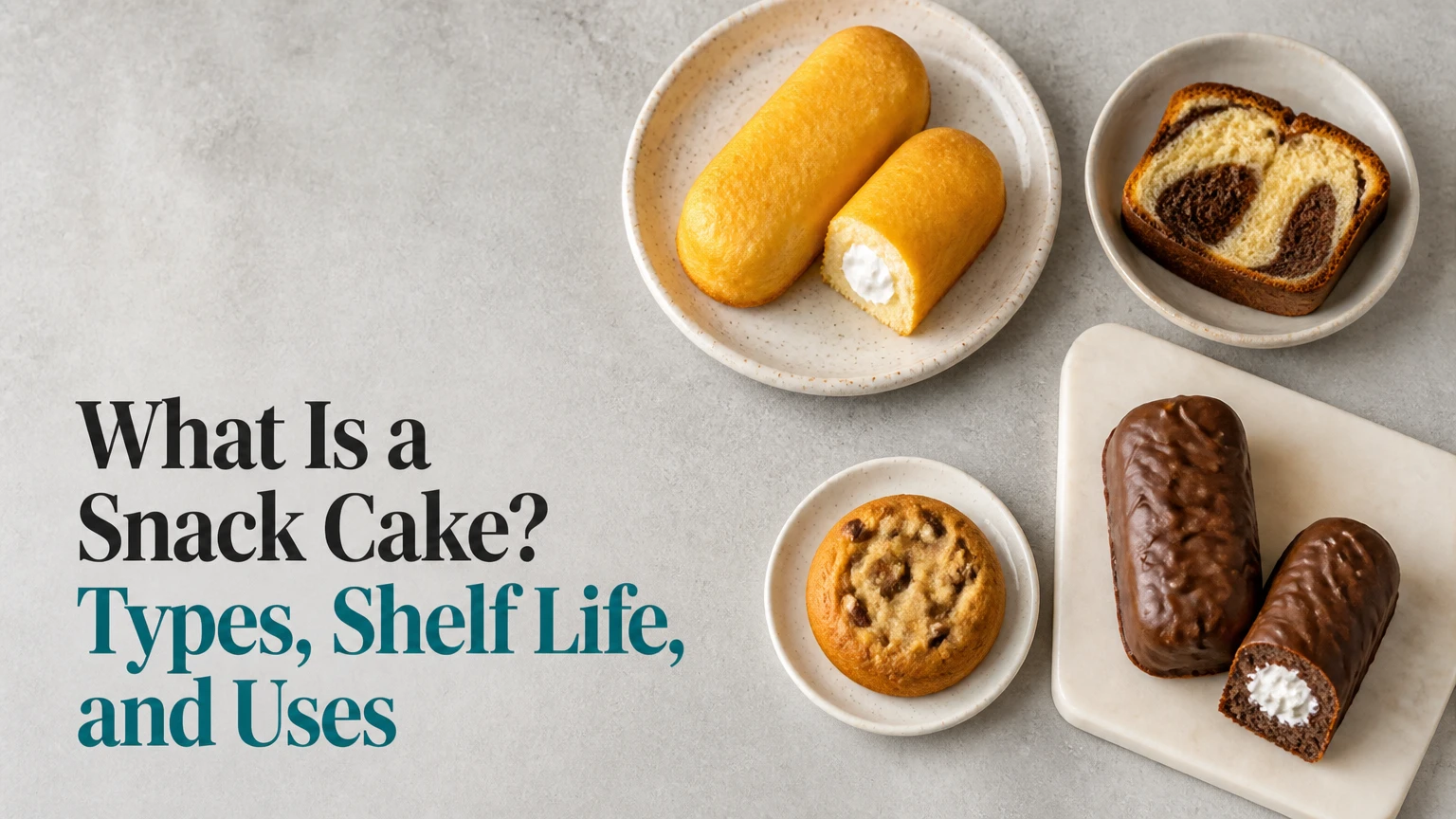
A snack cake is a small cake portion made for eating between meals, usually as an individually wrapped packaged dessert or a simple homemade cake. Unlike a celebration cake, a snack cake emphasizes portability, modest serving size, and quick eating; it may be filled, coated, glazed, layered, or served plain.
Key Facts About Snack Cakes
- A snack cake usually weighs about 30-85 grams when sold as an individual packaged portion.
- Packaged snack cakes commonly contain cake, filling or topping, and moisture-control ingredients, but recipes vary widely.
- Commercial snack cakes may remain unopened for several weeks, while homemade versions commonly keep for 1-4 days at room temperature.
- A “snack cake” can mean a packaged dessert or a one-pan homemade cake intended for casual portions.
- Individual cakes often contain about 150-350 calories, although size, filling, coating, and recipe can change the total substantially.
- A snack cake is not automatically shelf-stable, refrigerated, highly processed, or individually wrapped.
What Is a Snack Cake?
A snack cake is a compact cake intended for casual, convenient eating rather than formal serving. The term describes purpose and portion more reliably than a single recipe: a wrapped chocolate cake with cream, a small iced sponge, a square of apple cake, and a homemade one-pan cake can all fit the category.
The commercial meaning is narrower in many grocery stores. It usually refers to a packaged, single-serve or multi-pack dessert sold near cookies, pastries, and lunchbox foods. The homemade meaning is broader, especially in recipes titled “snacking cake,” where the cake is often baked in an 8-inch square pan and cut into uncomplicated portions.
The main distinction is use. A snack cake normally needs no slicing ceremony, elaborate decoration, or special occasion. A celebration cake prioritizes appearance, multiple layers, and serving many people, while a snack cake prioritizes a manageable portion and straightforward storage.
Why the Term Causes Confusion
“Snack cake” has no single universal legal recipe definition. Food manufacturers use the phrase for packaged desserts, while recipe writers use “snacking cake” for a small, everyday cake that may contain fresh fruit, nuts, yogurt, or dairy frosting.
The word “cake” also varies by region. Some products called snack cakes resemble filled sponge cakes, whereas others are closer to iced brownies, mini-donuts, oatmeal sandwiches, or crumb squares. Product labeling and ingredient lists provide a more reliable description than the front-of-package category.
How Is a Snack Cake Built?
A snack cake typically combines a baked base with one or more components that change its texture, flavor, and storage behavior. The base may be sponge, yellow cake, chocolate cake, chiffon, carrot cake, apple cake, or a dense crumb mixture; the topping may be icing, glaze, streusel, fruit, cream, or chocolate-flavored coating.
Cake Base
Commercial bases are formulated for consistent volume and resistance to crumbling during filling, wrapping, shipping, and handling. Flour, sugar, eggs or egg ingredients, water, fat, leavening agents, and flavorings create the structure.
Packaged cakes often use emulsifiers to help fat and water remain evenly dispersed. Humectants such as glycerin or sorbitol can bind water and help preserve softness. These ingredients are functional, not proof that a product is unsafe or that every packaged cake contains the same formulation.
Filling and Topping
Fillings range from shortening-based cream and marshmallow-style centers to fruit paste, custard, jam, or buttercream. A filling with substantial water activity can migrate into the cake and soften it, so manufacturers control formulation, acidity, fat content, and packaging.
Toppings include compound coating, icing, powdered sugar, glaze, streusel, nuts, and chocolate. “Compound coating” usually uses vegetable fat instead of cocoa butter, which makes it easier to process and more resistant to bloom than untempered chocolate.
What Ingredients Extend Softness?
Commercial softness usually comes from a combination of fat, sugar, humectants, emulsifiers, packaging, and controlled baking. Hydrogenated oils are not a defining requirement, and partially hydrogenated oils have been removed from most United States food production because the Food and Drug Administration determined that artificial trans fat from partially hydrogenated oils was not generally recognized as safe.
A shelf-stable filling also does not contain “zero water” in every case. Manufacturers reduce available water, adjust acidity, use approved preservatives where appropriate, and validate the product through testing. Water can exist in a food while remaining unavailable to microorganisms.
What Types of Snack Cakes Are Common?
Snack cakes fall into several structural groups, but the categories overlap. A product can be both a Swiss roll and a cream-filled cake, or both a crumb cake and a single-serve packaged dessert.
| Type | Typical structure | Common topping or filling | Typical eating use |
|---|---|---|---|
| Cream-filled log | 40-75 g sponge cylinder | Vanilla or marshmallow-style cream | Lunchbox or handheld snack |
| Chocolate sandwich cake | 35-70 g paired cake layers | Cream center and chocolate coating | Individually wrapped dessert |
| Swiss roll | 30-60 g thin rolled sponge | Cream, jam, or fruit filling | Sliced or handheld serving |
| Oatmeal creme sandwich | 45-75 g soft oatmeal rounds | Sweet cream filling | Packaged afternoon snack |
| Mini-donut cake | 20-45 g ring-shaped cake | Sugar glaze or icing | Breakfast-style snack |
| Crumb cake square | 50-100 g dense cake | Streusel, glaze, or fruit | Bakery or homemade portion |
| Seasonal shaped cake | 35-85 g molded cake | Colored icing or sugar decoration | Holiday or event snack |
Cream-filled logs and rolls are engineered around flexible sponge and controlled filling. Sandwich cakes create a larger filling-to-cake ratio, while crumb cakes depend more on butter, sugar, flour, and streusel for flavor and tenderness.
Homemade snacking cakes usually have fewer structural parts. An apple cake baked in a square pan, a chocolate sheet cake, or a lemon yogurt cake can qualify even without filling or packaging.
How Are Commercial Snack Cakes Made?
Commercial snack cakes are produced through a sequence of mixing, depositing, baking, cooling, filling, finishing, inspection, and packaging. The exact line differs by manufacturer, but the process is designed to control portion weight, moisture migration, microbial safety, and mechanical damage.
Typical Production Sequence
- Mixing: Flour, sugar, fat, water, eggs or egg ingredients, leavening, flavors, and functional additives form a batter.
- Aeration: Mixing incorporates air and creates the desired cell structure; some lines use continuous aeration.
- Depositing: Pumps or depositors place measured batter into molds, trays, or continuous baking bands.
- Baking: Tunnel ovens set the crumb and brown the surface, with time and temperature adjusted to cake size.
- Cooling: Controlled cooling prevents filling from melting and reduces condensation inside the wrapper.
- Filling: Depositors or injection needles add cream, fruit, or custard where the product design requires it.
- Finishing: Cakes receive glaze, icing, streusel, powdered sugar, or an outer coating.
- Packaging: Flow-wrap film, trays, cartons, or multipacks protect the cake from oxygen, moisture exchange, crushing, and contamination.
Nitrogen flushing may replace some air in selected packages, but it is not universal. Many products rely on barrier film, sealed wrappers, preservatives, low available moisture, and careful production controls instead.
What Makes a Packaged Cake Last?
A packaged snack cake lasts because several controls work together. The recipe reduces spoilage risk, the bake reduces microbial load, the package limits air and moisture transfer, and quality testing establishes an appropriate date.
The package date is not a universal expiration guarantee. The United States Department of Agriculture explains that date labels often indicate quality rather than a direct safety cutoff, but consumers should discard products with mold, unusual odor, leaking filling, swollen packaging, or obvious contamination.
How Long Do Snack Cakes Last?
Unopened commercial snack cakes commonly remain acceptable for about 21-45 days, but the actual period depends on formulation, packaging, preservatives, distribution, and the printed date. Homemade and bakery snack cakes usually keep for 1-4 days at room temperature, with cream, custard, or fresh-fruit versions requiring more caution.
| Snack cake format | Typical unopened or fresh period | Best storage location | Main limiting factor |
|---|---|---|---|
| Wrapped commercial cake | 21-45 days | Cool, dry cupboard | Moisture migration and staling |
| Frozen commercial cake | 3-6 months for quality | Freezer at 0°F or colder | Freezer burn and texture change |
| Homemade plain square | 2-4 days | Sealed container | Staling and drying |
| Homemade cream-filled cake | 1-2 days | Refrigerator at 40°F or colder | Perishable filling |
| Bakery cake with fruit | 1-3 days | Refrigerator if labeled perishable | Fruit moisture and mold |
| Unfrosted homemade cake | 2-3 days | Sealed container | Moisture loss |
Freezing can extend quality, but it does not improve a stale cake. Wrap portions tightly, place them in an airtight freezer container, and thaw them while wrapped so condensation forms on the wrapper rather than the crumb.
How Many Calories Are in a Snack Cake?
A snack cake commonly provides about 150-350 calories per individual portion, with larger coated or filled products near the upper end. The calorie total depends on weight, sugar, fat, filling volume, coating thickness, and whether the package contains one serving or multiple servings.
| Product style | Typical portion weight | Typical calorie range | Main calorie driver |
|---|---|---|---|
| Plain mini cake | 30-45 g | 120-210 | Flour, sugar, and fat |
| Cream-filled cake | 40-75 g | 180-330 | Filling and coating |
| Chocolate-coated cake | 45-85 g | 220-350 | Outer fat-based coating |
| Crumb cake square | 50-100 g | 200-420 | Streusel and butter or oil |
| Mini-donut cake | 20-45 g | 100-220 | Fried or rich cake base |
| Homemade fruit snack cake | 45-85 g | 160-300 | Recipe fat, sugar, and fruit |
The Nutrition Facts label is the correct source for a packaged product. The Food and Drug Administration uses a 2,000-calorie daily reference value for general labeling, but individual energy needs differ. Portion size, added sugar, saturated fat, and fiber matter more than the word “snack” on the package.
Packaged, Bakery, and Homemade Snack Cakes
Packaged, bakery, and homemade snack cakes solve different problems. Packaged cakes provide portability and predictable storage, bakery cakes usually provide fresher flavor, and homemade cakes allow control over ingredients, portion size, and sweetness.
| Feature | Packaged cake | Bakery cake | Homemade cake |
|---|---|---|---|
| Typical serving | 30-85 g | 60-120 g | 50-100 g |
| Typical quality window | 21-45 days unopened | 1-3 days | 2-4 days |
| Typical price per portion | $0.50-$1.25 | $2-$6 | $0.75-$2.50 ingredients |
| Packaging | Individual barrier wrapper | Paper box or clamshell | Reusable container |
| Recipe control | Low | Medium | High |
| Portability | High | Medium | Medium to high |
When Is a Packaged Snack Cake the Better Choice?
A packaged snack cake fits commuting, school lunches, travel, and situations where refrigeration is unavailable. Its wrapper limits handling and its consistent size makes calorie and cost estimates easier.
The trade-off is ingredient complexity and packaging waste. A packaged cake may also taste less fresh because the formula prioritizes softness over the buttery crumb found in a same-day bakery cake.
When Is Homemade Better?
Homemade cake is usually better when ingredient control, fresh flavor, or dietary adaptation matters more than shelf life. A baker can reduce sweetness, use whole fruit, replace part of the flour with oats, or portion a cake into squares for several days.
Homemade cake is a poor choice when it must remain unrefrigerated for a week. Cream cheese frosting, custard, whipped cream, and cut fruit shorten storage time and should follow the recipe’s refrigeration instructions.
What Should You Check Before Buying a Snack Cake?
Check serving size, ingredient order, allergen information, package condition, and storage instructions before buying. The front label may show one cake as a serving while the nutrition panel defines two cakes as one serving, which can double the apparent calorie and sugar amount.
Use this buying sequence:
- Confirm the number of cakes per serving.
- Compare grams of added sugar, saturated fat, and fiber.
- Check whether the filling requires refrigeration after opening.
- Inspect the wrapper for tears, leaks, swelling, or crushed seams.
- Compare price per cake rather than price per box.
- Choose a plain or fruit-based option when coating and filling are unnecessary.
- Check allergen statements for wheat, milk, egg, soy, peanuts, and tree nuts.
An Expert Rule About Softness
Softness is not the same as freshness. A cake can remain soft because humectants retain water while its aroma, coating, or crumb quality declines, so texture alone cannot confirm that an old package is suitable to eat.
Common Snack Cake Problems and Fixes
Snack cake problems usually come from moisture movement, temperature changes, weak structure, or poor packaging. The most reliable fix addresses the cause rather than adding more filling, icing, or storage time.
| Problem | Likely cause | Practical correction | Prevention |
|---|---|---|---|
| Swiss roll cracks | Sponge cooled unrolled or became dry | Roll while warm in a dusted towel | Roll immediately after baking |
| Filling makes crumb soggy | Filling has high available moisture | Use a thicker filling or add a barrier layer | Cool cake fully before filling |
| Coating streaks | Temperature instability or poor tempering | Recoat with compound coating | Keep coating and cake at stable temperatures |
| Homemade cake dries | Loose wrapping or overbaking | Add syrup or frosting to a fresh cake | Seal within one hour |
| Wrapper fogs inside | Cake was packaged before cooling | Open, cool, and rewrap if safe | Cool to room temperature first |
| Mold appears | Excess moisture, age, or contamination | Discard the entire cake | Reduce storage time and keep container clean |
A cracked roll is often blamed on rolling technique, but moisture loss is the more common cause. Rolling the warm sponge establishes shape before the crumb sets, while filling it after complete cooling prevents cream from melting.
A soggy filling cannot usually be repaired after moisture has migrated through the crumb. Separate the affected components only if the cake remains fresh and safe, then use a lower-moisture filling for the next batch.
Can Snack Cakes Replace Other Snacks?
Snack cakes can replace cookies, muffins, pastries, or granola bars when the priority is a ready-to-eat sweet portion. They are less suitable when the snack must provide substantial protein, high fiber, low added sugar, or sustained fullness.
| Alternative | Typical portion | Primary advantage | Main limitation |
|---|---|---|---|
| Snack cake | 30-85 g | Sweet, portable dessert | Often low in fiber |
| Muffin | 60-120 g | Larger, bakery-style portion | May contain similar sugar |
| Granola bar | 25-45 g | Compact and portable | Texture and sugar vary widely |
| Fruit with nuts | 150-200 g combined | Fiber and unsaturated fat | Requires more preparation |
| Yogurt cup | 120-170 g | Protein and calcium | Usually needs refrigeration |
| Plain crackers with spread | 25-40 g | Savory alternative | Less dessert-like |
A snack cake is best treated as a dessert or convenience food, not automatically as a nutritionally complete snack. Pairing a small cake with milk, yogurt, nuts, or fruit can add protein and fiber when the eating occasion requires more satiety.
Frequently Asked Questions
Is a snack cake the same as a cupcake?
A cupcake is a small cake baked in a cup-shaped liner, usually with icing on top. A snack cake is defined by casual use and portability, so it may be a cupcake, a square, a roll, a sandwich, or a wrapped coated cake. The categories overlap but are not identical.
Do snack cakes need refrigeration?
Unopened commercial snack cakes generally follow the package’s storage instructions and often remain at room temperature. Homemade cakes with custard, whipped cream, cream cheese frosting, or fresh fruit usually need refrigeration, because those fillings can support spoilage more readily than a dry packaged center.
Are snack cakes safe after the date on the package?
A date on a commercial snack cake often concerns quality rather than an automatic safety cutoff, but the product should be discarded if the wrapper is damaged or the cake has mold, leaking filling, unusual odor, or an abnormal appearance. When storage conditions are unknown, replacing the product is the safer choice.
Why are packaged snack cakes so soft?
Packaged snack cakes stay soft through a moist crumb, fats, sugars, emulsifiers, humectants, and barrier packaging. The formulation holds water in the cake and slows moisture exchange, but softness does not prove that the cake is fresh or nutritionally superior.
Can you make a snack cake without filling?
Yes. A plain chocolate square, apple cake, lemon cake, or crumb cake can be a snack cake without filling. The defining features are the small, casual portion and everyday purpose, not the presence of cream, icing, coating, or an individual wrapper.
What is the best snack cake for travel?
A sealed, individually wrapped commercial cake is usually the most practical travel option because it resists handling and does not normally require immediate refrigeration. Avoid cakes with custard, whipped cream, or cream cheese filling when a cool storage temperature cannot be maintained.
The Bottom Line
A snack cake is a small cake intended for convenient, informal eating, and the term covers both packaged desserts and simple homemade portions. Commercial versions commonly weigh 30-85 grams and may last 21-45 days unopened, while homemade cakes usually have a 1-4 day quality window. The right choice depends on portability, freshness, ingredients, nutrition, and storage conditions, not on the label alone.
