

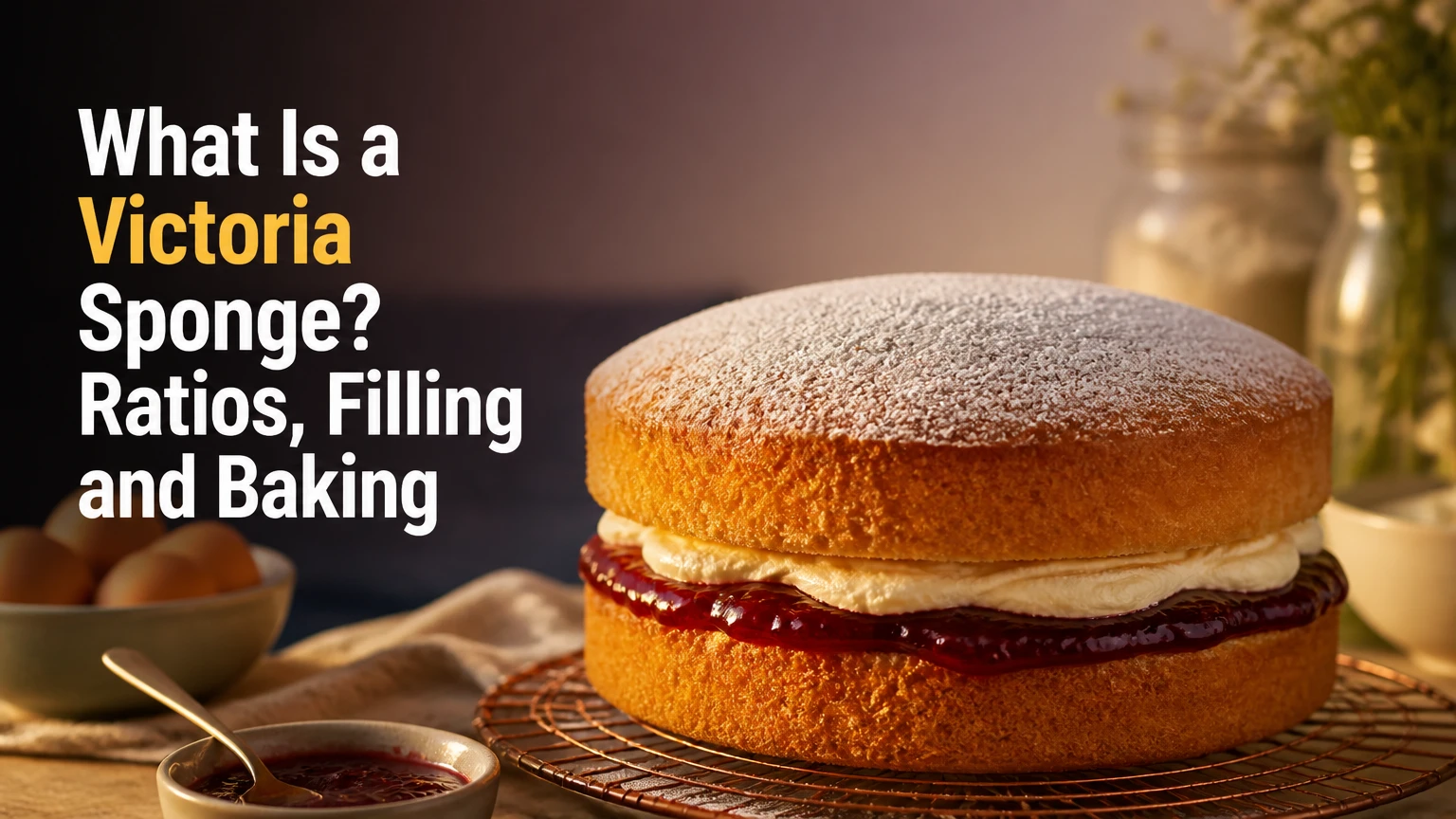
A Victoria sponge is a British butter cake made from two layers of light, creamed sponge filled traditionally with raspberry or strawberry jam and finished with sugar. Also called a Victoria sandwich, it relies on creamed fat, sugar, eggs, flour, and chemical raising agents rather than whipped egg whites alone.
Key Facts at a Glance
- A classic Victoria sponge uses equal weights of eggs, fat, sugar, and self-raising flour.
- A standard 20 cm cake usually contains about 225 g of each main ingredient.
- Traditional fillings center on raspberry or strawberry jam, while cream and buttercream are later variations.
- The cake is normally baked as two separate layers at approximately 180°C fan for 20-25 minutes.
- Victoria sponge is a butter cake with an aerated crumb, not the same structure as a genoise or angel food cake.
- Plain sponge layers freeze well for up to three months when wrapped airtight.
What Defines a Victoria Sponge?
A Victoria sponge has two relatively shallow, round cake layers joined by fruit jam. The top is usually dusted with caster sugar or icing sugar, although whipped cream, buttercream, fresh fruit, or a more elaborate decoration may appear in modern versions.
The defining identity is the combination of structure and proportion. A cake with two layers and jam is not automatically a Victoria sponge if the layers are made from a radically different batter, such as a fat-free genoise. Conversely, a modern cake with buttercream can still be recognized as a Victoria sandwich if the sponge follows the traditional style.
The name “Victoria sponge” is used mainly in Britain and Ireland. “Victoria sandwich” refers to the same cake, with “sandwich” describing the filling between two layers rather than a separate recipe.
Why Is It Named After Queen Victoria?
The cake is associated with Queen Victoria’s afternoon tea during the nineteenth century, when afternoon tea became an established social meal among wealthy households. The Royal Collection Trust describes Queen Victoria’s tea habits and the growing importance of tea service, but the precise claim that she personally created or standardized the cake is not supported.
The strongest historical explanation is that the cake was named after a royal association, then became linked with the queen’s preferred afternoon refreshment. Modern accounts often simplify that history into “Queen Victoria invented the cake,” which is misleading. Alfred Bird’s baking powder, patented in 1843, helped make reliably risen domestic cakes more practical, but the Victoria sponge developed through broader Victorian baking practice rather than one documented inventor.
How Does a Victoria Sponge Rise?
A Victoria sponge rises through a combination of trapped air, expanding water vapor, and carbon dioxide from chemical leavening. The creaming process creates the initial air cells, while heat and baking powder enlarge and stabilize those cells inside the batter.
Softened butter or baking margarine is beaten with caster sugar. Sugar crystals cut into the fat and create tiny air pockets, although the effect depends on the fat being soft enough to aerate without melting. Eggs then add water and protein, and the flour supplies starch and gluten that set around the expanding bubbles during baking.
Self-raising flour usually contains a measured quantity of baking powder. Adding extra raising agent can make the batter rise rapidly and then collapse because the cake structure cannot support the enlarged bubbles.
Victoria Sponge Ingredients and Their Functions
| Ingredient | Typical amount in a 20 cm cake | Function in the batter | Practical requirement |
|---|---|---|---|
| Unsalted butter or baking margarine | 225 g | Fat, flavor, aeration | Soft, not melted |
| Caster sugar | 225 g | Sweetness and air-cell formation | Fine crystals cream efficiently |
| Eggs | About 225 g without shells | Structure, moisture, emulsification | Weigh after cracking |
| Self-raising flour | 225 g | Starch, gluten, and base raising agent | Sift before folding |
| Baking powder, if using plain flour | About 2 teaspoons | Carbon dioxide production | Omit when flour already includes it |
| Raspberry or strawberry jam | 120-180 g | Fruit filling and acidity | Spread after complete cooling |
| Whipped cream or buttercream | 200-300 g, optional | Moisture, richness, and adhesion | Choose according to storage conditions |
What Is the Correct Victoria Sponge Ratio?
The classic Victoria sponge ratio is equal weights of eggs, fat, sugar, and flour. Weighing the eggs in their shells gives a useful traditional benchmark, but weighing cracked eggs is more accurate because egg sizes vary between brands and countries.
A practical 20 cm formula uses four medium or large eggs weighing approximately 225 g in their shells, with 225 g butter, 225 g sugar, and 225 g self-raising flour. If the cracked eggs weigh 205 g, use 205 g of each other principal ingredient rather than forcing the recipe to match an assumed egg count.
| Cake size | Egg weight, cracked | Butter or margarine | Sugar | Self-raising flour | Typical bake |
|---|---|---|---|---|---|
| 15 cm, two layers | 150 g | 150 g | 150 g | 150 g | 20-24 minutes |
| 18 cm, two layers | 180 g | 180 g | 180 g | 180 g | 22-26 minutes |
| 20 cm, two layers | 225 g | 225 g | 225 g | 225 g | 20-25 minutes |
| 23 cm, two layers | 275 g | 275 g | 275 g | 275 g | 25-32 minutes |
The exact time depends on batter depth, tin material, oven calibration, and whether the oven uses a fan. A dark metal tin often colors the edge faster than a pale aluminum tin, so the surface color alone cannot determine doneness.
Fan Oven and Conventional Oven Temperatures
For a typical 20 cm Victoria sponge, use 180°C in a fan oven or approximately 190°C in a conventional oven. The conversion is approximate because fan strength and oven calibration vary, so the spring-back test and a fully set center remain more reliable than the dial setting alone.
How Do You Make a Victoria Sponge?
A traditional Victoria sponge takes about 15-20 minutes to mix and 20-25 minutes to bake, with complete cooling and assembly adding 45-75 minutes. The most important success factor is controlled aeration: soften the fat, emulsify the eggs, and fold the flour only until combined.
Before You Start
| Requirement | Typical specification |
|---|---|
| Equipment | Two 20 cm sandwich tins, electric mixer, scales, sieve, cooling rack |
| Ingredients | 225 g butter, 225 g sugar, 225 g eggs, 225 g self-raising flour |
| Oven | 180°C fan or 190°C conventional |
| Preparation time | 15-20 minutes |
| Baking time | 20-25 minutes |
| Difficulty | Moderate for a first-time baker |
| Approximate homemade cost | £5-£10, excluding equipment |
Step 1: Prepare the Tins and Ingredients
Heat the oven and grease two 20 cm sandwich tins. Line the bases with baking parchment, then bring the butter and eggs toward room temperature.
Room-temperature ingredients combine more easily because softened fat can hold air and eggs are less likely to break the emulsion. Do not place butter directly in a hot oven or microwave it until oily, because melted fat cannot create the same stable creaming structure.
Success checkpoint: the butter should dent under light pressure but retain its shape.
Common mistake: using cold butter, which leaves dense patches and extends mixing time.
Step 2: Cream the Fat and Sugar
Beat the butter and caster sugar for about 4-7 minutes with an electric mixer, or longer by hand, until pale and visibly aerated. Scrape the bowl once or twice so the mixture develops evenly.
The mixture does not need to become white, and volume is more useful than a specific color target. Baking margarine generally creams faster and produces a lighter batter, while block butter gives deeper flavor but becomes firm when chilled.
Success checkpoint: the mixture looks fluffy and leaves ridges from the beaters.
Common mistake: stopping when the ingredients merely look combined.
Step 3: Add the Eggs Gradually
Beat the eggs lightly and add them one tablespoon at a time, mixing after each addition. If the mixture begins to curdle, add one tablespoon of the measured flour and continue gradually.
Curdling is a temporary emulsion failure, not proof that the cake must be discarded. Cold eggs, a large addition of liquid, or butter that is too warm can all destabilize the mixture.
Success checkpoint: the batter remains mostly smooth after the final egg addition.
Common mistake: adding all the eggs at once.
Step 4: Fold in the Flour
Sift the self-raising flour over the batter in two or three additions. Fold with a spatula using broad movements from the bottom of the bowl, stopping as soon as no dry flour remains.
Excessive mixing develops gluten and removes the air introduced during creaming. A few small streaks of flour can be eliminated with two or three final folds, but beating the finished batter produces a tighter crumb.
Success checkpoint: the batter drops slowly from a spoon and contains no visible dry pockets.
Common mistake: using an electric mixer after adding flour.
Step 5: Divide and Bake
Divide the batter between the tins, using scales if uniform layers matter. Level the surface without pressing the batter hard, then bake on the same oven shelf for 20-25 minutes.
Avoid opening the oven during the first 18 minutes, when the internal framework is still setting. The cakes are ready when the centers spring back, the edges begin to pull slightly from the tins, and a skewer emerges without wet batter.
Success checkpoint: both layers have an even golden surface and a resilient center.
Common mistake: relying on a fixed timer when the two tins contain unequal quantities.
Step 6: Cool and Assemble
Leave the cakes in their tins for 5 minutes, then turn them onto a wire rack and remove the parchment. Cool completely before spreading jam, because warmth loosens the filling and can melt buttercream.
Place the less attractive layer on the bottom. Spread jam nearly to the edge, add cream or buttercream if using it, and position the second layer with its flattest side upward. Dust immediately before serving.
Which Victoria Sponge Filling Is Most Traditional?
Jam alone is the most conservative traditional filling, while jam with whipped cream is a widely accepted modern teatime version. Buttercream is less historically strict but offers the best stability for transport, warm rooms, and celebration cakes.
| Filling style | Typical quantity | Texture and flavor | Storage requirement | Best use |
|---|---|---|---|---|
| Raspberry jam only | 120-180 g | Tart, clean, firm | Airtight at cool room temperature | Traditional serving |
| Strawberry jam only | 120-180 g | Sweeter, softer fruit note | Airtight at cool room temperature | Family tea |
| Jam plus whipped cream | 120 g jam plus 200 g cream | Fresh, rich, soft | Refrigerate below 5°C | Same-day dessert |
| Jam plus vanilla buttercream | 120 g jam plus 250 g buttercream | Sweet, structured | Cool room or refrigerator | Transport and parties |
| Jam plus mascarpone cream | 120 g jam plus 220 g filling | Tangy and dense | Refrigerate below 5°C | Summer serving |
Cream debates often concern authenticity rather than quality. Some British bakers reserve “classic Victoria sandwich” for jam and sugar, while others treat fresh cream as a normal contemporary addition.
What Are the Main Alternatives to a Victoria Sponge?
Victoria sponge differs from genoise, Madeira cake, and an all-in-one sandwich cake in mixing method, fat content, and crumb. The Victoria sponge is the most recognizable choice when the goal is a soft, buttery, two-layer cake with a simple fruit filling.
| Cake type | Fat level | Main raising method | Typical crumb | Best distinguishing feature |
|---|---|---|---|---|
| Victoria sponge | 1:1 with flour | Creaming plus baking powder | Soft, buttery, moderately firm | Two layers with jam |
| Genoise | Low or no added fat | Whipped whole eggs | Elastic and airy | Folded whipped-egg foam |
| Angel food cake | No butter | Whipped egg whites | Very light and dry | Tall, fat-free structure |
| Madeira cake | Higher flour proportion | Creaming plus baking powder | Dense and close | Firm sliceable crumb |
| Chiffon cake | Oil-based | Whipped whites plus chemical leavening | Moist and springy | Light texture with oil |
Butter or Margarine: Which Works Better?
Butter produces richer flavor and a firmer texture when cold, while baking margarine usually gives greater volume and a softer crumb. Neither choice changes the cake’s identity if the equal-weight structure, two layers, and characteristic filling remain intact.
| Fat choice | Typical rise | Flavor | Cold texture | Practical recommendation |
|---|---|---|---|---|
| Unsalted block butter | 4-6 cm layer height, typical | Rich dairy flavor | Firms noticeably | Best for traditional taste |
| Baking margarine | 5-7 cm layer height, typical | Mild, less dairy depth | Remains softer | Best for reliable lightness |
| Salted butter | Similar to unsalted | Salted dairy flavor | Firms noticeably | Reduce added salt elsewhere |
| Plant-based block | 4-6 cm, brand dependent | Varies by formulation | Usually soft | Check water and fat content |
The height figures are typical home-baking ranges, not laboratory specifications. Oven temperature, tin depth, and mixing quality can change them substantially.
Creaming or All-In-One Method?
The creaming method gives the baker more control over aeration, while the all-in-one method saves time and reduces the chance of visibly curdled batter. An all-in-one cake can still be excellent, but food processors can overwork the flour and produce a less open crumb.
For all-in-one mixing, place the softened fat, sugar, eggs, and sifted flour in a bowl and mix briefly until smooth. A stand mixer on low speed is safer than a high-speed food processor, which can heat the fat and damage the batter’s structure.
Winner for traditional texture: creaming.
Winner for speed and beginner convenience: all-in-one.
How Long Does Victoria Sponge Last?
A plain, unfilled Victoria sponge lasts about 3-5 days in an airtight container at a cool room temperature, while whipped-cream-filled cake should be refrigerated and eaten within 24 hours for best texture. Jam and buttercream versions commonly remain pleasant for 2-3 days when protected from heat and moisture.
Refrigeration extends food safety for dairy fillings but can make a butter-based sponge seem dry or firm. Bring a buttercream cake out 30-60 minutes before serving; cream-filled cake should remain chilled until close to service.
| Cake condition | Storage location | Typical best quality | Freezing guidance |
|---|---|---|---|
| Plain baked layers | Airtight container, cool room | 3-5 days | Freeze up to 3 months |
| Jam-filled cake | Airtight container, cool room | 2-3 days | Freeze layers before filling |
| Buttercream-filled cake | Cool room below 20°C | 2-3 days | Freeze layers or finished cake |
| Whipped-cream-filled cake | Refrigerator below 5°C | Up to 24 hours | Do not freeze fresh cream filling |
| Fresh-fruit-filled cake | Refrigerator below 5°C | 1 day | Freeze sponge only |
Wrap each cooled layer in parchment and two layers of film before freezing. Thaw while wrapped so condensation forms on the wrapper rather than directly on the crumb.
What Does a Victoria Sponge Cost?
A homemade 20 cm Victoria sponge typically costs £5-£10 in the United Kingdom, depending on butter, eggs, jam, and decoration prices. Commercial prices commonly range from £4 for a basic supermarket cake to more than £80 for a decorated boutique celebration cake.
Price varies with labor, packaging, delivery, decoration, and ingredient quality. A plain jam-filled cake has a very different cost structure from a tall, hand-decorated cake with fresh fruit and refrigerated cream.
| Supplier type | Typical UK price | Typical size | Main cost driver | Lead time |
|---|---|---|---|---|
| Supermarket | £4-£7 | 18-20 cm | Industrial production | Same day |
| High-street bakery | £10-£25 | 18-23 cm | Fresh production and labor | 1-3 days |
| Independent celebration baker | £45-£90 | 20-25 cm | Decoration and customization | 3-14 days |
| Premium boutique bakery | £80-£150+ | 20-25 cm | Design, delivery, premium finish | 1-3 weeks |
These are typical indicative ranges rather than fixed market prices. Regional differences, seasonal demand, and delivery distance can materially alter the final quotation.
Why Does a Victoria Sponge Sink or Turn Dense?
A sunken Victoria sponge usually results from an underbaked center, excessive raising agent, an early oven-door opening, or batter whose emulsion and structure were damaged. A dense cake more often reflects cold ingredients, inadequate creaming, unequal distribution, or flour overmixing.
| Problem | Likely cause | Diagnostic clue | Corrective action |
|---|---|---|---|
| Sunken center | Underbaking or excess baking powder | Wet middle, collapsed top | Bake until springy; measure leavener |
| Curdled batter | Cold eggs or rapid addition | Grainy, watery mixture | Add egg gradually; use a little flour |
| Tough crumb | Flour overmixed | Chewy or tight interior | Fold only until combined |
| Dry cake | Excessive bake time | Crumb flakes and lacks moisture | Check 2 minutes early |
| Heavy dome | Oven too hot | Dark edges, raised center | Reduce by 10°C and extend baking |
| Uneven layers | Batter divided by eye | One layer much taller | Weigh batter into tins |
| Sticky middle | Too much jam or warm filling | Filling leaks and crumb softens | Cool fully and use measured jam |
A domed cake is not always a recipe failure. Small domes can be trimmed, but a pronounced dome usually indicates that the tin edge set before the center finished expanding, which points to excessive heat or an oven shelf positioned too high.
Can Victoria Sponge Be Adapted?
Victoria sponge can be made gluten-free, dairy-free, or egg-free, but each substitution changes the structure and requires a different expectation. Gluten-free flour usually needs a stabilizer such as xanthan gum, while vegan formulas depend on plant fat, liquid, and a commercial egg replacer.
| Dietary version | Main substitution | Typical adjustment | Main limitation |
|---|---|---|---|
| Gluten-free | 225 g gluten-free self-raising blend | Add xanthan gum if blend lacks it | Crumb may be more fragile |
| Dairy-free | 225 g plant baking block | Use a block, not watery spread | Flavor varies by brand |
| Egg-free | Commercial egg replacer plus plant milk | Follow product hydration ratio | Lower natural lift |
| Reduced sugar | 180-200 g sugar | Keep enough sugar for aeration | Drier, less tender crumb |
| Nut-free | Standard flour and seed-free jam | Check labels on margarine and jam | Cross-contact needs checking |
Egg-free versions are the least predictable because eggs provide water, emulsification, protein, color, and structure simultaneously. A recipe designed specifically for egg-free baking is more reliable than simply omitting eggs from the equal-weight formula.
How Should You Choose a Victoria Sponge Style?
Choose jam-only butter sponge for traditional afternoon tea, cream-filled cake for immediate serving, margarine-based sponge for maximum lightness, and buttercream for travel or warm conditions. The correct version depends mainly on serving time, temperature, and desired flavor rather than on a single authenticity rule.
- For a traditional tea table: use butter, raspberry jam, and caster sugar.
- For a beginner: use baking margarine and the all-in-one method.
- For a summer dessert: use jam and whipped cream, then refrigerate.
- For transport: use jam and firm buttercream, not fresh cream.
- For strong dairy flavor: use unsalted butter and serve at room temperature.
- For a decorated celebration cake: bake deeper layers or use a stable buttercream, because a classic shallow sandwich is not designed for heavy tiers.
Victoria sponge is not ideal for every purpose. The soft crumb can compress under heavy fondant or multiple tiers, and fresh cream makes the cake unsuitable for prolonged warm-room storage. A Madeira cake or a firmer butter cake may be better for structural decoration.
Frequently Asked Questions
Is Victoria sponge the same as pound cake?
Victoria sponge and pound cake share an equal-weight tradition, but they are not identical. Pound cake historically uses a pound of butter, sugar, eggs, and flour and often has a denser crumb, whereas Victoria sponge usually uses chemical leavening, two shallow layers, and a fruit filling.
Should a Victoria sponge have cream?
A Victoria sponge does not have to contain cream. Jam alone with a sugar dusting is the most conservative traditional presentation, while whipped cream became a common later variation. Cream improves richness but shortens storage life and requires refrigeration.
Can I use plain flour instead of self-raising flour?
Plain flour can replace self-raising flour if baking powder is added in a measured quantity. For approximately 225 g plain flour, use about 2 teaspoons of baking powder, although the exact amount depends on the flour and recipe. Do not add extra baking powder when using self-raising flour.
Why does my cake taste eggy?
An eggy flavor usually comes from underbaking, unusually large eggs relative to the flour and sugar, or insufficient vanilla and fruit contrast. Weigh the cracked eggs, bake until the center is fully set, and avoid increasing egg quantity beyond the equal-weight formula.
Can I make Victoria sponge in one deep tin?
A Victoria sponge can be baked in one deep tin, but two separate sandwich tins produce more even layers and reduce the risk of a wet center. A deep single cake may require 35-50 minutes, and the center should be tested carefully before cooling and slicing.
The Bottom Line
What is a Victoria sponge? It is a British two-layer butter cake based on equal weights of eggs, fat, sugar, and flour, usually filled with raspberry or strawberry jam and dusted with sugar. Use butter for traditional flavor, margarine for a lighter and more forgiving crumb, whipped cream for same-day serving, and buttercream when the cake must travel.
