

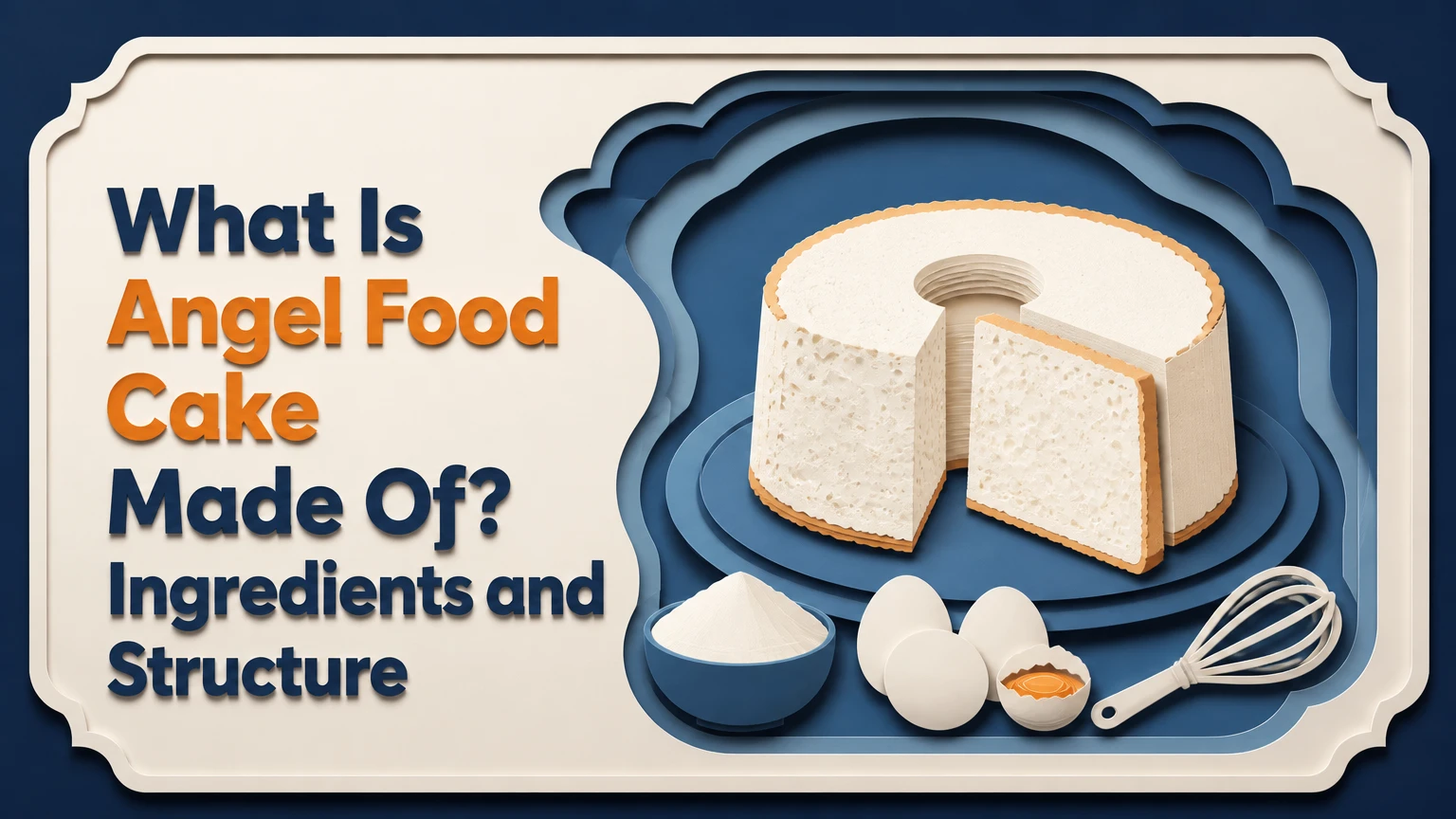
Angel food cake is traditionally made from whipped egg whites, granulated sugar, cake flour, cream of tartar, salt, and flavorings such as vanilla. It contains no added butter, oil, or egg yolks. Its airy height comes from an egg-white meringue that expands in the oven, while flour and coagulated egg proteins set the cake’s structure.
What Is Angel Food Cake Made Of, Exactly?
Traditional angel food cake contains six functional components: egg whites, sugar, cake flour, cream of tartar, salt, and flavoring. A standard 10-inch tube cake typically uses 10-12 large egg whites, 1.5-2 cups sugar, about 1 cup sifted cake flour, 1-2 teaspoons cream of tartar, and small amounts of salt and extracts.
The cake is fat-free in the baking sense because the formula excludes added fat and egg yolks. Egg whites themselves contain trace nutrients and are not chemically identical to a zero-calorie ingredient. Encyclopaedia Britannica describes angel food cake as a “light cake made with egg whites, flour, and sugar,” which captures the defining formula but leaves out the acid and flavoring that make the foam more reliable.
| Ingredient | Typical amount for 10-inch cake | Primary function | What happens if reduced |
|---|---|---|---|
| Large egg whites | 10-12, about 1.25-1.5 cups | Foam, water, protein structure | Lower height and a thinner cake |
| Granulated sugar | 1.5-2 cups, about 300-400 g | Sweetness, tenderness, foam support | Dry crumb and unstable meringue |
| Cake flour | About 1 cup, 100-115 g | Starch and light protein network | Coarser or heavier structure |
| Cream of tartar | 1-2 teaspoons, 3-6 g | Acidifies and supports egg foam | Less forgiving whipping and folding |
| Fine salt | 0.25-0.5 teaspoon, 1-3 g | Flavor balance | Flat-tasting sweetness |
| Vanilla or almond extract | 1-2 teaspoons, 5-10 ml | Aroma and flavor | Plain egg-and-sugar flavor |
Why Does Angel Food Cake Rise Without Baking Powder?
Angel food cake rises primarily from mechanically whipped egg-white foam, not from baking powder or baking soda. Beating introduces millions of air cells into the whites; heat expands those cells, water becomes steam, and egg proteins plus flour set the expanded network before it can collapse.
Egg-white proteins unfold during whipping and form thin films around air bubbles. Cream of tartar lowers the mixture’s pH, helping the proteins tolerate stretching and reducing the risk of a fragile, quickly draining foam. Sugar dissolves into the liquid phase and slows protein coagulation, giving the cake time to expand before the structure becomes rigid.
A useful correction is necessary: traditional angel food cake is not chemically leavened in the usual baking-powder sense. Steam contributes expansion, but the initial lift comes from air incorporated during whipping. A recipe that includes baking powder may still produce a tall cake, but it is a variation rather than the classic method.
How do the ingredients work together?
Egg whites create the bubbles, sugar moderates their formation, acid improves foam tolerance, and flour turns the liquid meringue into a sliceable cake. Removing one ingredient changes more than flavor because each component occupies a different structural role.
The formula is unusually sensitive to contamination. A few drops of yolk, oil, butter, or greasy residue can prevent whites from reaching full volume because fat interferes with protein films around air bubbles. That is why bakers use a clean bowl, dry beaters, and an ungreased pan.
How Many Eggs and How Much Flour Does It Need?
A typical 10-inch angel food cake uses 10-12 large egg whites and 100-115 grams of cake flour, although formulas vary by pan depth, egg size, and desired height. Weighing separated whites is more reliable than counting eggs because large eggs differ slightly in volume.
| Cake size | Egg whites by weight | Cake flour | Sugar | Typical bake |
|---|---|---|---|---|
| 6-inch tube pan | 170-200 g | 55-65 g | 170-210 g | 30-35 minutes |
| 8-inch tube pan | 250-285 g | 75-85 g | 240-285 g | 35-40 minutes |
| 10-inch tube pan | 340-400 g | 100-115 g | 300-400 g | 35-45 minutes |
| 9 x 13-inch pan | 300-350 g | 90-105 g | 280-350 g | 25-35 minutes |
The sugar quantity often looks high because angel food cake depends on a stable meringue rather than butter, oil, or yolks for tenderness. Reducing sugar by a small amount can make the cake less moist and less resilient; replacing most of it with a low-calorie sweetener usually changes foam volume, browning, and crumb.
For consistent results, use carton egg whites only when the package says they whip well. Some liquid whites contain stabilizers that alter foam behavior. Freshly separated whites usually give the strongest volume, while whites aged overnight in a covered refrigerator container may whip more readily after returning to room temperature.
Which Pan and Tools Does Angel Food Cake Require?
A two-piece, ungreased aluminum tube pan is the most reliable choice because the batter needs to cling to the sides as it rises, then remain attached while cooling upside down. A nonstick or greased pan can allow the cake to slide downward and lose much of its height.
| Equipment | Recommended specification | Reason | Common unsuitable choice |
|---|---|---|---|
| Tube pan | 9-10 inches, removable base, aluminum | Supports climbing and inverted cooling | Greased nonstick pan |
| Mixing bowl | Stainless steel or glass, 3-4 quarts | Resists grease and holds foam volume | Damp plastic bowl with residue |
| Mixer | Stand or hand mixer with whisk | Produces even soft-to-firm peaks | Manual whisk for a full batch |
| Sifter | Fine mesh, 2-3 passes | Distributes flour without lumps | Dumping flour directly into foam |
| Spatula | Flexible silicone, 10-12 inches | Folds with limited deflation | Rigid spoon that crushes bubbles |
| Cooling support | Pan feet or bottle neck | Keeps cake inverted and elevated | Flat counter without support |
Never grease the tube pan. The apparent inconvenience is structural: the batter must grip the metal wall during expansion. Wash the pan with hot soapy water before baking, then dry it completely; even a thin film of shortening can reduce adhesion.
A tube pan with removable feet is convenient, but a pan without feet can be inverted over a sturdy bottle. The bottle must fit the center tube securely and hold the pan several centimeters above the counter so air can circulate.
How Do You Make the Meringue and Fold the Batter?
Build the meringue gradually, then fold the sifted dry ingredients in small batches. The target is a glossy foam with medium-firm peaks that hold their shape but still curl slightly at the tip, because dry, overbeaten whites do not accept flour evenly.
- Separate the eggs carefully. Put each white into a small cup before adding it to the main bowl. One broken yolk can contaminate the batch.
- Bring the whites near room temperature. About 20-30 minutes on the counter improves whipping speed, but do not leave them in a warm room for extended periods.
- Whip with cream of tartar and salt. Begin at medium speed until the whites become foamy, then continue until soft peaks form.
- Add sugar slowly. Add the sugar one tablespoon at a time over 5-8 minutes. The meringue should become smooth, glossy, and medium-firm.
- Sift flour and part of the sugar. Three passes remove clumps and distribute the flour, although two careful passes can work with finely milled ingredients.
- Fold in four to six additions. Cut down through the center, sweep along the bottom, and turn the mixture over. Rotate the bowl after each fold.
- Stop at uniformity. A few faint flour streaks are safer than ten extra folds, but visible pockets of flour will create dense areas.
You will know the meringue is ready when a lifted whisk leaves a peak that bends slightly without dripping. If the whites appear grainy, clumped, or dry, the foam has probably been overbeaten. Starting again is usually more efficient than trying to repair it with additional liquid.
How Is Angel Food Cake Baked and Cooled?
Bake angel food cake at about 325-350°F, or 163-177°C, for approximately 30-45 minutes depending on pan size and batter depth. The surface should be golden, spring back after light pressure, and show a few dry cracks rather than a wet, shiny center.
| Stage | Typical setting or duration | Checkpoint | Main risk |
|---|---|---|---|
| Oven preheat | 20-30 minutes | Oven reaches 325-350°F | False temperature from a cold oven |
| Initial baking | First 25-30 minutes | Cake rises without a sunken center | Opening door too early |
| Final baking | Additional 5-15 minutes | Top springs back and looks dry | Removing while center is wet |
| Inverted cooling | 1.5-2 hours | Cake feels fully cool | Structure sliding or collapsing |
| Removal | After complete cooling | Thin knife releases edges | Tearing the crumb while warm |
Set the pan on the lowest or middle rack according to the oven’s heat pattern, leaving space above the rising cake. Avoid opening the door during the first 25 minutes because a sharp temperature drop can leave the protein network too weak to support itself.
Invert the pan immediately after removal. Cake feet, the pan’s rim, or a bottle neck can hold it upside down. Cool completely before loosening the sides and bottom, because warm angel food cake is flexible and compresses easily under its own weight.
A thermometer can provide an additional check, but visual and tactile signs matter more because formulas differ. If the center is visibly wet, the cake needs more baking time even when the top has browned.
Is Angel Food Cake Dairy-Free, Gluten-Free, or Low-Calorie?
Traditional angel food cake is dairy-free when the flour, flavorings, and pan release contain no milk ingredients, but it is not gluten-free because ordinary cake flour contains wheat. The cake is often lower in calories than butter cake by serving, although the exact value depends on slice size, sugar, toppings, and recipe proportions.
| Version | Contains wheat? | Contains added fat? | Typical structural result | Best adjustment |
|---|---|---|---|---|
| Traditional | Yes | No | Tall, elastic, airy crumb | Use cake flour |
| Gluten-free | No, with certified ingredients | No | Slightly more delicate crumb | Use rice flour and starch blend |
| Chocolate | Usually yes | No | Darker, somewhat drier crumb | Replace part of flour with cocoa |
| Reduced-sugar | Depends on sweetener | No | Lower volume and more fragile crumb | Use a tested meringue formula |
| Dairy-containing topping | Depends on cake | Topping may contain fat | Moist, richer serving | Add after slicing |
Reduced-fat does not mean automatically low-sugar. A traditional cake can contain 300-400 grams of sugar, so a modest serving may still provide substantial carbohydrate. Fresh berries, citrus segments, or unsweetened fruit puree add moisture and acidity without the heavy fat load of buttercream.
Gluten-free conversion requires more than swapping wheat flour one-for-one. A blend containing finely milled rice flour plus potato or tapioca starch can approximate cake flour, but the altered starch network may produce a more fragile cake. Use certified gluten-free ingredients when cross-contact matters.
How Do Angel Food, Chiffon, and Sponge Cake Differ?
Angel food cake uses only egg whites and no added fat, chiffon cake uses oil and usually whole eggs plus whipped whites, and sponge cake may use whole eggs or separated eggs with little or no fat. Their different formulas produce distinct moisture, density, pan requirements, and serving uses.
| Cake type | Egg composition | Added fat | Main rise mechanism | Typical texture |
|---|---|---|---|---|
| Angel food | Whites only | 0 g in classic formula | Whipped whites and steam | Airy, elastic, lightly chewy |
| Chiffon | Whole eggs plus whites | Vegetable oil, often 60-120 g | Foam plus chemical leavener | Moist, tender, velvety |
| Genoise sponge | Whole eggs | Butter may be 0-60 g | Whipped whole eggs | Fine, absorbent, flexible |
| Victoria sponge | Whole eggs | Butter, often 100-200 g | Creaming and baking powder | Tender, rich, compact |
| Japanese castella | Whole eggs | Usually no butter | Whipped eggs and syrup | Moist, fine, springy |
Angel food cake is best with berries, peaches, citrus curd, or lightly sweetened fruit because its open crumb absorbs liquid readily. It is less suitable for very heavy fillings or thick fondant, which can compress the cake and overpower its mild flavor.
Chiffon cake is the more practical choice when a cake must remain moist for several days or support a substantial frosting. Sponge cake is preferable when syrup soaking and layered pastry fillings are part of the design.
What Can Replace Cake Flour or Cream of Tartar?
Cake flour can be approximated with all-purpose flour and cornstarch, while cream of tartar can be replaced by a small amount of lemon juice or white vinegar. Substitutions change reliability, so weigh the flour and avoid adding enough liquid to make the meringue loose.
For each cup of cake flour needed, remove 2 tablespoons from 1 cup of all-purpose flour and replace them with 2 tablespoons cornstarch. Sift the combination several times. This is an approximation, not an exact protein match, because all-purpose flour commonly contains about 10-12% protein while cake flour often falls near 6-8%.
For 1 teaspoon cream of tartar, use about 2 teaspoons lemon juice or white vinegar. Add the liquid while the whites are foamy. Citrus juice can add a faint flavor, while vinegar is usually less noticeable after baking.
| Substitution | Starting amount | Expected effect | Better use case |
|---|---|---|---|
| All-purpose flour plus cornstarch | 14 tbsp flour mixture per cup cake flour | Slightly stronger crumb | When cake flour is unavailable |
| Lemon juice | 2 tsp per 1 tsp cream of tartar | Mild citrus note | Lemon or berry cake |
| White vinegar | 2 tsp per 1 tsp cream of tartar | Minimal flavor | Neutral-flavored cake |
| Gluten-free flour blend | Equal weight only if tested | More delicate, variable volume | Certified gluten-free baking |
| Dutch-process cocoa | Replace 15-25% of flour by weight | Deeper color, less flour structure | Chocolate variation |
Do not replace granulated sugar with powdered sugar without checking the formula. Powdered sugar contains starch and dissolves differently, so an untested swap can change both volume and crumb.
Why Does Angel Food Cake Collapse or Turn Gummy?
Angel food cake usually collapses because the foam was deflated, the pan lacked grip, the center was underbaked, or the cake was not cooled upside down. A gummy bottom commonly indicates flour settling, excessive liquid, or incomplete baking rather than a problem with the recipe’s absence of butter.
| Symptom | Likely cause | Confirmation | Next-batch correction |
|---|---|---|---|
| Cake slides from pan | Greased or nonstick pan | Bare sides show little residue | Use ungreased aluminum |
| Dense bottom band | Flour settled or folding stopped early | Heavy layer at base | Sift and fold in four to six batches |
| Coarse, crumbly crumb | Whites overbeaten or sugar added too fast | Dry peaks and uneven holes | Stop at glossy medium-firm peaks |
| Sunken center | Underbaking or early door opening | Wet center or sharp dip | Bake until springy and keep door closed |
| Cake shrinks heavily | Warm removal or weak foam | Collapse during cooling | Invert immediately for 1.5-2 hours |
| Sticky surface | Condensation or excess sugar | Tacky top after cooling | Cool uncovered, verify sugar weight |
A counterintuitive rule is that a taller cake is not always a better cake. A very stiff meringue may appear impressive in the bowl, yet its dry protein walls cannot stretch smoothly around flour particles, producing coarse tunnels and a fragile crust.
Another practitioner rule is to fold by feel rather than by a fixed number of strokes. The correct endpoint is a uniform batter with minimal visible flour and retained volume; counting strokes alone encourages either under-mixing or unnecessary deflation.
If the cake has already collapsed, do not try to re-bake it. Slice the firm portions for berries, toasted cubes, or layered dessert cups. Reheating cannot restore the original foam network.
How Much Does Angel Food Cake Cost and How Should It Be Stored?
A homemade 10-inch angel food cake typically costs about $4-$8 in the United States, with eggs accounting for much of the variation; a bakery cake commonly costs $12-$25 before premium decoration. Store the cooled cake airtight at room temperature for 1-2 days or refrigerate it for about 4-5 days.
| Factor | Typical range | Main cost or quality driver | Practical choice |
|---|---|---|---|
| Large eggs | 10-12 eggs | Local egg price | Separate fresh eggs |
| Cake flour | 100-115 g | Brand and package size | Buy a small bag for freshness |
| Sugar | 300-400 g | White granulated sugar price | Use fine-grain sugar if available |
| Homemade total | $4-$8 | Egg and flavoring costs | Best for a plain cake |
| Bakery total | $12-$25 | Labor, fruit, decoration | Convenient for events |
| Room-temperature storage | 1-2 days | Airtight wrapping | Best texture and aroma |
| Refrigerated storage | 4-5 days | Moisture loss and odors | Wrap tightly before chilling |
Refrigeration extends keeping time but can make the crumb firmer and drier. Wrap slices individually or place the whole cake in an airtight container after it has cooled completely; wrapping a warm cake traps condensation and creates a sticky surface.
Freeze plain slices for about 1-2 months in airtight freezer packaging. Thaw them while wrapped to limit condensation, then add fruit or cream after the crumb has returned to room temperature.
Angel food cake is not a good candidate for a heavy buttercream coating if the goal is to preserve its signature texture. A thin glaze, fruit sauce, yogurt, or lightly sweetened cream gives moisture without crushing the open crumb.
The Bottom Line
Angel food cake is made of whipped egg whites, sugar, cake flour, cream of tartar, salt, and flavoring. Traditional recipes contain no added butter, oil, or egg yolks, and they rise through mechanically trapped air plus steam rather than baking powder. The most important success factors are grease-free equipment, gradual sugar addition, gentle folding, complete baking, and inverted cooling.
Angel food cake is a specialized foam cake, not simply a low-fat version of ordinary sponge cake. Its ingredient list is short, but every component controls a specific structural event. Understanding those roles makes substitutions, troubleshooting, and serving decisions much more predictable.
Frequently Asked Questions
Does angel food cake contain egg yolks?
Traditional angel food cake contains egg whites but no egg yolks. Egg yolks contain fat, and even a small amount can interfere with the protein films that hold the whipped foam. Separate eggs individually, then transfer each clean white to the mixing bowl to prevent one broken yolk from spoiling the entire batch.
Can angel food cake be made in a loaf pan?
Angel food cake can be baked in some ungreased loaf pans, but a tube pan is safer because its center column supports even baking and its sides help the batter climb. A loaf pan may produce a shorter, denser cake and may not provide a secure way to cool the cake upside down.
Is angel food cake healthier than regular cake?
Angel food cake is usually lower in fat than butter cake because it contains no added butter, oil, or yolks. It can still contain 300-400 grams of sugar in a full cake, so healthfulness depends on portion size, toppings, and the eater’s dietary needs rather than the word “angel” in its name.
Why is angel food cake served with fruit?
Angel food cake has a mild flavor and an open, absorbent crumb that pairs well with berries, peaches, citrus, and other moist fruit. Fruit adds acidity and juiciness without the heaviness of buttercream. Add very wet toppings shortly before serving so the cake does not become saturated.
Can angel food cake be made without sugar?
Sugar-free angel food cake is possible with specialized recipes, but a direct sugar replacement is unreliable. Sugar dissolves into the egg foam, moderates protein setting, contributes tenderness, and supports volume. Allulose or erythritol blends may produce a shorter, drier, or more fragile cake unless the formula is specifically developed for them.
