

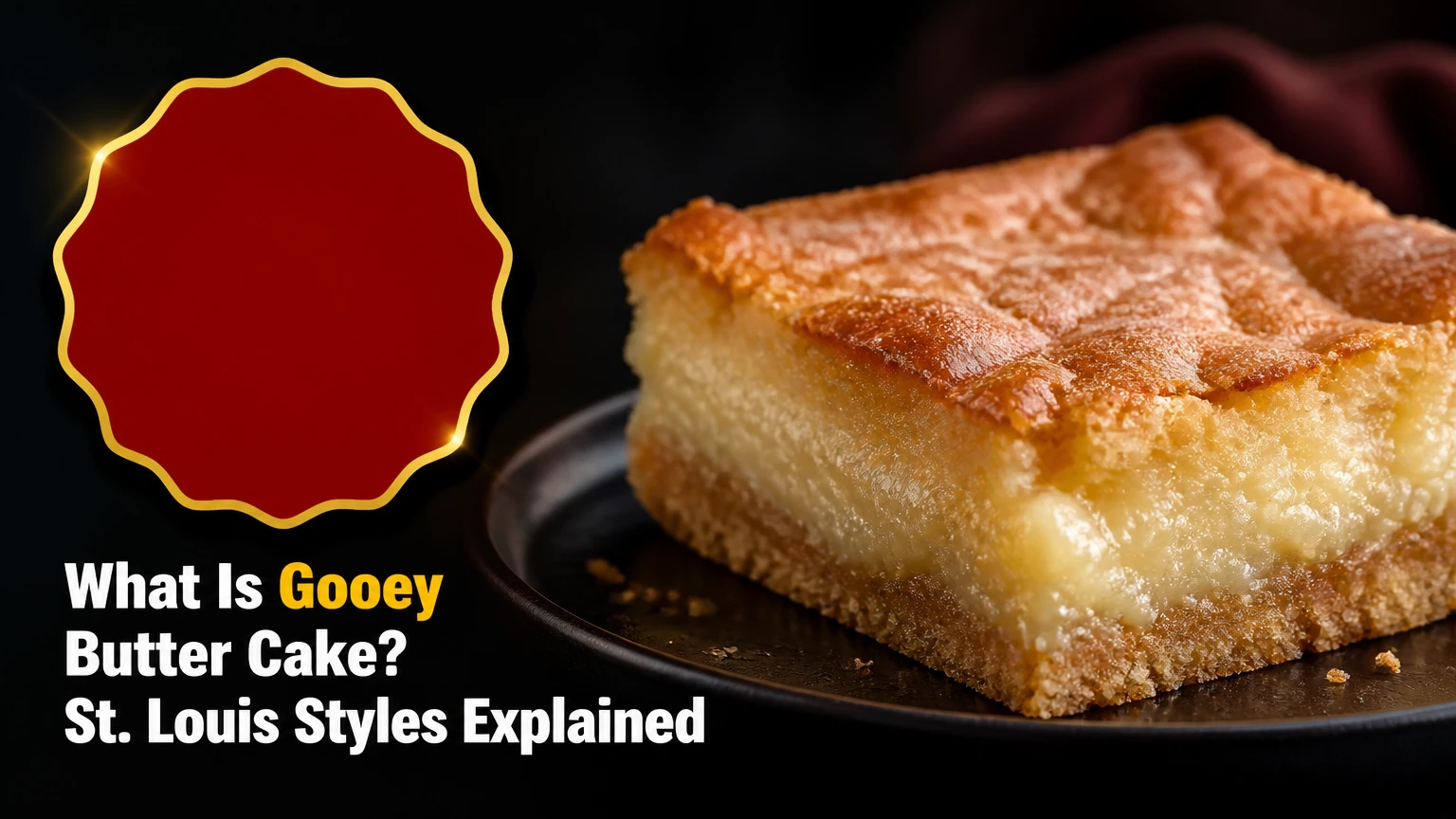
Gooey butter cake is a St. Louis, Missouri dessert made from a dense sweet base and a rich, soft topping that stays custardy in the center. Traditional versions use yeasted dough and a corn-syrup-based topping, while the widely circulated quick version uses yellow cake mix, cream cheese, eggs, butter, and powdered sugar.
Key Facts About Gooey Butter Cake
- Gooey butter cake originated as a regional specialty in St. Louis, Missouri.
- The traditional cake has a yeasted bottom and a sweet, buttery topping.
- The quick version uses boxed yellow cake mix for the base and cream cheese for the topping.
- A properly baked center jiggles gently but does not flow like liquid.
- Gooey butter cake becomes firmer and easier to slice after complete cooling.
- Powdered sugar is usually sifted over the cooled surface before serving.
What Is Gooey Butter Cake?
Gooey butter cake is a two-layer dessert with a structured bottom and a soft, intensely rich top. The bottom can resemble sweet bread, a chewy cookie bar, or a dense cake depending on the recipe, while the upper layer has a texture between custard, fudge, and soft cheesecake.
The cake is associated with St. Louis bakeries and home kitchens, where multiple formulas developed over time. The name describes the eating experience rather than a single standardized formula: butter contributes richness, and the top remains deliberately soft instead of baking into a conventional crumb.
The finished dessert is typically cut into squares and dusted with confectioners’ sugar. It is sweeter and denser than ordinary yellow cake, but it is not simply a cheesecake because its topping is baked over a separate pastry or cake-like base.
What Does It Taste and Feel Like?
Gooey butter cake tastes strongly of butter and sugar, with vanilla and mild tang from cream cheese in the quick style. Traditional versions usually taste more like enriched sweet dough, while cake-mix versions have a stronger vanilla-candy profile.
| Feature | Traditional style | Quick cake-mix style | Typical eating result |
|---|---|---|---|
| Bottom texture | Soft, yeasted, bread-like | Dense, chewy, cookie-like | Firm support under the topping |
| Top texture | Glossy, custardy, soft | Velvety, fudgy, cheesecake-like | Rich center that yields under a fork |
| Main flavor | Butter, yeast, vanilla | Butter, vanilla, cream cheese | Very sweet with a tangy finish |
| Surface finish | Golden and slightly crackled | Pale, crackled, powdered with sugar | Soft top with a delicate crust |
| Serving form | Bakery squares | Bar-cookie squares | Small portions suit the richness |
Where Did Gooey Butter Cake Come From?
Gooey butter cake is generally credited to St. Louis bakers in the 1930s, although the exact bakery and first formula remain disputed. The commonly repeated story involves a baker using incorrect proportions of butter, flour, or sugar and selling the resulting soft cake rather than discarding it.
The historical point is more reliable than the precise accident story. St. Louis developed a recognizable bakery tradition around the dessert, and local versions differ in thickness, sweetness, topping composition, and whether the base contains yeast.
Food writers and regional institutions often describe the cake as a St. Louis specialty, but no single recipe controls the category. A cake-mix recipe can be recognizable as a modern adaptation, while a yeasted dough with a corn-syrup topping is closer to the older bakery form.
Why Is St. Louis Important to the Cake’s Identity?
St. Louis matters because the city’s bakeries preserved gooey butter cake as a local product rather than treating it as an ordinary bar dessert. Regional bakeries often sell it in small squares, and recipes appear under names such as St. Louis gooey butter cake and ooey-gooey butter cake.
The regional label also prevents a common misunderstanding. Gooey butter cake is not a generic description for any underbaked butter dessert; it refers to a recognizable St. Louis-style preparation with a bottom layer and a soft upper layer.
Why Does Gooey Butter Cake Stay Gooey?
Gooey butter cake stays soft because the topping contains more sugar and fat relative to flour than a standard cake batter, so the mixture develops less rigid structure. Eggs provide binding, but the center remains soft when the cake is removed before the egg proteins and starches create a firm crumb.
The quick topping combines cream cheese, eggs, butter, powdered sugar, and often vanilla. Powdered sugar dissolves readily into the moist mixture, while cream cheese supplies water, protein, and acidity. The result sets during cooling into a thick, sliceable layer rather than a fluffy cake.
The center should not be confused with raw batter. Heat must pass through the topping sufficiently for the eggs to set and for the cake to reach a safe, stable texture. The visual target is a slight gelatin-like wobble in the middle, not a rippling liquid pool.
What Do the Ingredients Contribute?
| Ingredient | Primary role | Typical quick-style amount | Result when changed |
|---|---|---|---|
| Yellow cake mix | Flour, starch, leavening, flavor | 15.25 ounces | Defines the base’s density and sweetness |
| Unsalted butter | Fat and moisture carrier | 3/4 cup total | More creates softness; less creates dryness |
| Eggs | Structure and emulsification | 3 large eggs | Extra egg firms the topping |
| Cream cheese | Tang, protein, and body | 8 ounces | Less produces a thinner, less tangy topping |
| Powdered sugar | Sweetness and bulk | 3-4 cups | Less can leave the center loose |
| Vanilla extract | Aromatic flavor | 1 teaspoon | Adds rounded vanilla character |
An expert baking rule applies here: do not judge the cake’s final texture while it is hot. Butter remains fluid at oven temperature, and the topping gains substantial body as it cools. A cake that looks slightly loose after baking can become properly fudgy after two hours.
What Are the Two Main Styles?
The two main styles are the traditional yeast-based cake and the modern quick version made with boxed cake mix. Traditional gooey butter cake offers more fermentation flavor and a softer bread-like base, while the quick style takes less time and produces a sweeter, denser bar.
Traditional Yeast-Based Gooey Butter Cake
Traditional gooey butter cake begins with a sweet yeast dough made from flour, milk, yeast, sugar, butter, and an egg. The dough is pressed into a pan and allowed to rise before the topping is spread over it.
The topping commonly includes butter, sugar, eggs, corn syrup, and a small amount of flour. Recipes vary, and some include milk or water. The top should bake into a glossy, soft layer with browned edges and a center that remains tender after cooling.
This version normally requires roughly 2-3 hours because the dough needs proofing. The extra time changes the result: fermentation adds mild flavor and creates a more distinct contrast between the bottom and top.
Quick Cake-Mix Gooey Butter Cake
The quick version combines one box of yellow cake mix with melted butter and an egg, then presses that dough into a 9-by-13-inch pan. A separate mixture of softened cream cheese, eggs, vanilla, powdered sugar, and butter goes on top.
The quick style usually needs 15-20 minutes of active preparation and 35-45 minutes in a 350°F oven. It is accessible, consistent, and suitable for first-time bakers, but its sweetness and cream-cheese flavor differ from the older bakery style.
| Decision factor | Traditional yeast style | Quick cake-mix style |
|---|---|---|
| Active preparation | 35-50 minutes | 15-20 minutes |
| Total elapsed time | 2-3 hours | 3-4 hours including cooling |
| Main base | Sweet yeast dough | Yellow cake mix dough |
| Main topping | Butter, sugar, eggs, corn syrup | Cream cheese, sugar, eggs, butter |
| Texture | Pillowy base, glossy custard | Chewy base, fudgy topping |
| Skill demand | Moderate | Beginner-friendly |
| Sweetness | High but more balanced | Very high and distinctly tangy |
| Best use | Traditional bakery experience | Fast home baking and variations |
How Do You Make the Quick Version?
The quick version takes about 15-20 minutes to assemble, 35-45 minutes to bake, and at least two hours to cool. The most important control is removing the cake while the center still jiggles gently, because a fully firm center will become overbaked after cooling.
Before You Start
| Requirement | Practical specification |
|---|---|
| Pan | Light-colored metal, 9 by 13 inches |
| Oven | 350°F, or 175°C |
| Active time | 15-20 minutes |
| Bake time | 35-45 minutes |
| Cooling time | Minimum 2 hours |
| Yield | 24 small squares |
| Main equipment | Mixer, spatula, bowl, wire rack |
| Estimated ingredient cost | Typically $10-$18 at home |
Step 1: Prepare the Pan and Ingredients
Heat the oven to 350°F. Grease a 9-by-13-inch pan, or line it with parchment so the cooled cake can be lifted out.
Use room-temperature cream cheese and eggs. Melt the butter, then let it cool until warm rather than hot. Hot butter can partially cook the egg in the base mixture and make blending uneven.
Success checkpoint: The cream cheese should press easily under a finger, and the butter should feel barely warm.
Common mistake: Starting with cold cream cheese creates small lumps that remain visible after baking.
Step 2: Build the Base
Mix one 15.25-ounce box of yellow cake mix, 1/2 cup melted butter, and one large egg until a thick dough forms. Press the dough evenly into the pan, using lightly buttered fingers or the flat bottom of a measuring cup.
A level base matters because a thin corner can overbake before the center sets. Keep the layer approximately 1/4 to 3/8 inch thick across the pan.
Success checkpoint: The dough reaches every corner without visible gaps.
Common mistake: Packing the base too thickly in the center produces a raw-looking middle and dry edges.
Step 3: Mix the Gooey Topping
Beat 8 ounces of softened cream cheese until smooth. Add two large eggs and one teaspoon of vanilla, then blend until uniform.
Add 3 cups of powdered sugar gradually. Mix in 1/4 cup melted butter. For a thicker, sweeter topping, some formulas use up to 4 cups of powdered sugar, but increasing the sugar changes both sweetness and firmness.
Success checkpoint: The topping flows slowly from the spatula and contains no cream-cheese lumps.
Common mistake: Mixing at high speed after adding powdered sugar incorporates excess air, which can cause a high rise followed by a sunken center.
Step 4: Bake Until the Center Wobbles
Pour the topping over the base and spread it to the edges. Bake for 35-45 minutes, rotating the pan once if the oven has uneven heat.
The edges should look golden and slightly puffed. The center should move as one soft mass when the pan is nudged, with a wobble similar to set gelatin. A liquid wave indicates underbaking, while a completely motionless center usually indicates overbaking.
Success checkpoint: The surface is pale golden with cracks or a slight blistering pattern, and the middle still trembles.
Common mistake: Baking to a toothpick-clean result produces a firm cake rather than a gooey one.
Step 5: Cool, Chill, and Cut
Cool the cake in the pan on a wire rack for at least two hours. For especially clean slices, refrigerate it for 30-60 minutes after room-temperature cooling, then dust the surface with powdered sugar.
Cut 24 small squares with a sharp knife. Wipe the blade between cuts to keep the cream-cheese layer distinct.
Success checkpoint: The center yields under pressure but does not run across the cut surface.
Common mistake: Cutting while warm releases melted butter and soft topping onto the crust.
Which Style Should You Choose?
Choose the quick style for speed, predictable results, and easy flavor variations. Choose the traditional style when the yeasted base, bakery flavor, and historical character matter more than convenience.
| Baker or occasion | Better choice | Typical reason | Main compromise |
|---|---|---|---|
| First-time baker | Quick style | Fewer technique-sensitive steps | Higher sweetness |
| St. Louis traditionalist | Yeast style | Closer to bakery formulas | Proofing time |
| Holiday dessert table | Quick style | Easy to scale and flavor | Needs small portions |
| Pastry-focused baker | Yeast style | More complex base texture | More variables |
| Weeknight baking | Quick style | 15-20 minutes active work | Less fermented flavor |
How Does It Compare With Similar Desserts?
Gooey butter cake differs from cheesecake because its topping is thinner, sweeter, and baked over a cake or pastry base rather than a crumb crust. It differs from chess pie because chess pie is usually a single custard filling in a pastry shell, while gooey butter cake has a substantial bottom layer.
| Dessert | Base | Top or filling | Typical texture | Main flavor |
|---|---|---|---|---|
| Gooey butter cake | Yeast dough or cake-mix dough | Soft butter and sugar topping | Chewy base, gooey top | Butter and sugar |
| Cheesecake | Cookie or pastry crust | Cream cheese custard | Firm, creamy slice | Tangy dairy |
| Chess pie | Pastry shell | Egg and sugar custard | Dense, smooth filling | Sugar and butter |
| Lemon bar | Shortbread crust | Lemon egg curd | Firm curd over crumb | Tart citrus |
| Butter cake | Cake batter | No separate gooey layer | Tender cake crumb | Butter and vanilla |
Gooey butter cake is a poor choice when a light, low-sugar dessert is needed. The dessert is dense, rich, and portion-sensitive, so a 2-inch square is usually more practical than a large cake wedge.
How Should You Store and Serve It?
Store gooey butter cake covered in the refrigerator for up to five days because the cream-cheese topping contains perishable dairy and eggs. Let individual pieces sit at room temperature for 15-20 minutes before serving so the topping softens without becoming runny.
Traditional versions without cream cheese may remain acceptable at room temperature for a shorter period, but refrigeration is the safer default for modern recipes. Keep the cake covered to prevent the surface from drying and absorbing refrigerator odors.
| Storage method | Timeframe | Texture after storage | Best use |
|---|---|---|---|
| Room temperature, covered | Up to 2 hours for cream-cheese versions | Softest topping | Immediate serving |
| Refrigerator, covered | Up to 5 days | Firmer, cleanest slices | Make-ahead dessert |
| Freezer, airtight | About 2 months | Slightly denser after thawing | Long-term storage |
| Refrigerator after thawing | 2-3 days | Soft and stable | Planned dessert service |
To freeze the cake, cool it completely, cut it into squares, wrap each piece, and place the wrapped portions in an airtight container. Thaw overnight in the refrigerator, then remove the covering after condensation has dissipated.
What Variations Work Best?
Pumpkin, chocolate, lemon, pecan, and salted versions work well when the added ingredient does not introduce too much liquid. Flavor changes should preserve the topping’s balance of sugar, fat, egg, and cream cheese.
| Variation | Base adjustment | Topping adjustment | Expected result |
|---|---|---|---|
| Pumpkin | Yellow cake mix | Add 1/2 cup pumpkin and 1 tablespoon spice | Softer, more custardy top |
| Chocolate | Chocolate cake mix | Add 1/4 cup Dutch-process cocoa | Darker, denser flavor |
| Lemon | Lemon cake mix | Add 2 tablespoons zest | Bright citrus aroma |
| Peanut butter | Yellow cake mix | Add 1/2 cup smooth peanut butter | Heavier, chewy topping |
| Pistachio | Yellow cake mix | Add pistachio pudding mix | Green color and nutty sweetness |
Pumpkin purée adds water, so the center may require several additional minutes in the oven. Lemon zest adds flavor without greatly changing structure, while substantial lemon juice can thin the topping and should be used sparingly.
Why Does Gooey Butter Cake Fail?
Most failures come from temperature, measurement, pan geometry, or premature slicing rather than from the dessert’s unusual texture. The best correction depends on whether the cake is dry, liquid, lumpy, sunken, or unevenly baked.
| Problem | Likely cause | Practical fix | Prevention |
|---|---|---|---|
| Firm, cake-like center | Overbaking | Serve with cream or fruit | Remove at the jiggle stage |
| Liquid middle | Severe underbaking or early cutting | Return to oven if still warm; otherwise chill | Check the center, not the clock alone |
| Dry edges | Dark pan or thin edges | Trim only if necessary | Use a light metal pan |
| Grainy topping | Cold cream cheese or undissolved sugar | Beat cream cheese smooth before sugar | Bring dairy to room temperature |
| Sunken center | Excess air or underbaked structure | Chill fully before judging | Mix on low after adding sugar |
| Uneven layers | Base pressed inconsistently | Level the dough before topping | Measure thickness in corners |
A counterintuitive practitioner rule is that a slightly underbaked-looking center is usually closer to the target than a clean toothpick. The topping continues to set during cooling, so oven firmness is a poor measure of finished firmness.
Another useful rule concerns pan color. A dark metal pan absorbs more heat at the edges, increasing the risk of a dry border before the middle sets. If a dark pan is the only option, begin checking several minutes early and consider reducing the oven temperature by 15-25°F.
Do not solve a liquid center by adding a large amount of flour to the topping. Flour changes the dessert into a cakier bar and can create a pasty texture. First verify the powdered sugar measurement, cream-cheese temperature, bake time, and cooling period.
How Can You Scale the Recipe?
A 9-by-13-inch pan has 117 square inches of surface area, so changing pan dimensions changes thickness and baking time. A smaller pan makes a taller cake that needs more time, while a larger pan makes a thinner layer that can dry out quickly.
| Pan size | Area | Relative thickness | Typical bake adjustment |
|---|---|---|---|
| 8-inch square | 64 square inches | Much taller | Add 10-20 minutes |
| 9-inch square | 81 square inches | Taller | Add 5-15 minutes |
| 9-by-13-inch | 117 square inches | Recipe baseline | Use 35-45 minutes |
| 10-by-15-inch | 150 square inches | Thinner | Begin checking 8-12 minutes early |
| Two 8-inch squares | 128 square inches | Similar to baseline | Check around 35 minutes |
When scaling, divide the finished cake by surface area rather than by volume alone. The visual doneness signals remain more reliable than a fixed time because ovens, pans, ingredient temperatures, and topping depth vary.
Frequently Asked Questions
Is gooey butter cake supposed to be refrigerated?
Gooey butter cake made with cream cheese should be refrigerated after serving and kept covered for up to five days. Refrigeration firms the topping and makes clean cutting easier, while 15-20 minutes at room temperature restores a softer texture before eating.
Can you make gooey butter cake without a cake mix?
You can make gooey butter cake without cake mix by using a sweet yeast dough or a scratch butter-flour base. The yeast version is closer to the older St. Louis bakery style, but it requires proofing and produces a softer, less cookie-like bottom.
Can I use salted butter?
Salted butter works, but the finished dessert may taste saltier because cake mix and cream cheese already contain some sodium. If using salted butter, omit any added salt and avoid adding more than a small pinch until the first batch establishes the preferred flavor.
Why is my gooey butter cake not gooey?
A non-gooey cake was usually baked too long, made with too much flour, or cut before its texture could be evaluated correctly. Remove the cake when the edges are set and the center jiggles, then cool it for at least two hours before deciding whether the formula worked.
Can gooey butter cake sit out overnight?
A cream-cheese version should not sit at room temperature overnight. Refrigerate it within two hours of serving, and discard it if it has remained warm for an extended period. Traditional recipes without cream cheese still benefit from covered storage and prompt refrigeration.
Where can you buy gooey butter cake in St. Louis?
St. Louis bakeries, grocery bakeries, and specialty dessert shops commonly sell gooey butter cake, but availability changes by neighborhood and season. Ask whether the bakery makes a yeast-based traditional version or a cream-cheese cake-mix-style bar, since those labels describe noticeably different desserts.
The Bottom Line
Gooey butter cake is a rich St. Louis dessert built from a firm sweet base and a deliberately soft, buttery topping. Traditional yeast-based cake offers the strongest regional character, while the quick cake-mix version delivers reliable results in roughly 35-45 minutes of baking. For either style, the defining technique is removing the cake while the center still jiggles, then allowing enough cooling time for the gooey layer to set.
