

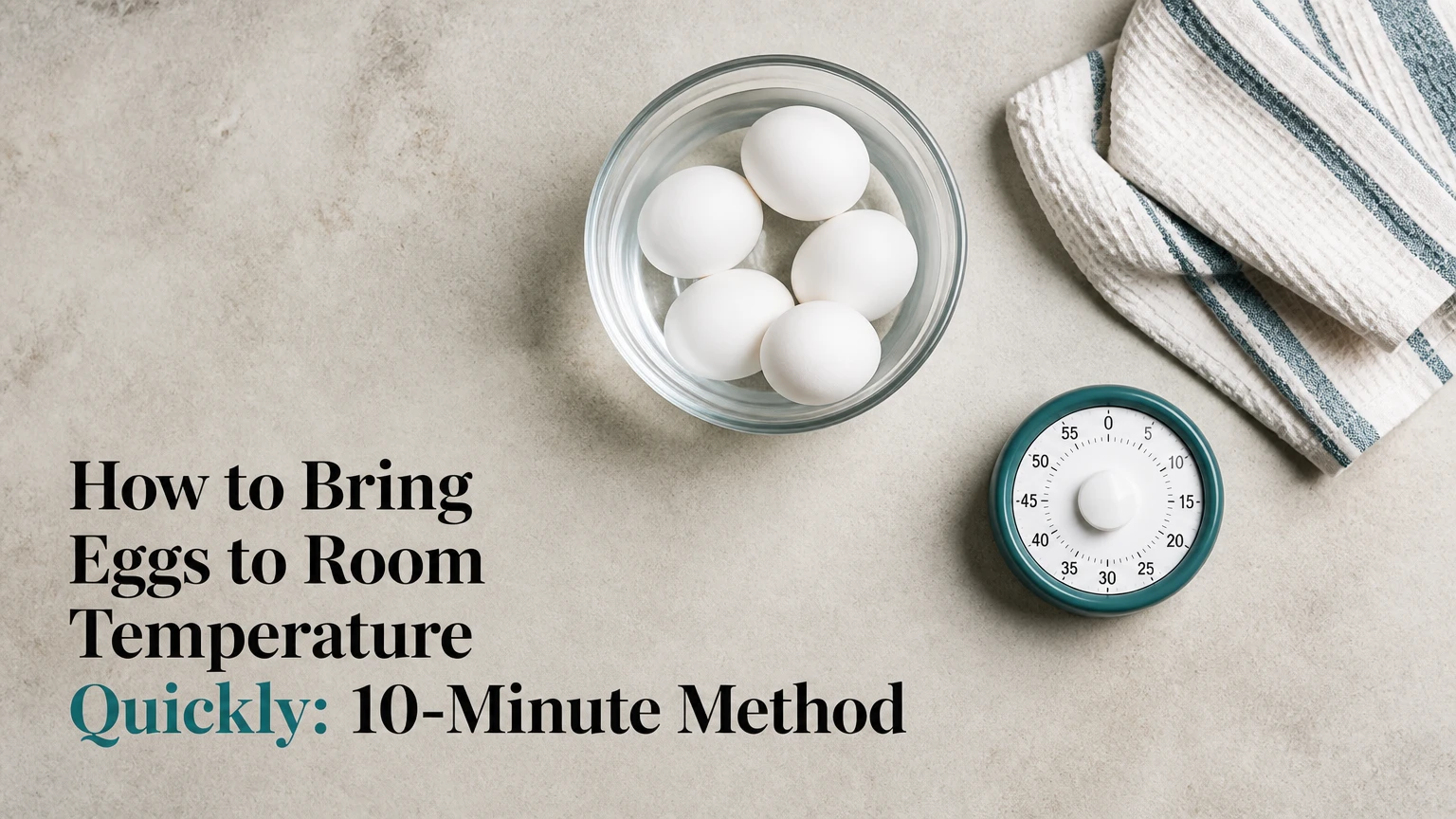
To bring eggs to room temperature quickly, place whole, uncracked refrigerated eggs in 30-35°C (85-95°F) tap water for 5-10 minutes. Rotate or replace the water once if necessary, then dry the shells before cracking. The method warms eggs gently without partially cooking the whites or diluting the recipe.
Key Facts at a Glance
A warm water bath brings refrigerated eggs close to room temperature in 5-10 minutes.
Use 30-35°C (85-95°F) water, which should feel comfortably warm rather than hot.
Whole eggs warm more safely than cracked eggs because the shell limits direct heat.
A large refrigerated egg may need closer to 10 minutes than 5 minutes.
Never microwave a whole egg in its shell because trapped steam can cause it to burst.
In the United States, the FDA advises refrigerating shell eggs at 40°F (4°C) or below and avoiding more than 2 hours at room temperature.
How to Bring Eggs to Room Temperature Quickly
The most reliable procedure uses warm tap water, a deep bowl, and whole eggs that have no cracks. A typical batch of two to six large eggs reaches a useful baking temperature in about 5-10 minutes, although the center may remain slightly cooler than the surrounding room.
Before You Start
| Requirement | Recommended specification | Practical reason |
|---|---|---|
| Water temperature | 30-35°C (85-95°F) | Warms shells without setting egg proteins |
| Water depth | 8-12 cm (3-5 inches) | Covers the largest egg completely |
| Egg quantity | 2-6 large eggs | Maintains stable water temperature |
| Warming time | 5-10 minutes | Matches typical refrigerated large eggs |
| Equipment cost | $0 if tap water is available | No specialized tool required |
| Difficulty | Beginner | Requires temperature awareness, not cooking skill |
Use a clean bowl large enough for the eggs to remain submerged without stacking tightly. If the water feels hot on your wrist, add cooler water. A kitchen thermometer gives a more repeatable result, but a comfortable bath-like temperature is suitable when no thermometer is available.
Step 1: Fill a Bowl With Warm Water
Fill the bowl with 30-35°C water until the waterline sits above the eggs. Warm tap water is preferable to boiling water because direct high heat can begin changing the egg white before the center warms.
You will know the setup is suitable when an egg can remain submerged without the shell feeling hot. The common mistake is using freshly boiled water or very hot tap water, which can create localized cooked patches near the shell.
Step 2: Submerge the Whole Eggs
Lower the refrigerated eggs gently into the water. Keep every shell intact and separate eggs that are stuck together so water can contact the entire surface.
The eggs should remain underwater for the full warming period. If an egg floats, it may still be usable, but floating is primarily a freshness clue rather than a reliable safety test. The common mistake is cracking eggs before the shells have dried, allowing water from the bowl to enter the mixing bowl.
Step 3: Wait 5-10 Minutes
Leave small or medium eggs for about 5 minutes and large or extra-large eggs for 8-10 minutes. For a large batch, stir the water gently once or replace it with fresh 30-35°C water after 5 minutes because cold shells gradually reduce the bath temperature.
The eggs are ready when the shell no longer feels refrigerator-cold and the recipe can be mixed immediately. Surface warmth does not prove that the yolk has reached 20-22°C, so use the longer end of the range when the eggs started near 4°C.
Step 4: Dry the Shells and Crack the Eggs
Remove each egg with clean hands or a slotted spoon, then dry the shell thoroughly with a clean towel. Crack the eggs into a separate small cup if the recipe requires separating yolks and whites or if shell fragments would be difficult to remove from the batter.
The success checkpoint is a dry shell and an intact egg with no white cooked onto the shell. The common mistake is rinsing eggs under warm running water, which can spread contamination around the work area and adds unnecessary moisture.
Why Do Baking Recipes Ask for Room-Temperature Eggs?
Room-temperature eggs blend more readily with softened butter, oil, sugar, and other batter ingredients because warmer egg proteins and water phases combine with fat more smoothly. Cold eggs can firm softened butter, break an emulsion, and reduce the volume of cakes that depend on trapped air.
A creamed cake batter is especially sensitive. When cold egg is added quickly to butter and sugar, the butter can seize into small solid pieces, producing a curdled appearance. The cake may still bake successfully, but the crumb can become denser and less even.
Room-temperature eggs also whip more efficiently in preparations such as sponge cake, genoise, and some foam cakes. The benefit is not universal: a cookie recipe made with melted butter usually gains less from warming eggs because the butter is already liquid.
The practical rule is simple. Warm eggs when the recipe combines them with softened butter or relies on whipped egg volume; use refrigerated eggs without concern when temperature has little structural influence.
What Temperature and Time Should You Use?
Egg-warming time depends on starting temperature, egg size, water temperature, the number of eggs, and whether the water stays warm. The following figures are typical kitchen estimates for eggs beginning at approximately 4°C (40°F) in a 30-35°C bath.
| Egg size | Typical mass with shell | First-check time | More reliable time | Recommended use |
|---|---|---|---|---|
| Small | 43-49 g | 4 minutes | 6 minutes | Small-batch cookies |
| Medium | 49-56 g | 5 minutes | 7 minutes | Muffins and quick breads |
| Large | 56-63 g | 6 minutes | 8-10 minutes | Standard cake recipes |
| Extra-large | 63-70 g | 7 minutes | 10-12 minutes | High-volume baking |
| Jumbo | 70-80 g | 8 minutes | 12-15 minutes | Commercial-size formulas |
These are practical timing ranges rather than laboratory guarantees. A crowded bowl loses heat faster, and eggs stored at 1°C will warm more slowly than eggs stored near 5°C.
Does Water Temperature Need to Be Measured?
A thermometer is useful when consistency matters, but most home cooks can identify a suitable bath by touch. Water at 30-35°C feels warm and comfortable; water approaching 40°C feels distinctly hot and provides little advantage because the egg remains cool at its center.
Egg white begins to thicken at temperatures well above ordinary warm tap water, with different proteins changing at different temperatures. Therefore, the claim that all water above 40°C immediately cooks egg whites is too broad. Water above 40°C is still unnecessarily aggressive, and hotter water increases the chance of partial coagulation near the shell.
Which Egg-Warming Method Is Best?
Warm-water submersion is the best general method because it combines a 5-10 minute timeframe with even heat transfer and minimal handling. Countertop warming is gentler but slower, while a cracked-egg water bath is useful only when the eggs will be mixed immediately.
| Method | Typical time | Water or air condition | Best use | Main limitation |
|---|---|---|---|---|
| Whole-egg water bath | 5-10 minutes | 30-35°C water | Cakes, muffins, enriched dough | Requires drying shells |
| Countertop warming | 30-60 minutes | 20-22°C room | Planned baking | Longer exposure to room temperature |
| Warm towel wrap | 15-25 minutes | Dry towel, warm room | Small batches without a bowl | Uneven center warming |
| Cracked-egg indirect bath | 5-8 minutes | 30-35°C surrounding water | Immediate liquid mixing | Higher handling and contamination risk |
| Refrigerator-to-bowl use | 0 minutes | Approximately 4°C | Melted-butter recipes | Less useful for creamed batters |
The warm-water bath wins for most home baking. The cracked-egg method wins only when speed matters more than shell protection and the bowl can be kept clean.
Can You Warm Cracked Eggs Faster?
Cracked eggs can warm in about 5-8 minutes when placed in a clean bowl set inside a larger bowl of warm water. Do not place the egg bowl directly on a stove, use a microwave, or pour warm water into the eggs, because direct heat can set the proteins and added water changes the formula.
Crack the eggs into a heat-safe glass or stainless-steel bowl. Set that bowl in a larger bowl containing 30-35°C water, keeping the water outside the egg bowl. Stir the eggs once or twice with a clean fork to distribute temperature.
This method is not “almost instant.” A shallow layer warms quickly at the surface, but the center still needs time. Use it only when the eggs will go straight into the recipe, and discard the contents if shell fragments, dirty water, or a visible crack compromise cleanliness.
Which Method Fits Your Recipe?
Egg temperature matters most when the recipe depends on emulsification or aeration. The table below maps common baking situations to a practical choice rather than treating room-temperature eggs as mandatory for every formula.
| Recipe or technique | Egg condition | Warming method | Typical time | Reason |
|---|---|---|---|---|
| Butter cake | Room temperature preferred | Whole-egg bath | 8-10 minutes | Protects butter emulsion |
| Sponge cake | Room temperature preferred | Whole-egg bath | 8-12 minutes | Supports whipping volume |
| Cheesecake | Slightly warm preferred | Whole-egg bath | 6-10 minutes | Reduces lumps in cream cheese batter |
| Muffins | Helpful, not mandatory | Whole-egg bath | 5-8 minutes | Improves blending with oil |
| Melted-butter brownies | Usually unnecessary | Use cold eggs if directed | 0 minutes | Liquid fat is less likely to seize |
| Meringue | Whites often warmed separately | Clean indirect bath | 5-10 minutes | Supports whipping, with hygiene control |
| Custard | Recipe-specific | Follow recipe temperature | 0-10 minutes | Excess warmth can accelerate curdling |
| Yeast-enriched dough | Mildly warm preferred | Whole-egg bath | 5-8 minutes | Reduces chilling of the dough |
For sponge cake, warming the eggs is only one part of volume control. The bowl, whisk, sugar, and mixing speed also affect aeration. For cheesecake, room-temperature ingredients reduce lumps, but eggs should not become hot because excessive warmth can loosen the batter and increase cracking during baking.
What Are the Food-Safety Limits?
The FDA recommends buying clean, uncracked shell eggs, keeping them refrigerated at 40°F (4°C) or below, and cooking eggs until both the yolk and white are firm. FDA guidance also uses a two-hour limit for perishable foods at room temperature, reduced to one hour when ambient temperature exceeds 90°F (32°C).
“Cook eggs until both the yolk and white are firm,” advises the U.S. Food and Drug Administration in its egg-safety guidance.
A five-to-ten-minute warming bath is far below that time limit. The safety concern arises when eggs are forgotten on a warm counter, repeatedly warmed and chilled, or handled with contaminated utensils.
Food-safety rules differ by country because egg-washing practices and supply chains differ. In the United Kingdom and parts of Europe, retail eggs are commonly stored at room temperature to avoid condensation, while washed eggs in the United States are generally refrigerated. Follow the storage instructions printed on the carton and avoid switching repeatedly between storage systems.
| Situation | Maximum practical exposure | Recommended action | Reason |
|---|---|---|---|
| Warm-water bath at 30-35°C | 5-15 minutes | Use immediately | Short controlled warming |
| Countertop at 20-22°C | Up to 2 hours in FDA guidance | Cook or refrigerate promptly | Perishable food limit |
| Room above 32°C | Up to 1 hour in FDA guidance | Use immediately or discard | Faster bacterial growth |
| Shell cracked before warming | 0 minutes unattended | Crack into clean bowl and use now | Shell barrier is compromised |
| Egg touched dirty water | 0 minutes | Discard | Surface contamination risk |
| Egg remained warm overnight | More than 8 hours | Discard | Unsafe duration |
The FDA’s time limits are not a target for preparation. They are an upper safety boundary for perishable food exposure under stated conditions.
Common Mistakes and How Can You Fix Them?
The most common failures are excessive water heat, forgotten eggs, wet shells, and direct heating. Each problem has a different remedy, and some cannot be safely repaired.
| Mistake | Observable result | Immediate fix | Prevention |
|---|---|---|---|
| Water above 45°C | White patches near shell | Discard visibly cooked egg for baking | Use 30-35°C water |
| Eggs left out 3 hours at 21°C | Warm, forgotten eggs | Follow local safety guidance; FDA practice is discard | Set a 10-minute timer |
| Shell hairline cracks | Leaking white or dirty water | Discard if contamination occurred | Lower eggs gently |
| Water enters cracked egg | Thinner egg mixture | Do not compensate with flour | Dry shells first |
| Microwave used on whole egg | Steam pressure buildup | Never microwave in shell | Use an indirect bath |
| Bowl overcrowded | Water cools below 25°C | Replace water once | Warm 2-6 eggs per batch |
A hairline crack does not automatically mean water has chemically ruined the egg. The main concerns are contamination and the loss of the shell barrier. If dirty bath water enters an egg, discard it rather than trying to correct the batter.
An egg that becomes slightly warm in a clean bath can be used normally. An egg that has been forgotten on the counter for several hours should be judged by food-safety guidance, not by smell or appearance, because Salmonella cannot be reliably detected with household sensory tests.
How Do You Warm Many Eggs at Once?
For 12 or more eggs, use a sanitized food-safe container and enough water to prevent a rapid temperature drop. A larger volume of 30-35°C water gives more stable heating than a small bowl, but the eggs should remain in a single loose layer whenever possible.
For a home batch, divide 12 eggs into two groups of six and refresh the water after 5 minutes. In a commercial kitchen, follow the facility’s HACCP procedure, calibrated thermometer requirements, and local rules rather than relying on hand temperature.
| Batch size | Container example | Starting water | Refresh point | Typical total time |
|---|---|---|---|---|
| 2-6 eggs | 1.5-2 L bowl | 30-35°C | 5 minutes if cool | 5-10 minutes |
| 7-12 eggs | 3-4 L food-safe tub | 30-35°C | 5 minutes | 8-12 minutes |
| 13-24 eggs | 6-8 L sanitized tub | 32-35°C | 4-5 minutes | 10-15 minutes |
| 25 or more eggs | Commercial prep container | Follow HACCP plan | Calibrated checks | Site-specific |
A common professional rule is to warm only the quantity needed for the current production run. Holding a large number of eggs at room temperature creates more exposure without improving batter quality after the first required batch.
Can Eggs Return to the Refrigerator After Warming?
Eggs can return to the refrigerator only when they were warmed briefly, remained clean and uncracked, and have not exceeded applicable room-temperature safety limits. Repeated temperature changes are less desirable than a single controlled warming period because condensation and handling increase contamination opportunities.
If the eggs spent 5-10 minutes in clean warm water, dry them and refrigerate them promptly if the recipe is postponed. If they sat at room temperature for more than two hours, FDA guidance does not support simply chilling them again for later use.
FAQ
Do Eggs Have to Be Room Temperature for Every Cake?
No. Room-temperature eggs matter most in creamed butter cakes, sponge cakes, and recipes that whip eggs for volume. Recipes using melted butter or oil often tolerate cold eggs with little change. Follow the recipe when it specifies temperature because ingredient ratios and mixing methods determine the effect.
Can I Use Warm Water From a Kettle?
Use kettle water only after mixing it with cool water and checking that the final bath is 30-35°C. Direct kettle water is usually far hotter than needed and can partially cook the egg white against the shell. Warm tap water is simpler and safer for this task.
How Can I Tell Whether an Egg Is Room Temperature?
A shell that no longer feels refrigerator-cold indicates useful warming, but it does not prove the center has reached 20-22°C. A thermometer cannot easily measure an intact egg without breaking the shell, so timing, egg size, and bath temperature provide the practical test.
Is It Safe to Put Eggs in Warm Water in Their Carton?
Only if the carton remains dry enough to stay intact and the eggs can be submerged safely, which is rarely convenient. A clean bowl gives better water contact and makes cracks visible. Paper cartons can weaken when wet, so they are inferior to direct placement in a bowl.
Can I Warm Egg Whites and Yolks Separately?
Yes. Place separated whites or yolks in a clean bowl over warm water at 30-35°C, stir gently, and use them within several minutes. Separate eggs while cold because cold yolks are less likely to break, then warm the components indirectly.
What Should I Do If the Egg Starts Cooking?
Remove the egg from the bath immediately and inspect it. If the white has opaque cooked patches or a rubbery edge, do not use it for a recipe requiring a smooth emulsion; use a fresh egg instead. Reduce the bath temperature before warming the replacement.
The Bottom Line
To bring eggs to room temperature quickly, use a 30-35°C warm-water bath for 5-10 minutes, then dry the shells before cracking. Choose the longer time for large eggs, crowded batches, or very cold refrigerator settings. Warmed eggs are most valuable in butter cakes, sponge cakes, and whipped mixtures, while melted-butter recipes often work well with cold eggs. Food safety still governs the process: keep eggs clean, intact, and within the applicable room-temperature limit.
