

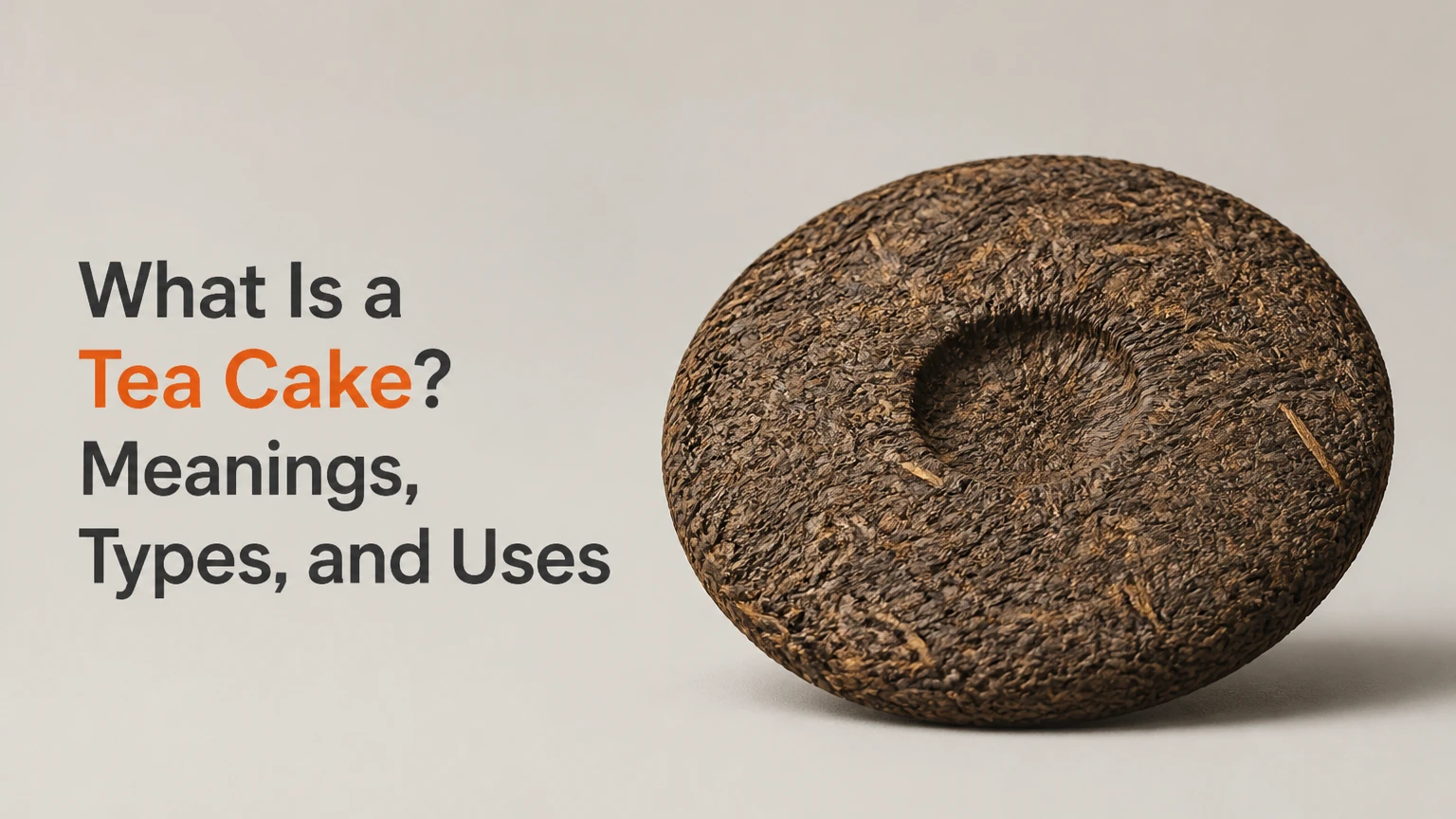
A tea cake is a baked treat or compressed tea product associated with tea service, but the meaning changes by region. In Britain, it usually means a sweet yeast bun, while in the Southern United States it means a soft, buttery cookie. In other contexts, it can mean a Russian tea cake, a loaf cake, or a compressed pu-erh tea disc.
Key Facts at a Glance
- A British teacake is usually a lightly sweetened, yeast-leavened bun served split, toasted, and buttered.
- A Southern American tea cake is a soft, thick cookie flavored with butter, vanilla, and often nutmeg.
- A Russian tea cake is an eggless nut shortbread rolled in powdered sugar and also called a snowball cookie.
- A bakery tea cake can mean a plain, moist loaf cake intended for slicing with tea.
- A Chinese tea cake is usually a compressed disc of tea leaves, especially pu-erh, and is not a pastry.
- The historical 357-gram pu-erh cake is common, but modern compressed tea cakes also come in 100-, 200-, and 250-gram sizes.
What Does Tea Cake Mean?
The phrase tea cake is a broad food name rather than one standardized recipe. The word “tea” identifies the customary serving context, while “cake” may describe a baked confection or, in Chinese tea terminology, a pressed cake-shaped mass of leaves.
English dictionaries and food histories treat teacake as a regional term. Usage therefore matters more than appearance. A customer in Manchester may expect a toasted currant bun, a family in Alabama may expect a tender cookie, and a tea merchant in Yunnan may mean a compressed pu-erh disc.
The supplied overview describes four main types but names five distinct uses: British bun, Southern cookie, Russian tea cake, contemporary loaf cake, and Chinese pu-erh cake. Treating them as five meanings is more accurate because their ingredients, production methods, storage requirements, and eating occasions differ completely.
Why Does the Name Change by Region?
Regional food vocabulary developed around local tea customs, bakery traditions, and migration. British usage usually keeps teacake as one word, while American recipes often write tea cake as two words. Neither spelling alone identifies the product.
| Term or region | Typical meaning | Main ingredients or material | Usual service |
|---|---|---|---|
| British teacake | Yeasted fruit bun | Flour, yeast, milk, butter, dried fruit | Toasted with butter |
| Northern English teacake | Often a currant bun | Yeast dough, currants, spice | Toasted at breakfast or tea |
| Southern US tea cake | Soft cookie | Flour, butter, sugar, egg, vanilla | Plain or with tea |
| Russian tea cake | Nut shortbread | Butter, flour, nuts, powdered sugar | Small dessert cookie |
| Chinese tea cake | Compressed tea leaves | Pu-erh or other processed tea | Brewed in a teapot or gaiwan |
| Bakery tea cake | Plain loaf cake | Butter or oil, flour, sugar, eggs | Sliced with hot tea |
What Are the Main Types of Tea Cake?
The main types are the British fruit bun, Southern American cookie, Russian tea cake, contemporary loaf cake, and Chinese compressed tea cake. The first four are edible baked goods; the Chinese version is a dry agricultural product prepared for brewing.
British Fruited Teacake
A British teacake is a small, sweet yeast bun containing dried fruit, commonly currants, sultanas, or raisins. The bun is generally split horizontally, toasted until the cut surface is lightly browned, and spread with butter while warm.
British teacakes are different from American cupcakes and from the fruit-filled pastries commonly called hot cross buns. A hot cross bun contains spices and traditionally has a cross marking, while a teacake usually has a simpler round shape and no religious decoration.
The texture depends on yeast fermentation rather than a large amount of chemical raising agent. The finished bun should be springy and bread-like, with enough structure to withstand toasting without becoming brittle.
Southern American Tea Cake
A Southern American tea cake is a thick, tender cookie with a cakey interior. Traditional versions commonly include butter or shortening, sugar, eggs, flour, vanilla, and nutmeg, although family recipes vary widely.
The Southern tea cake has an important African-American culinary history. Recipes were passed through families and communities, particularly in the American South, where the cookies could be made from inexpensive pantry ingredients and served during visits, holidays, or communal gatherings.
Southern tea cakes are usually rolled and cut or shaped into rounds. They should be soft rather than crisp. Overbaking creates a dry biscuit-like result, while excessive flour produces a dense cookie with muted flavor.
Russian Tea Cake
A Russian tea cake is a small, round, eggless nut cookie coated in powdered sugar. In the United States, the same general style is often called a snowball, Mexican wedding cookie, Italian wedding cookie, or butterball, although regional recipes and names differ.
The usual formula combines butter, flour, finely chopped pecans or walnuts, powdered sugar, vanilla, and salt. The dough contains no yeast and normally no baking powder. Fat coats the flour particles, limiting gluten development and producing the characteristic sandy, delicate bite.
Powdered sugar is often applied twice. The first coating adheres while the cookies are warm, and the second creates a bright, dry exterior after cooling.
Contemporary Loaf Tea Cake
A contemporary loaf tea cake is a moist, unfrosted cake baked in a loaf pan and cut into slices. The term appears frequently in bakeries and home recipes for cakes flavored with lemon, orange, banana, spices, dates, or tea-infused milk.
Unlike a decorated celebration cake, a loaf tea cake is designed for clean slicing and casual service. The crumb is usually tighter than a whipped sponge, but it should remain moist enough to eat without icing.
“Tea cake” in this context is often a commercial or recipe label rather than a fixed historical category. Checking the ingredient list and shape is more reliable than relying on the name.
Chinese Pu-erh Tea Cake
A Chinese tea cake is a compressed portion of processed tea leaves, most famously pu-erh from Yunnan. Producers steam softened leaves and press them into a disc, brick, bowl, or other shape so the tea can be transported, stored, and brewed over multiple sessions.
Pu-erh tea may be sheng, or raw, and shou, or ripe. Raw pu-erh ages through gradual chemical and microbial change, while ripe pu-erh undergoes controlled wet piling before sale to accelerate a darker, mellower profile.
The 357-gram cake is a historical standard associated with the traditional seven-cake bamboo bundle called a tong. It is not the only size available. Smaller samples are more practical for beginners, while large cakes may offer better value per gram but require longer storage.
How Do Baked Tea Cakes Work?
Baked tea cakes achieve their texture through the interaction of flour, fat, sugar, eggs, liquid, and leavening. Yeast creates gas gradually in British buns, chemical leaveners expand quickly in some cookies and loaf cakes, and high fat levels shorten gluten formation in Russian tea cakes.
Flour proteins form gluten when hydrated and mixed. A yeast bun needs enough gluten development to retain fermentation gases, whereas a delicate cookie needs limited mixing so the crumb remains tender.
Butter contributes flavor, water, and milk solids. Butter that is too warm can make cookie dough spread, while butter that is creamed with sugar at a moderate room temperature helps incorporate air into a loaf cake. Eggs bind ingredients and create structure, but eggless shortbread depends mainly on fat and flour balance.
| Style | Main structure | Typical leavening | Target texture | Typical bake |
|---|---|---|---|---|
| British bun | Yeast gluten network | Instant or active yeast | Springy and chewy | 190-200°C, 12-18 minutes |
| Southern tea cake | Cookie dough with egg structure | Baking powder or none | Soft and cakey | 175-180°C, 8-12 minutes |
| Russian tea cake | Fat-shortened flour matrix | None | Sandy and melting | 175-180°C, 12-16 minutes |
| Loaf tea cake | Creamed or oil-based batter | Baking powder or soda | Moist and sliceable | 165-180°C, 40-60 minutes |
| Tea-infused loaf | Batter with brewed tea | Baking powder or soda | Dense, aromatic crumb | 170-180°C, 40-55 minutes |
Why Are Russian Tea Cakes So Crumbly?
Russian tea cakes are crumbly because the recipe contains substantial fat and no egg-based binder. Butter coats flour particles, reducing contact between gluten-forming proteins and water, so the baked cookie breaks into a fine, short crumb rather than stretching.
Nuts add another source of fragility. Finely chopped nuts interrupt the flour network and provide oil, while powdered sugar dissolves quickly and produces a smooth sweetness.
A practical rule is to chill shaped Russian tea cake dough for 30-60 minutes when the kitchen is warm. Cold dough delays butter melting, allowing the exterior to set before the cookie spreads.
How Are Tea Cakes Made?
Baked tea cakes follow different production paths, but the reliable sequence is ingredient control, controlled mixing, shaping, baking, and complete cooling. A British bun takes approximately 2-3 hours because it includes fermentation, while a loaf cake usually reaches the table in 1-2 hours.
British Bun Process
- Mix flour, yeast, sugar, salt, milk, butter, and egg into a soft dough.
- Knead for 6-10 minutes until the dough becomes smooth and elastic.
- Add dried fruit after initial gluten development so the fruit does not tear the dough.
- Proof for 60-90 minutes, or until the dough expands noticeably.
- Divide into 70-100 gram portions and shape into rounds.
- Proof again for 30-45 minutes.
- Bake at approximately 190°C until golden and internally set.
- Cool, split, toast, and spread with butter.
The main checkpoint is elasticity. Properly mixed dough stretches slightly before tearing. Dough that remains rough after kneading needs more development, while dough that feels greasy and weak may contain overheated butter or excess liquid.
Loaf Cake Process
A typical loaf tea cake uses the creaming method. Cream room-temperature butter with sugar for 3-5 minutes, add eggs gradually, then fold in sifted flour and leavening alternately with milk or another liquid.
Use a lined 8.5-by-4.5-inch loaf tin for a standard home batch. Fill the pan approximately two-thirds full, bake at 170-175°C for 40-55 minutes, and test the center with a skewer. A few moist crumbs are acceptable; wet batter indicates underbaking.
Cooling is part of the process. Leave the cake in the pan for 10-15 minutes, then transfer it to a rack for at least 45 minutes before slicing.
Pu-erh Cake Process
Pu-erh tea cakes begin with processed tea leaves, not cake batter. Producers typically wither fresh leaves, heat-fix them in a wok to reduce enzyme activity, roll them, sun-dry them into maocha, steam them briefly, and compress them inside a cloth bag.
Raw and ripe pu-erh follow different aging paths. Ripe pu-erh receives a controlled humid fermentation stage before compression, whereas raw pu-erh is compressed with less microbial transformation and changes gradually during storage.
| Pu-erh stage | Typical condition | Approximate duration | Result |
|---|---|---|---|
| Withering | Sunlight or controlled airflow | 4-24 hours | Reduced leaf moisture |
| Heat fixation | Hot wok, roughly 100°C or higher | Several minutes | Slower enzymatic oxidation |
| Rolling | Manual or machine rolling | 5-20 minutes | Released leaf juices and shaped leaves |
| Sun drying | Warm, ventilated environment | 1-3 days | Stable maocha |
| Steaming | Brief high-moisture heating | Seconds to minutes | Flexible leaves |
| Compression | Stone or hydraulic press | Seconds to minutes | Compact disc |
| Final drying | Ventilated room | Several days | Shelf-stable cake |
How Do Tea Cake Types Compare?
The best tea cake depends on whether the user wants a toasted bread, a soft cookie, a crumbly confection, a sliced loaf, or a tea product for brewing. No single style wins every use because the five categories differ in ingredients, preparation time, storage, and serving method.
| Tea cake type | Preparation time | Typical serving | Best feature | Main limitation |
|---|---|---|---|---|
| British bun | 2-3 hours | Toasted and buttered | Yeasty chew | Requires proofing |
| Southern cookie | 30-60 minutes | Plain with tea | Soft, simple formula | Can become dry |
| Russian tea cake | 60-90 minutes | Powdered sugar coated | Eggless, delicate crumb | Fragile during handling |
| Loaf tea cake | 75-120 minutes | Sliced at room temperature | Easy portioning | Needs full cooling |
| Pu-erh cake | No baking time | Brewed in 5-15 infusions | Long storage life | Requires tea equipment |
Is a Tea Cake the Same as a Scone?
A tea cake is not generally the same as a scone. A scone is a lightly sweetened quick bread made with chemical leavening and cut before baking, while a British teacake is yeast-leavened, rounded, and normally toasted after baking.
Scones usually contain cream, milk, or butter and are served with preserves or clotted cream. Teacakes are more often served warm from the toaster with butter. A loaf tea cake may resemble a slice of sweet bread, but it still differs from the crumbly, wedge-shaped structure of a scone.
Is a Tea Cake the Same as a Fruitcake?
A tea cake is not automatically a fruitcake. A British teacake may contain currants or raisins, but it is a light bun with modest fruit content; fruitcake is a dense, heavily fruited cake with a much richer batter.
The distinction affects storage and service. A teacake is usually eaten fresh or toasted within several days, whereas a dense fruitcake can remain stable for weeks when wrapped correctly.
What Should You Serve With a Tea Cake?
British teacakes pair most naturally with butter because heat softens the crumb and allows the fat to melt into the toasted surface. Southern and Russian tea cakes are usually served plain, since spreads can overwhelm their delicate texture.
| Style | Recommended pairing | Serving temperature | Portion |
|---|---|---|---|
| British bun | Salted or unsalted butter | Warm and toasted | 1 bun |
| Southern cookie | Black tea or spiced tea | Room temperature | 1-2 cookies |
| Russian tea cake | Plain tea or coffee | Room temperature | 1 small cookie |
| Lemon loaf cake | Unsweetened tea | Room temperature | 40-60 g slice |
| Pu-erh cake | Hot water | Brewed at 90-100°C | 5-8 g leaves |
A tea cake does not need frosting to be complete. Icing can make a loaf cake harder to dip and can hide the flavor balance that defines a simple tea-time bake.
How Much Does a Tea Cake Cost?
A bakery tea cake typically costs $3-$6 per serving, while a home batch of cookies or loaf cake commonly uses $5-$15 of ingredients before accounting for labor and equipment. Pu-erh prices range widely, from approximately $10-$60 for accessible daily-drinking cakes to hundreds or thousands of dollars for verified aged or rare material.
These are typical retail ranges, not fixed market prices. Location, ingredient quality, bakery reputation, harvest year, storage history, and authentication can change the final amount substantially.
| Product | Typical retail price | Typical quantity | Main price variable |
|---|---|---|---|
| British teacake | $2-$5 | 1 bun | Bakery location |
| Southern tea cake | $1-$3 | 1 cookie | Handmade versus packaged |
| Russian tea cake | $8-$20 | 12-24 cookies | Nut and butter quantity |
| Loaf tea cake | $8-$25 | 450-700 g loaf | Flavor and bakery |
| Young pu-erh cake | $15-$60 | 100-357 g | Factory, region, harvest |
| Aged pu-erh cake | $100-$1,000+ | 357 g common | Provenance and storage |
A 357-gram tea cake should not automatically command a high price. Weight is only one attribute. Production date, leaf grade, producer, storage environment, and trustworthy provenance matter more when comparing expensive pu-erh.
How Should a Pu-erh Tea Cake Be Stored?
A pu-erh tea cake should be stored in a dark, clean, odor-free, ventilated room with stable moderate humidity. A practical household target is approximately 60-70% relative humidity, while extreme dampness, direct sunlight, sealed plastic, and strong nearby odors can damage the tea.
Do not confuse desirable aging aromas with mold. A clean aged cake may smell woody, earthy, camphor-like, or sweet. Fuzzy growth, sharply musty odor, wet patches, or persistent sourness indicates a storage problem, not a premium aging characteristic.
Use breathable paper or a clean cardboard tea box. Avoid refrigerators because temperature swings and food odors create more problems than they solve.
What Are Common Tea Cake Problems?
Most baked tea cake failures come from inaccurate flour measurement, excessive mixing, incorrect butter temperature, insufficient cooling, or an oven that runs hotter than its setting. Pu-erh problems usually result from humidity, odor exposure, poor provenance, or confusing harmless surface variation with mold.
| Problem | Likely cause | Recovery | Prevention |
|---|---|---|---|
| Loaf sinks in center | Underbaking or excess liquid | Return to oven if still warm and wet | Test center at 40 minutes |
| Cookie spreads flat | Warm butter or unchilled dough | Chill remaining dough 45 minutes | Use cool, pliable butter |
| Bun is dense | Weak yeast or short proof | Toast thinly and serve fresh | Check yeast date and dough expansion |
| Cake is dry | Too much flour or overbaking | Brush lightly with syrup | Weigh flour and check early |
| Russian cookie crumbles excessively | Too little binder or overbaking | Recombine unbaked dough with 1 tsp milk | Measure flour by weight |
| Pu-erh smells moldy | Damp storage | Isolate and inspect; discard visibly moldy tea | Maintain ventilation and moderate humidity |
Why Did My Tea Cake Turn Out Dense?
A dense tea cake usually contains too much flour, too little leavening, insufficient aeration, or excessive mixing after flour hydration. In yeast buns, dense texture more often indicates weak yeast activity, inadequate proofing, or dough that was too cold.
Weigh flour whenever possible. A measuring cup can vary substantially depending on how tightly flour is packed, and even a modest excess can make a loaf cake heavy.
Why Did My Tea Cake Spread?
A cookie tea cake spreads when the fat melts before the dough structure sets. Warm baking sheets, melted butter, excessive sugar, and insufficient chilling all increase spread.
Bake one test cookie first. If the test round becomes thin, chill the dough, use a cool tray, and verify that the oven reaches its stated temperature.
Which Tea Cake Is Best for Different People?
The best tea cake for a beginner is usually a Southern-style cookie or Russian tea cake because both avoid the long fermentation schedule required by a British bun. A traditional British tea service calls for the yeast bun, while a tea drinker seeking a brewable product needs pu-erh rather than pastry.
- For a first-time baker: Choose a Russian tea cake if an eggless, shortbread-style cookie is preferred, or a Southern tea cake if a soft cookie is the goal.
- For a British-style afternoon tea: Choose a fruited teacake and serve it split, toasted, and buttered.
- For a simple bake-ahead dessert: Choose a loaf tea cake because it slices cleanly and keeps well wrapped for 2-4 days.
- For an egg-free option: Choose Russian tea cakes, but verify the recipe because some modern versions add egg.
- For a tea enthusiast: Choose a small 100-200 gram pu-erh cake or sample before buying a full 357-gram cake.
- For a low-equipment kitchen: Choose Southern tea cakes because they require a mixing bowl, baking tray, and standard oven.
A tea cake is not ideal for every purpose. A British bun is a poor substitute for a frosted celebration cake, a Russian tea cake is too fragile for heavy transport, and an inexpensive pu-erh cake should not be bought as an investment without reliable production and storage information.
Frequently Asked Questions
Do Tea Cakes Contain Fruit?
Some tea cakes contain fruit, but fruit is not universal. British teacakes commonly include currants, raisins, or sultanas, while Southern tea cakes, Russian tea cakes, and plain loaf cakes may contain no fruit. Always check the recipe or package because the name alone does not establish the ingredient list.
Are Tea Cakes Usually Sweet?
Most edible tea cakes are mildly to moderately sweet rather than intensely sugary. British buns receive sweetness from enriched dough and dried fruit, Southern cookies use granulated sugar, and Russian tea cakes gain additional sweetness from powdered sugar. Pu-erh tea cakes contain no added sugar unless a flavored product has been blended separately.
Can You Freeze a Tea Cake?
Most baked tea cakes freeze successfully when wrapped airtight and cooled completely first. Freeze loaf slices for approximately 2-3 months and cookies for 1-2 months for best texture. British buns can also be frozen, although toasting after thawing gives a better surface than microwaving.
What Is a Tea Cake Called in England?
In much of England, a teacake means a round, lightly sweetened yeast bun containing dried fruit and served toasted with butter. Regional usage varies, and some bakeries sell plain or fruit-free versions. The English teacake is therefore closer to a sweet bread roll than to a frosted sponge cake.
Can You Make Tea Cakes Without Dairy?
Dairy-free tea cakes are possible with substitutions such as plant-based butter, neutral oil, or unsweetened plant milk. Russian tea cakes require the greatest care because butter provides much of their structure, while loaf cakes tolerate oil more easily. Check the replacement’s water content before using a one-for-one substitution.
The Bottom Line
A tea cake is a regional name with several valid meanings, not one universal recipe. British teacakes are toasted yeast buns, Southern tea cakes are soft cookies, Russian tea cakes are eggless nut shortbreads, loaf tea cakes are moist sliced cakes, and Chinese tea cakes are compressed leaves prepared for brewing.
When someone asks, “What is a tea cake?” the safest answer is to identify the location and context first. For baking, choose the style based on desired texture and preparation time; for Chinese tea, check whether the product is raw or ripe pu-erh, its weight, provenance, and storage history.
