

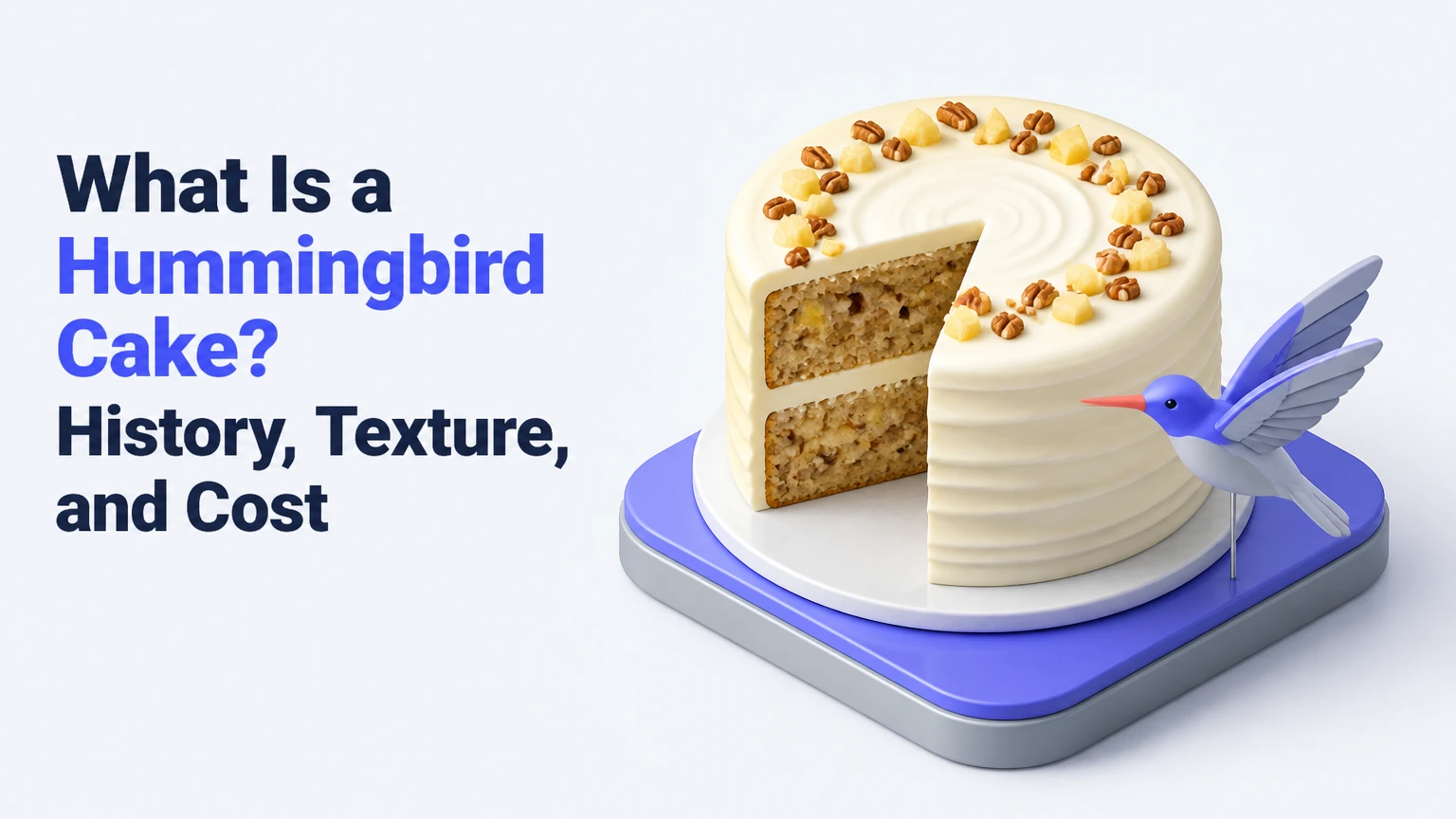
Hummingbird cake is a moist, oil-based spice cake made with ripe bananas, crushed pineapple, pecans, cinnamon, and commonly nutmeg, then covered with cream cheese frosting. The traditional American version is a dense layer cake with tropical fruit flavor, a tender crumb, and enough acidity and chemical leavening to support its unusually heavy batter.
Key Facts at a Glance
- Hummingbird cake traditionally contains ripe bananas, crushed pineapple, pecans, cinnamon, oil, eggs, and cream cheese frosting.
- The cake originated in Jamaica, where an early version was called Doctor Bird cake.
- Southern Living helped popularize the American version after publishing a recipe in 1978.
- Oil creates a softer, longer-lasting crumb than creamed butter in this fruit-heavy formula.
- A typical 9-inch layer cake takes 20-30 minutes to prepare, 25-35 minutes to bake, and 1-2 hours to cool.
- A homemade cake typically costs $15-$25, while a bakery cake commonly costs $45-$70.
What Defines a Hummingbird Cake?
Hummingbird cake is a fruit-and-nut spice cake whose identity comes from the combination of banana, pineapple, pecans, and tangy cream cheese frosting. The cake is usually mixed with oil rather than creamed butter, so the finished crumb feels plush and moist instead of airy or crumbly.
The fruit should be noticeable in every slice, but the cake should not taste like banana bread with frosting. Cinnamon supplies the primary warm-spice note, while nutmeg, allspice, or ginger may appear in regional and modern versions. Pecans add roasted flavor and a crisp contrast to the soft fruit.
Traditional formulas vary in whether the pineapple is drained. A recipe with carefully balanced flour and liquid may use crushed pineapple with some or all of its juice; a recipe designed for a firmer layer may drain it. The recipe’s liquid ratio matters more than a universal drainage rule.
| Component | Typical amount for a 9-inch cake | Function | Practical specification |
|---|---|---|---|
| Very ripe bananas | 2-3 medium, 225-300 g mashed | Sweetness and moisture | Brown-speckled fruit gives the strongest flavor |
| Crushed pineapple | 8-16 oz can | Acidity, moisture, fruit flavor | Use the quantity and drainage instruction in the formula |
| Pecans | 100-150 g chopped | Roasted flavor and texture | Toast at 350°F for 8-10 minutes |
| Neutral oil | 150-240 ml | Tender crumb and shelf life | Canola, sunflower, or other mild oil works |
| Cinnamon | 1-2 teaspoons | Warm spice character | Increase carefully because excess tastes dusty |
| Cream cheese frosting | 3-5 cups | Tang, sweetness, and decoration | Use brick-style full-fat cream cheese |
Where Did the Name Come From?
The hummingbird cake name is linked to Jamaica’s national bird, the streamertail hummingbird, while the cake itself circulated under the name Doctor Bird cake. The name is also commonly explained as a reference to its pronounced sweetness. King Arthur Baking uses the phrase “sweet enough to attract hummingbirds” when discussing that popular explanation.
The historical record is less tidy than a single-origin story suggests. Jamaican recipes and tourism materials helped introduce Doctor Bird cake beyond the island, while American Southern cooks adapted the formula into the layer cake now associated with the name hummingbird cake.
Southern Living published a version in 1978, and that publication is widely credited with bringing the dessert to a large United States audience. The magazine’s recipe helped establish the familiar combination of bananas, pineapple, pecans, and cream cheese frosting.
How Did the Cake Travel From Jamaica to the American South?
Jamaican promotional cooking materials introduced Doctor Bird cake to North American readers before Southern Living gave the style broader visibility. American versions generally increased the emphasis on layered presentation and cream cheese frosting, while retaining the fruit, nut, and spice foundation.
| Period | Place or source | Development | Why it matters |
|---|---|---|---|
| Late 1960s | Jamaica | Doctor Bird cake circulated with banana and pineapple | Establishes the Jamaican connection |
| 1970s | United States | Southern cooks adapted tropical fruit into layer cakes | Added a recognizable regional presentation |
| 1978 | Southern Living | Magazine published a hummingbird cake recipe | Expanded national awareness |
| 1980s onward | North America | Loaf, Bundt, cupcake, and sheet versions spread | Made the cake practical for more occasions |
Why Is the Crumb So Moist?
Hummingbird cake stays moist because oil remains liquid after cooling, while bananas and pineapple contribute water, dissolved sugars, and soft fruit solids. The combination produces a tender, dense crumb that remains pleasant for several days when refrigerated, although excessive fruit liquid can make the center gummy.
Oil coats flour particles without introducing the creaming aeration associated with butter cakes. That makes the mixing method simple, but it also means the batter has less trapped air and naturally feels heavier. Eggs provide emulsification and structure; flour proteins set around the fruit as the cake heats.
Chemical leaveners must lift a substantial load of fruit and nuts. Baking soda reacts with acidic ingredients, including pineapple, while baking powder supplies additional gas when the formula includes it. The exact balance depends on the pineapple’s acidity, the flour quantity, and the recipe’s total liquid.
Does Hummingbird Cake Taste Like Banana Bread?
Hummingbird cake resembles banana bread because both use ripe bananas and often oil, but hummingbird cake usually has more pronounced pineapple acidity, warm spices, pecans, and cream cheese frosting. Banana bread is commonly baked as a single loaf and has a tighter, less decorated presentation.
The distinction is useful when choosing a format. A loaf version can be served for breakfast or afternoon tea, while a frosted layer cake is richer and better suited to birthdays, celebrations, or large gatherings.
How Do You Make the Cake?
A standard hummingbird cake requires about 20-30 minutes of active preparation, 25-35 minutes of baking, and 1-2 hours for cooling and frosting. The most important success factor is controlling the batter’s liquid level, especially when the pineapple is not fully drained.
Before You Start
| Requirement | Typical specification | Why it matters |
|---|---|---|
| Oven temperature | 350°F, or 175°C | Sets the fruit-heavy crumb without excessive browning |
| Cake pans | Two or three 9-inch pans | Determines layer thickness and bake time |
| Active preparation | 20-30 minutes | Includes chopping, measuring, and mixing |
| Total finished time | 2-4 hours | Includes cooling, frosting, and chilling |
| Homemade cost | $15-$25 | Pecans and cream cheese drive the range |
| Essential tools | Scale, bowls, spatula, parchment, cooling rack | Improves consistency and handling |
Step 1: Toast and Cool the Pecans
Spread 100-150 grams of chopped pecans on a baking sheet and toast them at 350°F for 8-10 minutes. Remove the nuts when they smell fragrant and appear slightly darker, then cool them completely before adding them to the batter.
Hot pecans can warm the mixture and soften their texture. You will know the nuts are ready when the aroma changes from raw and grassy to distinctly roasted. Burning occurs quickly during the final two minutes, so inspect them rather than relying only on the timer.
Step 2: Prepare the Pans and Oven
Grease two or three 9-inch cake pans, line the bottoms with parchment, and dust the sides lightly with flour. Preheat the oven for at least 20 minutes so the batter enters a stable baking environment.
A dark metal pan can brown the edges faster than a light aluminum pan. If using dark pans, begin checking the cake several minutes early and avoid placing the pans directly against the oven wall.
Step 3: Combine the Dry Ingredients
Whisk flour, sugar, baking soda, baking powder when specified, salt, cinnamon, and other spices in a large bowl. Breaking up soda pockets at this stage prevents concentrated bitter spots in the finished cake.
Do not treat the sugar as a last-minute wet ingredient. Sugar affects tenderness and moisture retention, so it belongs with the dry mixture in many oil-based formulas.
Step 4: Mix the Wet Ingredients
Whisk the oil, eggs, vanilla, mashed ripe bananas, and crushed pineapple in a separate bowl. Mash the bananas until mostly smooth, leaving small pieces for flavor but removing large chunks that can create wet pockets.
Measure mashed banana by weight when possible. Two bananas can differ by more than 100 grams, and that difference changes the liquid-to-flour ratio enough to affect the center.
Step 5: Fold the Batter Gently
Pour the wet mixture into the dry mixture and fold with a flexible spatula until no broad streaks of flour remain. Fold in the cooled pecans last, stopping as soon as the batter becomes uniform.
Overmixing develops gluten and can produce a rubbery texture. The batter should look thick and unevenly textured because of the fruit, not smooth like a sponge-cake batter.
Step 6: Bake Until the Center Sets
Divide the batter evenly among the prepared pans and bake at 350°F for approximately 25-35 minutes. The cake is ready when a toothpick inserted near the center comes out with a few moist crumbs, not liquid batter.
A more reliable check is a center temperature near 200-210°F, measured away from a fruit pocket. The surface should spring back lightly when pressed, while the edges should pull away from the pan by a few millimeters.
Step 7: Cool, Assemble, and Chill
Cool the cakes in their pans for 10-15 minutes, then transfer them to a rack and cool completely. Apply a thin crumb coat, chill the layers for 20-30 minutes, then finish with cream cheese frosting and toasted pecans.
Frosting warm layers causes melting and sliding. A fully cooled cake may still feel soft because of its fruit content, so handle each layer with a wide support or cake board.
Which Format Fits the Occasion?
The best format depends on handling, serving style, and frosting needs. A three-layer cake gives the most traditional result, while a loaf or Bundt cake reduces assembly work and travels more easily.
| Format | Typical bake time | Typical yield | Frosting style | Best use |
|---|---|---|---|---|
| Three 9-inch layers | 25-30 minutes | 12-16 slices | Full cream cheese frosting | Celebrations and formal serving |
| Two 9-inch layers | 30-35 minutes | 10-14 slices | Stacked frosting | Smaller parties |
| 10-inch Bundt | 50-65 minutes | 14-18 slices | Drizzle or partial coating | Transport and brunch |
| 9-by-13-inch sheet | 35-45 minutes | 18-24 pieces | Single frosting layer | Potlucks and large groups |
| Standard cupcakes | 18-23 minutes | 18-24 cakes | Piped frosting | Individual portions |
| 9-by-5-inch loaf | 55-70 minutes | 8-12 slices | Glaze or thin frosting | Casual serving |
A Bundt pan needs careful greasing because fruit and sugar cling to its ridges. Cupcakes require less structural support but can dry faster around the edges, so begin checking them early.
What Variations Are Common?
Traditional Southern, coconut-forward, brown-butter, loaf, Bundt, and sheet versions all preserve the central banana-pineapple identity while changing richness, texture, or convenience. A variation stops resembling hummingbird cake when the signature fruit balance disappears.
| Variation | Added or changed feature | Texture outcome | Main trade-off |
|---|---|---|---|
| Southern layer cake | Three layers and full frosting | Dense, moist, soft | Requires careful stacking |
| Jamaican-inspired | Coconut, allspice, or ginger | More aromatic and tropical | Less historically uniform across recipes |
| Brown-butter version | Part of the oil replaced with cooled browned butter | More nutty and slightly firmer | Butter can reduce long-term softness |
| Loaf cake | Single pan and thin glaze | Tight, sliceable crumb | Less celebratory presentation |
| Bundt cake | Ring pan and glaze | Even slices with browned crust | Higher risk of sticking |
| Nut-free version | Pecans omitted or replaced with seeds | Softer, less crunchy | Loses the traditional roasted-nut note |
Browned butter should be cooled before mixing. Adding it hot can partially cook eggs, melt sugar unevenly, and create a batter with inconsistent structure.
How Is Hummingbird Cake Different From Similar Cakes?
Hummingbird cake is fruitier and moister than standard spice cake, more pineapple-forward than banana bread, and usually sweeter and softer than carrot cake. Carrot cake is the closest comparison because both often use oil, nuts, warm spices, and cream cheese frosting.
| Cake | Primary produce | Typical fat | Texture | Signature frosting |
|---|---|---|---|---|
| Hummingbird cake | Banana and pineapple | Neutral oil | Moist and fruit-heavy | Cream cheese |
| Carrot cake | Grated carrot | Oil or butter | Moist with vegetable texture | Cream cheese |
| Banana bread | Banana | Butter or oil | Tight loaf crumb | None or simple glaze |
| Spice cake | No required fruit | Butter, oil, or shortening | Light to moderately dense | Buttercream or cream cheese |
| Carrot-pineapple cake | Carrot and pineapple | Oil | Very moist and coarse | Cream cheese |
Choose hummingbird cake over carrot cake when you want clear tropical fruit flavor and a softer crumb. Choose carrot cake when grated vegetable texture, raisins, or a less banana-dominant profile better fits the occasion.
How Should Pineapple Be Handled?
Pineapple should be drained only when the recipe specifies drainage or when the batter already contains substantial liquid. Crushed canned pineapple with juice adds acidity and moisture, but excess liquid can delay setting and leave a gummy center.
The safest method is to follow the formula’s stated can size and drainage instruction exactly. Do not substitute a larger can, fresh pineapple, or extra juice without recalculating the liquid. Fresh pineapple also differs in acidity and enzyme activity, although baking heat neutralizes its tenderizing enzymes.
| Pineapple choice | Liquid control | Flavor effect | Recommended use |
|---|---|---|---|
| Canned, undrained | Highest moisture | Sweet and consistent | Formulas designed for the juice |
| Canned, lightly drained | Moderate moisture | Fruit remains prominent | General layer-cake formulas |
| Canned, fully drained | Lowest added liquid | Cleaner fruit texture | Dense batters or Bundt cakes |
| Fresh, finely chopped | Variable moisture | Brighter, sharper flavor | Experienced bakers adjusting formula |
A practical rule is to weigh the drained fruit and reserve the juice rather than discarding it immediately. That lets you correct a mixture that appears unusually dry without adding an uncontrolled quantity.
What Does Hummingbird Cake Cost?
A homemade 9-inch layer cake typically costs $15-$25 in the United States, while a bakery version commonly costs $45-$70 for a full cake or $6-$9 per slice. Regional pecan prices, cream cheese brands, labor, decoration, and delivery can move the final price substantially.
These are typical retail ranges rather than fixed market prices. A sheet cake often costs less per serving than a decorated layer cake because assembly and piping require less labor.
| Purchase route | Typical price | Typical servings | Main cost driver |
|---|---|---|---|
| Homemade layer cake | $15-$25 | 12-16 | Pecans and cream cheese |
| Bakery slice | $6-$9 | 1 | Labor and retail overhead |
| Bakery 9-inch cake | $45-$70 | 12-16 | Decoration and assembly |
| Grocery-store sheet cake | $25-$50 | 18-24 | Size and decoration level |
| Homemade loaf | $8-$15 | 8-12 | Cream cheese and nuts |
| Custom decorated cake | $70-$120+ | 16-24 | Design, delivery, and labor |
How Should Hummingbird Cake Be Stored?
Hummingbird cake with cream cheese frosting should be refrigerated and is typically best within 3-5 days. Store the cake covered so the refrigerator does not dry the exposed crumb or transfer odors into the frosting.
Let individual slices sit at room temperature for 20-30 minutes before serving. Cold oil-based cake remains firm and muted, while brief warming restores aroma and a softer bite.
Unfrosted layers freeze well for approximately two to three months when wrapped tightly in plastic and placed inside a rigid container. Thaw the layers while wrapped, then frost after they reach refrigerator temperature.
Can You Transport It Safely?
A frosted hummingbird cake transports best when chilled for at least 1 hour and placed on a level cake board inside a snug carrier. Cream cheese frosting softens quickly in warm conditions, so use an insulated bag with cold packs for journeys longer than 30 minutes.
Avoid placing the cake directly against a frozen pack. Condensation can damage the frosting, and uneven cooling may cause sliding between layers.
What Substitutions Work?
Hummingbird cake can be adapted for nut-free, dairy-free, and gluten-free diets, but each substitution changes structure or flavor. The most dependable adaptations preserve the fruit weight and use a tested flour blend rather than replacing wheat flour cup for cup.
| Dietary need | Substitution | Quantity guidance | Expected change |
|---|---|---|---|
| Nut-free | Toasted pumpkin seeds | Replace pecans by weight | Similar crunch, milder flavor |
| Dairy-free | Plant-based cream cheese | Use frosting formula’s volume | Softer frosting in some brands |
| Egg-free | Commercial egg replacer | Follow package equivalence | Slightly less rich crumb |
| Gluten-free | 1-to-1 flour blend with xanthan gum | Replace flour by weight | May need 5-10 extra minutes |
| Lower sweetness | Reduce frosting first | Remove 15-25% frosting | Better flavor balance than cutting fruit |
| No pineapple | Applesauce plus a little acid | Use a tested recipe | Less tropical and less acidic |
Do not reduce both sugar and fruit simultaneously without testing. Sugar affects tenderness, browning, and moisture retention, so a large reduction can create a dry, pale, fragile cake.
What Common Problems Need Fixing?
Most hummingbird cake failures come from excess liquid, inaccurate fruit measurements, overmixing, or frosting layers before they cool. Diagnosis depends on where the failure appears, because a wet center, collapsed top, and sliding frosting have different causes.
| Problem | Likely cause | Immediate diagnosis | Corrective action |
|---|---|---|---|
| Gummy center | Excess pineapple juice or underbaking | Center feels paste-like after cooling | Drain fruit next time and verify temperature |
| Sunken middle | Weak structure or early oven opening | Edges set while center collapses | Bake longer and avoid opening before 25 minutes |
| Tough crumb | Overmixed batter | Slice feels elastic | Fold only until flour disappears |
| Fruit at bottom | Large wet pieces | Pineapple collects beneath crumb | Drain better and chop evenly |
| Runny frosting | Warm or spreadable cream cheese | Frosting loses peaks | Chill ingredients and use brick-style cheese |
| Dry edges | Small pan or overbaking | Rim is firm before center sets | Check earlier and use a lighter pan |
| Sliding layers | Warm cake or excessive frosting | Layers move during assembly | Chill layers and apply a thinner filling |
Why Did the Cake Sink?
A sunken hummingbird cake usually contains too much liquid for its flour and leavening, or the center was underbaked before the cake structure set. Opening the oven early can compound the problem by releasing heat while the fruit-heavy center remains fluid.
A toothpick test can mislead when it strikes pineapple. Test two or three locations and use the center temperature as a second check. Cooling the cake completely before judging it prevents mistaking normal softness for failure.
Why Is the Cream Cheese Frosting Runny?
Runny cream cheese frosting usually results from spreadable tub cheese, warm butter, excess liquid, or prolonged beating after the cheese is added. Use cold brick-style full-fat cream cheese, beat the butter and sugar first, then mix in the cheese briefly.
If the frosting loosens, refrigerate it for 20-30 minutes and stir it by hand. Adding large amounts of powdered sugar can make the frosting overly sweet without restoring a clean texture.
Who Should Choose Each Version?
Beginners should choose a loaf or sheet cake because both avoid layer leveling and reduce the risk of structural collapse. Experienced bakers can choose a three-layer cake when presentation and traditional texture matter more than speed.
- For a first attempt: Bake a 9-by-13-inch sheet cake and use a single frosting layer.
- For a birthday or celebration: Choose three 9-inch layers with chilled cream cheese frosting.
- For brunch: Use a Bundt or loaf with a thin glaze.
- For warm outdoor service: Use a lightly frosted sheet cake and keep it chilled until serving.
- For a nut-free table: Omit pecans or substitute toasted pumpkin seeds.
- For a large event: Bake sheet cakes, which provide more portions with simpler transport.
Hummingbird cake is a poor choice when you need a very light, airy sponge or a cake that can remain in direct heat for hours. The fruit-heavy crumb and cream cheese topping prioritize moisture and flavor over heat stability.
FAQ
Is Hummingbird Cake From Jamaica?
Hummingbird cake has Jamaican roots, where an earlier preparation was known as Doctor Bird cake. The American layer-cake version developed through adaptation and became widely recognized after Southern Living published a recipe in 1978. The exact historical path includes Jamaican promotion, American home baking, and regional recipe changes.
Does Hummingbird Cake Need to Be Refrigerated?
Hummingbird cake needs refrigeration when covered with cream cheese frosting. Keep the covered cake chilled and serve slices after 20-30 minutes at room temperature. Unfrosted layers can remain wrapped in the freezer for approximately two to three months without major quality loss.
Can You Make Hummingbird Cake Without Pecans?
You can make hummingbird cake without pecans, especially for a nut-free table. Omit the nuts for a softer texture, or replace them by weight with toasted pumpkin seeds. The cake will retain its banana, pineapple, spice, and cream cheese identity but lose some roasted flavor and crunch.
Is Hummingbird Cake Very Sweet?
Hummingbird cake is typically sweet because it combines ripe bananas, pineapple, sugar, and sweet frosting. The acidity of pineapple and cream cheese, plus cinnamon and toasted pecans, prevents the flavor from becoming one-dimensional. Reducing frosting by 15-25% is usually more effective than cutting the fruit.
Can You Use Fresh Pineapple?
Fresh pineapple can work, but its moisture and acidity vary more than canned pineapple. Finely chop it, weigh the fruit, and use a formula designed for fresh pineapple or adjust the liquid carefully. Canned crushed pineapple remains the more predictable choice for a first attempt.
What Is the Best Pan for Beginners?
A 9-by-13-inch sheet pan is the most forgiving option for beginners because it removes layer stacking and reduces frosting work. A loaf pan is also practical, but its deeper batter generally needs 55-70 minutes and requires careful center testing.
The Bottom Line
Hummingbird cake is a Jamaican-rooted, American-popularized fruit-and-nut spice cake built around ripe bananas, crushed pineapple, pecans, oil, and cream cheese frosting. The dessert succeeds when the pineapple liquid is controlled, the batter is folded gently, and the cake cools fully before frosting. For the easiest reliable result, choose a sheet or loaf format; for the classic presentation, choose chilled three-layer assembly.
