

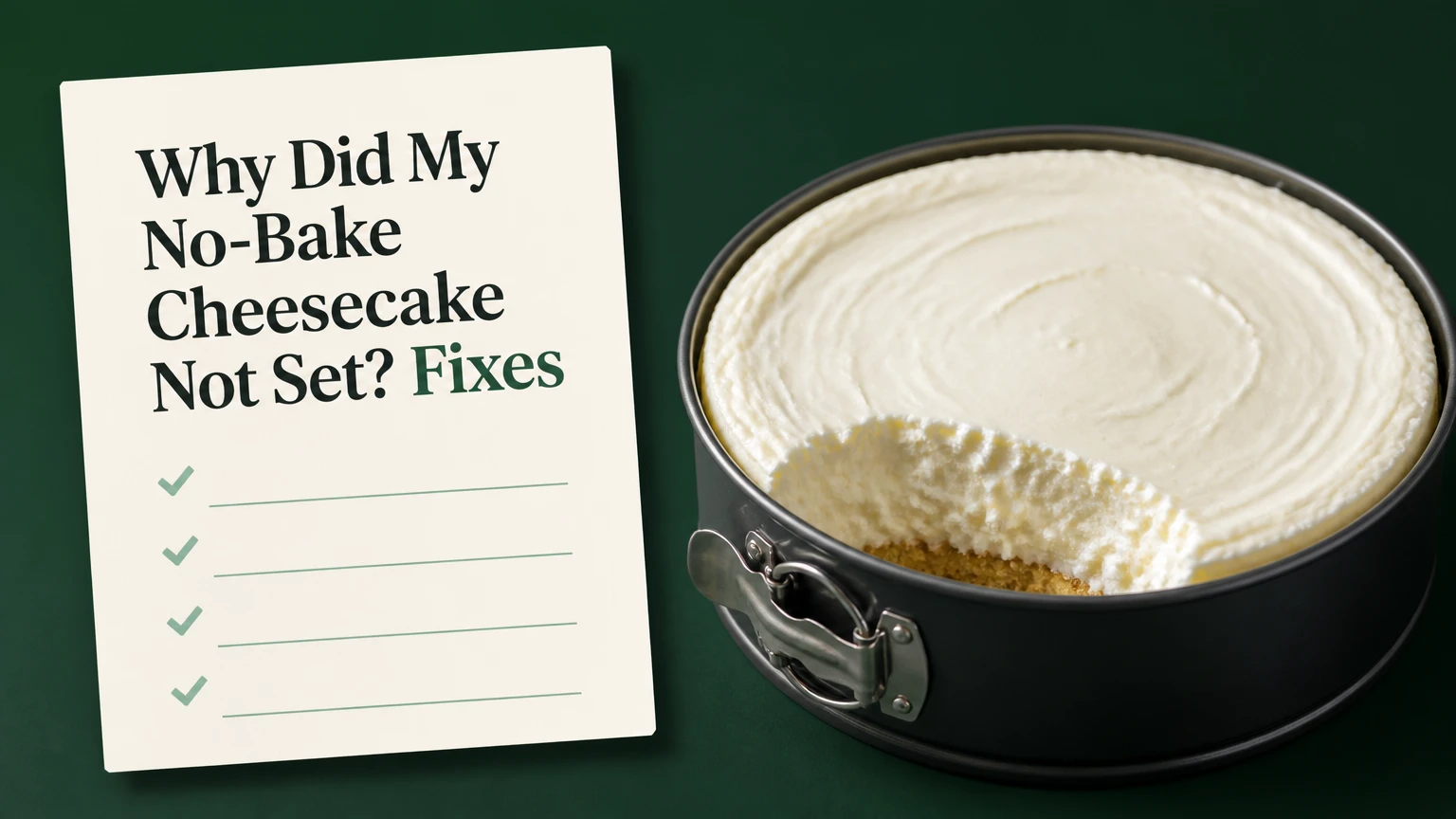
Your no-bake cheesecake did not set because its filling lacked enough structure from solidified fat, trapped whipped-cream air, gelatin, or a combination of these. The most common causes are tub cream cheese, under-whipped cream, excess liquid, inadequate chilling, and a refrigerator warmer than 4°C (40°F).
Key Facts at a Glance
A fat-based no-bake cheesecake usually needs 6-8 hours of chilling, while 12-24 hours produces cleaner slices.
Full-fat brick cream cheese and cream containing at least 35% fat provide the most dependable structure.
Whipped cream should reach firm peaks before folding, but cream cheese should be mixed only until smooth.
A refrigerator should remain at or below 4°C (40°F), measured with an appliance thermometer.
Freezing can firm a runny cheesecake for immediate serving, but it does not permanently repair a weak filling.
Gelatin can rescue a liquid filling when it is bloomed, dissolved, tempered, and evenly incorporated.
Why Did a No-Bake Cheesecake Not Set?
A no-bake cheesecake sets when chilled dairy fat becomes firm and the filling retains a stable network of whipped cream, cream cheese, and optional gelatin. Baked cheesecake gains strength from heated egg proteins; no-bake cheesecake has no comparable heat-set protein framework, so its ingredient ratio and handling determine the final texture.
Cream cheese supplies fat and solids, while whipped cream contributes a partial foam that gives the filling volume and resistance to flow. Gelatin creates a separate protein network when hydrated and cooled. White chocolate can add cocoa butter and milk solids, and condensed milk formulas rely on the thickening reaction between dairy proteins and acidic juice.
The structure is temperature-sensitive. A filling that looks firm at 3°C (37°F) can soften rapidly on a warm counter, especially when the recipe uses no gelatin or chocolate.
What actually holds the filling together?
| Structural element | Main ingredient | Typical function | Failure symptom |
|---|---|---|---|
| Dairy fat | Full-fat cream cheese | Firms below about 4°C (40°F) | Soft slices and spreading |
| Foam matrix | 35-40% cream | Traps air after whipping | Dense, loose filling |
| Protein gel | 3-6 g powdered gelatin | Holds water during chilling | Liquid or watery center without it |
| Cocoa butter | 100-180 g white chocolate | Firms when chocolate cools | Sweet, soft filling if omitted |
| Crust support | 200-250 g biscuit crumbs | Supports the base only | Firm base with runny topping |
The crust cannot compensate for a filling that has too much free water. A compressed biscuit base may remain perfectly firm while the topping flows because the two layers use different structural mechanisms.
Did the Cream Cheese Contain Too Much Water?
Tub cream cheese can prevent a no-bake cheesecake from setting because spreadable products often contain more water and stabilizing ingredients than dense brick cream cheese. Use full-fat brick cream cheese when the recipe specifies it, and avoid whipped or reduced-fat versions unless the recipe was formulated for them.
Tub products vary substantially by brand and country. Some are suitable for chilled desserts, but a recipe developed around a dense brick product may become loose when the spreadable version contributes extra moisture. The label should identify cream cheese as the primary ingredient, with fat near 30% or higher where local labeling permits.
Cream cheese should be softened enough to blend smoothly, usually after 30-60 minutes at room temperature. It should not feel warm, glossy, or partly melted. Warm cheese can soften the whipped cream as soon as the two mixtures meet.
Is low-fat cream cheese always the problem?
Low-fat cream cheese is not automatically unusable, but it gives a narrower margin for error because it contributes less fat and often more water. A filling made with light cream cheese may require gelatin, white chocolate, or a recipe-specific thickener to produce stable slices.
| Cream cheese choice | Typical fat level | Water risk | Recommended use |
|---|---|---|---|
| Full-fat brick | 30-35% | Low to moderate | Fat-based cheesecake |
| Full-fat tub | 25-33% | Moderate to high | Recipe tested for tub cheese |
| Reduced-fat brick | 15-25% | Moderate to high | Gelatin-stabilized filling |
| Light tub | 5-15% | High | Mousse, parfait, or adapted recipe |
| Whipped spread | Variable | High | Usually unsuitable for clean slices |
Was the Cream Whipped Correctly?
Under-whipped cream leaves too much liquid in the filling and too little foam to support it. Heavy cream should reach firm peaks that hold their shape briefly when the whisk is lifted, while over-whipped cream becomes grainy and may begin turning into butter.
Start with cream at approximately 2-5°C (36-41°F), and chill the bowl and beaters for 10 minutes if the kitchen is warm. Beat at medium-high speed until the whisk leaves defined tracks, then stop as soon as the peaks remain upright.
Fold the whipped cream into the cream cheese mixture in two or three additions. A few visible streaks after the first addition are preferable to vigorous stirring that removes the air structure.
Which peak stage does the filling need?
| Peak stage | Visual test | Approximate whipping time | Cheesecake result |
|---|---|---|---|
| Soft peak | Tip bends immediately | 1-2 minutes | Loose and fluid |
| Medium peak | Tip bends slightly | 2-4 minutes | Acceptable for cups |
| Firm peak | Peak stays upright | 3-6 minutes | Best for slices |
| Grainy stage | Curds or dull clumps appear | 5-8 minutes | Deflated, buttery texture |
| Separated stage | Liquid pools visibly | 7-10 minutes | Unsuitable without reformulation |
Whipped cream does not need to be beaten until dry or rigid. Ultra-stiff cream is difficult to fold evenly, and uneven pockets can create weak areas that collapse during chilling.
Was the Filling Overmixed or Overheated?
Overmixing can loosen a no-bake cheesecake when it warms the cream cheese and destroys the whipped-cream foam. Mix cream cheese and sugar until smooth, but fold whipped cream by hand with a spatula and stop when the color and texture are uniform.
A stand mixer can incorporate heat through friction, especially when the bowl contains a large batch. The filling may look smooth immediately after mixing, yet become progressively thinner as the fat warms. The safest sequence is smooth cream cheese first, cold whipped cream second, and gentle folding last.
Sugar also affects texture. Powdered sugar dissolves faster than granulated sugar, while large amounts of liquid sweetener add water. A recipe that substitutes maple syrup, honey, or extra fruit spread without changing the liquid balance may never reach the intended firmness.
What temperature should each ingredient have?
| Ingredient | Useful temperature | Why it matters | Warning sign |
|---|---|---|---|
| Cream cheese | 18-21°C (64-70°F) | Blends without lumps | Hard lumps or glossy warmth |
| Heavy cream | 2-5°C (36-41°F) | Whips into stable foam | Slow whipping or soupiness |
| Melted gelatin | 35-45°C (95-113°F) | Fluid but not scorching | Strings or melted filling |
| Melted white chocolate | 30-34°C (86-93°F) | Mixes without firm flakes | Seized or grainy streaks |
| Refrigerator | 0-4°C (32-40°F) | Firms fat and gel | Filling remains soft overnight |
The temperature contrast matters. Room-temperature cream cheese and refrigerator-cold whipped cream are compatible; warm cream cheese and warm cream are not.
Did Gelatin Fail?
Gelatin fails when it is not hydrated before heating, overheated, added unevenly, or allowed to cool into strings before mixing. Powdered gelatin normally needs cold water first, followed by gentle melting and tempering with a small amount of filling.
For a typical 20-23 cm (8-9 inch) cheesecake, 3-6 g of powdered gelatin is a moderate range for a soft, sliceable set. One teaspoon commonly weighs about 3 g, but weighing the gelatin gives more reliable results because spoon volume varies by product.
Bloom 3 g gelatin in 15 ml (1 tablespoon) cold water for 5-10 minutes. Melt it gently until clear, cool briefly, stir in two or three spoonfuls of filling, and then blend that tempered mixture into the main bowl. Immediate pouring of hot gelatin into cold filling can produce threads or small rubbery pieces.
How much gelatin should you use?
| Desired texture | Gelatin for 500-700 g filling | Chill time | Best application |
|---|---|---|---|
| Soft spoonable set | 2-3 g | 4-6 hours | Dessert cups |
| Clean slice | 3-5 g | 6-8 hours | Standard cheesecake |
| Firm transport set | 5-7 g | 8-12 hours | Warm-room service |
| Very firm molded set | 7-9 g | 12 hours | Decorative shapes |
Gelatin strength differs among products, so these are practical starting ranges rather than universal laws. Excess gelatin creates a bouncy, rubbery texture and can mask the cream cheese flavor.
Did Extra Liquid Dilute the Filling?
Excess liquid is a frequent hidden cause of failure because fruit purée, yogurt, citrus juice, brewed coffee, and liquid sweeteners all increase the water load. A no-bake filling can tolerate only the liquid quantity built into its formula, unless a stronger stabilizer is added.
Fruit requires special handling. Strained purée is more concentrated than unstrained purée, and frozen fruit releases additional water as it thaws. Drain wet fruit, reduce purée over low heat, and cool it completely before adding it to the filling.
Acidic juice can thicken some condensed-milk fillings because acid changes milk-protein interactions. That mechanism does not automatically rescue a conventional cream-cheese-and-cream formula. Adding more juice to a weak filling usually makes the problem worse.
| Addition | Typical added liquid | Risk to a fat-based filling | Better adjustment |
|---|---|---|---|
| Lemon juice, 30 ml | 30 g | Medium | Reduce other liquid |
| Thin fruit purée, 120 g | 100-110 g | High | Strain or reduce first |
| Greek yogurt, 120 g | 80-95 g | Medium | Use gelatin or chocolate |
| Brewed coffee, 60 ml | 60 g | High | Use espresso powder |
| Maple syrup, 60 ml | 80 g | Medium | Reduce sugar and cream liquid |
| Citrus zest, 1 tablespoon | Under 2 g | Low | Preferred flavoring |
An expert rule of thumb is to treat every spoonful of watery flavoring as a structural ingredient, not a harmless flavor adjustment.
How Long Should a No-Bake Cheesecake Chill?
A no-bake cheesecake usually needs 6-8 hours in a refrigerator at 0-4°C (32-40°F), while an overnight chill of 12-24 hours gives the firmest center and cleanest cut. Three or four hours may be enough for a shallow dessert, but a deep cheesecake often remains soft in the middle.
Chill the assembled cake uncovered for the first hour if condensation is a concern, then cover it without pressing plastic wrap onto the surface. Keep the pan on a level shelf rather than in the refrigerator door, where temperature changes are greater.
The U.S. Food and Drug Administration recommends keeping refrigerators at 4°C (40°F) or below. That food-safety limit also supports the fat-solidification needed by a no-bake cheesecake, although a refrigerator at 4°C may set the cake more slowly than one near 1-2°C.
What does chilling time indicate?
| Time in refrigerator | Likely interpretation | Recommended action | Slice quality |
|---|---|---|---|
| 0-3 hours | Too early to judge | Continue chilling | Usually poor |
| 4-6 hours | Shallow cake may set | Check center gently | Variable |
| 6-8 hours | Minimum practical window | Slice if firm | Usually acceptable |
| 12-24 hours | Fully developed set | Serve or decorate | Cleanest |
| Over 24 hours | Structure stable, crust softens | Store covered | Good, less crisp crust |
A firm edge with a liquid center usually signals insufficient time, excess filling depth, or an under-structured formula. It does not prove that the whole batch is ruined.
Can the Cheesecake Be Rescued?
A runny no-bake cheesecake can often be rescued, but the best method depends on whether the filling is slightly soft or genuinely liquid. Freeze a mildly soft cake for 1-2 hours for immediate serving; reformulate a liquid filling with gelatin; use extra whipped cream only when the mixture still has enough body to fold.
Rescue 1: Extend chilling before changing the recipe
If the cheesecake has chilled for less than 8 hours and the edges hold their shape, leave it refrigerated overnight. This is the least disruptive option and preserves the original flavor and texture.
Rescue 2: Use the freezer for immediate service
Freeze the cake for 1-2 hours, slice it while firm, and serve immediately. The freezer changes the physical state of the fat and water, but it does not create a stronger permanent network, so the slices soften quickly at room temperature.
Do not freeze a cheesecake in a glass dish unless the dish is rated for sudden temperature changes. A metal springform pan transfers cold faster and reduces cracking during the short freeze.
Rescue 3: Add gelatin to a liquid filling
Scrape the filling into a bowl. Bloom 3 g gelatin in 15 ml cold water, wait 5-10 minutes, melt it gently, and temper it with several spoonfuls of the runny filling. Mix the tempered gelatin into the batch, return the filling to the crust, and chill for at least 4-6 hours.
If the crust has become wet, replace it with fresh crumbs pressed into a lined pan. Do not pour a rescued liquid filling onto a saturated base.
Rescue 4: Convert the dessert
When the filling cannot support a cake shape, portion it into glasses with fresh crumb layers. Refrigerate the mousse for 4-6 hours and add fruit immediately before serving. This preserves the flavor while removing the need for unmolding and clean slicing.
Adding more whipped cream is a limited rescue. An extra 120 ml (1/2 cup) of cold cream, whipped to firm peaks, may improve a slightly loose filling, but folding it into a watery mixture can increase total liquid and produce a larger, still-soft dessert.
Which Setting Method Is Most Reliable?
Gelatin provides the most dependable clean slice, while a fat-only formula gives the softest, creamiest texture. White chocolate offers firm structure without gelatin, and condensed milk with citrus produces a different, tangier filling that depends on its own recipe balance.
| Setting method | Typical stabilizer amount | Refrigerator set | Room-temperature tolerance | Main drawback |
|---|---|---|---|---|
| Fat-only | 0 g added | 6-24 hours | About 1-2 hours | Softens quickly |
| Gelatin | 3-6 g per cake | 4-12 hours | About 2 hours | Can feel rubbery |
| White chocolate | 100-180 g | 4-8 hours | About 2-3 hours | Adds sweetness |
| Condensed milk and citrus | 300-400 g condensed milk | 4-8 hours | About 1-2 hours | Formula-specific texture |
No method is universally superior. Fat-only fillings suit immediate home service, gelatin suits transport and sharp slices, white chocolate suits rich dessert profiles, and condensed-milk fillings suit recipes designed around acidic fruit.
Which method fits a warm kitchen?
Use gelatin or white chocolate when the kitchen exceeds 24°C (75°F), when the cake must travel, or when serving will last longer than 60 minutes. A fat-only cheesecake is less forgiving because the cream cheese fat and whipped cream soften together as the cake warms.
A cooler serving environment still does not make a food-safe holding plan unlimited. Perishable dairy desserts should not remain at room temperature for extended periods; the U.S. Department of Agriculture uses a two-hour limit for refrigerated foods in ordinary room conditions, with a shorter limit in high heat.
What Formula and Equipment Prevent Failure?
A dependable 20 cm (8 inch) fat-based cheesecake commonly uses 450-600 g full-fat brick cream cheese, 240 ml cold cream containing about 35-40% fat, 100-150 g powdered sugar, and a 200-250 g crumb crust. Exact ratios vary, but the filling needs enough dairy solids and whipped foam for its volume.
Use a digital scale, chilled mixing bowl, flexible spatula, and refrigerator thermometer. A springform pan improves release, but pan type does not correct a weak filling.
| Item | Typical quantity or specification | Typical price range in USA | Purpose |
|---|---|---|---|
| Brick cream cheese | 450-600 g | $6-$10 | Dense dairy base |
| Heavy cream | 240 ml | $3-$6 | Whipped structure |
| Powdered sugar | 100-150 g | $1-$3 | Sweetness without granules |
| Gelatin, optional | 3-6 g | $1-$3 | Firm, transportable set |
| Biscuit crumbs | 200-250 g | $2-$5 | Structural crust |
| Springform pan | 20-23 cm | $12-$30 | Easy release |
| Digital scale | 1 g resolution | $10-$25 | Accurate ratios |
The most useful practitioner rule is to weigh cream cheese, sugar, gelatin, and fruit additions. Volume measures conceal differences in packed crumbs, spooned sugar, and gelatin density.
Is a Runny Cheesecake Safe to Eat?
A runny no-bake cheesecake is safe only when its refrigerated ingredients were kept at safe temperatures and within their storage limits. Soft texture alone indicates a structural failure, not spoilage, but a cake left above 4°C (40°F) for more than two hours should be discarded rather than rescued.
Do not taste-test a questionable filling repeatedly. Check the refrigerator temperature, the age of the dairy, and the time spent on the counter. Freezing improves texture but does not reverse bacterial growth or make spoiled ingredients safe.
The Bottom Line
Why did my no-bake cheesecake not set? The most likely answer is a combination of excess moisture and insufficient structure, usually from tub cream cheese, low-fat dairy, soft-whipped cream, excessive liquid flavoring, or too little chilling. Refrigerate the cake overnight if it is only soft, freeze it briefly for immediate service, or add properly bloomed gelatin when the filling is genuinely liquid.
For the next batch, use full-fat brick cream cheese, cold 35-40% cream, firm whipped peaks, gentle folding, and a refrigerator at or below 4°C (40°F). Add a measured stabilizer when the cake must travel, sit in a warm room, or produce consistently sharp slices.
Frequently Asked Questions
Can I use tub cream cheese in no-bake cheesecake?
You can use tub cream cheese only when the recipe was developed for that product. Tub cream cheese often contains more water than brick cream cheese, so a brick-based formula may remain soft. If tub cheese is your only option, use a gelatin-stabilized recipe, drain visibly watery cheese, and avoid adding extra fruit liquid.
Why is the crust firm when the cheesecake filling is runny?
The crust is firm because melted butter binds dry biscuit crumbs as the butter cools. The filling uses dairy fat, whipped foam, and optional gelatin, so its structure can fail independently. A firm crust therefore does not confirm that the topping has chilled long enough or contains the correct ingredient ratio.
Can I rewhip a no-bake cheesecake filling?
Rewhipping usually does not repair a liquid filling because the existing foam has already collapsed and the mixture may be too warm. If the filling is only slightly loose, whip 120 ml cold cream to firm peaks and fold it in gently. For a liquid batch, gelatin gives a more predictable rescue.
Can I freeze a no-bake cheesecake overnight?
You can freeze a no-bake cheesecake overnight in a freezer-safe pan, but thaw it in the refrigerator for several hours before serving. Freezing produces a firm texture, yet repeated freeze-thaw cycles can cause water separation and a softer crust. Wrap the cake tightly to limit ice crystals and odor absorption.
How do I know whether whipped cream has stiff peaks?
Lift the whisk and inspect the peak. A stiff peak remains upright with a sharp or slightly rounded tip, while a soft peak folds over immediately. Stop before grainy clumps appear, because over-whipped cream loses its smooth foam and becomes difficult to incorporate evenly.
Should no-bake cheesecake jiggle after chilling?
A fully chilled no-bake cheesecake may show a small movement in the center, but the surface should not ripple like liquid and the edge should release cleanly from the pan. A deep cake that still sloshes after 12 hours needs structural correction, not merely additional slicing time.
