

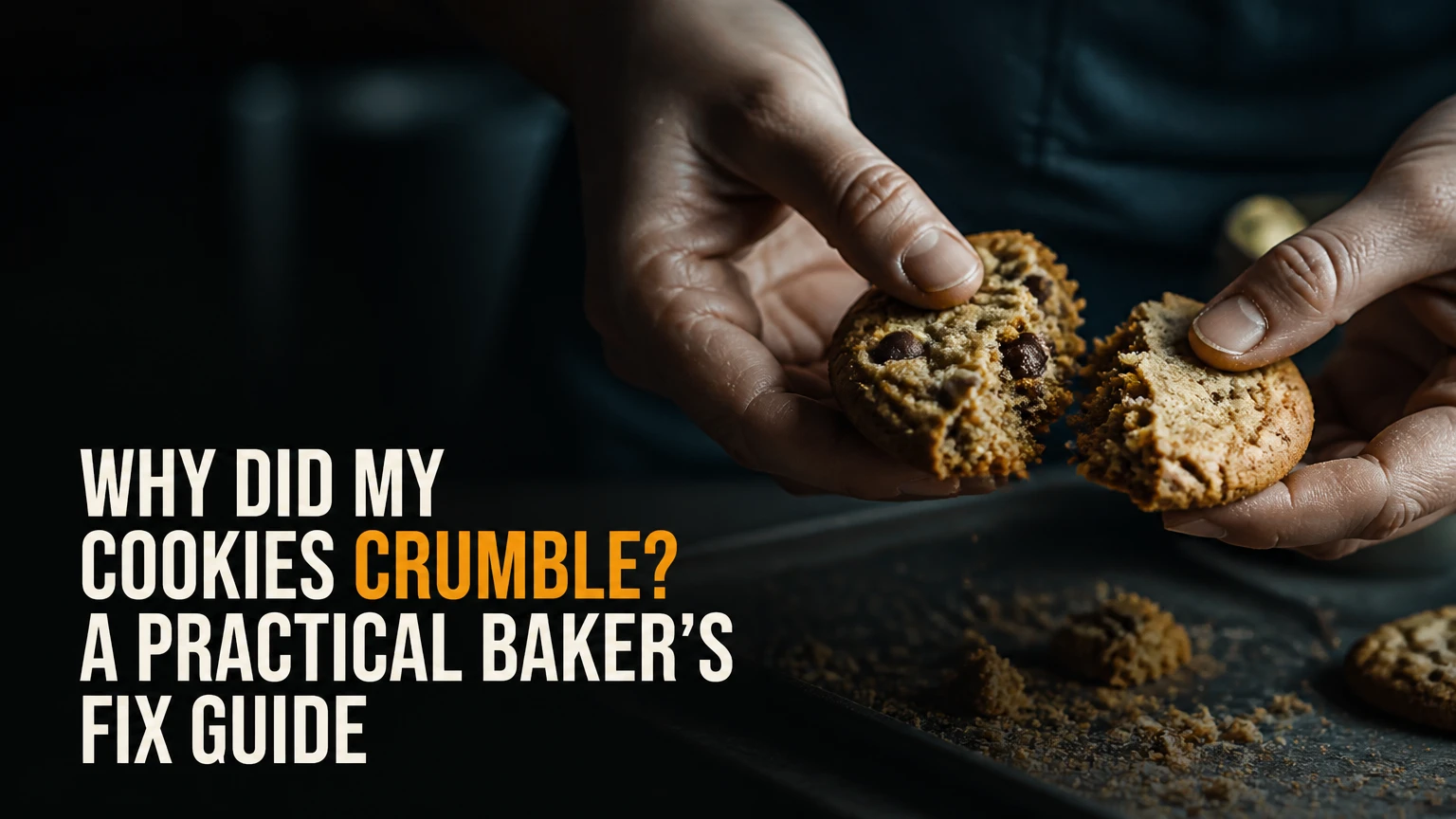
Cookies crumble when the recipe contains too much dry material, too little liquid binder, too much fat for the available flour, or enough baking time to remove the moisture that holds the crumb together. The exact failure depends on whether the dough crumbled before baking or the finished cookies broke after cooling, because those symptoms point to different corrections.
Key Facts at a Glance
- Excess flour is the most common correctable cause of crumbly cookie dough, especially when flour is scooped directly from a container.
- A cookie needs a continuous matrix of set starch, egg or milk proteins, dissolved sugar, and fat-coated flour particles.
- Butter contains roughly 16-18% water, while vegetable shortening contains essentially no water.
- Cookies continue setting on the hot baking sheet for about 5 minutes after removal from the oven.
- Adding liquid can rescue raw dough, but it cannot restore structure to cookies that were already overbaked.
- Gluten-free, egg-free, and shortbread cookies require different binding expectations from standard wheat-flour cookies.
Why Did My Cookies Crumble?
The main reason cookies crumble is a structural imbalance: the dough has more flour and other dry solids than its fat, liquid, sugar, and protein can bind. Overbaking then removes additional water and leaves a rigid, brittle starch-and-sugar network that fractures when handled.
A cookie does not need maximum gluten development. Cookies need enough cohesion to hold their shape, while fat and sugar limit gluten formation to create tenderness. The useful structure comes from several overlapping systems: hydrated flour, gelatinized starch, coagulated egg proteins, dissolved sugar that later hardens, and fat that separates particles.
Recipe formulas differ widely. A chewy chocolate-chip cookie, a rolled sugar cookie, and shortbread cannot share one universal flour-to-fat “safe ratio.” Shortbread intentionally contains little water and relies on compact handling, while a soft drop cookie depends more heavily on egg moisture and a hydrated flour network.
What Holds a Cookie Together?
Cookie structure develops in stages. Liquid hydrates flour proteins and starch, mixing distributes the ingredients, oven heat melts fat and expands trapped gases, and baking sets starch and proteins. Cooling solidifies fats and hardens dissolved sugars, so a hot cookie is weaker than the same cookie after several minutes.
The balance matters more than any single ingredient. Flour supplies starch and proteins, eggs supply water and protein, sugar competes for water and tenderizes, and fat limits protein hydration while improving tenderness. A recipe can crumble with plenty of flour if the flour was measured heavily, the egg was reduced, or the cookies lost too much moisture.
Did the Dough Crumble Before Baking?
Cookie dough that falls apart before baking usually lacks available moisture or contains excess flour. The dough should generally compress into a cohesive mass when squeezed, although some formulas, including shortbread, remain more fragile than drop-cookie dough.
Press a handful of dough in your palm before changing the recipe. If the mixture forms a firm clump, chilling or shaping may solve the issue. If the particles remain sandy and separate immediately, add liquid in small increments rather than pouring in a large amount.
| Raw-dough symptom | Likely cause | First correction | Typical amount |
|---|---|---|---|
| Sandy dough that will not clump | Excess flour or missing liquid | Add milk, cream, or water | 1 teaspoon at a time |
| Greasy dough that splits | Warm butter or excess fat | Chill and remix briefly | 20-30 minutes |
| Dough cracks while rolling | Low hydration or cold fat | Rest at room temperature | 5-10 minutes |
| Dough feels stiff after chilling | Flour absorbed available moisture | Knead minimally or add liquid | 1-2 teaspoons |
| Dough crumbles only at the edges | Uneven mixing or dry pockets | Fold and compress dough | 30-60 seconds |
How Do You Fix Crumbly Cookie Dough?
To fix crumbly cookie dough, first add 1 teaspoon of milk or water per 250-300 grams of dough, mix briefly, and wait 2 minutes before deciding whether more liquid is needed. Stop when the dough holds together without becoming sticky, then chill it for 20-30 minutes if the fat has softened.
For richer dough, one egg yolk can improve cohesion without adding as much free water as a whole egg. A tablespoon of cream adds water and fat, while milk adds more water with less fat. Additions change texture, so record the quantity if you plan to repeat the recipe.
Do not add flour during rolling until the dough has been tested for cohesion. Extra bench flour can turn a nearly successful sugar-cookie dough into a dry one. For a gluten-free mixture, allow 20-30 minutes of hydration before judging texture because rice flour and starches absorb liquid gradually.
Does Too Much Flour Make Cookies Crumble?
Too much flour makes cookies crumble because unhydrated flour particles remain separated by fat instead of joining the baked matrix. Volume measurements can vary substantially: a packed cup of all-purpose flour may weigh around 140-160 grams, while a gently spooned and leveled cup often weighs about 120-130 grams.
A digital scale provides the most consistent measurement. If a recipe gives cups only, spoon flour into the cup and level it with a straight edge rather than dipping the cup into the bag. Flour type also changes weight and absorption, so substituting by volume can introduce two errors at once.
| Measuring or formula issue | Typical quantity effect | Result after baking | Better practice |
|---|---|---|---|
| Spoon-and-level all-purpose flour | 120-130 g per cup | Predictable spread and crumb | Weigh in grams |
| Scooped, packed flour | 140-160 g per cup | Dry, thick, fragile cookies | Avoid direct scooping |
| Added flour for sticky dough | 15-30 g extra per batch | Reduced spread and increased crumble | Chill before adding flour |
| Whole-wheat substitution | 10-15% more absorption, typically | Denser, drier crumb | Add liquid and rest dough |
| Oat flour substitution | Recipe-dependent, often weaker structure | Tender cookies that break easily | Combine with starch or wheat flour |
The popular claim that scooping flour always adds exactly 30% is too rigid. The increase depends on the flour, container, scoop pressure, and settling, but a difference of 10-25% is common enough to justify weighing.
How Do Fat, Sugar, and Eggs Change Cookie Structure?
Fat, sugar, and eggs influence cookie cohesion in different ways. Fat coats flour and limits gluten formation, sugar attracts water and delays starch setting, while eggs contribute water, emulsifiers, and proteins that coagulate during baking.
Butter is approximately 80-82% fat and 16-18% water, although values vary by brand and region. Shortening is nearly 100% fat and adds no meaningful water, so replacing butter with shortening can make a formula drier unless another liquid is added. Margarine varies widely and should be checked on its nutrition label.
| Ingredient | Main structural contribution | Typical behavior | Crumble risk |
|---|---|---|---|
| Butter, 80-82% fat | Fat plus 16-18% water | Tender crumb, flavorful spread | Medium if overbaked |
| Vegetable shortening, about 100% fat | Tenderness without water | Holds shape, less browning | Higher in dry formulas |
| Whole egg | Water, protein, emulsifier | Cohesive, softer structure | Higher when omitted |
| Egg yolk | Fat, emulsifier, some protein | Rich, tender, cohesive | Lowers dryness risk |
| Granulated sugar | Dissolves, spreads, hardens on cooling | Crisp edges, more spread | Higher at excessive levels |
| Brown sugar | Sugar plus molasses and moisture | Softer, darker, chewier | Lower than white sugar in many formulas |
Egg omission is especially significant in cookies that use a whole egg for both moisture and binding. Replacing a whole egg with a small amount of oil does not reproduce its structure because oil supplies fat but no water or coagulating protein.
Can Too Much Fat Cause Crumbly Cookies?
Too much fat can cause crumbly cookies when the flour and liquid cannot create enough continuous structure around the fat-coated particles. Fat does not automatically destroy a cookie, because shortbread deliberately uses a high fat proportion, but excess or incorrectly substituted fat can prevent cohesion.
Warm butter creates a different failure from excessive butter. Soft butter may make dough spread, while an overly high fat quantity can produce cookies that spread thinly, cool greasy, and fracture. Chilling controls temperature, not formula balance.
Which Flour and Fat Combination Is Most Stable?
All-purpose flour with standard butter provides the most forgiving structure for ordinary drop cookies because it combines moderate protein with butter’s water content. Cake flour, shortening, coconut oil, and gluten-free blends can work well, but each requires a recipe designed for its absorption and binding behavior.
Wheat flour proteins form gluten when hydrated and mixed, but cookies need restrained gluten development rather than the elastic network desired in bread. Bread flour can reduce crumbling while increasing chewiness, whereas cake flour produces tenderness at the cost of structural strength.
| Choice | Protein or water profile | Texture tendency | Best adjustment |
|---|---|---|---|
| Cake flour, about 7-9% protein | Lower wheat protein | Very tender, fragile | Use recipe-specific liquid |
| All-purpose flour, about 10-12% protein | Moderate protein | Balanced structure | Best default for drop cookies |
| Bread flour, about 12-14% protein | Higher protein | Chewier, stronger | Mix only until combined |
| Gluten-free blend | No gluten network | Variable, often fragile | Use binder and hydration rest |
| Butter, 16-18% water | Fat plus water | Spread and browning | Chill if dough is soft |
| Shortening, near 100% fat | No useful water | Tender, pale, stable shape | Add liquid if replacing butter |
| Coconut oil | Usually near 100% fat | Firm when cool, brittle if dry | Pair with starch or binder |
Gluten-free cookies often need xanthan gum, psyllium, egg, starch gelatinization, or a commercial blend designed for cookies. A fixed addition such as 1/4 teaspoon xanthan gum is not universally correct because blend composition and batch size determine the required amount.
Did Baking Time or Cooling Break the Cookies?
Overbaking breaks cookies by removing water and making the starch, sugar, and protein network more brittle. Cookies should usually leave the oven when the edges are set and lightly colored while the center still appears somewhat soft, because residual heat continues baking the center on the sheet.
A recipe’s stated time is only a starting point. Cookie diameter, dough temperature, pan color, oven accuracy, convection airflow, and batch size can change the endpoint by several minutes. Dark metal pans brown bottoms faster, while insulated pans may require longer baking.
| Baking variable | Typical range or condition | Structural effect | Practical response |
|---|---|---|---|
| Oven temperature | 165-175°C, 325-350°F | Moderate spread and setting | Confirm with oven thermometer |
| Standard cookie bake | 9-12 minutes | Center remains soft | Start checking early |
| Large or thick cookie | 12-16 minutes, typically | Center sets more slowly | Lower heat slightly if edges darken |
| Dark baking sheet | Dark aluminum or steel | Faster bottom browning | Reduce temperature by about 5-10°C |
| Convection oven | Fan-assisted airflow | Faster surface drying | Check 1-2 minutes early |
| Cooling on sheet | About 5 minutes | Structure finishes setting | Move gently afterward |
Move cookies to a rack only after they have firmed enough to lift without bending. A cookie that breaks while hot may be perfectly sound after cooling, whereas a cookie that crumbles after 20 minutes has a genuine structural or moisture problem.
What Are the Most Common Failure Modes?
The fastest diagnosis comes from matching the break pattern to the stage at which failure occurred. A dry, sandy dough points toward flour or hydration, while a crisp cookie that disintegrates after cooling points toward overbaking, low binder content, or an intentionally delicate formula.
| Failure pattern | Most likely explanation | Recovery for current batch | Prevention |
|---|---|---|---|
| Dough remains sandy | Too much flour or too little liquid | Add 1 teaspoon liquid, then rest | Weigh flour |
| Cookie spreads and breaks | Warm fat or excessive fat | Chill remaining dough | Cool butter and chill dough |
| Edges burn, centers crumble | Oven too hot or pan too dark | Reduce temperature 10°C | Use a light pan |
| Cookie breaks when lifted hot | Structure has not set | Leave on sheet 5 minutes | Use a thin spatula |
| Cookies are dry throughout | Overbaking or low-moisture formula | Crush for a topping or trifle layer | Remove earlier |
| Gluten-free cookies crack | Weak binder or insufficient hydration | Add binder to remaining dough | Rest GF dough 30 minutes |
Does Over-Creaming Cause Crumbling?
Over-creaming can contribute to fragile cookies when extensive aeration creates a light, porous dough that expands and later contracts, but over-creaming is not the default explanation for every crumbly cookie. Flour quantity, missing egg, and overbaking are usually more direct suspects.
Cream softened butter and sugar until evenly blended and slightly lighter, often 2-3 minutes with a mixer at medium speed. Stop when no large butter streaks remain. Mixing for 8-10 minutes can incorporate substantially more air, especially with a stand mixer, and may produce uneven spreading or a cakey, fragile texture.
Can Chilling Prevent Crumbling?
Chilling can prevent crumbling caused by warm fat, excessive spreading, or dough that has not fully hydrated, but refrigeration cannot repair a formula with a major flour-to-liquid imbalance. A 30-60 minute rest is useful for many wheat-flour doughs because flour particles absorb available moisture more evenly.
Chilling also firms butter, making the dough easier to portion. If a chilled dough becomes rock-hard and cracks during shaping, let it stand for 5-10 minutes before rolling. Do not add liquid merely because cold fat makes the dough temporarily seem dry.
How Should You Adapt the Recipe for Special Diets?
Gluten-free, vegan, and egg-free cookies need a deliberate binder because wheat gluten and egg proteins may be absent. The replacement must supply either water-binding capacity, gel formation, emulsification, or a protein network.
For vegan cookies, commercial egg replacer, ground flaxseed gel, applesauce, aquafaba, or nut butter can provide different forms of cohesion. Applesauce increases moisture and softness, flax gel adds mucilage, and nut butter adds fat and solids, so substitutions are not interchangeable by volume.
| Cookie type | Main structural gap | Useful binder | Typical starting point |
|---|---|---|---|
| Gluten-free | No gluten network | Xanthan gum or psyllium | Use blend label first |
| Vegan | No egg protein or yolk emulsifier | Flax gel or commercial replacer | 1 flax egg per egg |
| Egg-free wheat cookie | Missing water and protein | Milk plus starch or replacer | 1-2 tablespoons liquid |
| Shortbread | Deliberately low water | Compact flour-fat matrix | Avoid extra liquid |
| Nut-flour cookie | Low starch and weak network | Egg, starch, or flour blend | Add binder according to formula |
Shortbread is expected to be tender and crumbly, but it should still slice or hold its molded shape. If shortbread turns to dust, the flour may be excessive, the dough may have been under-compressed, or the cookies may have been baked until unusually dry.
How Can You Prevent Crumbly Cookies Next Time?
Prevent crumbly cookies by weighing flour, preserving the recipe’s liquid and egg quantity, mixing only until homogeneous, and removing the cookies when the edges are set but the centers remain soft. Those controls address measurement, hydration, gluten development, and moisture loss in the order they usually affect the result.
Use this practical sequence:
- Weigh the flour and sugar. Record grams rather than relying on packed cups.
- Check substitutions. Compare the water and fat content of butter, margarine, shortening, or coconut oil.
- Mix until uniform. Scrape the bowl so dry flour does not remain in pockets.
- Rest the dough. Give wheat dough 20-60 minutes and gluten-free dough about 30 minutes.
- Bake one test cookie. Check spread, edge color, center softness, and break strength.
- Adjust the batch. Add 1 teaspoon liquid for dry dough or chill for excess spread.
- Cool before moving. Leave cookies on the pan for approximately 5 minutes.
One useful professional rule is to bake a single test cookie before committing an entire tray. A test cookie exposes a measurement or temperature problem while the remaining dough can still be corrected.
Can You Rescue Cookies That Already Crumbled?
Already baked cookies cannot be structurally rehydrated without changing their texture, but they can often be repurposed successfully. Crush them into a cheesecake base, ice-cream topping, layered dessert, or crumb coating rather than trying to soften them with added liquid.
For cookies that are only slightly dry, store them in an airtight container with a soft bread slice for several hours, keeping the bread from direct contact with the cookies. The cookies may absorb some moisture, but the method cannot reverse burning, excessive browning, or a missing binder.
Do not add water to baked cookies. Liquid applied to the surface creates sogginess and uneven texture rather than rebuilding the internal matrix.
What Measurements and Costs Matter?
A reliable correction usually costs nothing if the issue is weighing, mixing, baking time, or cooling. A digital kitchen scale commonly costs about $10-$25, while an oven thermometer often costs $8-$20 and can reveal temperature errors that a timer cannot detect.
| Correction tool or action | Typical cost | Time required | Best use |
|---|---|---|---|
| Digital kitchen scale | $10-$25 | 1-2 minutes | Accurate flour measurement |
| Oven thermometer | $8-$20 | 10 minutes to check | Detects temperature error |
| Dough rest | $0 | 20-60 minutes | Improves hydration |
| Test cookie | Ingredient cost only | 10-15 minutes | Verifies corrections |
| Extra milk or water | Less than $1 | 1-3 minutes | Rescues dry raw dough |
| Egg or yolk | About $0.25-$1 | 2-5 minutes | Adds moisture and protein |
The most expensive mistake is usually not an ingredient. It is baking the whole batch before testing one portion.
FAQ
Why Are My Cookies Crumbly but Not Dry?
Cookies can crumble without feeling dry when the formula lacks a strong binder, such as egg protein, hydrated flour, or starch. Shortbread and nut-flour cookies may feel rich rather than dry but still fracture because fat separates particles and the recipe contains little elastic structure.
Can I Add Milk to Cookie Dough That Falls Apart?
Yes, add milk 1 teaspoon at a time, mix briefly, and wait 2 minutes between additions. Stop when the dough compresses into a cohesive ball. Too much milk can make cookies spread, turn cakey, or brown unevenly, so add the minimum quantity needed.
Why Do My Gluten-Free Cookies Fall Apart After Cooling?
Gluten-free cookies fall apart after cooling when the blend lacks a binder, contains too much starch, or did not hydrate before baking. Use the blend manufacturer’s gum guidance, rest the dough for about 30 minutes, and allow cookies to set on the baking sheet before transferring them.
Why Do My Cookies Break When I Pick Them Up?
Cookies break when lifted because they are still hot, overbaked, unusually thin, or structurally weak. Leave them on the baking sheet for approximately 5 minutes, then use a thin spatula. If they still fracture after cooling, inspect flour quantity, egg content, and bake time.
Is Crumbly Cookie Dough Always a Problem?
Crumbly cookie dough is not always a problem because shortbread, sablés, and some nut-flour doughs are intentionally low in water and gluten. The correct test is whether the dough compresses into the intended shape. Dough that cannot hold a slice, ball, or rolled surface needs adjustment.
The Bottom Line
Why did my cookies crumble? The most likely causes are excess flour, missing liquid or egg, a high-fat substitution, inadequate binding in a gluten-free or egg-free formula, or overbaking. Weigh flour, restore moisture gradually, rest the dough, bake one test cookie, and cool the finished cookies for about 5 minutes before moving them.
