

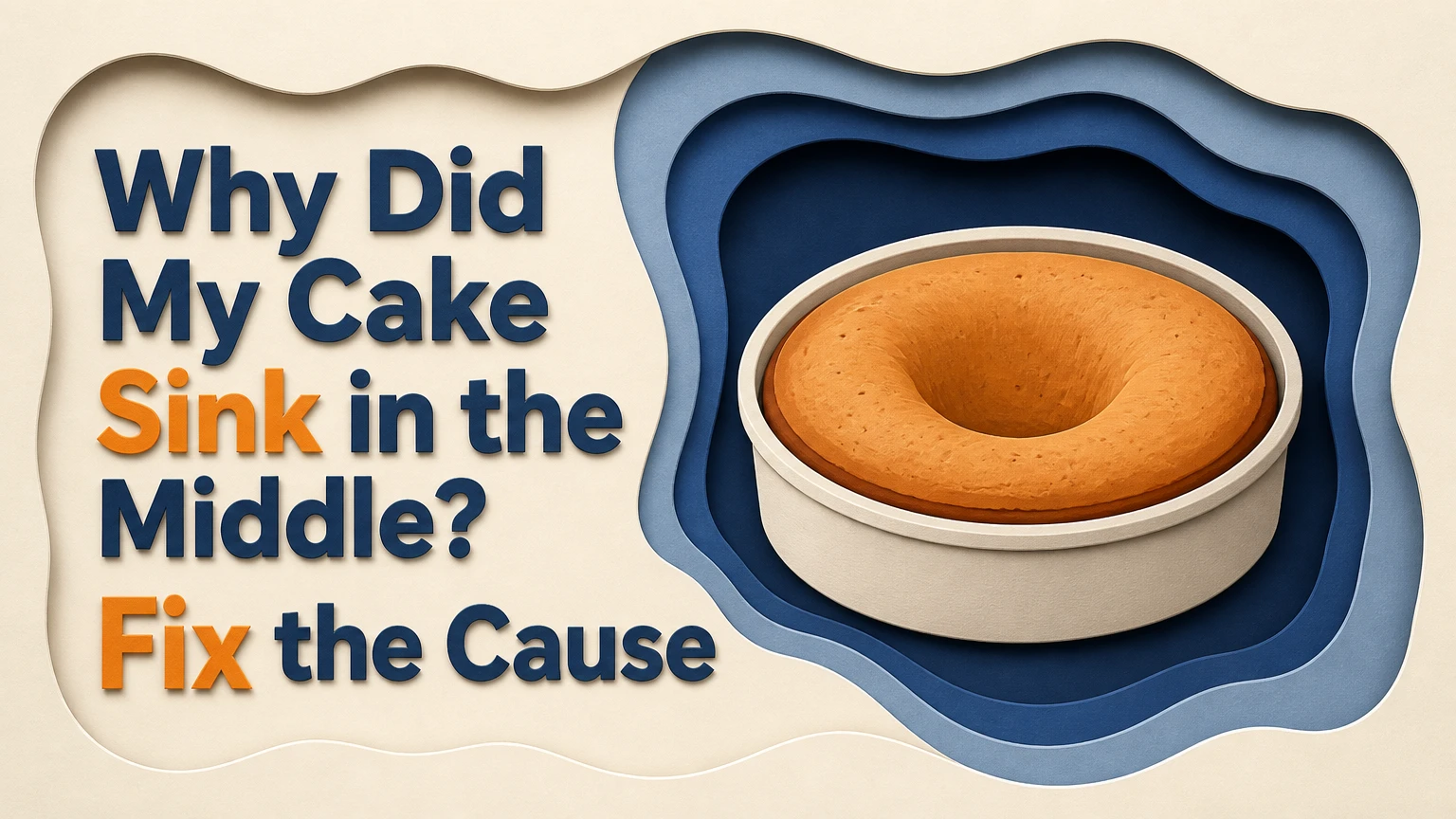
A cake sinks in the middle when its internal structure cannot support expanding gas and its own weight after the center rises. The most common causes are an underbaked center, excessive or poorly balanced leavening, an inaccurate oven temperature, premature door opening, incorrect ingredient proportions, or mixing that creates weak bubbles.
Key Facts at a Glance
- Cake structure forms when egg proteins coagulate and flour starches gelatinize around expanding air and steam.
- The center sets last because heat moves inward from the pan and the hot oven air.
- A crater that appears while baking usually indicates structural failure before the crumb finished setting.
- A cake that falls after removal is often underbaked, even when the outside looks fully browned.
- Baking powder quantity must follow the specific recipe; a universal amount per cup of flour cannot suit every cake formula.
- A digital scale and an independent oven thermometer eliminate two frequent causes of sinking.
Why Did My Cake Sink in the Middle?
A sunken cake is the result of a timing problem: gas expands before the batter has developed enough strength to contain it. Cake batter must remain flexible while bubbles enlarge, then become firm at the right moment; if setting happens too late, bubbles merge or escape and gravity pulls the soft center downward.
Cake structure comes from several interacting ingredients. Flour supplies starch and, when hydrated and mixed, gluten-forming proteins. Eggs add proteins that firm with heat and emulsifiers that help distribute fat and water. Sugar tenderizes the crumb but also delays setting when used in large amounts, while fat shortens gluten and keeps the finished cake soft.
The oven drives three overlapping changes. Leaveners release carbon dioxide, trapped air expands, and water becomes steam. Butter or other solid fats melt, temporarily making the batter more fluid. Later, starch gelatinization and protein coagulation turn the fluid batter into a permanent crumb.
That sequence explains the central symptom. The outside edges receive heat first and may look finished while the middle remains wet and weak. The outer cake can rise and hold its shape even though the center eventually collapses.
How does a cake rise and collapse?
A cake rises because gas occupies more volume as temperature increases, then collapses when the surrounding batter cannot maintain the bubble walls. Chemical leaveners create carbon dioxide, creamed butter traps air, whipped eggs hold air, and water contributes steam; each gas source behaves differently during baking.
| Gas source | Where it comes from | Main risk | Best control |
|---|---|---|---|
| Baking powder | Acid and base in the leavener | Excess gas and coarse bubbles | Weigh flour and follow the formula |
| Baking soda | Alkaline soda reacting with recipe acids | Soapy flavor and weak structure | Match soda to acidic ingredients |
| Creamed butter | Air incorporated during mixing | Oversized bubbles after excessive creaming | Cream until pale and moderately aerated |
| Whipped eggs | Mechanical foam around egg proteins | Foam deflates during folding | Fold flour in several gentle additions |
| Steam | Water in eggs, milk, and batter | Rapid expansion before setting | Bake at the recipe temperature |
Harold McGee’s On Food and Cooking describes baking as a transition in which a fluid batter becomes a solid foam through heat-driven protein and starch changes. That description matters in practice: rising is not success by itself, because the cake must set while its gas cells are still supported.
When Did the Cake Sink?
The timing of the collapse narrows the diagnosis. A cake that sinks before the center has visibly set points toward excessive gas, temperature disruption, or weak batter, while a cake that falls during cooling more often has a wet or underdeveloped interior.
| Timing of collapse | Visible sign | Most likely cause | Confirmation test |
|---|---|---|---|
| Within the first 15 minutes | Sudden crater and spreading batter | Excess leavener or very low structure | Review leavener and flour weights |
| Mid-bake | Edges set, center dips | Door opening, temperature drop, weak formula | Check oven with a thermometer |
| Immediately after removal | High cake deflates centrally | Underbaked center or over-aeration | Skewer the center and inspect crumb |
| During 20-60 minute cooling | Center wrinkles or contracts | Moist crumb and insufficient setting | Check internal texture after cooling |
| Several hours later | Slight depression with firm crumb | Normal contraction or formula imbalance | Compare with recipe photographs |
A cake can also settle slightly without being defective. A tall foam cake may contract as steam leaves, especially if it was removed from the pan too quickly. A deep crater, gummy center, or wet streak indicates a problem rather than ordinary cooling.
Is the Center Raw or Simply Collapsed?
A sunken cake with a sticky, shiny, or paste-like center is underbaked and needs additional heat if the cake is still warm. A fully baked cake with a shallow depression, elastic crumb, and no wet streaks has a structural or formula issue but does not need more baking.
Use several doneness signals instead of relying on one toothpick. Insert a wooden skewer into the deepest part, press the center lightly, and inspect the cake’s edges. A few moist crumbs are acceptable for many butter cakes; liquid batter is not.
| Center condition | Skewer result | Press test | Correct action |
|---|---|---|---|
| Raw batter | Wet batter clings to skewer | Surface ripples or stays indented | Continue baking 5-10 minutes |
| Underbaked but salvageable | Thick paste and large crumbs | Center feels soft | Cover top and bake at same temperature |
| Properly baked | A few moist crumbs | Center springs back | Cool and decorate |
| Overbaked | Dry crumbs | Firm and resistant | Do not rebake; add syrup or filling |
| Collapsed but baked | Crumbs, no liquid | Firm but low | Level, fill, or repurpose |
Is a sunken cake safe to eat?
A fully baked sunken cake is generally safe to eat, but a cake containing raw flour or undercooked egg should not be served until the center reaches a baked, set condition. Appearance alone cannot establish safety, so discard any portion that remains liquid after reasonable additional baking.
The safest recovery method is to return an underbaked cake to the oven promptly. Cover the top loosely with foil if the crust is already dark, then bake until the center no longer contains wet batter. A food thermometer can provide an additional check, although finished-cake temperatures vary by formula and should support, not replace, texture testing.
Can Too Much Baking Powder Make a Cake Sink?
Too much baking powder can make a cake rise rapidly and then collapse because the batter produces more gas than its protein and starch network can hold. The result often includes a peaked top that falls, a coarse crumb, bitter or metallic flavor, and a hollow or gummy center.
Expired baking powder is a different problem. It may release too little gas, leaving a dense cake that never develops sufficient lift. Test baking powder by stirring a small amount into hot water; vigorous bubbling indicates activity, although the test does not measure exact strength.
Baking soda requires an acidic ingredient such as buttermilk, yogurt, molasses, citrus juice, natural cocoa, or brown sugar. Replacing baking powder with soda at equal volume is not a safe substitution because soda is much more alkaline and depends on the recipe’s acid balance.
| Leavener issue | Typical symptom | Flavor clue | Next-batch correction |
|---|---|---|---|
| Excess baking powder | Fast rise, then crater | Bitter or metallic | Recheck the recipe and spoon level |
| Too little baking powder | Low, dense cake | Usually neutral | Confirm leavener was added |
| Expired baking powder | Heavy, compact crumb | Usually neutral | Replace container and date it |
| Excess baking soda | Dark crumb and spread | Soapy or alkaline | Reduce soda and preserve recipe acids |
| Uneven distribution | One-sided rise or tunnels | Inconsistent | Whisk leavener thoroughly into flour |
A useful practitioner rule is to measure leaveners over a bowl, not over the mixing bowl. One accidental extra spoonful can permanently alter a small batch, and spilled powder is difficult to detect after it disappears into flour.
Did the Oven Temperature Cause the Collapse?
An oven that runs cool delays setting and allows gas to escape, while an oven that runs hot sets the edges before the center has finished expanding. Both conditions can produce a sunken middle, so the oven’s actual temperature matters more than the number printed on its dial.
Use a standalone oven thermometer placed near the cake pan, then compare its reading with the recipe setting after at least 20 minutes of preheating. Many domestic ovens cycle above and below the displayed temperature, and a single reading should be treated as a practical estimate rather than laboratory calibration.
Keep the pan on the rack specified by the recipe, usually the center rack. Dark metal pans absorb heat more quickly than shiny aluminum pans, glass heats differently, and a crowded oven can restrict airflow. Each change can alter the time at which the center sets.
Should you open the oven door during baking?
Avoid opening the oven during the first two-thirds of baking, when the center is still fluid and its bubbles are fragile. If a recipe requires checking, open the door briefly after the cake has developed a set surface and use a light touch rather than shaking the pan.
| Oven or pan condition | Likely result | Practical adjustment | Typical effect |
|---|---|---|---|
| Oven 10°C too cool | Pale crust, wet center | Verify thermometer and preheat | Add 5-15 minutes |
| Oven 10°C too hot | Dark edges, raw middle | Lower temperature and extend bake | Slower, more even setting |
| Dark metal pan | Fast edge browning | Reduce heat about 10°C if recipe permits | Earlier crust formation |
| Glass pan | Slower heat transfer | Follow glassware guidance | Longer bake time |
| Low rack position | Dark underside | Move to center rack | More balanced heat |
| Door opened early | Deflated center | Keep door closed until set | Prevents temperature shock |
A cake does not fall merely because a door opens. The risk is greatest when the batter has not formed a stable network, so opening the door late in the bake is much less damaging than opening it during the initial rise.
Did the Ingredients Weaken the Cake?
Excess liquid, sugar, or fat can delay setting and overload the batter, but ingredient ratios cannot be diagnosed using one universal percentage. A sponge, pound cake, oil cake, and chiffon cake deliberately use different balances, so compare substitutions with the original formula rather than applying a fixed rule.
Flour type matters when the recipe depends on a specific protein level. Cake flour usually produces a tender, lower-gluten crumb, while all-purpose flour provides more structure; substituting one for the other can change both absorption and support.
Ingredient temperature also affects the batter. Cold eggs can make a butter mixture curdle, while very warm butter can remove the solid fat crystals that help hold air. Weigh flour, sugar, and fat with a digital scale when possible, because packed cups create large batch-to-batch variation.
| Ingredient change | Structural effect | Common appearance | Best response |
|---|---|---|---|
| Extra liquid, 30-60 g | Delayed starch setting | Wet central band | Restore measured liquid |
| Extra sugar, 25-50 g | Softer, slower-setting crumb | Sticky depression | Follow original sugar weight |
| Extra fat, 25-40 g | Weaker gluten and heavier batter | Greasy edges | Weigh butter or oil |
| Cake flour for all-purpose | Less gluten support | Tender but fragile crumb | Use recipe-specified flour |
| All-purpose for cake flour | More gluten and absorption | Dense or chewy crumb | Avoid aggressive mixing |
| Large egg substitution | More water and protein | Variable lift and texture | Match egg weight |
Recipes with very high sugar or fat are not automatically wrong. They require a different structure, often supplied by eggs, emulsifiers, aeration, or a longer, gentler bake. The correct fix is formula-specific.
Did Mixing Create the Problem?
Mixing can cause sinking in opposite ways. Insufficient mixing leaves pockets of baking powder or uneven hydration, while overmixing after flour is added develops excess gluten and creates a dense, irregular crumb that cannot expand evenly.
For butter cakes, cream softened butter and sugar until lighter in color and moderately fluffy, commonly 3-5 minutes with a stand mixer. Do not continue indefinitely; excessive creaming may create large, unstable air cells that expand dramatically and rupture.
Once flour enters the bowl, mix only until no dry streaks remain. For whipped-egg cakes, fold with a broad spatula from the bottom upward and rotate the bowl, stopping when the batter is uniform. Scraping aggressively can remove the air the recipe depends on.
A practitioner’s diagnostic clue is crumb pattern. Long tunnels suggest excess mixing or uneven leavener, while a compact, heavy layer suggests insufficient aeration, too much liquid, or a cool oven.
Which Cake Types Sink Most Easily?
Foam cakes and high-moisture cakes are more sensitive to deflation, while pound cakes are more tolerant of moderate handling but can still collapse when the center remains underbaked. The correct diagnosis depends on whether the recipe relies mainly on whipped air, chemical leavening, or creamed fat.
| Cake type | Primary lift | Main structural risk | Most important control |
|---|---|---|---|
| Chiffon cake | Whipped egg foam and oil | Foam collapse | Fold gently and cool as directed |
| Genoise sponge | Whipped whole eggs | Lost aeration | Fold flour without deflating eggs |
| Butter cake | Creamed fat and leavener | Excess bubbles or weak center | Cream moderately and weigh ingredients |
| Oil cake | Chemical leavener and eggs | Heavy, fluid batter | Verify leavener and bake fully |
| Pound cake | Eggs and creamed fat | Dense underbaked center | Use correct pan and moderate heat |
| Cheesecake-style cake | Eggs and steam | Central contraction | Cool gradually and avoid overbaking |
Why do cupcakes sink in the middle?
Cupcakes sink when their small, rapidly expanding batter portions contain too much leavener, are underbaked, or are filled too high. Their short baking time leaves less margin for an inaccurate oven, and a deep central pocket can remain soft even when the edges look finished.
Fill standard cupcake wells about two-thirds full unless the recipe specifies another level. Rotate the pan only after the tops have begun to set, and test the center of one cupcake rather than the shallow edge.
How Can You Prevent a Sunken Cake?
Preventing a sunken cake requires controlling formula, aeration, heat, and doneness in that order. The most reliable workflow uses weighed ingredients, fresh leavener, a verified oven temperature, the specified pan, and a center test before removal.
Prevention checklist
- Read the recipe completely before measuring.
- Weigh flour, sugar, and fat instead of scooping flour into a cup.
- Bring eggs and butter to the temperatures specified by the recipe.
- Check baking powder or soda dates and test questionable powder.
- Mix leavener evenly through the flour.
- Preheat the oven for at least 20 minutes.
- Place the pan on the center rack with clear airflow.
- Avoid opening the door until the cake has visibly set.
- Test the deepest center, not only the edge.
- Cool the cake according to its recipe before unmolding.
| Prevention tool | Typical price | What it measures | Useful threshold |
|---|---|---|---|
| Digital kitchen scale | $10-$25 | Ingredient mass | Weigh flour to the recipe gram |
| Oven thermometer | $6-$15 | Actual oven heat | Compare after 20 minutes |
| Instant-read thermometer | $15-$35 | Internal temperature | Use with crumb and skewer tests |
| Straight-sided pan | $12-$30 | Consistent baking geometry | Match recipe diameter |
| Fine-mesh sieve | $8-$20 | Even dry blending | Sift dense cocoa or leavener |
The strongest low-cost improvement is an oven thermometer. A scale helps with formula accuracy, but an oven that runs 15°C low can still produce a collapsed center even when every ingredient is weighed correctly.
How Do You Fix a Cake That Already Sank?
A sunken cake cannot be restored to its original height, but the texture determines whether you should rebake, level, fill, or repurpose it. A wet center may be recoverable, whereas a fully baked crater is usually best treated as a decorating or serving problem.
If the center is underbaked
Return the cake to the oven immediately at the recipe temperature. Cover the top with foil if browned, then bake in 5-minute intervals until a skewer shows moist crumbs rather than liquid batter. Let the cake cool fully before judging its final texture.
If the cake is baked but sunken
Trim the raised rim with a serrated knife so the surface is level. Fill the hollow with a stable ingredient such as fruit curd, pastry cream, ganache, or frosting, then chill the cake if the filling needs to firm.
If the crumb is dense or gummy
Do not keep baking indefinitely. Extended heat may dry the edges while leaving the texture unpleasant; instead, cut away any wet portion and use the baked crumb in layered dessert cups or cake truffles.
| Cake condition | Recovery method | Added time | Expected result |
|---|---|---|---|
| Liquid center, browned top | Foil-covered rebake | 5-15 minutes | Potentially sliceable cake |
| Firm crater, good crumb | Level and fill | 10-20 minutes | Decorated layer cake |
| Dense but baked | Syrup and frosting | 15-25 minutes | Moist, rich slices |
| Crumbly and uneven | Cake truffles | 25-40 minutes | Portionable bite-size dessert |
| Dry edges, soft center | Remove edges, layer center | 20-30 minutes | Trifle-style dessert |
Food safety limits the salvage options. Do not serve raw batter as a filling, and do not assume frosting will make an uncooked center safe.
What Should You Change for Altitude or Pan Size?
High altitude can make cakes rise too quickly and lose moisture before the structure sets, while a smaller or deeper pan creates a thicker center that needs more time. Pan geometry often explains a failure that appears to be a leavener problem.
At elevation, lower air pressure allows gas bubbles to expand more readily and water to evaporate at a lower temperature. Typical high-altitude adjustments include reducing leavener modestly, adding liquid, increasing oven heat slightly, or shortening the bake, but the correct change depends on altitude and recipe design.
Changing from a 20-centimeter round pan to a 23-centimeter pan spreads batter thinner and usually shortens baking time. Pouring the same batter into a smaller pan makes the center deeper and increases the risk of a raw middle.
Do not change several variables at once. Record pan diameter, batter weight, oven reading, bake time, and result so the next adjustment has a clear cause.
The Bottom Line
The answer to “Why did my cake sink in the middle?” is usually a center that rose before it was strong enough to set. Check the collapse timing, center texture, actual oven temperature, leavener amount, ingredient weights, pan size, and mixing method in that order. Rebake only when the center is genuinely undercooked; otherwise level and fill the cake or repurpose it.
Frequently Asked Questions
Can I bake a sunken cake again the next day?
Rebaking the next day rarely improves a cake that has already cooled because the structure has set in its collapsed form. If the center is still visibly wet, refrigerate the cake promptly, then rebake or discard it according to its ingredients and condition. A firm, baked crater should be decorated rather than reheated.
Why did my cake sink after I added fruit?
Fresh fruit releases water as it heats and can create heavy, wet pockets that weaken the surrounding crumb. Excess fruit also disrupts bubble networks and concentrates weight in the center. Pat fruit dry, coat it lightly with flour when appropriate, distribute it evenly, and avoid adding more than the recipe specifies.
Does tapping the cake pan make it sink?
A gentle tap before baking can remove unusually large bubbles, but striking or shaking a partially baked cake can deflate fragile foam. Set the pan down carefully, avoid jiggling it during the first two-thirds of baking, and use a skewer or gentle center press to check doneness.
Why does my cake sink only when I use a fan oven?
Fan ovens circulate heat and often bake faster than conventional ovens, so the outside may set before the center finishes expanding. Use the recipe’s fan setting if provided; otherwise, a typical adjustment is lowering the temperature by about 15-20°C and checking early, while confirming the actual oven temperature with a thermometer.
Can I replace eggs without causing a sunken cake?
Egg replacements can cause sinking because eggs provide water, protein, emulsification, and sometimes most of the cake’s aeration. A commercial replacement designed for cakes is more predictable than a single improvised substitute. Use a recipe formulated for the replacement when possible, especially for sponge and chiffon cakes.
