

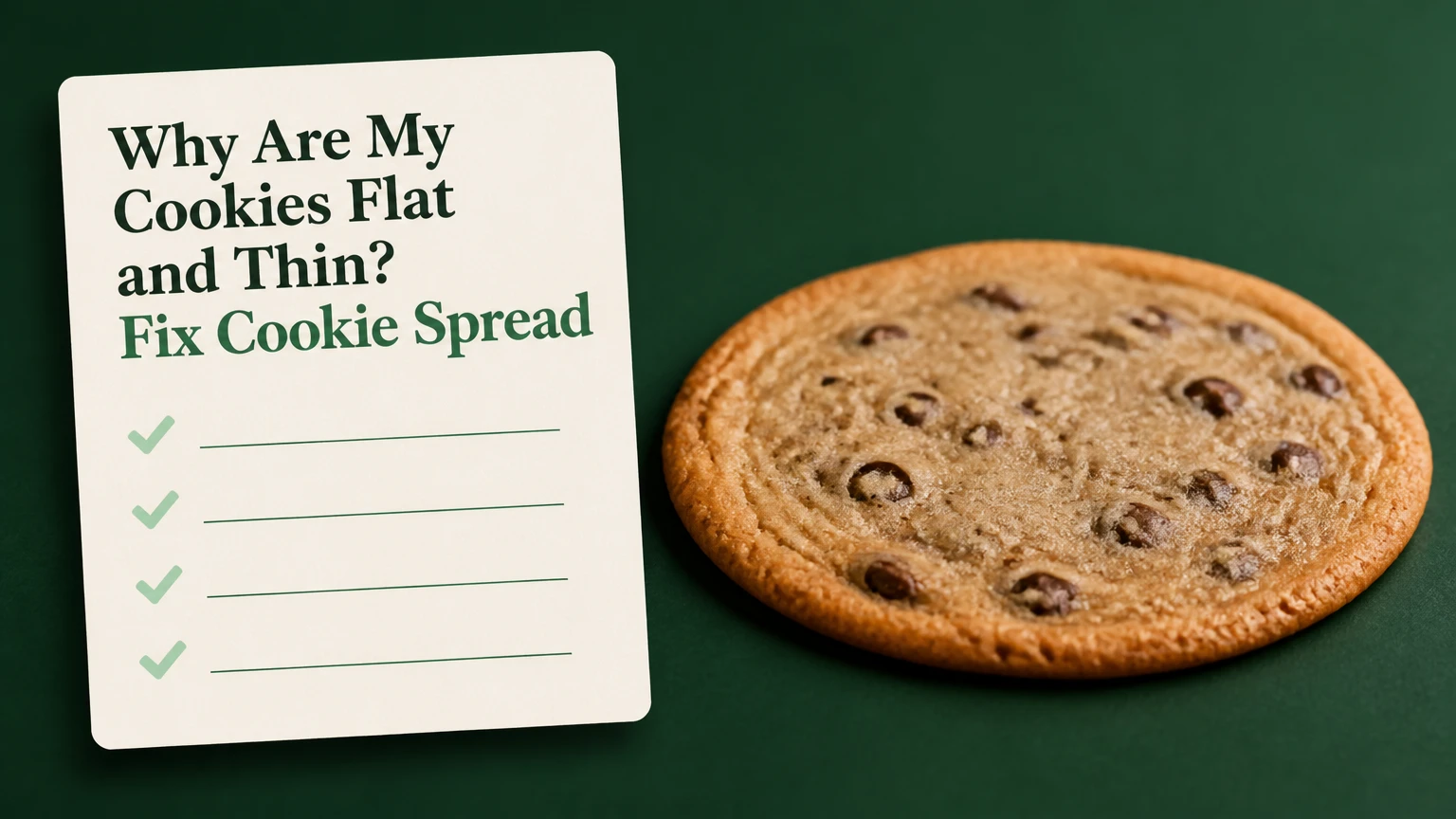
Flat, thin cookies usually result from dough spreading before flour, eggs, and starches set. The most common triggers are overly warm fat, too little flour, an inaccurate oven, a hot or greased baking sheet, or dough that needed chilling. A single test cookie can identify the dominant cause before you bake the whole batch.
Key Facts at a Glance
Softened butter should generally be cool, solid, and about 18-20°C, not glossy or partially melted.
Scooping flour into a cup can produce materially different weights, so weighing the recipe is the most reliable correction.
Refrigerating dough for 30 minutes reduces initial spread, while 2 hours or overnight chilling produces a stronger effect.
A properly preheated oven commonly falls between 175°C and 190°C for drop cookies, but the recipe determines the final setting.
Vinegar can prove that baking soda reacts, but the test does not prove that soda will perform correctly in a cookie recipe.
Parchment on a cool, light-colored aluminum sheet usually gives more predictable spread than a greased or insulated pan.
What Causes Cookie Spread?
Cookie spread occurs when fat liquefies before the dough develops enough structure to hold its shape. Butter and sugar become mobile early in baking; meanwhile, egg proteins coagulate, flour starch gelatinizes, and gluten proteins strengthen later. If the liquid phase wins that timing contest, the dough flows outward and produces a thin cookie.
Cookie structure depends on several linked variables rather than one universal ratio. Butter supplies fat and water, sugar controls sweetness and browning, flour absorbs moisture and contributes starch and protein, and eggs bind the mixture while setting in the oven. Baking soda or baking powder changes gas production, pH, and browning, but leavening alone cannot support a weak dough.
Harold McGee’s On Food and Cooking describes baking as a sequence in which “the proteins coagulate and the starches gelatinize.” That sequence explains why a cookie can look liquid at the edges before becoming firm in the center. The practical goal is to slow fat flow or accelerate structural setting.
Which ingredients hold a cookie upright?
Flour is the main dry structural ingredient, while eggs provide water, emulsifiers, and proteins that set with heat. Brown sugar can retain more moisture than white sugar because molasses is present, but that does not automatically make cookies thicker. Brown sugar often produces a softer, chewier cookie and can increase spread if the formula has insufficient flour.
Chocolate chips, nuts, oats, and shredded coconut can interrupt flow, but they do not replace flour’s continuous structural network. A recipe with many inclusions may appear thicker even when the underlying dough is weak.
Was the Butter Too Warm?
Warm or melted butter is the most common cause of unexpectedly thin cookies in recipes designed for creamed butter. Butter at approximately 18-20°C remains plastic enough to hold air during mixing; butter that is glossy, oily, or liquid cannot create the same aerated matrix.
Use the finger-press test. Properly softened butter yields under light pressure but keeps sharp edges and a matte surface. If the finger leaves a greasy shine, the butter is too warm for traditional creaming. Refrigerate it for 10-15 minutes, then reassess rather than adding extra flour immediately.
| Fat condition | Typical temperature | Likely cookie result | Corrective action |
|---|---|---|---|
| Refrigerator-cold butter | 3-7°C | Dense dough, limited aeration | Cut into cubes and soften 20-40 minutes |
| Properly softened butter | 18-20°C | Defined edges and moderate spread | Cream with sugar for 3-5 minutes |
| Warm softened butter | 22-25°C | Increased spread and weaker aeration | Chill butter 10-15 minutes |
| Partly melted butter | 25-32°C | Thin edges and uneven shape | Cool until opaque and plastic |
| Fully melted butter | 35-45°C | Wide, often flat cookies | Follow a melted-butter recipe or chill dough thoroughly |
Margarine and baking spreads behave differently because their water and fat ratios vary by brand. Some soft spreads contain enough water to create steam and enough liquid fat to increase flow. Shortening contains no water and often produces taller cookies, but it changes flavor and browning.
Should melted butter be used for cookies?
Melted butter is acceptable only when the recipe is formulated for it. Melted-butter recipes commonly compensate with flour, chilling, or a different mixing method. Converting a creamed-butter recipe to melted butter without changing the formula commonly creates flat cookies.
Was There Too Little Flour?
Too little flour leaves insufficient starch and protein to absorb the dough’s water and immobilize melted fat. Flour measurement errors are common because a loosely filled cup can weigh much less than a compacted cup, while an overfilled cup can make cookies dry and cakey.
For general planning, one cup of all-purpose flour often weighs about 120-130 grams, but the recipe’s stated gram weight takes priority. King Arthur Baking uses 120 grams as its standard cup weight, while other recipe publishers use different conventions. A digital scale eliminates that specific variable.
| Flour measurement method | Typical weight for 1 cup AP flour | Likely error | Best use |
|---|---|---|---|
| Weighed with a scale | 120-130 g | 0-3 g | Repeatable baking |
| Spoon and level | 115-130 g | 5-12% | Acceptable without a scale |
| Scooped directly from bag | 135-160 g | 10-25% high | Inconsistent, often dry |
| Heavily shaken cup | 130-150 g | 8-18% high | Avoid for delicate cookies |
If the mixed dough is glossy, slack, and impossible to scoop into a mound, compare your flour weight with the recipe before baking. For a typical batch containing 250-300 grams of flour, add 15-30 grams of flour, mix briefly, and bake one test cookie. Large additions can make the result tough.
Can too much flour also cause thin cookies?
Too much flour rarely causes thin cookies directly, but flour can be distributed unevenly or fail to hydrate when the dough is mixed poorly. A dough with excessive flour usually produces thick, pale, crumbly, or cakey cookies. If cookies are thin and dry at once, check whether the spread occurred first and overbaking then removed the remaining moisture.
Did the Sugar Balance Change?
Sugar affects spread because dissolved sugar becomes mobile during baking and lowers the temperature at which the dough flows. White granulated sugar commonly produces more crispness and outward spread than brown sugar in the same formula, while brown sugar usually contributes moisture, chew, molasses flavor, and darker color.
The claim that brown sugar’s acidity reliably activates baking soda is too broad. Brown sugar is mildly acidic because of molasses, but the amount varies, and a recipe’s total acidity determines whether soda is balanced. Sugar substitution changes texture and moisture, so it should not be treated as a guaranteed thickening fix.
| Sugar choice | Moisture contribution | Typical texture | Spread tendency in unchanged formula |
|---|---|---|---|
| Granulated white sugar | Low | Crisp, thin edges | Moderate to high |
| Light brown sugar | Moderate | Chewy, soft center | Moderate |
| Dark brown sugar | Higher | Moist, strongly molasses-flavored | Moderate |
| Powdered sugar | Variable, includes starch | Tender, short texture | Low to moderate |
| Liquid sweetener | High | Soft, bendable cookie | High unless formula is adjusted |
A large reduction in sugar can make cookies thicker but also less tender and less browned. Sugar is structural in a broad sense because it changes water availability and caramelization, so removing it is not a neutral repair.
Was the Oven Hot Enough?
A low oven lets butter melt and flow before the cookie’s perimeter sets. Most drop cookies bake around 175-190°C, or 350-375°F, but the correct setting depends on dough size, pan material, sugar content, and whether the oven uses convection.
Check the oven with an independent thermometer placed near the center of the middle rack. Allow at least 15-20 minutes after the preheat signal, because the display can indicate readiness before the walls and rack stabilize. A 15°C temperature error is enough to change spread and browning timing.
| Oven condition | Actual temperature | Common result | Adjustment |
|---|---|---|---|
| Underheated | 160-170°C | Wide, pale, soft cookies | Preheat longer and verify thermometer |
| Standard drop-cookie range | 175-180°C | Balanced spread and browning | Bake one test cookie |
| Hot conventional oven | 185-190°C | Faster edge setting, darker bottoms | Reduce time by 1-2 minutes |
| Convection setting | 165-175°C | Faster surface drying | Reduce recipe temperature by about 15°C |
| Overshot oven | Above 200°C | Burned edges, raw centers | Wait for the oven to stabilize |
Increasing oven temperature is not a universal emergency fix. A hotter oven can set the perimeter faster, but it can also burn the edges while the center remains underbaked. Use a test cookie, not an automatic 10°C increase.
Did the Baking Sheet Cause Spreading?
A hot baking sheet starts melting the dough underneath before the surrounding air can set the upper surface. A greased sheet reduces friction and can encourage dough to slide outward. Use a cool, room-temperature sheet lined with parchment for the most repeatable result.
Silicone mats are reusable and promote even release, but their insulating properties can alter bottom browning and spread. Dark metal absorbs more radiant heat than shiny aluminum, while insulated sheets can delay bottom setting enough to produce broader cookies.
| Baking surface | Approximate material behavior | Spread pattern | Best choice |
|---|---|---|---|
| Parchment on aluminum | Moderate heat transfer, moderate friction | Predictable, defined edges | Most standard drop cookies |
| Silicone mat | Insulated, reusable surface | Slightly softer, sometimes broader bottoms | Delicate or low-browning cookies |
| Greased metal | Low friction, direct contact | Highest outward movement | Avoid unless recipe specifies it |
| Dark metal sheet | Faster heat absorption | Darker bottoms, quicker edge set | Shorter bake monitoring |
| Insulated sheet | Slow bottom heating | More spread, pale underside | Soft cookies needing gentle bottoms |
Never place raw dough on a sheet that is still hot from the previous batch. Transfer dough to a second cool sheet or wait until the original pan reaches room temperature.
Which surface limits spread best?
Parchment on a cool, light-colored aluminum sheet usually limits unpredictable spread better than a greased pan or insulated sheet. Parchment does not freeze the dough in place, but it provides consistent release and friction without adding oil to the dough’s contact area.
Is the Leavener Responsible?
Baking soda and baking powder affect cookie height, browning, acidity, and tenderness, but expired leavener is not the usual reason cookies become flat. A cookie can spread widely even with active leavening if the dough contains too much fat, sugar, or water relative to flour.
The vinegar test is limited. A quarter teaspoon of baking soda in vinegar should fizz immediately if the soda is reactive, but that reaction does not replicate the cookie’s acidity, moisture, or oven conditions. Baking powder should be tested with hot water according to the manufacturer’s guidance, not vinegar.
| Leavener | Main reaction requirement | Typical cookie effect | Diagnostic note |
|---|---|---|---|
| Baking soda | Recipe acid and moisture | Browning, spread, crispness | Excess can taste soapy |
| Single-acting baking powder | Moisture and heat | Lift during baking | Less common in modern cookies |
| Double-acting baking powder | Moisture plus heat | More reliable lift | Check package age and storage |
| No chemical leavener | Steam and mixing aeration | Dense, often crisp cookie | Correct in some formulas |
Store leaveners sealed and dry. Replace them when they fail a relevant test or when the package is well beyond its printed best-by period, rather than following a universal six-month rule.
Will Chilling Fix the Dough?
Chilling cookie dough solidifies fat and gives flour time to hydrate, so the dough spreads more slowly during the first minutes of baking. Thirty minutes can help, 2 hours usually has a stronger effect, and overnight refrigeration can improve both shape and flavor. Chilling cannot correct every formula error.
| Chilling time | Dough condition | Expected benefit | Limitation |
|---|---|---|---|
| 0 minutes | Soft or warm | Fastest spreading | Useful only for recipes designed that way |
| 30 minutes | Cool exterior, softer center | Moderate reduction in spread | Dough may warm while scooping |
| 2 hours | Firm, hydrated dough | Stronger shape retention | Requires portioning or rest time |
| Overnight, 8-24 hours | Fully chilled and hydrated | Maximum control and deeper flavor | Dough may need 10 minutes to soften |
| Frozen, 30-60 minutes | Very firm portions | Useful for emergency control | Centers may bake unevenly |
Portion dough before an overnight chill when possible. Chilled dough that is baked as a large, dense block may brown outside before the center cooks.
How Can I Rescue Dough Already Mixed?
Rescue mixed dough by baking one test cookie before changing the entire bowl. Chill a portion for 30-60 minutes, bake it on a cool parchment-lined sheet, and compare its diameter, edge color, and center texture with an unchilled sample.
Use this decision sequence:
- If the test cookie spreads but stays pale: verify oven temperature and increase flour by 15 grams per 250-300 grams already present.
- If the test cookie spreads and browns quickly: reduce the pan temperature problem first, then chill the dough.
- If the dough is glossy or oily: refrigerate 30-60 minutes before adding anything.
- If the dough is extremely loose after chilling: add 10-15 grams flour, mix briefly, and test again.
- If the cookie is thick but cakey: stop adding flour and inspect overmixing, excess egg, or baking powder.
Do not add large amounts of flour blindly. A correction of 30 grams can rescue a batch, while 100 grams can turn a chewy cookie into a dry biscuit.
What Is the Reliable Correction Workflow?
The most reliable workflow takes about 45 minutes, including a 30-minute chill, and controls the four variables that most affect spread: flour weight, fat temperature, dough temperature, and oven accuracy.
Step 1: Weigh the ingredients
Use the recipe’s gram weights for flour, sugar, and fat. If no gram weights exist, use approximately 120-130 grams per cup of all-purpose flour and record the amount you use.
Success checkpoint: The dough matches the recipe’s expected consistency before chilling.
Common mistake: Packing flour into a cup and compensating with additional liquid.
Step 2: Control the butter
Bring butter to about 18-20°C for creaming. Combine it with sugar for 3-5 minutes on medium speed, stopping when the mixture looks lighter and fluffy rather than wet.
Success checkpoint: The mixture holds soft ridges from the beater.
Common mistake: Continuing to mix warm butter until it becomes glossy.
Step 3: Add eggs gradually
Use eggs near room temperature if the recipe specifies creaming, but add them in small portions. Cold eggs can make the mixture curdle, while warm eggs can soften the butter excessively.
Success checkpoint: The mixture is cohesive and creamy after each addition.
Common mistake: Adding all liquid at once and overheating the butter through extended mixing.
Step 4: Mix in dry ingredients briefly
Whisk flour, salt, and leavener separately, then mix them into the wet ingredients only until no dry flour remains. Extended mixing develops gluten and can make cookies tough without reliably preventing spread.
Success checkpoint: No dry pockets remain and the dough still looks soft.
Common mistake: Mixing for several extra minutes after the flour disappears.
Step 5: Chill and portion
Chill the dough for 30 minutes when time is limited, or 2 hours for more reliable control. Scoop portions of 30-45 grams and shape them into tall mounds rather than flat discs.
Success checkpoint: A portion holds its mound on the tray.
Common mistake: Leaving shaped dough on a warm counter while the oven heats.
Step 6: Bake a test cookie
Place one or two portions on parchment, leaving at least 5 centimeters between them. Bake on the middle rack at the recipe temperature, then record the diameter and texture.
Success checkpoint: The edges set before the center flows beyond the intended diameter.
Common mistake: Baking the entire batch before detecting a faulty ratio.
Step 7: Adjust one variable
Change only one factor between tests: chill longer, add 10-15 grams flour, replace the pan, or verify the oven. Multiple simultaneous changes hide the true cause.
Success checkpoint: The second test has the desired thickness and edge color.
Common mistake: Increasing flour, temperature, and leavener together.
How Do Special Situations Change the Diagnosis?
Why do gluten-free cookies spread more easily?
Gluten-free cookies can spread because starch blends do not create the same protein network as wheat flour. Use the recipe’s specified gluten-free blend, allow 30-60 minutes for hydration, and avoid replacing wheat flour gram-for-gram with a single starch such as cornstarch.
Why do cookies spread only on the first tray?
The first tray may be greased, unusually dark, or heated by preheating. Later trays may also differ if dough portions sit at room temperature for 20-30 minutes. Bake one chilled portion from the same dough on a cool parchment-lined pan to isolate the tray variable.
Why do oatmeal cookies turn flat?
Oats absorb moisture more slowly than finely milled flour, and old-fashioned oats create a coarse structure that can spread before setting. Rest oatmeal dough for at least 30 minutes, then check whether the recipe contains enough flour to bind the added oat volume.
Why do cookies flatten at high altitude?
Lower air pressure can increase evaporation and alter leavening, while dry conditions change flour hydration. At elevations above approximately 1,500 meters, test a small batch with the recipe’s altitude guidance before adding flour or reducing sugar independently.
Which Baking Tools Improve Consistency?
A scale and oven thermometer provide the highest return because they measure the two variables home bakers most often estimate incorrectly. Parchment is inexpensive and useful, while silicone mats are convenient but can change bottom texture.
| Tool | Typical price | Useful specification | Main limitation |
|---|---|---|---|
| Digital kitchen scale | $10-$25 | 1 g increments, tare function | Needs a stable, dry surface |
| Oven thermometer | $5-$15 | Center-rack hanging or standing model | Measures one location only |
| Parchment paper | $4-$12 per package | Rated to at least 215°C | Disposable |
| Silicone baking mat | $10-$25 | Sheet-specific fit and heat rating | Can soften bottoms |
| Light aluminum sheet | $12-$30 | 2-3 mm thick, non-insulated | Can warp under high heat |
Equipment cannot repair a badly proportioned recipe. A scale reveals the error, and a thermometer reveals the oven error, but neither substitutes for a balanced formula.
Common Mistakes and Their Fixes
| Mistake | Observable symptom | Recovery for current dough | Prevention next time |
|---|---|---|---|
| Warm butter | Glossy dough, wide cookies | Chill 45-60 minutes | Measure butter temperature by touch |
| Undermeasured flour | Slack dough, thin centers | Add 10-15 g and test | Weigh flour |
| Hot baking sheet | First cookies spread most | Move dough to a cool pan | Rotate two sheets |
| Low oven temperature | Pale, broad cookies | Verify thermometer and extend preheat | Use middle rack |
| Excessive post-flour mixing | Tough, uneven texture | Do not remix aggressively | Stop when flour disappears |
| Recipe substitution | Changed spread and browning | Compare fat and sugar weights | Preserve ingredient type and ratio |
A practitioner rule of thumb is to diagnose diameter before texture. Diameter reveals uncontrolled spread, while softness can result from underbaking, high moisture, or the intended recipe style.
Another counterintuitive point is that colder dough does not always produce better cookies. Very cold dough can stay thick while the center remains raw, especially for 60-gram portions. Portion size and oven heat must be evaluated together.
A third rule is to correct the earliest failure in the process. If butter was liquid during creaming, adding flour later may produce a cookie with acceptable width but poor aeration and a dense interior.
Frequently Asked Questions
Should I freeze cookie dough instead of refrigerating it?
Freezing portioned dough for 30-60 minutes can reduce spread more strongly than a short refrigerator rest, but frozen centers need additional baking time. For standard 30-45 gram portions, bake directly from frozen only if the recipe permits it, and add approximately 1-3 minutes while checking the center.
Does baking soda make cookies flatter?
Baking soda can increase spread and browning when a recipe contains enough acidity, because it raises pH and changes how the dough behaves. Too much soda can create a soapy flavor and dark edges. Flat cookies still require a broader diagnosis of flour, fat, sugar, pan, and oven temperature.
Can I add cornstarch to make cookies thicker?
Cornstarch can soften and tenderize cookies, and small amounts may reduce gluten development, but it is not a universal anti-spread ingredient. A typical test uses 10-20 grams replacing an equal weight of flour. Larger additions may make cookies fragile, chalky, or cakey.
Should cookie dough rest at room temperature before baking?
Creamed-butter dough should generally remain cool before baking, while very firm refrigerated dough may need 5-15 minutes to become scoopable. Resting warm dough for 30 minutes increases spread risk because the fat softens before the oven sets the edges.
Why are my cookies thin but still raw?
Thin, raw cookies usually indicate excessive spread combined with insufficient oven heat or oversized portions. Verify the oven with a thermometer, chill the dough, and bake one smaller test portion. Do not simply extend the bake time if the edges are already dark, because the center may remain structurally weak.
How do I make cookies thicker without making them dry?
Chill the dough, use the recipe’s intended flour weight, and shape portions taller rather than adding a large amount of flour. Bake until the edges are set and the center still looks slightly soft. A 10-15 gram flour adjustment is safer than a major increase for a typical home batch.
The Bottom Line
Why are my cookies flat and thin? In most batches, the answer is excessive spread before the dough sets, usually caused by warm butter, insufficient flour, a low or inaccurate oven, or a hot or greased pan. Weigh the flour, cool the fat, chill the dough for at least 30 minutes, and bake one test cookie on parchment before committing the batch.
